The morning after the storm was silent, but for the river.
Its grey water curled slow beneath the bridge, licking at the stones as if to wash them clean of the night before. It could not.
Boldolph lay there still, fur wet, eyes closed in the peace of warriors who never feared death. Morrigan was beside him, her flank pressed against his as though she had refused to fall alone.
Taranis did not kneel. He stood apart, a horn of bitter mead in one hand, the other wrapped around the haft of his spear. His brothers spoke words over the dead the kind of words that should have meant something but the high warlord’s gaze was elsewhere. Past the pyres, past the valley, toward the ridges where the enemy had come.
The smell of charred wood and dragon’s breath lingered. Somewhere above the clouds, the great wings of Pendragon and Tairneanach were gone to ash or exile. He could feel the absence as a wound.
When the flames took the wolves, he drank deep. When the ashes scattered on the wind, he did not look back.
That night, in the hall of Ignis, Lore spoke of rebuilding. Draven spoke of the Ring’s oaths. Drax spoke of vengeance. Taranis said nothing until the room had emptied.
Then, to the empty benches, he muttered, “The Ring is cracked. And cracks spread.”
Outside, the moon rode high. In its light, a man in a blackened cloak rode from Emberhelm with no banner and no blessing only a storm sigil scratched into his shield with the point of a knife.
The Black Shields had begun.
2025 Emma Hewitt. All rights reserved. This story and all characters within the StormborneLore world are the original creation of Emma Hewitt. No part of this publication may be reproduced, distributed, or transmitted in any form or by any means without the prior written permission of the author, except in the case of brief quotations used in reviews or scholarly works.
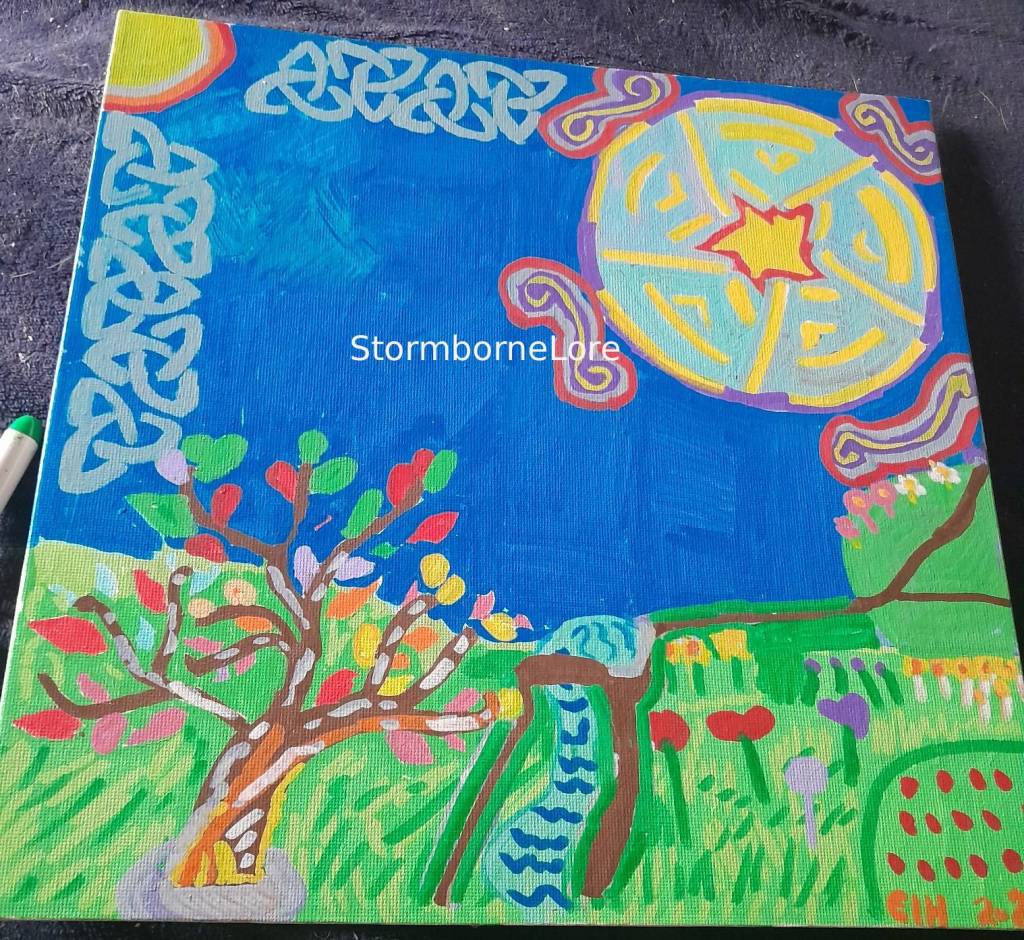
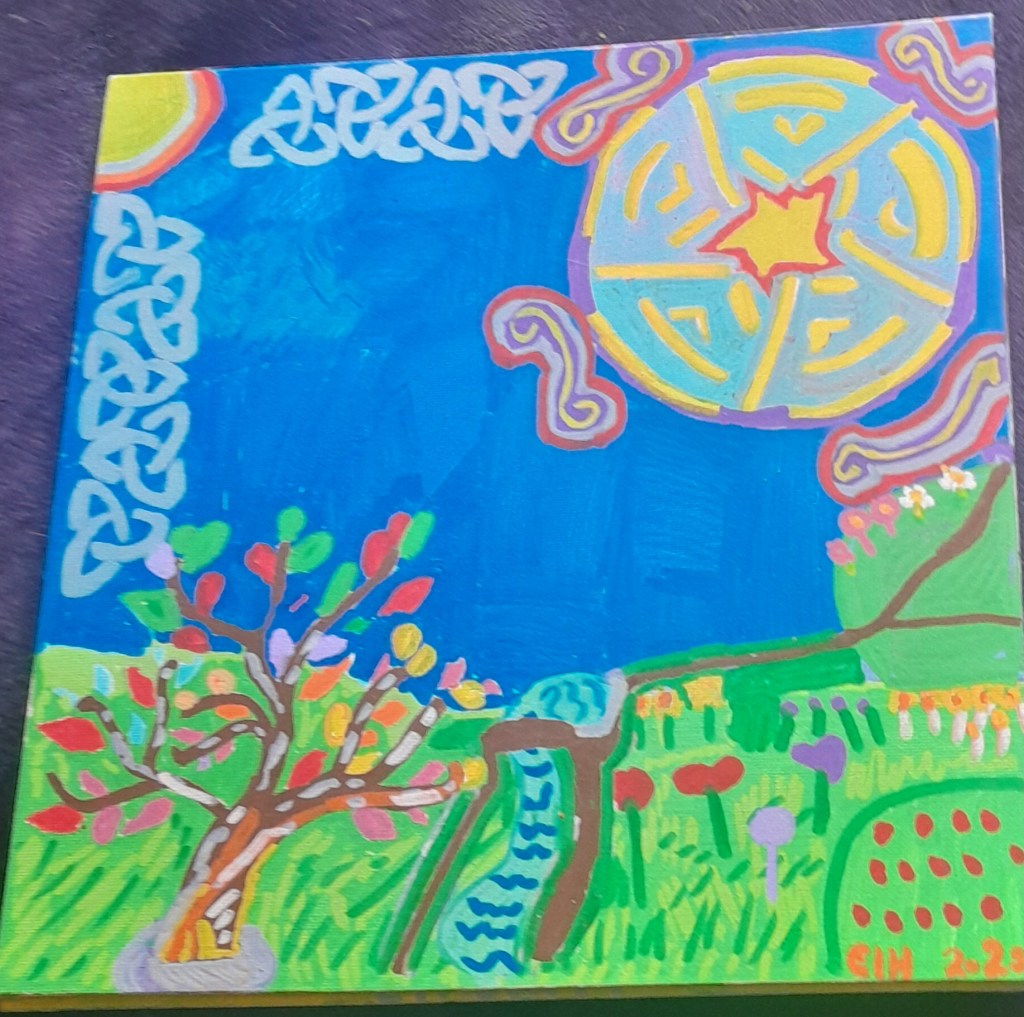
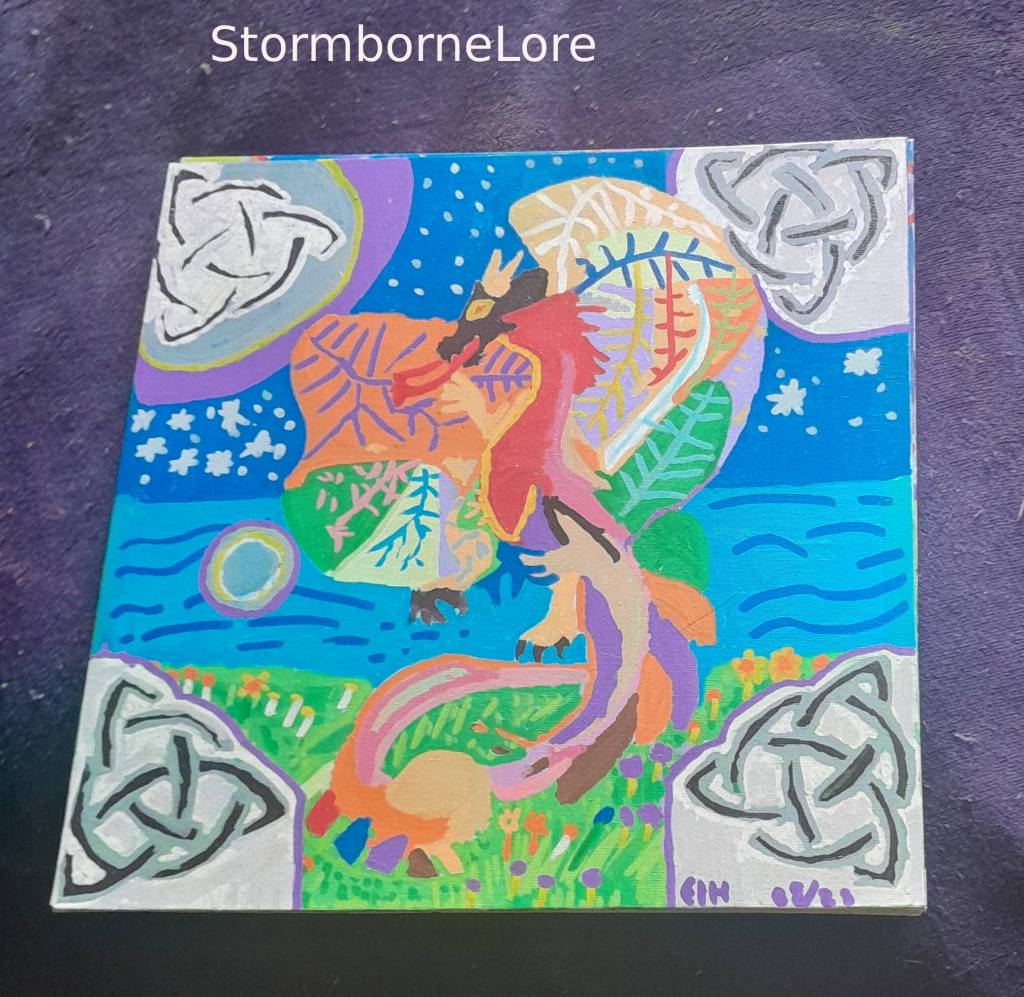
An artistic representation featuring a vibrant blue sky, a radiant sun, and a colorful tree, embodying the themes of nature and rebirth.
The fires of the Ring had long since burned low. Smoke and judgment still clung to the stones, but the voices were gone scattered into the dark like leaves. The echoes of debate, of accusations half-spoken and oaths half-broken, were swallowed by wind.
Only Taranis remained.
He stood at the centre of the stone circle, not as a warlord or seer or storm-marked legend, but as a man uncertain of what to do next.
At his feet, a small crib newly carved, rough-edged but lovingly made sat in the shadow of an ancient standing stone.
Runes spiralled along its frame like protective thorns. Inside, the child slept, his breath barely stirring the wolfhide blanket that covered him.
Taranis stared. Watched. Listened to nothing but the sound of his son’s heartbeat soft, fragile, real.
“He’s mine,” he whispered.
The words fell like an oath.
He hadn’t spoken them aloud until now. Not to the Ring. Not even to himself. But the moment he looked into the child’s eyes, he had known.
There in that small, storm-dark gaze was the same flicker that had burned in his own since birth. A fire that would not die, even when beaten. Even when left in chains.
“I wasn’t sure,” he said, as if the child could hear him. “But now I am.”
Footsteps approached quiet but familiar. He didn’t turn.
Drax entered the ring with Aisin beside him. Her dark braid caught what little moonlight remained. She wore no armor, no crown but her presence always arrived like both.
They stood silently for a while, watching him.
“We thought you’d already gone,” Aisin said gently.
“I couldn’t,” Taranis replied. “Not yet.”
He gestured toward the crib, voice taut.
“I know what you’re thinking. That I’m out of character. That I’ve gone soft.”
He turned toward them now. His eyes were storm-lit, ringed with exhaustion. But beneath that a rawness neither of them had ever seen.
“He’s mine,” Taranis repeated. “There’s no denying it now.”
Aisin moved to the crib. She looked down at the child with the quiet reverence of a priestess before a sacred flame. One hand reached out, slow and certain, to brush the boy’s brow.
“He’s strong,” she said. “But quiet. Like he already knows too much.”
Taranis exhaled hard. His voice wavered a rare thing.
“If it’s too much… if he’s too much to carry…” “We’re not strangers to raising children,” Drax said. “This one isn’t just any child,” Taranis replied. “He’s my child. And I was no angel.”
He looked to Aisin, then Drax his oldest brother, his iron pillar.
“I can take him elsewhere. To a quiet place. Far from the weight of prophecy. Far from the Ring. Just say the word.”
Drax frowned.
“You’d give him up?”
“I’d shield him,” Taranis corrected. “From this. From me.”
Aisin turned to him, calm and sharp all at once.
“You fear yourself more than your enemies?”
“Yes,” he said. “Because I dream of betrayal, but never the face. I wake with my hand on my blade. I feel hunted in my own mind.”
He swallowed.
“I don’t trust myself near him. Not like this.”
Drax stepped forward and gripped his brother’s arm.
“Then trust us.”
Aisin nodded. “He stays. He is blood. That’s enough.”
Taranis closed his eyes. A moment of stillness passed between them.
Then he whispered, “His name is Caelum.”
The name rang like truth in the circle.
Drax smiled faintly. “Sky-born. Storm-blessed.”
“Let’s hope he lives to become more than that,” Taranis murmured.
Later – The Grove Beyond Emberhelm
Rayne stood in the dark, half-shrouded by the charred remnants of an old grove. Draven hovered nearby, shoulders hunched.
“So. He’s claimed him,” Rayne said, not asking.
“He named him Caelum,” Draven replied.
Rayne smiled thin, sharp.
“That’s dangerous. Naming something is binding it to fate.”
“He’s a child, Rayne.”
“No,” Rayne said. “He’s a threat. A future. A soft spot waiting to be pierced.”
Draven said nothing. He looked at the ash, not the stars.
“You said we’d only observe,” he whispered.
Rayne stepped closer, boots silent against the earth.
“And we are. But sometimes watching is how you choose the moment. Let the warlord get sentimental. Let him love.”
He leaned in, voice silk-wrapped iron.
“Love makes good men hesitate. And hesitation… kills kings.”
Smoke still curled above the hills, but for now, the killing had paused. The Ring had demanded silence, and the land obeyed with the uneasy stillness of a wolf watching from the edge of firelight.
Taranis sat by the river, sharpening a blade he hadn’t drawn in days. The sound was steady, comforting a ritual older than words.
“You missed your council seat,” Nessa said behind him.
He didn’t turn. “Let them speak in circles. The wind will tell me what they decide.”
She stepped closer, arms folded, eyes sharp as ever. Her hair was damp from the river, her scar still raw but healing.
“You’re their warlord whether you wear a crown or not,” she said. “They listen for your storms.”
“I’m tired of storms,” he said, standing slowly. “I want peace.”
She raised an eyebrow. “Peace from war? Or from yourself?”
That hit deeper than he expected. He turned, finally, and faced her. “Do you ever stop fighting?”
“Only when I’m sleeping.” A half-smile appeared on her face “And sometimes not even then.”
He studied her in the fading light the blood on her hands that hadn’t come from mercy, the way she stood like someone expecting betrayal at any moment. And yet, she was still here.
“They called me cursed,” he said. “Storm-marked. Said I was born to end things, not build them.”
Nessa’s gaze didn’t waver. “Then build something anyway. Let the curse bite its own tail.”
He stepped toward her. Close enough to feel her breath, to see the flecks of gold in her eyes.
“You speak like a seer,” he said.
“I speak like a woman who’s already lost too much to superstition.”
He wanted to reach for her but didn’t. Instead, he offered his hand. Just his hand.
She stared at it like it was a blade, then took it.
No vows were spoken. No gods were called.
But something passed between them in that moment not love, not yet. Something older.
Something true.
Later that Night Emberhelm
Lore lit the sacred fire at the centre of the stone ring. The flame flared blue for a moment unnatural. Ominous.
Draven flinched. Rayne smiled.
“Balance is shifting,” Lore muttered, eyes on the flame. “Something has stirred it.”
Drax stood at the edge of the circle, arms crossed. “He’s with her again.”
Rayne’s voice was soft and snake-slick. “Then let him be. Let him forget his duty.”
Draven shifted uneasily. “If Taranis lets her in, he could let in worse.”
“Or better,” Lore countered. “She may be a sword that cuts both ways.”
Rayne’s grin widened. “Then let’s see what she severs first.”
Outside the circle, a storm began to gather. Quiet, coiled. Watching.
The Circle of Stones, Emberhelm The storm broke slowly, not with thunder, but with footsteps.
Boots echoed between ancient stones as Taranis stepped into the sacred ring, his cloak still damp from river mist. Nessa walked a pace behind him, her eyes wary, her scar bright under the firelight.
The brothers stood in silence as he approached. Drax by the child’s cradle, Lore near the flame, Draven wringing his hands in shadow. Rayne stood like a blade left out in the cold smiling, but never warm.
Taranis’s voice cut through the stillness like flint on steel.
“I know what you speak when I’m not here. I hear it in the wind. I feel it in the ground. You question my loyalty because I do not sit with you every day. Because a girl now walks beside me.”
He looked at each of them in turn not as brothers, but as warriors who once bled beside him.
“Let me be clear. My oath to Caernath stands. I have not broken it. I will not.”
He turned briefly to Nessa, then back to the Ring, his voice rising with quiet fury.
“But I am not made of stone. I am not your thunder without end. Like you, I bleed. I grieve. And I deserve gods be damned to feel joy. To be loved.”
A gust of wind swept through the circle, snuffing one of the smaller fires. The shadows leaned in.
Taranis stepped closer to the central flame, gaze hard now.
“One of you will betray me. I don’t know when, or how. But it will be for power, land, and coin. That truth rots in the air. But hear me now.”
He unsheathed his blade, slowly, and drove it into the earth beside the flame.
“If you seek to take my crown, then come for me openly. Not with poison. Not with lies.”
His eyes flicked to Rayne just a heartbeat.
“Because I will forgive a blade. But I will not forgive a coward.”
The wind stilled. Even the stones seemed to listen.
Drax stepped forward first, his voice low and steady.
“My brother, I believe you. And should the time come I will not stand behind you. I will stand with you.”
Lore said nothing, but he placed his palm on the stone rune before him the sign of silent accord.
Draven looked down, unable to meet anyone’s gaze.
Rayne only smiled, slow and wolfish.
“You speak of storms and love as if either can save you,” he said softly. “But I wonder, brother… which will break you first?”
After Taranis walks away from the fire:
Nessa followed a few paces behind him, silent until they were beyond the edge of the circle. She spoke without looking at him.
“That wasn’t a warning. That was a reckoning.”
Taranis’s voice was low.
“They needed to hear it. And I needed to remember who I am.”
“And who is that?” she asked.
He paused, fingers brushing the hilt of the blade still buried in the earth behind them.
“A man who has been many things. But never loved and still whole.”
Ash fell like snow across the field, and the cries of dying men echoed over blood-stained earth. Taranis stood at the crest of the hill, his blade soaked, his breath ragged, eyes scanning the fray. His cloak snapped behind him, storm-charged and wild.
Then he saw her.
A blur of red hair and steel. She moved like fire unleashed cutting down two warriors with a rhythm so brutal it bordered on poetry. A deep scar crossed her cheek, fresh blood mingling with the old. Her spear spun once, twice, and buried itself in the chest of a man charging from behind.
She turned. Their eyes locked.
For a second, the war fell silent.
Taranis stepped forward. So did she.
They met in the no-man’s land between sides, blades raised not in anger, but instinct. Neither lowered their guard.
“You’re no foot soldier,” Taranis said, circling. “What are you?”
She didn’t smile, but her voice held a grin.
“I’m the reason you’re bleeding, warlord.”
He looked down. A shallow cut across his ribs. He hadn’t even felt it.
“I’d remember a woman like you,” he muttered, lowering his blade. “Name?”
“Nessa. And I don’t need saving.”
“I wasn’t offering,” he replied, “just watching the storm arrive.”
Her eyes narrowed. “You think this is a storm?” She stepped closer. “You’ve not seen anything yet.”
Then — the horn blew. Her side was retreating. She looked over her shoulder, then back at him.
“I should kill you,” she said.
“You should,” Taranis agreed, “but you won’t.”
She held his gaze another heartbeat… then turned and ran, vanishing into smoke and flame.
He stood alone, the sound of her name still echoing behind his ribs like thunder.
A Week Later Riverbank Clearing The village was in ruins blackened timbers, smoke curling from half-dead hearths. Survivors were few, and even they shrank from him as he passed. They whispered of a warrior woman who had held the bridge alone until the flames took her horse and half her shield arm.
Taranis followed the trail until it ended in a clearing by the river. And there she was.
Kneeling in the shallows, Nessa washed blood from her skin. Her armor was battered. Her shoulder bound with torn linen. But her spine was straight, and her hand never strayed far from the dagger at her hip.
“I should have known,” she said, not looking up. “Storms always return to the wreckage.”
Taranis didn’t smile. “You survived.”
“I always do.” She rose, eyes sharp. “Here to finish what we didn’t start?”
He stepped forward. “I came to offer a truce.”
She scoffed. “Why? Because I didn’t kill you the first time?”
“No,” he said. “Because I want to know why you fight like a warrior, but bleed like someone with nothing left to lose.”
Her jaw clenched. “You think you can read me, warlord? You think I’m one of your stories?”
“No,” Taranis said quietly, “but I know the look of someone trying to die just slowly enough to call it bravery.”
She drew her dagger, fast as lightning. Held it to his throat.
“Careful. You don’t know me.”
“I know enough,” he said, unmoving. “Your people are scattered. Your command is gone. And yet you stood alone at that bridge for strangers.”
“That’s more than you’ve done lately,” she snapped. “You walk the land like a ghost and leave nothing behind but ashes.”
His hand rose not to his weapon, but to gently press her dagger aside.
“I’m tired of ghosts,” he said.
They stood there, breath mingling, battle-scarred and burning. Neither of them moved. Neither of them lowered their guard.
But the space between them began to change.
“Besides I fight for those I deem worthy. That includes the people of Emberhelm.” Taranis smirked. “You’ve shown me you’re a friend of Emberhelm.”
He extended his hand.
“Who are you?” she asked.
“Taranis,” he said. “Who are you, my lady?”
“Nessa.”
The Night of Lammas.
That night, the people of Emberhelm feasted beneath the stars.
Lammas the first harvest was a time of bread and song, fire and gratitude. Children danced between torches, and the scent of roasted grain filled the cooling air. Drums echoed off the stones, old and deep, like the heartbeats of the land itself.
Taranis stood at the edge of it all, watching, half in shadow. Nessa leaned against a pillar beside him, arms folded, hair loose from its braid.
“I thought you’d be dancing,” he said.
“I don’t dance for tradition,” she replied. “Only for survival. Or joy.”
“Is this not joy?”
She looked around. The laughter. The flames. The peace however temporary. “Maybe.”
A silence fell between them, not awkward, just heavy with the unspoken.
“Come with me,” she said at last.
No orders. No questions. Just a truth spoken plainly. He followed.
They slipped from the celebration like ghosts, weaving through the orchard paths behind Emberhelm. The air was thick with ripening apples and the hum of distant music. When they reached the old stone lodge near the outer walls, she pushed the door open with one hand and led him in without a word.
There were no declarations. No romance wrapped in flowers or oaths. Only need.
Their bodies met like storm and flame fast, urgent, tangled with the memory of battle and the ache of survival. There was laughter when his armor refused to loosen, curses when her hair caught on his clasp, and a growl low in his throat when she bit his shoulder hard enough to mark.
Neither knew what the next day would bring. That was why it mattered.
That night, they made love like warriors with a fierceness born of loss and the tenderness of those who had bled for strangers.
Later, tangled in furs, the fire crackling low, she lay with her head against his chest.
“If I die tomorrow,” she murmured, “I’ll die warm.”
“You won’t,” he said, but his fingers curled tighter around her waist.
Outside, the stars burned cold and bright, and the first autumn wind began to stir.
He placed his hand gently on her belly.
“You and my son will live.”
Whispers in the Dark.
The next morning, the Ring summoned Taranis.
The gold circle at the council stones shone under a pale sky. Thirteen seats twelve filled. Lore was already speaking when Taranis entered, his voice low but urgent.
As he took his place, Nessa moved through the old halls of Emberhelm alone, her instincts sharp. Her step slowed when she passed the northern storeroom. Voices carried.
Rayne.
“We wait until the snows. When the passes are blocked, and he’s far from Emberhelm, we strike. The Ring will fall without him.”
Another voice, unsure. “He’s your brother.”
“Which is why I know his weakness.”
Nessa froze, the words burning into her mind.
Betrayal was coming.
And she was carrying the only thing that might save him.
Battles became rare. Raids grew smaller, born less from conquest and more from desperation. The crops suffered under strange seasons. Hunger took more than steel ever could. But with hardship came strange progress sharper tools, tighter village bonds, cleverer defences. Old powers shifted. The land quieted, not in peace, but in waiting.
And in that uneasy quiet, Taranis was content.
For the first time in years, he did not lead an army. He pursued a girl instead one with a scar beneath her eye and a laugh like war drums. She gave as good as she got, and that delighted him. The village wives said she would either tame him or kill him. The bards were divided on which would be the better story.
Meanwhile, I, Drax, his brother by blood and blade, walked a different path. I raised my people among the hills and rivers of Caernath. Children on hips, grain in hand, my wife laughing in doorways. I had earned my peace, or so I believed.
Lore, always the wisest of us, had vanished into his libraries. He said little, but he read much stars, omens, bones, spells. His son was growing fast, and Lore spoke often of unity, of law, of councils instead of kings.
Even Draven kept to himself in those days, unsure of where to cast his loyalty. And Rayne, well… Rayne’s silence was never a good sign.
Then the rumours came.
Another village, wiped clean. A warlord found burnt and broken, no enemies in sight. Smoke and whispers. They say a giant walked the battlefield, crowned in fire and storm. One witness swore she saw a great horned beast at his side. Another swore it was a dragon, wings spread across the sky like nightfall.
The name on their tongues? Taranis.
And with his name, the same plea echoed once again from the mouths of elders, farmers, and war-chiefs alike: “Take the crown.”
He refused. For the thirteenth time.
No matter their offerings gold, land, blood-oaths he turned his back on kingship. He called no banners. Built no fortress. No throne. Yet still he came when battle called. He turned tides, struck down tyrants, disappeared again into wind and legend.
And so, we formed the Ring not a court of nobles, but of equals. Thirteen warriors, leaders, seers, and voices of the old ways. It stood for balance, for judgment, for law older than any written word. At its centre: a circle of sacred stones, each carved with the oath of Stormborne.
And there, in that ring, Taranis spoke not often but when he did, the skies listened.
We thought we were building something unbreakable.
But we were wrong.
Because while we looked outward at the world beyond the hills, a darker storm gathered within us. In the silence of Lore’s spells, in the smile behind Rayne’s eyes, in the omens Draven refused to speak aloud.
The Thirteenth Ring was strong. But it only took one brother’s betrayal to crack the stone. And so the storm began to turn inward.
“Where’s the mother?” I asked.
“Her village was attacked. They slaughtered her while she screamed my name,” Taranis said.
The circle of stones stood solemn beneath a heavy sky bruised with gathering storm clouds. Within the sacred ring, thirteen seats carved with ancient runes and oaths bore silent witness as the brothers gathered once more.
Taranis sat with the weight of years pressing upon him, the child cradled carefully in Drax’s strong arms a fragile ember amidst the gathering darkness. The air was thick, charged with the unspoken dread of a prophecy unfolding.
Lore was the first to break the silence, stepping forward with measured grace. His voice was calm but sharp as flint, each word deliberate and coldly reasoned.
“Brother,” Lore said, eyes fixed on Taranis, “you speak of betrayal as if the serpent has already struck. Who do you suspect? Who harbors this poison within our bloodline?”
Rayne’s lips twitched into a mocking smile, his gaze a knife’s edge glinting in the half-light.
“Perhaps,” Rayne replied smoothly, “the betrayal lies not in our veins but in the stubbornness of one who refuses the crown. The storm we fear may well be born of his silence.”
Draven shifted uneasily on his stone, fingers twisting nervously as he swallowed hard.
“I… I cannot imagine we would turn against our own,” Draven stammered. “We are brothers forged in battle. Our oaths hold us true.”
Taranis’s gaze snapped sharply to Draven, eyes burning with bitter warning. “Blood is thicker than loyalty,” Taranis said quietly, “but fate is the thinnest thread of all easily severed, and often broken by the weakest hand.”
I stood from my seat, the strength in my voice like a hammer striking an anvil. “I swear to all here, I will raise this child as my own, guard him with my life. No harm will come to him under my watch.”
Rayne’s eyes narrowed dangerously. “Loyalty is a coin with many faces, brother,” Rayne said softly, stepping closer. “What of your people? Your wife and child? When the scales are tipped, whose cries will you hear first?”
Lore raised a hand, tracing the worn runes on his stone seat with thoughtful fingers.
“We stand at a crossroads. The old gods grow silent; new faiths rise from the south and east. It is no betrayal to seek survival. Perhaps adaptation is the true path.”
Taranis’s jaw clenched, muscles taut with anger and grief. “Survival without honor is death,” he growled. “One of you will fracture this Ring. When that stone breaks, the whole will crumble. Mark my words.”
A sudden gust of wind swept through the circle, rattling the ancient stones like a voice from the past. The child stirred in my arms, a small cry cutting through the tension like a knife.
The brothers’ eyes flickered to the babe innocent yet burdened with the weight of prophecy.
Silence fell again, thick with dread and unspoken accusations.
Rayne smiled then, colder and sharper than any blade. “So be it,” he whispered. “Let the storm come. I will be ready.”
From the edge of the circle, Draven lowered his gaze, his hands trembling. Behind closed eyes, fear and uncertainty warred in his heart a battle he dared not share.
Lore’s eyes scanned the sky, already darkening with rolling thunder. “We must decide soon,” Lore murmured, “for if we do not act, the fates will decide for us.”
Taranis stared out over the ring, his voice low but resolute.
“The time of peace is over. The Ring must hold or all we built will fall to ruin.”
He stood slowly, setting the child gently in my arms before turning toward the path out of the circle.
As he walked away, his figure a storm-shadow against the fading light, the brothers remained each wrestling with the secrets they now carried.
The morning mist clung to the earth like breath held too long.
Taranis stood barefoot in the frost-hardened dirt, his cloak wrapped tightly around his shoulders. Before him, the children the eleven pulled from the pit stood in an uneven line. Some shivered. One held a stick like a sword. Another clenched it like a club.
“Not to hurt,” Taranis said. His voice was calm but carried weight. “To protect.”
He walked along the line, placing his hand gently on each child’s shoulder. Their eyes were wide. Some still flinched. But none ran.
Boldolph sat at Taranis’s right, silent and unmoving, a guardian of the moment. Morrigan circled the clearing with the patience of a winter wind, occasionally brushing a child’s ankle with her tail when their stance faltered.
Solaris stood at the edge of the clearing, arms folded. He watched Taranis with an unreadable expression.
“They’re too small,” he said quietly.
Taranis turned.
“So was I,” he replied.
He took a staff from the ground and twirled it with precision, the end cutting the air in a slow arc.
“If we wait for them to grow, it will be too late.”
That evening, the fire burned low. The children huddled close to its warmth, whispering stories they were beginning to remember stories Taranis had told them about the wolves, the fire, the storm.
Solaris sat apart from them, alone with the thoughts that had haunted him for weeks.
He rose when all were asleep. He moved through the shadows, past the bones of old tents and the ghosts of gallows, until he reached the western tree line.
From inside his tunic, he pulled a strip of black cloth, worn thin and embroidered with a single red claw.
He tied it to a crooked branch. Then he whispered.
“Tell them the storm is coming.”
His voice cracked.
“Tell them… it’s Taranis.”
He turned, vanishing back into the mist.
It happened at dawn.
Taranis led a scouting party through the ashwoods Boldolph at his side, two scouts ahead, three boys from the training ring carrying supplies. The fog was thick, the silence heavier than snow.
They never saw the first spear.
It took one of the scouts through the chest. Another cried out and was silenced. The boys ran or tried to but two were taken by horsemen bearing the sigil of the Black Claw.
Taranis fought like a storm obsidian pendant flashing in the smoke, staff and blade spinning but by the time the sun broke the treetops, four were dead, two missing, and the forest was soaked in blood.
He returned on foot, armour torn, a wound above his eye leaking down his face.
Grael met him at the gates.
“They were waiting for us,” the warlord said grimly.
Taranis nodded.
“They knew we were coming.”
“Someone told them.”
The circle was cleared at dusk. Warriors formed the ring. The children watched from behind Morrigan’s flank. The fire crackled but did not comfort.
Solaris stood in the centre, unbound. He didn’t run. He didn’t plead.
Taranis entered last, blood still dried in the cracks of his skin.
“You warned them,” he said flatly.
Solaris bowed his head.
“I did.”
“Why?”
“Because they would have killed my children,” Solaris said softly. “I was trying to stop a war.”
Taranis stepped closer, gaze unwavering.
“You started one.”
The words were quiet. Measured. Final.
From a wrapped bundle at his belt, Taranis pulled a collar carved bone, etched with runes. Not the iron of chains. Something older. Something sacred.
“You are not my enemy,” Taranis said. “But you are no longer free.”
“You will serve. You will teach. You will live in the light of what you did and what you chose not to.”
He placed the collar around Solaris’s neck. It locked with a soft click.
Solaris did not resist. He simply whispered, “Thank you for letting me live.”
Taranis didn’t answer.
Days passed. The air grew colder. But the children trained each dawn, and the wolves stayed close.
Solaris taught them how to cook, how to read the skies, how to find warmth when the earth turned bitter. Taranis taught them how to fight but more than that, how to stand. How to speak without fear. How to remember.
“We were broken,” he told them. “But we are still here.”
A council formed. Not by title. By oath.
Grael stood with arms crossed, nodding at the children now sleeping beside the fire. Morrigan lay curled with the youngest boy against her ribs. Boldolph prowled the border like a guardian carved from ash and stone.
Taranis drew three sigils in the dirt.
A flame. A storm. A shadow.
“We are not a camp anymore,” he said. “We are Caernath.”
The Seer who had first named him stepped forward, voice wind-carried.
The fire still smouldered in the trial circle. Ash drifted across the camp like falling snow, silent and strange. But Taranis was already moving.
“There’s one more thing I need to do.”
Grael watched him from the shadows. He didn’t speak. He didn’t stop him either.
Boldolph padded beside Taranis in silence. Solaris followed, clutching a waterskin and a roll of cloth. Morrigan trailed at a distance, her red eyes glowing faintly.
They passed the old fletcher’s tent, the burned tree where whippings once took place, the bone pits that had once broken men.
“Where are we going?” Solaris asked quietly.
Taranis didn’t answer. He was listening not to voices, but to memory. He remembered a cough in the dark. A cry. The scraping of small fingers against stone.
“There’s a cage,” he said. “Near the quarry. They kept the youngest there. Said they were too small to work.”
The Pit They reached it just after dusk. The trees pressed tight around the stone hollow. At first, it looked abandoned broken boards, a slanted gate, silence.
Then a sound. A whimper.
Boldolph’s ears twitched.
Taranis crouched and pulled aside the brambles. A metal grate, rusted and choked with moss, covered a square hole in the earth.
“Help me,” he said.
Solaris held the torch. Boldolph tore at the frame with claws. Morrigan bared her teeth and bit through the last knot of rope.
Beneath, the darkness shivered.
A child peered up.
Eyes too wide. Bones too thin.
“We’re not guards,” Taranis said gently. “We’ve come to end this.”
There were eleven in total.
Some crawled. Some limped. One couldn’t speak. One clutched a half-rotten toy made from bark and wool. They emerged into the night like ghosts made of dirt and silence.
Taranis knelt before each one and touched their shoulders.
“No more pits. No more cages. I swear it.”
The eldest maybe ten looked at the wolves with fear. Then at Taranis.
“They’ll just chain us again.”
“Not if I teach you to fight,” he said. “Not if I teach you to speak.”
He turned to Solaris.
“They will need warmth. Names. A place.”
Solaris nodded.
“We will give them more than that. We will give them stories.”
A New Fire That night, Taranis did not return to his tent. He built a new fire at the edge of the camp. The children gathered near it, cautious, blinking at the light.
He laid out bowls of stew. He let them sit in silence.
Then he rose and spoke to the camp.
“They were buried alive in your shadows. Chained so young they forgot their own names.”
“This camp lives because of silence. But not anymore.”
“I will raise them. Feed them. Train them.”
“And one day, they will raise others.”
Grael stood from the back. He did not speak, but he gave a slow nod.
The Seer who had named Taranis walked to the fire and added herbs to it. The scent rose sharp rosemary and root. A symbol of memory.
“This fire,” she said, “is the first fire of the Order of Dawn.”
Taranis looked to Boldolph and smiled. There was fire behind his storm-grey eyes.
But he didn’t move.
Instead, he turned his gaze toward the centre of camp. A wide ring of bark and stone had been cleared where the warriors gathered in a hush that pressed against the skin. Grael stood tall at its edge, arms folded, flanked by his elite. One Seer stood silently with her staff grounded. Another stood beside her, cloaked in black and waiting.
Boldolph’s voice was low.
“You know this is bait.”
“I know,” Taranis said. “Let them bite.”
He raised his voice so all could hear.
“So where are the others, Grael? There were six of them. Six men who buried me alive. Are they here?”
Grael said nothing. His jaw clenched but no order came. The silence stretched like a drawn bowstring.
Taranis stepped forward. His torn cloak dragged behind him. Dirt still clung to his skin. The obsidian pendant swung from his chest, sharp as a blade and darker than the sky.
“You trained them. You gave them command. You stood idle when they dragged me from my fire and threw me in the earth like a beast.”
A ripple of movement stirred the crowd. Solaris moved silently to the left of Boldolph, his eyes alert. Morrigan circled the outer edge, her gaze sharper than any blade. The wolves were close, not quite in the circle, but near enough to strike.
The cloaked Seer stepped forward, her voice smooth and cold as river ice.
“And what are you now? A firewalker? A spirit in flesh? A wolf’s loyal mutt? You defied your masters. You broke laws. You call yourself marked as if it were a blessing. It is a curse.”
Taranis turned to face her. His tone was calm, but his voice carried like distant thunder.
“I am marked. Yes. Marked by flame and by fang. Marked by gods your kind no longer dare name.”
He looked across the ring, locking eyes with those who once saw him as nothing more than a chained boy.
“I wore the collar. I bore the mask. I bled into your soil and came back stronger. The dragon did not strike me down. It bowed.”
The first Seer the one who had first spoken of prophecy moved forward without a word. She laced her bone staff on the earth between them, the sound like a drumbeat in the dirt.
“Then let truth be spoken. Words before war. This circle is the law.”
The Circle Two lines formed. One stood behind the cloaked Seer and the old ways. The other stood in silence, eyes uncertain but shifting, behind the Seer who had named him Stormborne.
Grael remained between them all. He spoke nothing. But the weight of his silence was a blade in the dust.
The rival Seer raised her chin, her cloak fluttering as a sudden gust caught the air.
“Storms are sent as punishment. They do not crown kings. They drown them.”
Taranis stepped into the centre and lifted the obsidian pendant high.
“Then why did the storm not drown me?”
He turned slowly, meeting the eyes of warriors, elders, hunters, servants — and children.
“You speak of punishment. But where was your justice when a boy was chained for speaking truth? Where was your mercy when they threw me into a grave and danced over it?”
A murmur passed through the gathering, slow and spreading like rising smoke.
A healer stepped forward. She clutched a satchel of herbs, her hands trembling, but her voice rang clear.
“I stitched that boy once. His ribs were bruised. His wrists bled. I said nothing. I was afraid. But I will not stay silent again.”
Taranis gave her a solemn nod.
“Then speak now. Let every voice rise. This land will not be ruled by silence.”
The cloaked Seer opened her mouth to answer, but no sound came. She felt the tide turn and stepped back. The people had shifted.
A father stepped forward next, then a girl who’d once carried water to chained boys. An older warrior, limping from an old wound, nodded slowly. For the first time, Grael’s expression flickered — not with rage, but with understanding.
Verdict Grael finally stepped into the circle. The pressure broke like thunder in the air. He scanned the faces around him — warriors he had trained, people he had led. Then he looked to Taranis.
“The six who attacked you are dead or have run. That is not mercy. That is law. They broke it.”
He turned toward the Seers.
“But from this day, we follow one voice. Not the loudest. Not the oldest. The one the flame has not burned. The one the dragon did not kill.”
He turned his eyes on Taranis.
“The one who rose.”
From the back of the crowd, a girl no older than ten stepped forward. Her hair was matted but her eyes were bright with memory. She held a scrap of wolf-fur in her small hands.
“You pulled me from the pit. The dark place. I saw you in the fire. You held the sun in your hand.”
Taranis knelt before her, gently resting a hand over hers.
“Then keep that memory. Let it burn in you, not through you.”
He rose slowly, the firelight catching in his eyes. Then he turned to face the whole circle.
“No more collars. No more chains. No more silence. This is no longer a camp. It is a beginning.”
The wolves howled not out of hunger or fury, but in echo of a vow they once made long ago. A vow that now passed from wolf to man, and from man to child.
The first Seer stepped beside Grael and whispered a single truth.
“Stormborne.”
Solaris stepped closer, his voice a whisper only Taranis could hear.
“So what does that make you now?”
Taranis looked out at the crowd, at the firelit faces, the broken chains now lying in the dust, the wolves resting at the edge of the light. Then he looked to Solaris and smiled.
“A man. A friend. A warrior, if Grael will train me. Perhaps a healer. First in the line of the Order of Dawn.” He paused, gaze rising to the stars above. “Or maybe just someone who lived when he should have died.”
He turned back to Solaris, his voice soft.
“Who knows what tomorrow will give?”
And for the first time since exile, Taranis Stormborne laughed not out of pride, not out of pain, but because for once, the wind didn’t sting.





 StormborneLore