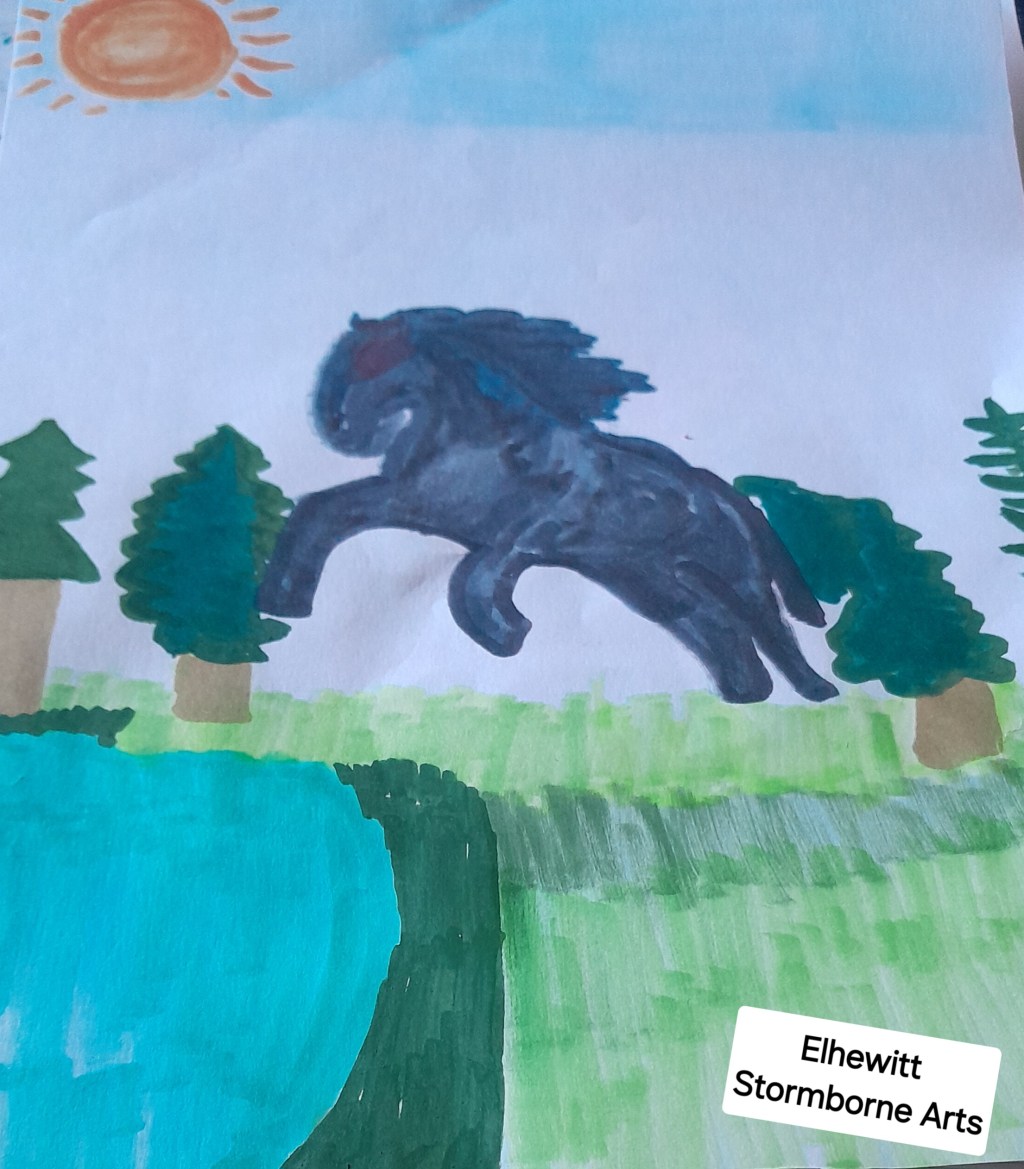
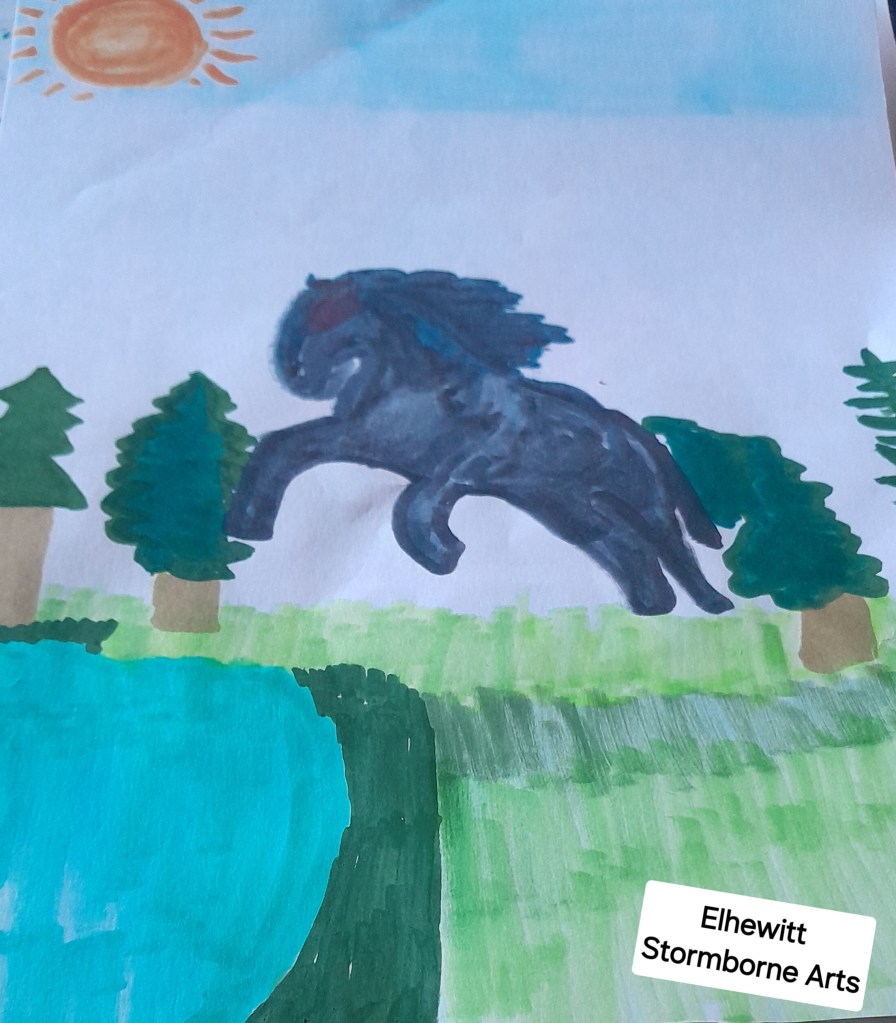
The Black Leaper soaring over the serene lakes of Chistlyn, embodying the spirit of freedom and magic.
They say that if you stand by the lakes of the Chistlyn at sunrise. Before the mist has fully lifted, before the birds dare to break the quiet you hear it.
A single, heavy exhale. Like the world itself taking a breath.
From the tree line emerges the Black Leaper. A spirit-steed older than the villages around Cannock Chase, older than the Forest Kings, older even than the Stormborne line.
Its coat is the colour of midnight after rain, slick and shifting like a storm cloud gathering its strength.
When it moves, the air warms with the scent of wet grass and pine sap. The ground trembles just enough to remind you that it is real.
Some say the Leaper was once a war horse belonging to a forgotten chieftain.
A beast so fiercely loyal that it refused to pass on when its master fell. Others whisper that it is no creature of this world at all. But a guardian born from the lake’s deepest waters, shaped from moonlight, fog, and old magic.
Whatever the truth, one thing is certain: the Black Leaper does not walk. It flies.
Witnesses speak of the thunder of hooves striking the earth for only a heartbeat. Before the creature rises, soaring over lakes and treetops in a single, impossible leap.
Many who see it feel a sudden pull in their chest . As if the horse carries every unspoken longing for freedom with it.
This artwork captures the creature in that moment between worlds. When the sun glows warm on its back, the wind twists its mane into wild ribbons. The forest watches in held breath as the guardian crosses the sky.
Some believe the Leaper appears only to those who feel trapped or lost. Others say it is a sign of protection, a reminder that the path ahead is wider than it seems.
Authors Note : Chistlyn is the Anglo Saxon name for what is now known as Cheslyn Hay.
For the artists or those interested. The drawing was drawn using Ohuhu Markers on A4 plain paper.
I wonder if the Black Leaper passed you by, what would it be urging you to run toward. Or away from?
Thank you for reading, if you have enjoyed this story or like the illustrations. Please support me by liking and follow.
The rain had eased by morning, though the ground still steamed where the storm had passed.
The Mist clung to the Chase like breath, thick and cold, rolling through the hollows where the Romans once marched proud. Taranis stood by the broken road, cloak heavy with water, hair plastered to his brow.
He could still see the ruts of cart wheels half-buried in mud Rome’s mark, carved deep into the land.
“Won’t last,” he muttered, toeing one of the stones. “Nowt they build ever does.”Byrin came up behind, shoulders hunched against the chill.
“They’ve gone, lord. Last cohort took the south road yestere’en. Fort’s empty now.”Taranis grinned, the kind of grin that didn’t reach his eyes.
“Aye, I know. Felt it in the wind. Empire’s breath cut short.”He knelt, pulling a scrap of bread from his pouch, laying it on the old stone. Where once the eagle banners stood. Then he poured a splash of mead beside it.
“For them as fought, an’ them as fell,” he said quiet-like.
“An’ for the land, what outlives us all.”Byrin shifted his weight.
“Spirit night, innit? Galan Gaeaf, like th’owd folk say. When t’dead walk an’ th’winds carry their names.”Taranis nodded, eyes on the fire they’d lit a low orange glow crackling through damp wood.
“Aye. Let ’em walk. Let ’em see what’s come o’ Rome. Maybe they’ll find peace in the storm’s breath.”One by one, the men came forward, tossing bits of bread, small charms, even blades into the flames.
Their offerings for their kin, for luck, for the year turning.
“Break the road,” Taranis said after a time. “Let the dead cross free. Rome’s way ends here.”The sound of stone splitting echoed through the trees like thunder.
Byrin wiped sweat from his brow. “Yow reckon we’ll be free now, lord?”
Taranis looked north, where the sky lightened just enough to show the edge of winter coming.
Free?” he said, voice low. “No mon’s ever free o’ summat storm, king, or ghost. But th’land’ll be ours again, leastways till next lot fancies it.” He turned toward the fire once more.
The wind caught it, scattering sparks into the mist like stars. Somewhere, a raven called deep and hollow. Taranis lifted his blade, resting it against his shoulder.
“Come on,” he said. “Let’s feed the fire one last time, then go. Night’s drawin’ in, an’ spirits’ll be walkin’ soon.”Behind ’em, the last stretch of Roman stone cracked under hammer blows.
As steam was rising from the breaks like breath from a wounded beast.Taranis didn’t look back. He just walked, slow and steady, into the mist where thunder rolled soft and low, like the old gods stirrin’ in their sleep.
The morning mist hung thick over the Roman fort, curling around the walls and the sentries like ghostly serpents.
Taranis Storm’s wrists ached where iron had bitten into bruised flesh, his ankles raw from chains. Yet the fire inside him refused to be tamed. Marcos had warned him that this day would test more than his body. It would probe the limits of fear, endurance, and wit.
The centurion led him across the courtyard. Other prisoners lined the path, eyes wide with terror or jealousy. Weak men, broken men, some shaking in expectation of death. None dared speak.
“Today, you fight for Rome’s amusement,” the centurion barked, voice carrying over the square. “The arena awaits. Survive, or die beneath their eyes.”
Taranis allowed a faint smirk, almost imperceptible. Chains or no chains, sword, axe, or spear he had survived worse. The storm was within him, and storms do not break.
The first trial: Damnatio ad Bestias.
Lions, their muscles rippling beneath tawny manes, were released into the sand. Their growls rolled like thunder, a sound meant to unnerve men and mark the end of hope. Taranis was pushed forward, unarmed, the chains clinking with each step. The crowd leaned forward, eager for carnage.
The first lion lunged. Taranis dropped low, letting its momentum carry it past him. Spinning the chain to trip the beast, a subtle but devastating movement learned in the wilds of Staffordshire. Another lunged, jaws snapping, claws tearing sand.
He moved like the wind low, sharp, unpredictable. He stood baiting, dodging, spinning chains like whips, forcing the predators into missteps against one another.
Blood rose in clouds around him, yet he remained untouched. When the final lion recoiled and the centurion’s mouth twitched a mix of disbelief and begrudging respect. Taranis exhaled slowly, chains clinking, storm-controlled and silent.
The second trial: Gladiatorial combat.
He was given crude weapons a short sword nicked from years of use. A small round shield marred by countless hits, a spear bent at the tip. Combatants approached with mockery, expecting an untrained barbarian to stumble, falter, and bleed.
Taranis did not falter. He did not rush. Each movement was a calculation, using the terrain, his chains, the enemies’ weight and momentum against them. The first pair charged together, one with sword, one with shield.
Taranis pivoted, letting the chains tighten around their legs. As he ducked beneath the sword, delivering a clean strike to the opponent’s flank.
The second soldier hesitated, startled by the unexpected precision. Taranis did not smile he simply waited for the next assault, reading, predicting, exploiting every weakness.
A guard whispered to another, “He’s no ordinary man… he fights like the storm itself.”
By midday, the arena was a battlefield of skill, endurance, and cunning. A third pair entered, wielding axes. Taranis dodged and parried, chains tangling in the sand and catching his enemies off-balance. His movements were fluid, almost artistic — a storm in motion, controlled yet deadly.
Between bouts, he observed fellow prisoners some cowering, some quietly strategizing, watching him with awe. He nodded subtly, acknowledging their respect without breaking focus. Alliances were unnecessary here; survival was enough.
Two massive bears were released simultaneously, roaring, claws digging into the arena floor. Taranis analyzed their pattern one slower, one feinting left before striking right. He baited them, using his chains to trip and distract, pushing one into the other’s path. The crowd gasped as claws met flesh, teeth snapping on fur instead of his own body. His footwork was precise; his breathing measured; his mind sharpened like a blade.
When the bears finally withdrew, exhausted or bested by circumstance, Taranis stood alone in the sand. Sweat streaked with blood and mud clung to his skin. He raised his head, grey eyes surveying the watching centurion. There was no fear in him. Only storm.
The centurion approached cautiously, expression unreadable. “Enough. You will live… for now. But know this: Rome does not forgive defiance. Your survival is theirs, not yours.”
Taranis’s gaze swept over the spectators and fellow prisoners alike. Some bowed in awe, some averted their eyes in fear. Marcos leaned against the wall, one eye glinting with pride. Even in chains, Taranis Storm had not been broken.
That night, in the darkness of the cell barracks, he traced patterns in the dirt beneath his chains. The arena had been a spectacle for Rome, yes, but also a proving ground for him. Every movement, every dodge, every strike had been a lesson in patience and precision. Each enemy, each beast, each whisper of fear from the crowd had been data to be remembered, stored, and used.
The storm waited. It always waited. Taranis knew the chains bind him. swords scratch his skin, lions and bears roar, but they could not break him.
He smiled faintly to himself, letting the chains clink softly. Rome had given him a stage, a spectacle, and a lesson. And when the right moment came, the storm would strike and it would not be for their amusement.


 StormborneLore