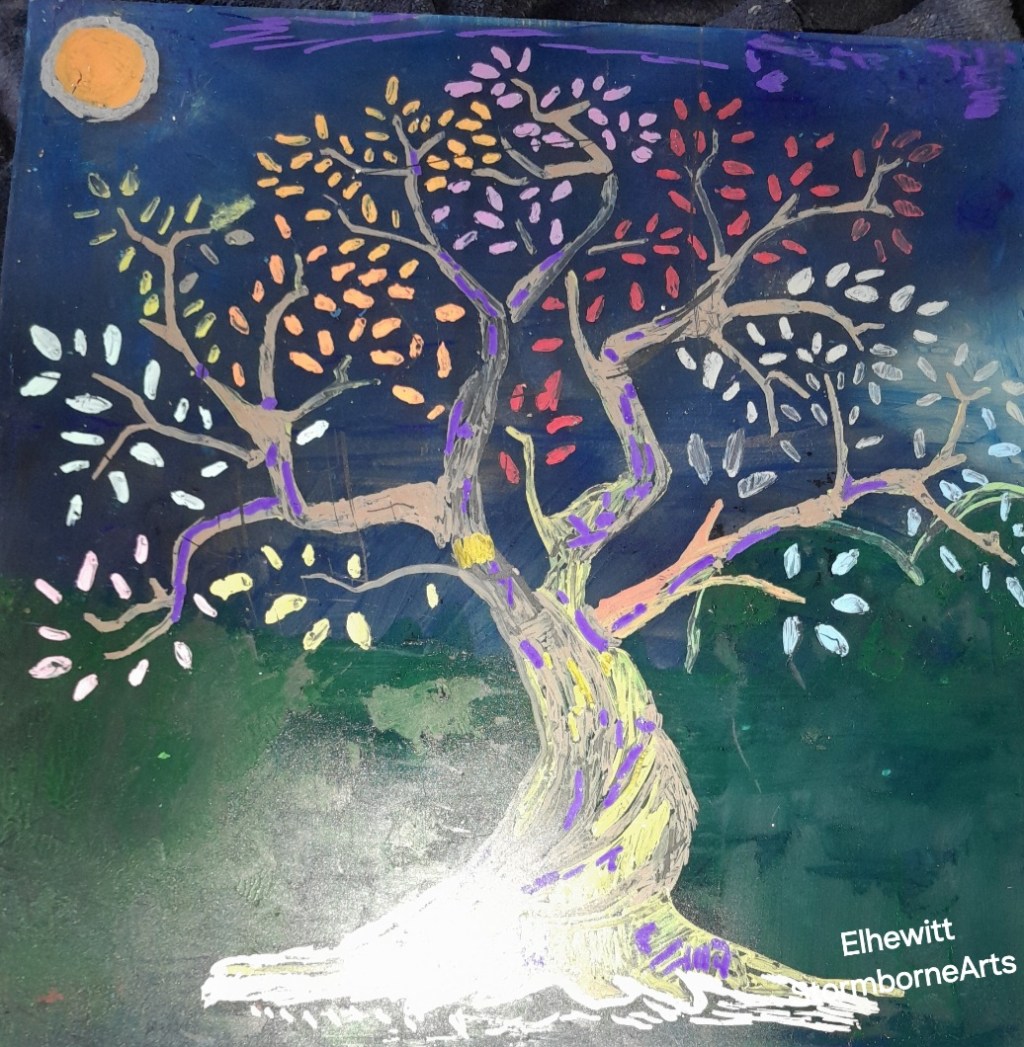
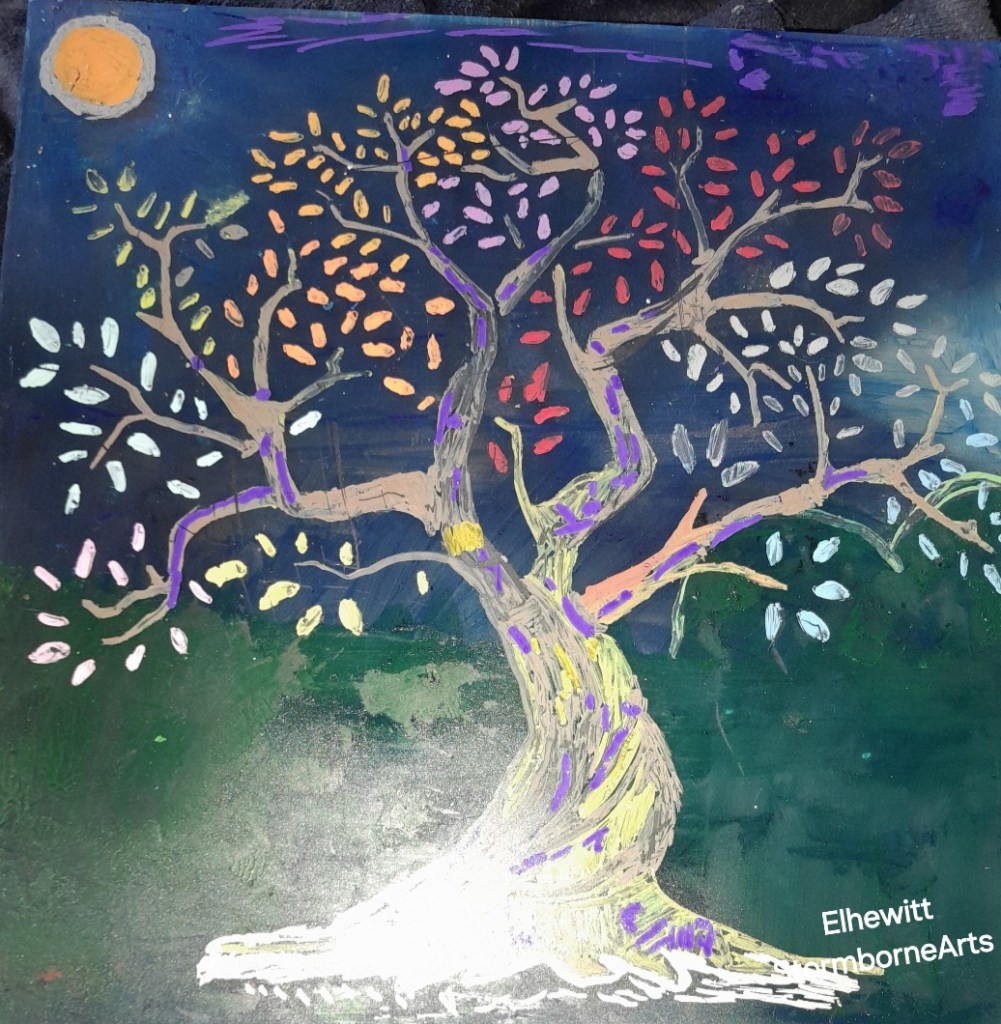
A vibrant, artistic depiction of a tree with colorful leaves set against a dark background, symbolizing the mystical elements of nature.
By E.L. Hewitt — StormborneLore
Dawn came slow over Cannock Chase, the sky still holding tight to the colours of night.
Mist clung to the ground, pale as breath on cold glass. The trees stood quiet as watchers in old cloaks.
Lore walked barefoot through the wet grass, collecting what the earth offered.
Yarrow first pale and feathery, growing in shy clusters where the sunlight would later reach. Good for blood and fever, and for protection against spirits that lingered too close.
He cut it gently, whispering, “For the ones who yet breathe.”
Rowan bark next, peeling in thin curls beneath his knife. The tree shivered, though no wind touched it.
Rowan remembers, the old women used to say and Lore believed them.
Last came the resin pine tears hardened in the bark of a fallen giant, still sweet, still golden.
He held it to his nose, breathing in the scent of memory. Smoke. Rain. Home.
Above him, the crows gathered.
Three at first. Then five. Then a dozen, their wings murmuring like pages turning.
They did not caw. They simply watched.
Lore did not fear them. The crows of the Chase were older than any Druid’s words. Older than Rome’s roads. Older even than the songs of the first tribes.
They followed him as he walked between the birches. Their trunks ghost-white, rising from the mist like bones of giants sleeping beneath the soil.
The air felt listening.
The trees breathed slow.
The old gods waited.
Lore spoke softly, almost too low to hear: “Stormfather. Bound-Brother. Wild King. I hear you.”
The leaves stirred, though the air was still.
And then
A whisper. Not with sound, but with bone and blood.
He rises.
Lore’s heart tightened. No fear only certainty.
The crows took flight at once, black wings cutting the dawn sky. They flew south, toward the marsh track near Landywood, toward the low birches where the Black Shields rested.
The sea was restless that night, black as iron and twice as cold. Taranis Stormborne stood at the prow of the ship, his cloak heavy with salt and rain. Behind him, the Black Shields moved in silence, their faces hidden, their oars cutting through the water with a rhythm older than empire.
Rome’s ships had been sighted near Carthage a patrol too far from home, too confident. This voyage was not conquest, but message.
Lightning split the horizon. Taranis lifted his gaze toward the thunderclouds, their light catching the gold in his eyes.
“Do you fear the storm?” one of the younger soldiers whispered.
Taranis’s answer was soft, almost drowned by the wind. “I am the storm.”
The first Roman galley loomed ahead, torches guttering in the wind. The Black Shields struck swift and silent, grappling hooks biting wood, blades flashing in the rain. No horns, no cries only the sound of waves breaking and chains rattling as old fears were unmade.
By dawn, the sea was calm again. The Roman ship burned behind them, its mast sinking like a dying pillar of the old world.
Taranis watched the smoke fade into the clouds. “Let them think it was lightning,” he said. “Let them think the gods themselves strike against their arrogance.”
He turned back toward the island, where fire and training awaited. The storm had passed but the Empire would wake to the scent of rain and know its name.
The dawn broke pale and brittle over the Western Marches. Mist clung to the hillsides like the remnants of a long-forgotten battle. The scent of wet earth hung thick in the air.
Drax Stormborne rode alone, the wolf badge at his breast glinting faintly in the weak light. Each hoof beat a steady rhythm against the quiet of the land.
Reports had come from the southern villages. Whispers of movement along the coast, smuggled supplies disappearing into the night, and the black shields stirring in secret. Rome called it rebellion. Drax called it preparation.
He paused at the ridge, scanning the valley below. The smoke curled from chimneys, thin and innocent. Yet he saw in it the same threads of tension that had always followed his family. Every glance, every movement, was a calculation an unspoken war between loyalty, law, and blood.
A courier approached, riding hard across the hill track. Drax reined in his horse. The rider’s eyes were wide with urgency, breath steaming in the cold morning.
“High Sheriff,” the courier gasped, bowing slightly. “The exiles… they’ve moved. South, toward the old Roman fort. But there are… signs. Traps, and sentries placed where none should be.”
Drax’s jaw tightened. He dismounted slowly, brushing mud from his cloak. “And our men?”
“Silent,” the rider said. “They wait, as you instructed. Patient. Watching.”
Drax nodded, feeling the familiar weight of responsibility press upon him. Patience, observation, action the long game. His thoughts flickered to Taranis, chained in distant Rome. Memories of the oath that bound him not just to the Empire, but to family. To storm.
He turned to the courier. “See to it that no one moves without my signal. Keep the villages safe. Let Rome believe all is still. But let our shadow fall across the fort when the time is right. The storm will not wait forever.”
Lightning fractured across the distant sky, a whisper of thunder rolling over the hills. Drax lifted his gaze and felt it stir through him, golden and alive. The storm was patient, and so would he be.
For when the winds finally tore through the land, nothing not even Rome would withstand it.
The clang of steel echoed across the Roman training yard. The sun was still low, its pale light glinting off helmets and polished shields. Taranis moved like shadow and storm, his chains rattling as he fought against three centurions in succession.
Every strike he gave was measured, precise but every parry cost him pain. The iron bindings cut into his wrists, leaving a thin red line that deepened with each movement. He refused to yield.
Caelum stood at the edge of the sand pit. His tunic far too fine for this place a youth of maybe sixteen, bright-eyed and restless. His gaze never left Taranis.
“uncle Marcos,” he said quietly, turning to the older man beside him. “Can those chains come off him?”
Marcos didn’t answer at once. His face was lined from years in service, his eyes as sharp as the swords he trained with. “Chains are the only reason he’s still alive, Caelum,” he said finally. “Without them, some fool would call it fear instead of discipline.”
“But he’s fighting for us now.” Caelum’s voice carried, defiant. “For Rome, at least.”
In the pit, Taranis struck low, sweeping a soldier’s legs out from under him. Before turning the momentum into a twist that sent the next centurion stumbling backward.
The last one hesitated, shield raised, watching the way. Taranis breathed steady, like a man waiting for the storm to break.
The chain coiled once, twice then snapped out, wrapping the shield edge and dragging it down. The sound of the soldier hitting the ground was followed by silence.
Caelum took a step ahead. “He’s more Roman than half your men.”
Marcos shot him a warning look. “Careful, boy. You sound like your mother.”
The youth smirked faintly. “She says the same.”
When the training was done, the soldiers dispersed, muttering under their breath half respect, half fear. Taranis knelt in the dust, hands bound before him. Marcos approached, tossing him a canteen.
“You could have killed them,” Marcos said.
Taranis drank, the water streaking through the dust on his face. “You didn’t tell me to.”
Marcos grunted, half a laugh, half frustration. “One day, that mouth of yours will get you killed.”
“Maybe,” Taranis replied. “But not today.”
Caelum stepped closer, watching the bruised wrists, the marks the chains left behind. “You’re not like the others. You don’t fight for their gods.”
Taranis looked at him not unkindly. “No. Mine are older. And they don’t care who wears the crown.”
The boy tilted his head. “If I asked you to fight for me instead of Rome?”
Marcos snapped, “Enough!” But Taranis only smiled slow, deliberate, dangerous.
“Then, little wolf,” he said softly, “you’d better be ready to pay the price.”
Above them, thunder rolled faintly in the distance, though the sky was still clear.
Chains clinked like faint echoes of the arena’s roars, and the scent of iron still clung to the air. Taranis Storm lay awake in the half-darkness, eyes open to the stone ceiling, counting the rhythm of the guards’ boots. Rome slept, but the storm within him did not.
He had won his life for another day, but victory came at a cost. He had shown them what he was. Not a beaten barbarian, but something far more dangerous a man who learned.
At dawn, Marcos appeared at his cell door, shadowed by two guards. “You’ve made them talk,” Marcos said quietly. “The governor himself wants to see you.”
Taranis said nothing. The chains around his wrists jingled as he stood.
They led him through the inner halls of the fortress, where Roman banners hung stiff and silent. Soldiers stared as he passed some curious, others wary. A man who defied lions and bears without breaking was not easily forgotten.
In the governor’s chamber, incense burned thick. Maps of Britannia sprawled across a marble table, marked with red ink and small figurines of silver legions.
The governor, Decimus Varro, was not a cruel man by Roman standards merely pragmatic. “You are a spectacle,” he said, voice calm. “A man who fights like the gods themselves favour him. Tell me, Briton what drives you?”
Taranis met his gaze. “The same thing that drives Rome. Freedom.”
Varro smiled faintly. “Freedom is an illusion. Order is what endures.” He leaned forward. “Serve Rome, and you’ll live well. Defy us again, and your death will be remembered only as noise in the sand.”
Silence stretched between them, thick as the smoke that coiled from the brazier. Then Taranis spoke, slow and deliberate.
“I have no wish to be remembered. Only to finish what began in the storm.”
Varro frowned not in anger, but thought. “Then we understand each other.” He gestured to Marcos. “Train him. Watch him. If he can be tamed, he’ll fight for Rome. If not…”
Taranis was taken to the training grounds. Men waited there gladiators, soldiers, slaves who had survived too long to be careless. The air rang with the sound of iron on iron. Marcos tossed him a blade, better balanced than the last.
“Your real trial starts now,” Marcos said. “In the arena, you fought to live. Out here, you’ll fight to learn what Rome fears most a man they can not own.”
For the first time since his capture, Taranis smiled. The storm had found a new horizon.
They say the stones at Emberhelm still whisper when the wind moves right a low murmur that rises from the earth like the breath of something ancient, waiting.
Farmers avoid the place now. Shepherds drive their flocks wide, and children dare each other to touch the outer ring, laughing until the laughter falters. Only the old remember that once, before Rome, before even the clans, the stones were not dead things.
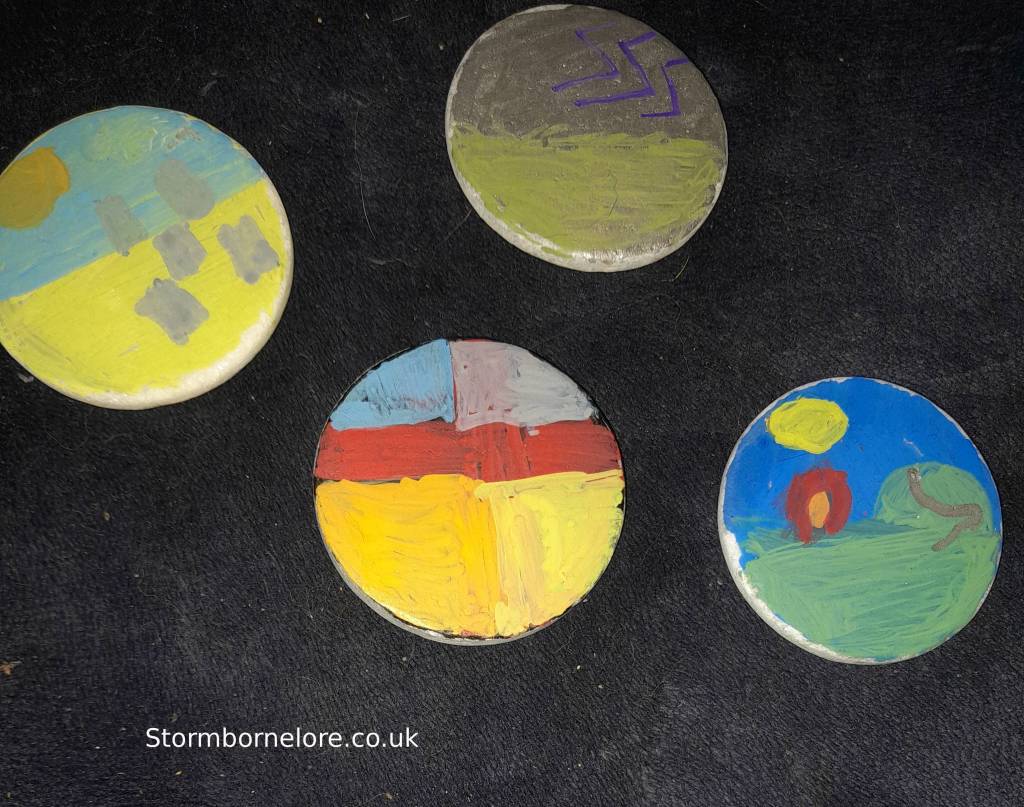
Each one bore a mark storm, fire, tide, and light carved by hands that no longer walk the world. Together they formed a circle, a promise between the gods and those who spoke their tongue. The Circle of the Gold Ring.
When the brothers swore their oaths there, thunder split the air. The eldest spoke of wisdom, the youngest of freedom, and the middle ones of strength, loyalty, and truth. But the sky heard more than words it heard pride. And pride is the chisel that breaks all stone.
Now, when lightning rolls across Cannock’s high fields, some claim to see figures between the stones. Not ghosts, not living men something between. They say one wears chains that sing when he moves, another bears a sword that hums with the weight of unspoken guilt, and one more walks with his hands clasped behind his back, watching the storm as though it answers to him.
The villagers leave offerings there still a bowl of salt, a coin, a lock of hair just in case the whispers are not only echoes, but memories listening for their name.
“Taranis is our baby brother, no matter what some think,” Drax growled, his voice low and edged with iron. His gaze locked on Rain across the firelight, sharp enough to cut stone. “You betrayed him when he was a child and you betray him now.”
Rain’s jaw tightened, but he did not speak. The silence stretched between them, thick with memory and regret.
The old priest, Maeron, lifted his hand gently. “He forgives you, Rain,” he said, his tone weary yet steady. “He wanted Drax, Draven, and Lore to know he will endure what they give him. So that you three will survive. He says to make choices that will keep you all safe and your people.”
Drax’s expression did not soften, though his eyes flickered with something that have been pain. “He forgives far too easily.”
Maeron inclined his head. “Forgiveness is not weakness, my lord. It is the weapon of those who can’t be broken. The Romans won’t rule forever. Prepare for what comes next.”
At the edge of the fire, Caelum shifted uneasily, his young face caught between fear and pride. “But what about my uncle’s meals?” he asked suddenly. “Uncle was exiled from the Circle years before they caught him. I was a baby then. Now I’m fourteen he shouldn’t be forgotten again.”
The words silenced the hall. Even Rain, for all his bitterness, not meet the boy’s gaze.
Drax rose slowly, the firelight glinting off his scars. “He will not be forgotten,” he said at last. “Not while the storm still bears our name.”
“But won’t they strip him of his name?” Caelum pressed, voice trembling now. “If Rome erases it, how will anyone know he lived?”
Drax looked down at his son the fire’s glow. Reflected in the boy’s wide eyes and placed a steady hand on his shoulder.
“Names can be taken,” he said quietly. “But legacies can’t. The Romans think power is carved in stone. Ours is carved in memory.”
He turned back to Maeron. “Tell him that. Tell him Emberhelm remembers.”
The priest nodded, rising to leave. But before he turned, his gaze swept the circle of men gathered in the hall. “When the storm returns,” he said softly, “I hope you are ready to stand beneath it.”
When Maeron’s footsteps faded into the night, the hall remained silent. The storm outside broke, rain hammering against the shutters like the echo of distant drums.
Drax stood by the window long after the others had gone. He could not see the fort from here, but he could feel it the iron cage that held his brother. The empire pressing closer each season. Yet as lightning flashed over the valley, he smiled grimly.
Because storms, no matter how long they’re caged, always find their way home.
The road to Viroconium was slick with rain. Drax rode beneath a low sky, his cloak heavy with water, the wind biting at his face. Beside him, Maeron’s hood was drawn deep, the priest’s silence carrying the weight of things better left unspoken.
When they reached the outskirts of the Roman fort, the air stank of smoke and iron. The rhythmic clash of hammers and the cries of soldiers echoed through the mist. But above it all, there was another sound low, strained, human.
Drax reined his horse sharply, his eyes narrowing.
At the edge of the square, raised above the mud and the murmuring crowd. Hung a man bound to a crude wooden cross. Blood streaked his arms, his body marked by lashes and bruises. His hair clung to his face in the rain. But the set of his jaw the defiant lift of his head was unmistakable.
Taranis.
Drax’s heart clenched as the legionnaire stepped forward, spear in hand. “He struck a guard and tried to run,” the man said stiffly. “By Roman law, the punishment is public display.”
“Law,” Drax echoed, his voice quiet, almost a whisper but Maeron flinched at the tone. “You call this law?”
The soldier hesitated, but before he could respond, Maeron laid a hand on Drax’s arm. “Careful,” he murmured. “The walls have ears.”
Drax dismounted, boots sinking into the mud. He walked forward until he stood before the cross, rain washing the grime from his face. Taranis raised his head slowly, eyes bloodshot but burning with that same inner fire that no empire could snuff out.
“Brother,” Drax whispered.
Taranis gave a faint, broken smile. “You shouldn’t have come.”
“And leave you to the crows?” Drax’s voice cracked like thunder. “Never.”
Maeron stepped forward, murmuring Latin prayers under his breath for the watching soldiers. Though his words were laced with druidic meaning ancient phrases meant to shield, not to save. His fingers brushed the iron nails that bound Taranis’s wrists. “These are not deep,” he said quietly. “They did not mean to kill him. Only to shame.”
Taranis’s laugh was hoarse. “They can’t shame what they don’t understand.”
The centurion appeared, cloak heavy with rain. “This man belongs to Rome,” he declared. “You will step back, Lord of Emberhelm.”
Drax turned slowly, the weight of centuries in his gaze. “And yet Rome forgets whose land it stands upon.”
The centurion stiffened. “Do you threaten?”
“No.” Drax’s tone softened to a dangerous calm. “I remind.”
The priest raised his hands quickly. “My lord only seeks mercy,” Maeron said. “Let him pray with his brother before the gods.”
After a pause, the centurion gestured sharply. “You have one hour.”
When the soldiers withdrew to the gatehouse, Drax knelt beside the cross. The rain had turned to sleet, stinging against his skin. “Hold on,” he murmured. “We’ll get you down when the watch changes.”
Taranis shook his head weakly. “No. Not yet. If you cut me down, they’ll know you came. They’ll burn Emberhelm.”
“Then let them come,” Drax growled.
But Taranis only smiled faintly. “Storms must wait for the right sky, brother.”
Maeron placed a hand on Drax’s shoulder. “He’s right. Endurance, not rage. That is his rebellion.”
Drax bowed his head, jaw clenched. He hated the wisdom in those words. He hated that Taranis could still smile through chains and nails.
As dusk fell, lightning cracked beyond the hills, white and wild. The storm gathered again over Viroconium.
And though Rome saw only a prisoner’s suffering. Those who remembered the old ways knew the truth: A storm had been crucified and still, it did not die.
The morning mist hung thick over the Roman fort, curling around the walls and the sentries like ghostly serpents.
Taranis Storm’s wrists ached where iron had bitten into bruised flesh, his ankles raw from chains. Yet the fire inside him refused to be tamed. Marcos had warned him that this day would test more than his body. It would probe the limits of fear, endurance, and wit.
The centurion led him across the courtyard. Other prisoners lined the path, eyes wide with terror or jealousy. Weak men, broken men, some shaking in expectation of death. None dared speak.
“Today, you fight for Rome’s amusement,” the centurion barked, voice carrying over the square. “The arena awaits. Survive, or die beneath their eyes.”
Taranis allowed a faint smirk, almost imperceptible. Chains or no chains, sword, axe, or spear he had survived worse. The storm was within him, and storms do not break.
The first trial: Damnatio ad Bestias.
Lions, their muscles rippling beneath tawny manes, were released into the sand. Their growls rolled like thunder, a sound meant to unnerve men and mark the end of hope. Taranis was pushed forward, unarmed, the chains clinking with each step. The crowd leaned forward, eager for carnage.
The first lion lunged. Taranis dropped low, letting its momentum carry it past him. Spinning the chain to trip the beast, a subtle but devastating movement learned in the wilds of Staffordshire. Another lunged, jaws snapping, claws tearing sand.
He moved like the wind low, sharp, unpredictable. He stood baiting, dodging, spinning chains like whips, forcing the predators into missteps against one another.
Blood rose in clouds around him, yet he remained untouched. When the final lion recoiled and the centurion’s mouth twitched a mix of disbelief and begrudging respect. Taranis exhaled slowly, chains clinking, storm-controlled and silent.
The second trial: Gladiatorial combat.
He was given crude weapons a short sword nicked from years of use. A small round shield marred by countless hits, a spear bent at the tip. Combatants approached with mockery, expecting an untrained barbarian to stumble, falter, and bleed.
Taranis did not falter. He did not rush. Each movement was a calculation, using the terrain, his chains, the enemies’ weight and momentum against them. The first pair charged together, one with sword, one with shield.
Taranis pivoted, letting the chains tighten around their legs. As he ducked beneath the sword, delivering a clean strike to the opponent’s flank.
The second soldier hesitated, startled by the unexpected precision. Taranis did not smile he simply waited for the next assault, reading, predicting, exploiting every weakness.
A guard whispered to another, “He’s no ordinary man… he fights like the storm itself.”
By midday, the arena was a battlefield of skill, endurance, and cunning. A third pair entered, wielding axes. Taranis dodged and parried, chains tangling in the sand and catching his enemies off-balance. His movements were fluid, almost artistic — a storm in motion, controlled yet deadly.
Between bouts, he observed fellow prisoners some cowering, some quietly strategizing, watching him with awe. He nodded subtly, acknowledging their respect without breaking focus. Alliances were unnecessary here; survival was enough.
Two massive bears were released simultaneously, roaring, claws digging into the arena floor. Taranis analyzed their pattern one slower, one feinting left before striking right. He baited them, using his chains to trip and distract, pushing one into the other’s path. The crowd gasped as claws met flesh, teeth snapping on fur instead of his own body. His footwork was precise; his breathing measured; his mind sharpened like a blade.
When the bears finally withdrew, exhausted or bested by circumstance, Taranis stood alone in the sand. Sweat streaked with blood and mud clung to his skin. He raised his head, grey eyes surveying the watching centurion. There was no fear in him. Only storm.
The centurion approached cautiously, expression unreadable. “Enough. You will live… for now. But know this: Rome does not forgive defiance. Your survival is theirs, not yours.”
Taranis’s gaze swept over the spectators and fellow prisoners alike. Some bowed in awe, some averted their eyes in fear. Marcos leaned against the wall, one eye glinting with pride. Even in chains, Taranis Storm had not been broken.
That night, in the darkness of the cell barracks, he traced patterns in the dirt beneath his chains. The arena had been a spectacle for Rome, yes, but also a proving ground for him. Every movement, every dodge, every strike had been a lesson in patience and precision. Each enemy, each beast, each whisper of fear from the crowd had been data to be remembered, stored, and used.
The storm waited. It always waited. Taranis knew the chains bind him. swords scratch his skin, lions and bears roar, but they could not break him.
He smiled faintly to himself, letting the chains clink softly. Rome had given him a stage, a spectacle, and a lesson. And when the right moment came, the storm would strike and it would not be for their amusement.
The roads ahead were quiet, the wind carrying the scent of burnt heather and distant sea. Each hoofbeat of my mount reminded me that the choice I had made was mine alone, and yet its echo stretched far beyond my chest.
Whispers followed me like shadows. Some were real the wary eyes of villagers, the wary glances of traveling merchants. Others were imagined, the scornful voices of my brothers, of Taranis, of the Ring itself. I did not flinch. Survival was colder than fear, sharper than guilt.
The circle was gone, fractured beneath my hand, yet its memory clung to the land. I felt it in every hollow, every mound, every stone left untouched, as if the earth itself remembered the covenant we had sworn. I had broken it not for power, not for spite, but for a chance to bend fate toward life.
Rome was patient. I knew that. And I knew too that the storm I had once sought to command in Taranis’s fury could now rise in me, subtle, quiet, lethal if misjudged. The choice of the traitor is never simple. It is measured in survival, in timing, in knowing the cost before the world dares to demand it.
Ahead, a ridge cut the horizon, the pale sun glinting over the salt flats. I pulled my cloak tighter, letting the chill remind me that I was still breathing, still moving, still in control of this shattered path.
The Ring was broken. But perhaps, in that fracture, a new pattern could emerge. One I alone might trace.
I rode past the remnants of burned villages and overturned carts, careful to keep to the high ground. From this distance, nothing looked alive; yet every shadow could be a scout, every rustle a whisper of accusation. I had betrayed the circle, but I had not betrayed survival. That distinction, razor-thin, I carried like a blade at my side.
Even so, the memory of Taranis lingered. I imagined him, bound in chains, his eyes storm-grey beneath a sky that mirrored his wrath. Some part of me hoped he hated me. Another part the part I refused to acknowledge wished he would understand.
I reached the edge of a woodland and dismounted. The quiet crackle of dead leaves underfoot reminded me of my childhood in Compton, of paths once walked under open skies, where choice had been play, not consequence. Here, choice was survival. Choice was betrayal.
A messenger approached, a thin man with a letter sealed in the eagle of Rome. I took it with careful fingers, breaking the seal only when I was certain no eyes watched. The words were simple, direct, and chilling:
“Keep the Ring moving. Keep the pieces apart. Rome watches, and the storm will be rewarded or crushed at our discretion.”
I folded the letter slowly, feeling its weight far heavier than the paper it was written on. Rome had not forgotten, and neither had the Circle though I was its only witness now.
I paused at a stream, letting my mount drink, listening to the water whisper over stones. I thought of my brothers, of Drax, of Lore, of Draven. Each had reacted differently to Taranis’s capture, to my choice. Some with anger, some with fear, some with silent, unspoken questions. And some… had already begun to take paths I could not predict.
Even here, on the open road, I felt the pull of power, subtle and insidious. The Ring had been broken, yes, but its legacy endured. That legacy could guide me—or consume me.
As night fell, I made camp beneath a lone oak, its twisted branches scratching the dark sky like fingers of fate. I allowed myself a single, quiet thought before sleep claimed me:
The storm does not always strike. Sometimes it waits, gathers, watches… and then it returns, quiet, inevitable, unstoppable.
The following morning, I rode again, the mist curling around the trees like living breath. Villagers had begun to recognize me, whispers trailing my passage. Traitor. Survivor. Coward. Protector. All names carried weight, none carried comfort. I ignored them. Survival required more than comfort; it required cold calculation.
By mid-morning, I encountered a small party of mercenaries scouts from a northern lord, curious about the broken Circle. They eyed me cautiously, their hands brushing the hilts of swords. I allowed a faint smile, enough to disarm suspicion. Words were sharper than steel when wielded carefully.
“I go where the path leads,” I said, voice steady. “I am alone. None should follow.”
They studied me, hesitated, then nodded, scattering into the woods. Even in my isolation, the choices of others shifted around me. Allies, enemies sometimes the line blurred, sometimes it vanished entirely.
Hours later, I made camp near a ruined chapel, overgrown with ivy and stones worn smooth by centuries. Flames licked at damp wood as I pondered the Circle, Taranis, and the pieces of the Ring now scattered across Britain. I could feel their influence, subtle, almost like a heartbeat beneath the earth. The storm of Emberhelm was not gone. It only waited.
A shadow moved near the edge of the firelight. I tensed, hand brushing the hilt of my dagger. The figure emerged: an old acquaintance, one of the scouts I had trained alongside in youth. His face betrayed both awe and fear.
“You broke the Circle,” he whispered, voice shaking. “And yet… you ride on.”
“I did what was necessary,” I said simply. “The Circle survives only in memory if we all fall. I intend to endure.”
He nodded, unease clinging to his gaze. “And Taranis?”
The name struck like a lance, but my expression remained calm. “He lives. That is enough for now. The storm is his. And perhaps it will return to me when I need it most.”
Night deepened. I lay beneath the ivy-draped stones, listening to the forest breathe. Each rustle, each call of distant creatures reminded me that life persisted, even when the world was fractured.
Survival, I reminded myself again, was not glory. It was endurance, patience, and the quiet shaping of what must come next.
And somewhere, far beyond the reach of my sight, the echoes of Emberhelm stirred, waiting for the right moment to rise again.
The sun dipped low over the hills, turning the sky the colour of old bronze. A warm wind blew across the half-built hillfort, stirring the campfire embers and the occasional ego.
Out from the shadow of the forge strutted Drax, shoulders broad, beard wild, and eyes gleaming with mischief.
“I’m riding Pendragon,” he announced to no one and everyone. “You can’t be the only rider, runt.”
Taranis, seated by the fire with a hunk of roasted meat in hand, didn’t even flinch. He just raised an eyebrow. “Oh, I’m sure Pendragon will love that.”
From the ridge above, the mighty dragon shifted. Pendragon, ancient and noble, snorted in what can only be described as pre-emptive disappointment.
Next to him, Tairneanach. The younger storm dragon, lowered his head as if already bracing for whatever chaos was about to unfold.
Drax clapped his hands. “Let’s fly, beasts!”
“Hey Pendragon, Tairneach,” Taranis called, struggling not to laugh. “Drax thinks he’s got wings.”
With an exaggerated swagger. Drax tried to climb up Pendragon’s massive side promptly slipping and landing flat on his back with a grunt.
Pendragon groaned like a disgruntled horse and used his wing like a shovel. As he started lifting Drax back onto the saddle with a firm thwap.
“Thank you!” Drax wheezed, trying to sit upright. “See? We’re bonding!”
Pendragon gave Tairneanach a long look. The younger dragon’s eyes gleamed. The mischief had begun.
With a mighty roar, the dragons launched into the sky, wings tearing through the clouds. At first, it was majestic. Drax whooped with delight, arms raised, his braids flying.
“This is incredible!” he bellowed. “I am one with the storm!”
And then Pendragon did a barrel roll.
Drax did not.
He flew off the saddle like a sack of meat and bellowed curses all the way down.
“OH YOU BLOODY SCALY!”
Before he could hit the ground. Tairneanach swooped in like a feathered bolt of lightning. Catching Drax by the back of his tunic with a precise claw.
“Thanks!” Drax wheezed again, now dangling like a trussed boar over a bonfire.
But the game wasn’t over.
Pendragon arced around and opened his claws mid-air. Tairneanach, with a playful screech, tossed Drax into the air like a sack of barley.
“WHAT IN THE STONE-FORSAKEN” Drax spun mid-air.
Pendragon caught him.
Then tossed him again.
Taranis stood below, hands on hips, watching the two dragons play catch with his brother.
“This is fine,” he muttered. “Completely normal.”
The wolves Boldolph and Morrigan lay nearby watching with what only be described as smug amusement. Morrigan even wagged her tail once.
Up above, Drax was shouting at both dragons.
“NOT THE EARS! I NEED THOSE! I’M A COMMANDER, DAMMIT!”
Eventually, they deposited him gently but with zero dignity onto a hay bale just outside the fort walls. He rolled off, dizzy, covered in ash, and missing one boot.
Taranis walked over and offered him a hand.
“Still think you’re a rider?”
Drax groaned. “I think… I’ll stick to walking.”
As Taranis helped him up. Pendragon landed behind them with a smug puff of smoke. while Tairneanach gave a playful chuff and nudged Drax’s remaining boot onto his head.




 StormborneLore