The wind off the coast carried a strange scent that morning salt, smoke, and something older.
Drax Stormborne stood upon the cliffs of Caerwyn. His cloak drawn tight, eyes narrowed toward the southern horizon where the sea met the clouds. The gulls wheeled low, uneasy, their cries sharp against the stillness.
Behind him, his second-in-command approached, boots crunching on frost-slick stone. “Another ship’s gone missing,” the man said quietly. “Roman, they say. A patrol near Carthage. The reports claim a storm took it.”
Drax didn’t turn. “A storm,” he repeated, voice low. “Or something that wears its name.”
The man hesitated. “You think it’s him?”
For a moment, only the wind answered. Then Drax’s gloved hand closed around the hilt of his sword, fingers tracing the worn leather grip. “Taranis never drowned easy,” he murmured. “If the Empire bleeds at sea, then he’s drawing the blade.”
He moved to the edge of the cliff, gazing down at the waves hammering the rocks below. The sea had always been Rome’s pride a wall of conquest, a promise of control. But now it whispered rebellion.
“Send word to the northern outposts,” Drax said. “Quietly. Tell them the Black Shields move again. No banners. No noise. Just watch the tide.”
The officer nodded and left, his footsteps fading into the mist.
Alone, Drax drew his sword, holding it toward the sea. The steel caught the dawn light, flashing gold for a heartbeat like lightning beneath the clouds.
“Brother,” he said softly, as the first drops of rain began to fall. “If the storm returns… then so do I.”
The thunder answered, rolling like distant drums of war.
The Empire called it weather. The Stormborne called it warning.
The sea was restless that night, black as iron and twice as cold. Taranis Stormborne stood at the prow of the ship, his cloak heavy with salt and rain. Behind him, the Black Shields moved in silence, their faces hidden, their oars cutting through the water with a rhythm older than empire.
Rome’s ships had been sighted near Carthage a patrol too far from home, too confident. This voyage was not conquest, but message.
Lightning split the horizon. Taranis lifted his gaze toward the thunderclouds, their light catching the gold in his eyes.
“Do you fear the storm?” one of the younger soldiers whispered.
Taranis’s answer was soft, almost drowned by the wind. “I am the storm.”
The first Roman galley loomed ahead, torches guttering in the wind. The Black Shields struck swift and silent, grappling hooks biting wood, blades flashing in the rain. No horns, no cries only the sound of waves breaking and chains rattling as old fears were unmade.
By dawn, the sea was calm again. The Roman ship burned behind them, its mast sinking like a dying pillar of the old world.
Taranis watched the smoke fade into the clouds. “Let them think it was lightning,” he said. “Let them think the gods themselves strike against their arrogance.”
He turned back toward the island, where fire and training awaited. The storm had passed but the Empire would wake to the scent of rain and know its name.
The morning mist clung to the earth like breath held too long.
Taranis stood barefoot in the frost-hardened dirt, his cloak wrapped tightly around his shoulders. Before him, the children the eleven pulled from the pit stood in an uneven line. Some shivered. One held a stick like a sword. Another clenched it like a club.
“Not to hurt,” Taranis said. His voice was calm but carried weight. “To protect.”
He walked along the line, placing his hand gently on each child’s shoulder. Their eyes were wide. Some still flinched. But none ran.
Boldolph sat at Taranis’s right, silent and unmoving, a guardian of the moment. Morrigan circled the clearing with the patience of a winter wind, occasionally brushing a child’s ankle with her tail when their stance faltered.
Solaris stood at the edge of the clearing, arms folded. He watched Taranis with an unreadable expression.
“They’re too small,” he said quietly.
Taranis turned.
“So was I,” he replied.
He took a staff from the ground and twirled it with precision, the end cutting the air in a slow arc.
“If we wait for them to grow, it will be too late.”
That evening, the fire burned low. The children huddled close to its warmth, whispering stories they were beginning to remember stories Taranis had told them about the wolves, the fire, the storm.
Solaris sat apart from them, alone with the thoughts that had haunted him for weeks.
He rose when all were asleep. He moved through the shadows, past the bones of old tents and the ghosts of gallows, until he reached the western tree line.
From inside his tunic, he pulled a strip of black cloth, worn thin and embroidered with a single red claw.
He tied it to a crooked branch. Then he whispered.
“Tell them the storm is coming.”
His voice cracked.
“Tell them… it’s Taranis.”
He turned, vanishing back into the mist.
It happened at dawn.
Taranis led a scouting party through the ashwoods Boldolph at his side, two scouts ahead, three boys from the training ring carrying supplies. The fog was thick, the silence heavier than snow.
They never saw the first spear.
It took one of the scouts through the chest. Another cried out and was silenced. The boys ran or tried to but two were taken by horsemen bearing the sigil of the Black Claw.
Taranis fought like a storm obsidian pendant flashing in the smoke, staff and blade spinning but by the time the sun broke the treetops, four were dead, two missing, and the forest was soaked in blood.
He returned on foot, armour torn, a wound above his eye leaking down his face.
Grael met him at the gates.
“They were waiting for us,” the warlord said grimly.
Taranis nodded.
“They knew we were coming.”
“Someone told them.”
The circle was cleared at dusk. Warriors formed the ring. The children watched from behind Morrigan’s flank. The fire crackled but did not comfort.
Solaris stood in the centre, unbound. He didn’t run. He didn’t plead.
Taranis entered last, blood still dried in the cracks of his skin.
“You warned them,” he said flatly.
Solaris bowed his head.
“I did.”
“Why?”
“Because they would have killed my children,” Solaris said softly. “I was trying to stop a war.”
Taranis stepped closer, gaze unwavering.
“You started one.”
The words were quiet. Measured. Final.
From a wrapped bundle at his belt, Taranis pulled a collar carved bone, etched with runes. Not the iron of chains. Something older. Something sacred.
“You are not my enemy,” Taranis said. “But you are no longer free.”
“You will serve. You will teach. You will live in the light of what you did and what you chose not to.”
He placed the collar around Solaris’s neck. It locked with a soft click.
Solaris did not resist. He simply whispered, “Thank you for letting me live.”
Taranis didn’t answer.
Days passed. The air grew colder. But the children trained each dawn, and the wolves stayed close.
Solaris taught them how to cook, how to read the skies, how to find warmth when the earth turned bitter. Taranis taught them how to fight but more than that, how to stand. How to speak without fear. How to remember.
“We were broken,” he told them. “But we are still here.”
A council formed. Not by title. By oath.
Grael stood with arms crossed, nodding at the children now sleeping beside the fire. Morrigan lay curled with the youngest boy against her ribs. Boldolph prowled the border like a guardian carved from ash and stone.
Taranis drew three sigils in the dirt.
A flame. A storm. A shadow.
“We are not a camp anymore,” he said. “We are Caernath.”
The Seer who had first named him stepped forward, voice wind-carried.
The fire still smouldered in the trial circle. Ash drifted across the camp like falling snow, silent and strange. But Taranis was already moving.
“There’s one more thing I need to do.”
Grael watched him from the shadows. He didn’t speak. He didn’t stop him either.
Boldolph padded beside Taranis in silence. Solaris followed, clutching a waterskin and a roll of cloth. Morrigan trailed at a distance, her red eyes glowing faintly.
They passed the old fletcher’s tent, the burned tree where whippings once took place, the bone pits that had once broken men.
“Where are we going?” Solaris asked quietly.
Taranis didn’t answer. He was listening not to voices, but to memory. He remembered a cough in the dark. A cry. The scraping of small fingers against stone.
“There’s a cage,” he said. “Near the quarry. They kept the youngest there. Said they were too small to work.”
The Pit They reached it just after dusk. The trees pressed tight around the stone hollow. At first, it looked abandoned broken boards, a slanted gate, silence.
Then a sound. A whimper.
Boldolph’s ears twitched.
Taranis crouched and pulled aside the brambles. A metal grate, rusted and choked with moss, covered a square hole in the earth.
“Help me,” he said.
Solaris held the torch. Boldolph tore at the frame with claws. Morrigan bared her teeth and bit through the last knot of rope.
Beneath, the darkness shivered.
A child peered up.
Eyes too wide. Bones too thin.
“We’re not guards,” Taranis said gently. “We’ve come to end this.”
There were eleven in total.
Some crawled. Some limped. One couldn’t speak. One clutched a half-rotten toy made from bark and wool. They emerged into the night like ghosts made of dirt and silence.
Taranis knelt before each one and touched their shoulders.
“No more pits. No more cages. I swear it.”
The eldest maybe ten looked at the wolves with fear. Then at Taranis.
“They’ll just chain us again.”
“Not if I teach you to fight,” he said. “Not if I teach you to speak.”
He turned to Solaris.
“They will need warmth. Names. A place.”
Solaris nodded.
“We will give them more than that. We will give them stories.”
A New Fire That night, Taranis did not return to his tent. He built a new fire at the edge of the camp. The children gathered near it, cautious, blinking at the light.
He laid out bowls of stew. He let them sit in silence.
Then he rose and spoke to the camp.
“They were buried alive in your shadows. Chained so young they forgot their own names.”
“This camp lives because of silence. But not anymore.”
“I will raise them. Feed them. Train them.”
“And one day, they will raise others.”
Grael stood from the back. He did not speak, but he gave a slow nod.
The Seer who had named Taranis walked to the fire and added herbs to it. The scent rose sharp rosemary and root. A symbol of memory.
“This fire,” she said, “is the first fire of the Order of Dawn.”
The stone halls of Emberhelm still held the breath of thunder. The storm had passed, but the scent of damp earth and smoke clung to every crack and carving.
Outside, the banners of the three Houses shifted gently in the wind. Flame, Shadow, and Storm. Inside, the High Warlord of Caernath sat upon the seat of judgment, the storm-carved throne of his ancestors.
Taranis wore no crown. His only adornment was the silver cuff upon his wrist, the one shaped like twisted flame. Around him stood those who had fought beside him, bled for him, defied death with him.
Lore stood silent to the left, hands folded into his long dark sleeves. Boldolph crouched at the side of the hall like a black statue, eyes ever scanning. Draven leaned near the great hearth, murmuring with a war-priest. Rayne stood furthest back, half-shadowed, watching everything.
“My brother did not steal,” she said, eyes red from the wind. She clutched a doll made of grass and thread. “He only took what the wolves left. We were hungry.”
Her mother knelt beside her, face pale, silent with shame.
Taranis rose. “Where is the boy now?”
A man stepped forward. Greying, armed, not unkind. “In the cells, my lord. The bread he took belonged to House Umbra’s stores.”
Lore turned his head slowly. “Bread unused for days. Moulding in a bin.”
“Aye,” said the man. “But rules are rules.”
Taranis stepped down from the dais. He did not look at the guards. He knelt to the girl.
“What is your name?”
“Aella,” she whispered.
“Aella,” he said, “your brother is no thief. He is a survivor. And from this day, your family eats under the protection of Emberhelm.”
He turned to the court. “Let the stores be opened to those in hunger. Starvation is not a crime. And those who would hoard while others suffer will answer to me.”
The next petition was colder.
Two men from the borderlands bowed stiffly. One bore a jagged scar along his scalp.
“My lord, Black Claw banners were seen near the Witherwood. We ask permission to hunt them down.”
A murmur rose. Boldolph straightened.
Taranis narrowed his eyes. “How many?”
“A dozen. More. Hiding in the ruins.”
Rayne shifted, his hand brushing the old collar scar on his neck.
“No,” said Taranis.
Gasps.
“We do not chase ghosts and bleed men for vengeance. Not now. Not today. Fortify the border. Send scouts. But no hunt.”
The men looked uneasy.
Draven raised his voice. “What if they attack?”
“Then we crush them,” said Taranis, steel in his voice. “But we do not start the fire.”
Boldolph gave a faint growl of approval.
Later, as the court thinned, an old woman with clouded eyes was led forward.
“I was once a healer,” she said. “Cast out in the time before. I seek no pardon, only a place.”
Morrigan stepped ahead from the shadows.
“I know her,” she said. “She taught me names of plants I still use.”
Taranis looked to the court. “Is there any who speak against her?”
Silence.
“Then let her be welcomed to Hearthrest,” he said. “Let her wisdom serve again.”
The old woman wept.
As the hall emptied, Lore remained behind.
“You did well,” he said.
“I did what had to be done.”
“Which is often the hardest thing.”
Taranis sat again upon the throne. He looked to the high carved beams, where the banners of the Stormborne rustled gently.
“The war will come again,” he said.
“It always does.”
“Then let this peace be something worth protecting.”
Lore nodded. “So we fight, not for power. But for dignity.”
Taranis gave a half smile.
“For bread. For brothers. For those who can’t fight. That’s what this court is for.”
And above them all, in the rafters where the light touched the carvings of wolves and dragons, the storm winds whispered through the stone:
The morning mist clung to the valley like a second skin. Emberhelm’s courtyard steamed with breath and sweat, the scent of stone, ash, and boiled roots heavy in the air. Around the inner circle, newly chosen warriors waited nervous, eager, some barely out of boyhood. Others bore scars older than Taranis himself.
At the centre stood the High Warlord of Caernath. His cloak cast aside, sleeves rolled, storm-grey eyes fixed on the line before him.
“No blades today,” he said. “Not until your hands know what weight feels like.”
He tossed a staff to the first in line. Then another. And another. Each warrior caught their weapon or fumbled it those who dropped theirs were told, simply, “Again.” And made to run.
On the other side of the training ground, beneath the shadow of the stone wolf banner, Boldolph paced in silence.
His pack half-men, half-beasts, with eyes like old moons watched him without blinking. He spoke low, but his voice carried like thunder over ice.
“You are not pets. Not soldiers. You are guardians.” A pause. “You see a child in harm’s way, you do not wait for orders. You act. That is the law of the wolf.”
One of the younger wolves whimpered. Boldolph turned sharply. “Fear is not failure. Freezing is. Move even if it hurts.”
Across the field, Taranis raised his voice again.
“This is Ignis. This is fire. You’re not here to impress me. You’re here to withstand the storm, and stand through it.”
He glanced at Boldolph.
“Or do you want to spar with his lot instead?”
A low growl rippled from the wolf-warriors.
The chosen laughed nervously until Boldolph nodded. One of his warriors, a massive figure with a half-healed burn across his chest. stepped ahead, gripping a staff as thick as a child’s leg.
Taranis smiled. “Right then. Let’s see who learned to dance.”
The wolf-warrior advanced, silent but for the low crunch of earth beneath padded feet. His height matched any war-chief. His eyes amber, slit like a blade of dusk fixed on the line of young recruits now stepping back.
Taranis caught Boldolph’s eye.
The old wolf-man crossed his arms, his growl half amusement, half challenge.
“Too much for them?” Taranis asked.
“They need to know pain has teeth. And that not all enemies snarl first.”
The recruits shifted nervously. One tried to step ahead, but Taranis raised a hand.
“No,” he said. “Not yet.”
Then, slowly, he removed the silver cuff from his wrist. The one shaped like twisted flame and dropped it into the dust.
The courtyard hushed.
Boldolph straightened, his expression unreadable.
“You mean to fight me?” he said, stepping ahead, voice low.
Taranis rolled his shoulder and took a training staff from the rack. “Not to wound,” he replied. “To remind.”
Boldolph took his own heavier, gnarled like a branch torn from an ancient tree.
They circled.
The recruits, wolf-men, and even dragons above watched in stillness.
Then Boldolph struck fast, low, aiming to knock out Taranis’s legs. But the warlord leapt, twisting mid-air, landing in a crouch with a grin. He swept his staff up, tapping Boldolph’s ribs before stepping back.
“Sloppy,” he said. “You’re slower in your old age.”
Boldolph snarled, but it wasn’t anger. It was the old dance. The rhythm of claw and command.
He lunged again this time a full force blow. Their staffs cracked like thunder as they met. Sparks flew from the impact. Recruits flinched. One dragon above rumbled softly, folding its wings to watch closer.
They moved like storm and shadow:
Taranis fluid, forged in battlefields and flame.
Boldolph grounded, brutal, unshakable like the old hills.
Neither aimed to kill. But neither held back.
A final clash and both stopped, locked staff to staff, breathing heavy, eyes locked.
“You’ve grown,” Boldolph said, finally. “Not just in size.”
“And you’ve not changed,” Taranis replied, sweat on his brow. “Still the rock I lean on.”
He broke the hold, stepped back, and offered a hand.
Boldolph took it without hesitation. The courtyard erupted in cheers both from humans and wolves alike.
Taranis turned to the watching recruits. “This,” he said, gesturing between them, “is how you lead. Not with fear. But with fire, with honour, and with those who would bite your enemies long before they betray your trust.”
Boldolph gave a rare smile.
“And don’t forget,” he growled to the recruits, “the wolves are watching.”
The fire had long gone out, and the cold crept in like a snake through the underbrush. Taranis sat with his back to a stone outcrop, shivering in silence. His breath came in misted gasps, though he dared not build another fire. Fire drew eyes. And eyes mean death.
He was only nine winters old skin and bones beneath a damp wolf-pelt, alone since exile. Alone… or so he believed.
Until that night.
A low growl rolled from the darkness.
Taranis reached for his stick-spear crude, splintered, tipped with flint and rose to a crouch. The growl came again, closer. Deep. Measured. Not hunger. Not rage. Warning.
The trees parted.
A shadow, massive and black, emerged from the mist.
The wolf.
Not just any wolf this one had eyes like embered blood. A scar down his left side that caught the moonlight. He have snapped Taranis in two.
But he didn’t.
Instead, the wolf circled once, then lay down, his tail wrapping around his legs. He did not blink. He just watched.
Taranis lowered his spear.
“You’re not here to eat me,” he said, voice hoarse from days without speech.
The wolf said nothing, but his ears twitched.
Taranis crept closer, sat back down beside the dying fire pit. He wrapped the pelt tighter and leaned ahead.
“I don’t know why they hate me,” he whispered.
The wolf’s eyes did not move.
“I saved my brother. I didn’t ask for the fire, or the storm. I just… did what I was told.”
Still the wolf said nothing, but his breathing was calm, deliberate like he was listening.
Taranis closed his eyes.
In the morning, he woke to warmth. Not from a fire, but from the wolf curled around him, sheltering him from the frost.
From that day onward, Boldolph never left his side.
He didn’t need to speak. His presence was enough. His strength, a shield. His silence, a vow.
Taranis never asked him why.
But deep down, he knew.
Boldolph had seen something in him not just a boy, not just a fire-starter. Something ancient. Something kin.
And Taranis, though still just a child, reached out and rested a hand on the wolf’s thick fur.
They say it happened on the edge of the fire season. When the trees stood crisp as tinder and the sky was low with storm breath. The boy was no longer just a boy then not quite a man, not quite a ghost. They called him Taranis Stormborne, though none dared speak it aloud after what he did that day.
He had been wandering for days with Boldolph limping and Morrigan stalking ahead like a shade. Hunger bit at them, sharp and constant. The streams were low, and even the birds had gone quiet. But it was not food that found them first it was smoke.
Taranis crouched low in the bracken and smelled it before he saw it: the reek of burning pitch, not wildfire. Deliberate. He motioned with his hand, and the wolves flanked him in silence. Through the underbrush, he saw it the den.
Nestled beneath the roots of an ancient yew was a she-wolf, panting, bloodied, and gravid with life. Around her lay ash and ruin. Two men not of Taranis’s tribe circled the den with torches and stone axes. Laughing. Taunting.
One of them stepped too close, and the she-wolf lunged. He clubbed her across the snout, and she crumpled, still breathing. Taranis felt something stir in his chest something hot and ancient, older than exile.
“She has done no wrong,” he muttered to the wind. “Then why do I burn?”
He rose from the bracken like thunder. The wolves ran with him, all teeth and fury. The first man turned and Taranis’s spear was already flying. It found flesh.
The second man screamed, torch raised but Morrigan leapt, black shadow, and his cry was cut short. The woods howled then, louder than wolves, louder than any storm. A torch dropped. The dry brush caught.
Flame leapt into the canopy.
Taranis didn’t run.
He tore the yew’s roots apart with bleeding hands and dragged the she-wolf to safety. Boldolph howled into the fire’s roar, guiding him. He covered her with his own cloak and stood between her and the blaze, smoke pouring into his lungs.
When the fire passed, the glade was scorched, the sky blackened and the she-wolf was alive.
She gave birth beneath the ashes, three pups whimpering in the smoldering earth.
One with a streak of red across its back. One with golden eyes. One with fur white as ash.
They say those pups were no ordinary wolves. They say the Phoenix’s line began that night the fire born. The storm guided, the ones who would follow only him.
But when Taranis rose from the ruin. His face black with soot and eyes like lightning, the people stopped calling him cursed.
They called him something else.
Stormfire. Brother of Wolves. Protector of the Ashborn.
The fire crackled low, licking the belly of a fresh kill. A young deer brought down by patience and precision. Its scent mingled with pine resin, wood smoke, and the dry musk of wolf-fur.
Taranis sat cross-legged near the embers, his gray eyes fixed on nothing.
He had not spoken aloud in days. The wolves Boldolph, silent and alert. Morrigan, fierce-eyed and restless watched him as they always did, as if tethered not by duty, but by knowing.
He tore the meat with his fingers, chewing slowly, not tasting. Hunger had long become a ghost he ignored, like the grief that gnawed behind his ribs.
Then came the rustle. Too light for bear. Too soft for storm.
He didn’t move. But the wolves did.
A man emerged from the trees, thin, mud-streaked, crouching low not with confidence, but desperation. He made for the meat as if pulled by instinct stronger than fear. But the moment his hand reached toward the platter of bark and stone…
A low growl stopped him.
Morrigan’s teeth shone like bone in firelight. Boldolph blocked his retreat. And Taranis finally looked up.
Their eyes met. One pair hollowed by loss, the other by starvation.
“I thought you would kill me,” the stranger whispered.
“I have,” Taranis replied, “for less.”
He stood slowly, towering over the man a figure carved by exile, his face painted with ash and time. But there was no rage in him now. Only silence. And a slow understanding.
He broke the meat in half. Handed the larger piece to the thief.
The man hesitated, then took it with shaking hands.
“What’s your name?” Taranis asked.
The man blinked. “Rhonan.”
“No longer a thief,” Taranis said, sitting again. “Tonight, you eat with me. Tomorrow, you hunt beside me. And if you run…” He glanced to Morrigan. “You’ll not outrun the black one.”
Rhonan gave a breath that was a laugh, or a sob.
And for the first time in many moons, Taranis chewed his meat and tasted it.
From the author:
This story bridges two truths: that hunger drives desperation, and that mercy can be stronger than fear. Taranis’s decision not to punish the man reflects a deeper shift. one from raw survival to the beginnings of community, yet small.
If you’ve ever chosen kindness when the world expected cruelty this story is for you.
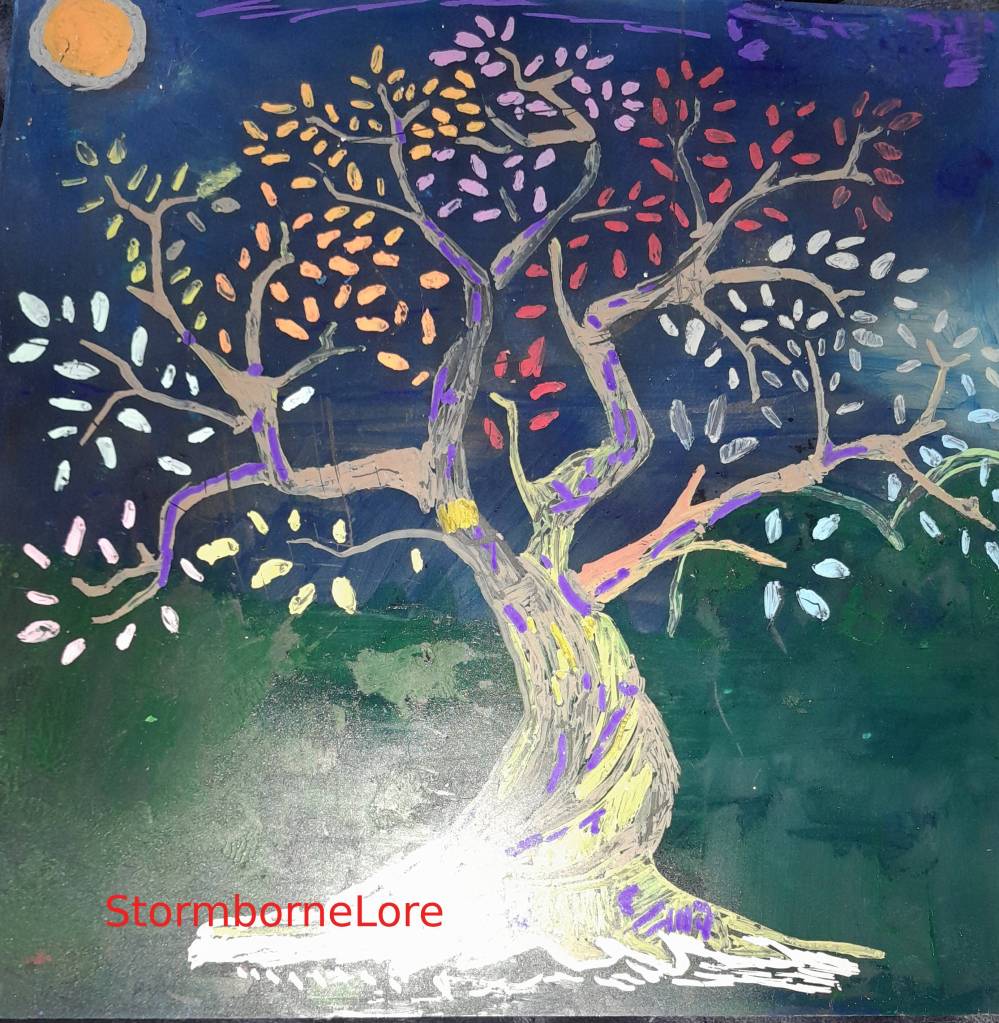
A vibrant, stylized tree under a dark sky, adorned with colorful leaves and a glowing moon, symbolizing the intertwining of nature and mysticism.
Taranis had wandered for three days since his exile. Taranis wore no furs now., just the old stag-hide wrap and the necklace his mother had pressed into his palm with shaking fingers.
He ate roots and river water,. Asheand slept like a fox with one ear open and his back to a tree.
That night, a full moon watched the world from behind broken cloud. The forest lit with silver veins. Taranis crouched low near a hollow oak, flint blade across his lap. He had not lit a fire. Fire betrayed you. Fire drew eyes.
But still eyes found him.
Two pairs.
One black, one white.
Both wolves. Both silent. Both watching from the mist beyond the briar.
He didn’t move. He didn’t breathe.
The white one larger, its coat matted with burrs stepped ahead. A long scar dragged across its eye, but the eye still burned red. Not the red of rage, but of knowing. Of memory.
The smaller wolf circled left. Her coat was black as smoke and moved like shadow even under moonlight.
Still, Taranis did not move. This was not a hunt. Not a threat. This was a test.
When the white wolf sat, the black one joined him.
They stared.
And then they spoke.
Not aloud not in the way people do but in the marrow of his bones. In the beat of his pulse. In the dreams he hadn’t yet had.
“You carry the storm. Not all storms destroy.”
He blinked. He gripped the flint tighter.
“We are not what we seem. Nor are you.”
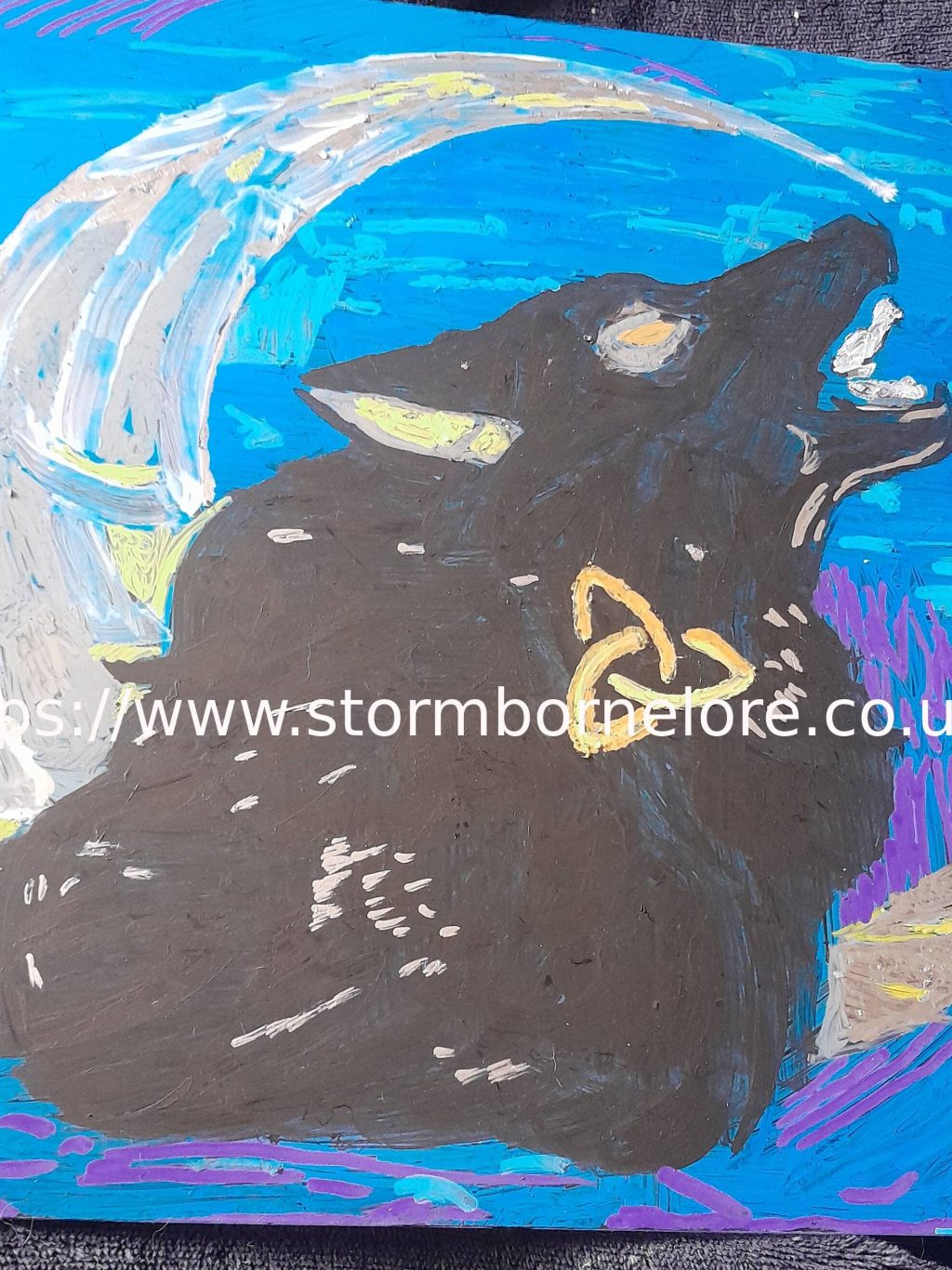
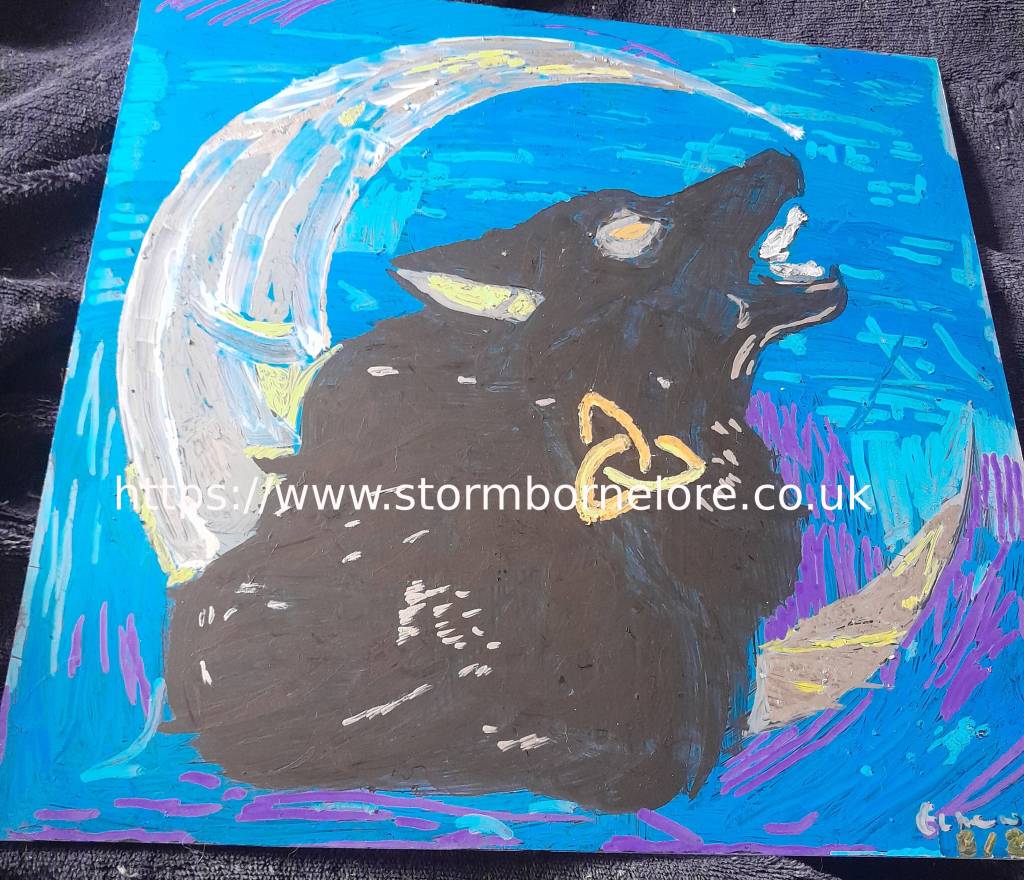
A striking depiction of a black wolf howling at the moon, surrounded by vibrant blues and purples, evoking a sense of mystery and wilderness.
Then, the black wolf Boldolph moved first. He stepped to the base of the hollow tree and pawed at the ground. When he pulled back, there was something in the soil. A ring of old stones. A feather. A scrap of iron, ancient before iron had names.
The white wolf Morrigan touched it with her snout.
And in a moment that split the world like thunder, they changed.
Two wolves became two people. Not naked, not fully human, but forms caught between part smoke, part bone, part memory. She bore a crow’s wing in her braid. He had a jaw shaped not by age, but by sorrow.
Taranis did not flinch. The storm inside him had seen worse. Had survived worse.
Morrigan reached ahead and laid the feather at his feet.
“Blood forgets. But stone remembers. You are carved already.”
Boldolph raised his hand, three fingers missing. Still, he gestured not in threat, but in oath.
“This forest sees you. You are not alone.”
And just like that, they were wolves again.
Gone into the mist.
Only the feather remained.
And the storm inside Taranis? It no longer howled alone.








 StormborneLore