The clang of steel echoed across the Roman training yard. The sun was still low, its pale light glinting off helmets and polished shields. Taranis moved like shadow and storm, his chains rattling as he fought against three centurions in succession.
Every strike he gave was measured, precise but every parry cost him pain. The iron bindings cut into his wrists, leaving a thin red line that deepened with each movement. He refused to yield.
Caelum stood at the edge of the sand pit. His tunic far too fine for this place a youth of maybe sixteen, bright-eyed and restless. His gaze never left Taranis.
“uncle Marcos,” he said quietly, turning to the older man beside him. “Can those chains come off him?”
Marcos didn’t answer at once. His face was lined from years in service, his eyes as sharp as the swords he trained with. “Chains are the only reason he’s still alive, Caelum,” he said finally. “Without them, some fool would call it fear instead of discipline.”
“But he’s fighting for us now.” Caelum’s voice carried, defiant. “For Rome, at least.”
In the pit, Taranis struck low, sweeping a soldier’s legs out from under him. Before turning the momentum into a twist that sent the next centurion stumbling backward.
The last one hesitated, shield raised, watching the way. Taranis breathed steady, like a man waiting for the storm to break.
The chain coiled once, twice then snapped out, wrapping the shield edge and dragging it down. The sound of the soldier hitting the ground was followed by silence.
Caelum took a step ahead. “He’s more Roman than half your men.”
Marcos shot him a warning look. “Careful, boy. You sound like your mother.”
The youth smirked faintly. “She says the same.”
When the training was done, the soldiers dispersed, muttering under their breath half respect, half fear. Taranis knelt in the dust, hands bound before him. Marcos approached, tossing him a canteen.
“You could have killed them,” Marcos said.
Taranis drank, the water streaking through the dust on his face. “You didn’t tell me to.”
Marcos grunted, half a laugh, half frustration. “One day, that mouth of yours will get you killed.”
“Maybe,” Taranis replied. “But not today.”
Caelum stepped closer, watching the bruised wrists, the marks the chains left behind. “You’re not like the others. You don’t fight for their gods.”
Taranis looked at him not unkindly. “No. Mine are older. And they don’t care who wears the crown.”
The boy tilted his head. “If I asked you to fight for me instead of Rome?”
Marcos snapped, “Enough!” But Taranis only smiled slow, deliberate, dangerous.
“Then, little wolf,” he said softly, “you’d better be ready to pay the price.”
Above them, thunder rolled faintly in the distance, though the sky was still clear.
“Taranis is our baby brother, no matter what some think,” Drax growled, his voice low and edged with iron. His gaze locked on Rain across the firelight, sharp enough to cut stone. “You betrayed him when he was a child and you betray him now.”
Rain’s jaw tightened, but he did not speak. The silence stretched between them, thick with memory and regret.
The old priest, Maeron, lifted his hand gently. “He forgives you, Rain,” he said, his tone weary yet steady. “He wanted Drax, Draven, and Lore to know he will endure what they give him. So that you three will survive. He says to make choices that will keep you all safe and your people.”
Drax’s expression did not soften, though his eyes flickered with something that have been pain. “He forgives far too easily.”
Maeron inclined his head. “Forgiveness is not weakness, my lord. It is the weapon of those who can’t be broken. The Romans won’t rule forever. Prepare for what comes next.”
At the edge of the fire, Caelum shifted uneasily, his young face caught between fear and pride. “But what about my uncle’s meals?” he asked suddenly. “Uncle was exiled from the Circle years before they caught him. I was a baby then. Now I’m fourteen he shouldn’t be forgotten again.”
The words silenced the hall. Even Rain, for all his bitterness, not meet the boy’s gaze.
Drax rose slowly, the firelight glinting off his scars. “He will not be forgotten,” he said at last. “Not while the storm still bears our name.”
“But won’t they strip him of his name?” Caelum pressed, voice trembling now. “If Rome erases it, how will anyone know he lived?”
Drax looked down at his son the fire’s glow. Reflected in the boy’s wide eyes and placed a steady hand on his shoulder.
“Names can be taken,” he said quietly. “But legacies can’t. The Romans think power is carved in stone. Ours is carved in memory.”
He turned back to Maeron. “Tell him that. Tell him Emberhelm remembers.”
The priest nodded, rising to leave. But before he turned, his gaze swept the circle of men gathered in the hall. “When the storm returns,” he said softly, “I hope you are ready to stand beneath it.”
When Maeron’s footsteps faded into the night, the hall remained silent. The storm outside broke, rain hammering against the shutters like the echo of distant drums.
Drax stood by the window long after the others had gone. He could not see the fort from here, but he could feel it the iron cage that held his brother. The empire pressing closer each season. Yet as lightning flashed over the valley, he smiled grimly.
Because storms, no matter how long they’re caged, always find their way home.
The road to Viroconium was slick with rain. Drax rode beneath a low sky, his cloak heavy with water, the wind biting at his face. Beside him, Maeron’s hood was drawn deep, the priest’s silence carrying the weight of things better left unspoken.
When they reached the outskirts of the Roman fort, the air stank of smoke and iron. The rhythmic clash of hammers and the cries of soldiers echoed through the mist. But above it all, there was another sound low, strained, human.
Drax reined his horse sharply, his eyes narrowing.
At the edge of the square, raised above the mud and the murmuring crowd. Hung a man bound to a crude wooden cross. Blood streaked his arms, his body marked by lashes and bruises. His hair clung to his face in the rain. But the set of his jaw the defiant lift of his head was unmistakable.
Taranis.
Drax’s heart clenched as the legionnaire stepped forward, spear in hand. “He struck a guard and tried to run,” the man said stiffly. “By Roman law, the punishment is public display.”
“Law,” Drax echoed, his voice quiet, almost a whisper but Maeron flinched at the tone. “You call this law?”
The soldier hesitated, but before he could respond, Maeron laid a hand on Drax’s arm. “Careful,” he murmured. “The walls have ears.”
Drax dismounted, boots sinking into the mud. He walked forward until he stood before the cross, rain washing the grime from his face. Taranis raised his head slowly, eyes bloodshot but burning with that same inner fire that no empire could snuff out.
“Brother,” Drax whispered.
Taranis gave a faint, broken smile. “You shouldn’t have come.”
“And leave you to the crows?” Drax’s voice cracked like thunder. “Never.”
Maeron stepped forward, murmuring Latin prayers under his breath for the watching soldiers. Though his words were laced with druidic meaning ancient phrases meant to shield, not to save. His fingers brushed the iron nails that bound Taranis’s wrists. “These are not deep,” he said quietly. “They did not mean to kill him. Only to shame.”
Taranis’s laugh was hoarse. “They can’t shame what they don’t understand.”
The centurion appeared, cloak heavy with rain. “This man belongs to Rome,” he declared. “You will step back, Lord of Emberhelm.”
Drax turned slowly, the weight of centuries in his gaze. “And yet Rome forgets whose land it stands upon.”
The centurion stiffened. “Do you threaten?”
“No.” Drax’s tone softened to a dangerous calm. “I remind.”
The priest raised his hands quickly. “My lord only seeks mercy,” Maeron said. “Let him pray with his brother before the gods.”
After a pause, the centurion gestured sharply. “You have one hour.”
When the soldiers withdrew to the gatehouse, Drax knelt beside the cross. The rain had turned to sleet, stinging against his skin. “Hold on,” he murmured. “We’ll get you down when the watch changes.”
Taranis shook his head weakly. “No. Not yet. If you cut me down, they’ll know you came. They’ll burn Emberhelm.”
“Then let them come,” Drax growled.
But Taranis only smiled faintly. “Storms must wait for the right sky, brother.”
Maeron placed a hand on Drax’s shoulder. “He’s right. Endurance, not rage. That is his rebellion.”
Drax bowed his head, jaw clenched. He hated the wisdom in those words. He hated that Taranis could still smile through chains and nails.
As dusk fell, lightning cracked beyond the hills, white and wild. The storm gathered again over Viroconium.
And though Rome saw only a prisoner’s suffering. Those who remembered the old ways knew the truth: A storm had been crucified and still, it did not die.
The dawn was cold, a thin veil of mist curling over the ramparts of the Roman fort. Taranis awoke to the metallic tang of iron and the distant clang of the blacksmith’s hammer.
His chains clinked softly as he shifted. The cold biting into bruised wrists, but the fire in his chest remained unbroken. He had learned to sleep with storms in his mind; the thunder never ceased, even when the sky cleared.
The sentries passed with measured steps, their eyes avoiding his. Even in chains, Taranis carried the weight of warning: a storm was bound, not broken.
Marcos stirred beside him, shoulders tense with age and pain. “They move you today,” he muttered, voice low. “Legionaries say they march prisoners to the amphitheatre. Another show… or training for others. Rome’s curiosity is insatiable.”
Taranis flexed his wrists against the iron, listening to the rhythm of the camp. The clatter of swords, the measured steps of patrols. The faint murmur of Latin all part of the pulse of this cage. He did not fear. He calculated.
The centurion arrived just as the morning sun began to pierce the mist. A figure of red and bronze framed against the wooden palisade.
“Stormborne,” he said, voice sharp, “prepare to march. Rome watches, and your survival is… optional.”
Taranis rose slowly, chains rattling in protest.
“Optional,” he echoed, smirk tugging at his lips, “like the wind choosing which trees to break.”
The march was silent, the prisoners lined in pairs, shields clinking and armor scraping. Taranis felt the eyes of the Romans on him, not all hostile.
The Curiosity and caution blended in the same gaze. Word had spread of his defiance surviving crucifixion. But unyielding under whip and sword and whispers of the “Storm of Emberhelm” made even hardened legionaries pause.
They crossed the outer hills and entered the amphitheatre grounds. Dust rose from the packed earth, carrying the scent of sweat, straw, and fear. The arena awaited not yet for combat, but for demonstration, for Rome’s fascination with endurance.
Taranis’ chains were secured to a central post. Around him, other prisoners fidgeted and whispered. He noticed the boy from the march days ago. A little child of six years old hiding behind a stack of crates, pale fingers gripping a fragment of bread. Their eyes met, and Taranis gave a faint nod not reassurance, not command, just acknowledgment.
A guard stepped forward, coiling a whip in his hand. “Today, we measure the storm,” he said in Latin, the words sharp as steel. “Let us see if the barbarian bends to Rome.”
Taranis let the chains pull taut, shoulders braced. “Storms bend only to themselves,” he whispered, almost to the wind.
The first demonstration began. Spears and short swords were thrust toward him, each movement designed to test, to gauge. Taranis shifted with the grace of the hunted and the hunter intertwined. As he continues deflecting, twisting, and using the very pull of the chains to redirect momentum.
Every strike met resistance, every thrust was countered. The audience of soldiers murmured in disbelief.
Marcos watched from the side, leaning heavily on his staff. “Still untamed,” he muttered. “Still Emberhelm.”
The sun climbed, and with it, Taranis’ endurance was tested further. Roman instructors pressed harder, pushing his limits, yet he remained unmoved, his grey eyes sharp as lightning.
When at last the centurion called an end, sweat streaming and blood staining the mud, Taranis did not collapse.
He simply lowered his gaze, catching a brief glimpse of the distant hills beyond the fort. Freedom waited there, somewhere beyond chains and Roman order.
As the prisoners were herded back to their quarters, Taranis’ mind raced. Rome could cage him, whip him, measure his endurance, but it could not touch the storm in his heart. The pulse of Emberhelm beat in every step, every breath, every thought of revenge, strategy, and survival.
That night, as firelight danced across the walls of the fort and the whistle of wind through battlements echoed like distant thunder, Taranis sat, chained but unbroken, and whispered to himself:
“Let Rome watch. Let them wait. Storms do not obey. Storms endure. And storms return.”
Night in the Roman fort was never truly silent. Even beneath the canopy of stars, there was always the creak of timber. The shuffle of soldiers on watch, the hiss of oil lamps dying in the cold wind. Yet somewhere beyond that human rhythm, another sound pulsed faint, rhythmic, like the heartbeat of the land itself.
Taranis listened.
He had learned to hear through walls of stone and iron. The whispers of chains, the breath of the wind through narrow slits.All were messages if one knew how to listen.
Marcos stirred nearby, groaning as he rolled against the rough bedding. “You hear it again,” he murmured, voice barely a rasp. “The storm that waits?”
Taranis’ eyes were half-shut, the dim firelight carving hollows beneath his cheekbones. “The storm doesn’t wait,” he said softly. “It watches.”
He turned the small iron shackle at his wrist, feeling for the weak link not yet ready, but close. Every night he tested it. Every day, he marked the rhythm of the guards, the rotation of their watch. Patience, he reminded himself. Storms struck only when the wind was right.
Beyond the barracks, the faint roar of the sea carried inland. Somewhere past those black waters lay the route to Gaul and beyond that, Rome. The thought of being caged beneath marble arches made his blood run colder than the chains.
The door creaked open. A shadow slipped inside small, quick, hesitant. The boy from the arena. He carried a satchel and a half-broken torch.
“They’ll see you,” Marcos hissed.
The boy shook his head. “The north wall guard sleeps. He drinks too much. I brought you this.” From the satchel, he pulled a narrow blade no longer than a hand, its edge dulled but serviceable.
Taranis took it without a word, his fingers brushing the boy’s for a heartbeat. “Why?” he asked.
The boy’s voice trembled. “Because you didn’t kill me when they told you to. Because the others they say you were a king once.”
Taranis looked up then, eyes grey as frost. “A king?” He almost smiled. “No. A storm given form. And Rome can chain storms, but it can not make them serve.”
The boy swallowed, uncertain whether to fear or believe him. “Then what will you do?”
Taranis turned the blade in his hand, the firelight glinting off the iron. “Wait,” he said. “And remember.”
He hid the weapon within the straw bedding, marking its place with a small twist of rope. Then he looked toward the sliver of moonlight cutting across the dirt floor. A thought of home of the high ridges above Emberhelm, of his brothers’ faces fading in memory. Rayne’s eyes full of guilt. Drax’s silence. Draven’s quiet grief.
He did not hate them. Not yet. But the distance between them had become as sharp as any blade.
When dawn came, the fort stirred again the horns of the morning watch echoing across the fields. The centurion approached, flanked by two guards.
“Stormborne,” he said, voice cold. “The governor himself has taken interest. You are to be moved south to Londinium within a fortnight.”
Taranis met his gaze. “To be paraded, then? Or displayed?”
Taranis’ jaw tightened, but his eyes betrayed nothing. Inside, the storm turned once more.
He whispered beneath his breath, too low for the Romans to hear:
As the guards led him from the barracks. He caught a glimpse of the horizon low clouds gathering over the hills, rolling in from the west. It was almost poetic.
“Emberhelm still breathes.”
That night, the chains whispered again not with fear, but with promise. The weak link shuddered beneath his fingers. And when the next storm broke over Viroconium, it would not be made of rain.
Dawn broke over the Roman camp like a blade drawn through fog. Grey light pooled across churned mud and sharpened stakes, catching on helmets and spearheads lined in perfect order.
The night’s rain had thinned to mist, and every droplet clinging to the leather tents shimmered like glass. The smell of smoke, sweat, and iron hung heavy in the air the scent of empire.
Taranis stirred. His back ached where the whip had bitten, skin raw beneath crusted blood. Yet the fire inside him burned brighter than pain the storm had not passed. It gathered.
Across from him, Marcos watched with his one good eye. The old fighter’s face a map of old wars and fading loyalties. “Rome wants to see storms broken,” he murmured, voice gravel-deep. “They’ll test you again today. But storms… storms don’t break. They shift. They wait.”
Taranis tilted his head, a faint smirk cutting through exhaustion. “And if they try?”
Marcos shrugged, rough amusement in his tone. “Then you show them the wind can cut as deep as the sword.”
Trumpets blared as the camp came alive in a heartbeat. Orders barked in Latin, armor clattered, horses stamped restlessly against their ropes. Two guards approached, eyes cold, hands twitching near the whips at their belts.
“On your feet,” one barked.
Taranis rose slowly. Chains clinked. His shoulders squared, each movement deliberate. The iron at his wrists and ankles was heavy a reminder that for now, he belonged to Rome.
Yet even bound, he carried the air of something untamed. The guards kept their distance, as though the storm in his eyes strike.
They led him toward a cleared space at the edge of the camp. A makeshift ring had been marked out with stakes and rope a place for training, punishment, or testing.
The centurion stood nearby, expression carved from granite. The boy from last night watched from behind a cart, pale fingers gripping the wood. He didn’t dare speak.
The centurion’s voice carried over the murmurs. “The barbarian survived crucifixion,” he said in clipped Latin. “He has killed Roman soldiers with sword, axe, and bow. Let us see if his storm can be harnessed or if it dies in the mud.”
Taranis met his gaze.
“Let him watch,” he murmured in Brythonic the tone sharp, almost ceremonial. The centurion frowned, not understanding, but the words left a chill in the air.
A guard offered him a practice axe, a short sword, and a small round shield. The weapons were worn, dulled, mockeries of what he once wielded but they would do.
He ran a thumb along the axe’s handle, testing the balance. The first bout began.
Two legionaries stepped into the ring, boots sinking into wet earth. They grinned, confident, soldiers against a chained barbarian. Taranis didn’t move until they struck.
The first swing came from the right clean, practiced.
He stepped aside, caught the motion with the rim of his shield, and turned it aside. The counter came low and fast a backhand with the axe that cracked into the soldier’s guard, splintering the wood. Mud sprayed. Gasps followed.
The second soldier lunged from behind. But Taranis ducked, dragging his chain taut to trip him, then drove an elbow into his ribs.
He rose without looking back. Breathing steady. Eyes cold.
He didn’t grin. He didn’t boast. He simply waited.
The crowd quieted. Even the centurion lowered his stylus for a moment.
“Again,” he said.
Another pair entered. Then another. By the third round, Taranis’s arms burned and his wrists bled where the chains bit into skin. Yet his movements only grew sharper measured, adaptive, each strike like thunder rolling closer.
Marcos leaned toward a watching soldier. “That’s no wild man,” he muttered. “That’s a storm that learned to fight back.”
By midday, silence had fallen across the ring. The spectators no longer laughed. They watched uneasy, enthralled, afraid.
The centurion finally raised a hand. “Enough,” he ordered. “Feed him. Let him rest. He will fight again tomorrow with steel.”
Taranis tilted his head, the faintest smirk touching his mouth. “Feed the storm,” he murmured, “and see what it grows into.”
The boy crept closer, slipping a crust of bread from his tunic and setting it by his side.
Taranis nodded once not gratitude, but recognition. A gesture between survivors.
As they led him away, one of the younger guards spoke quietly, incapable of concealing his curiosity. “They say you fought crucifixion itself and lived. What man survives that?”
Taranis turned his head slightly. The grey in his eyes caught the light. “Not a man,” he said. “A storm that forgot to die.”
Marcos barked a laugh, shaking his head. “Gods help Rome,” he said. “They’ve chained lightning and think it’ll sit still.”
When they finally removed his restraints for cleaning, Taranis flexed his wrists, skin bruised and torn. He studied the marks, then smirked.
“At least they removed the restraints,” he said quietly. “I grew up fighting in them.”
The centurion said nothing. The sky grumbled overhead thunder rolling distant but deliberate.
Then, softly, as if remembering something half-buried in blood and rain, Taranis spoke again.
“They put me up,” he said, eyes fixed north. “Nailed me in on the hill at Salinae”
Marcos frowned. “And yet here you are.”
Taranis flexed his fingers, old scars catching the light. “I ripped myself off,” he said simply.
Silence cracked through the camp. Guards shifted. Somewhere, a dog began to howl.
“Rome thinks it crucified me,” he murmured. “But the dead don’t stay nailed not when the gods still have use for them.”
Thunder answered. Closer this time.
Rome had not yet learned that storms do not serve. They return.
The rain had followed them south. Turning the clay of Staffordshire into a sucking mire that clung to boots and hooves alike.
The Romans marched as though it were paved stone beneath them, shields squared, helmets gleaming dull beneath the Grey sky. Between their ranks, chained at wrists and neck, walked Taranis Storm.
Every step tore at his ankles where the iron bit into flesh. Every breath was smoke and ash and memory. Behind him lay the broken circle of stones, the Black Shields scattered or slain. Ahead, only Rome.
The villagers came out to see. From hedges and low doors they watched the prisoner dragged past their fields, whispers coming like crows. The Stormborne, Ring-bearer. Betrayed. Some spat into the mud, others lowered their eyes.
A few, bold enough to remember, lifted hands in the old sign of the ring. when the soldiers were not looking.
At the front of the column the standard rose a square of blue cloth. That had been painted with a face in iron helm, cheeks daubed red with victory.
The mask grinned as though in mockery. The Romans called it their mark of order. To Taranis it was something else: the face of the empire that had swallowed his people.
He fixed his gaze on it as they dragged him past the rise where the heath opened wide. He thought of Boldolph and Nessa, of the wolf in the trees. He remembered the cairn and the promise beneath the oak. The chain jerked and he stumbled, but he did not fall. Not yet.
The centurion rode beside him, face shadowed beneath his crest.
“You see the banner, barbarian? Rome wears a smile even when it breaks you.”
Taranis lifted his head, eyes dark as storm clouds. “Smiles fade. Storms do not.”
The soldiers laughed, but unease rippled through their ranks all the same. For the wind carried his words across the heath, and even bound in chains, Taranis Storm did not sound broken.
By dusk the column reached the ridge where the woods thinned and the land opened to heath. Smoke already rose ahead straight, disciplined pillars from square fires. The marching camp of Rome.
The soldiers moved with the same precision as their shields: digging trenches, raising palisades, planting stakes.
Every camp was a fortress, stamped into the soil like a brand. The ground of Cheslyn Hay, once quiet pasture, now bristled with iron.
Taranis was dragged through the gate cut into the new rampart. The ditch still stank of wet clay, the sharpened stakes gleamed with fresh sap.
Inside, order reigned the tents in perfect rows, fires burning with measured rations, horses tethered and groomed. No laughter. No chaos. Just Rome.
The banner with the painted helm was planted at the camp’s centre. Beneath it the centurion dismounted, barking orders in clipped Latin. Slaves scurried to fetch water and oil for the men.
A scribe scratched notes into a wax tablet, not once looking up at the prisoner he recorded.
Taranis stood, wrists bound, staring at the banner. Its painted grin leered back at him, mockery frozen in blue and black.
Around him the soldiers muttered in their tongue some calling him beast, others trophy.
A soldier shoved him down beside the fire trench, close enough to feel its heat on his raw wrists.
“Sit, storm-man. Tomorrow the legate will decide whether you march to Wroxeter or Luguvalium. Either way, Rome will bleed you for sport.”
The word spread through the camp: arena.
Taranis lowered his head, though not in submission. He closed his eyes and listened. Beyond the walls of the camp, the wind still carried the smell of rain-soaked earth.
The whisper of fox and owl. And beneath that, deeper still, a memory: wolves circling, dragons wheeling, the voice of the tree.
Rest, child of storm. The road is not ended.
When he opened his eyes again, the firelight caught the glint of iron. Not on the chains, but in his gaze.
Even in Rome’s order, storm can find a crack. And cracks spread.
The fire burned low, and the camp settled into its rhythm. As guards pacing in pairs, dice rattling in the barracks-tents, the low cough of horses in their lines. The rain had eased, leaving the air damp, heavy with smoke.
Taranis sat in silence until he felt movement beside him. A figure shuffled forward, ankles hobbled, wrists bound with rope rather than iron. The man lowered himself onto the earth with a grunt.
“Storm of Emberhelm,” he rasped in Brythonic, his accent from the northern hills. “I thought the tales were lies. Yet here you sit, same chains as me.”
Taranis turned his head. The prisoner was older, his beard streaked white, his face cut with old scars. One eye clouded, blind. The other burned sharp as flint.
“And who are you,” Taranis asked, “that Rome keeps alive?”
The man chuckled, though it ended in a wheeze. “They call me Marcos now. Once, I was Maccus of the Ordovices. I led men against the Eagles before your birth.
Rome does not waste good meat. They break us, bind us, and sell us to the sands. I’ve fought in two arenas. Survived them both.”
Taranis studied him. The weight of years hung from his shoulders, yet there was steel still. “Then you know what waits.”
“Aye.” Marcos lifted his bound hands, showing knotted scars across his forearms. “The crowd roars for blood. Some fight once and die. Some fight a hundred times and die slower. But all die.”
The fire popped. Sparks leapt into the dark.
Taranis leaned closer, his voice low. “Not all. The storm endures.”
Marcos’s eye narrowed. “You think to outlast Rome?”
“No.” Taranis’s mouth twisted into something not quite a smile. “I think to break it.”
For the first time, the older man was silent. He searched Taranis’s face, weighing his words. Then he gave a slow nod.
“If you mean what you say, Storm of Emberhelm, then I’ll stand at your side when the time comes. Better to die tearing the eagle’s wings than caged beneath them.”
Chains clinked as they shifted nearer the fire. Around them the camp slept, unaware that in its shadow two sparks had met. Sparks that yet become flame.
The guards had thrown scraps of barley bread to the captives, little more than crusts softened with rain. Most fell on them like dogs, clutching and hiding their share as if it were treasure.
But when the boy, thin as a willow switch, glanced to where Storm sat, his brow furrowed. The man beside him Marcos noticed at once.
“What’s wrong, lad?” the old warrior asked, shifting his chains.
The boy’s voice was a whisper. “Why haven’t they fed him?” His gaze fixed on Taranis, who had taken nothing. His hands still resting on his knees, his eyes far away. as if listening to some thunder only he hear.
Marcos gave a grunt. “Rome plays its games. They starve the strong first. Weak men die quick, but a beast like him…” He lowered his voice. “They want to see how long he lasts. How much fury stays in him when his belly is empty.”
The boy clutched his crust but then held it out with trembling fingers. “He should eat.”
Taranis turned his head at last. His eyes, Grey as storm clouds, fell on the offering. He did not take it. Instead, he placed his bound hand gently over the boy’s.
“Keep it,” he said. His voice was rough, hollow from thirst, yet steady. “Storms do not starve. But you” he pressed the bread back into the boy’s palm, “you must grow.”
For a moment, silence hung around them. The boy swallowed hard, then nodded, biting into the bread with tears in his eyes.
Marcos watched, the ghost of a smile tugging at his scarred face. “A storm, indeed,” he muttered.
Above the camp, thunder rumbled faintly though the sky was clear.
“I’m fine ” Taranis smirked seeing a whip in someone’s hand and wood
“What’s going on?” The boy asked
The guard with the whip dragged a stake of green wood across the mud, planting it near the fire trench. Two soldiers followed, uncoiling rope and hammering pegs into the ground.
The boy’s eyes widened. “What’s going on?” he whispered, clutching what remained of his bread.
Marcos’s face hardened. “Discipline.” His single eye slid to Taranis. “Or rather a spectacle.”
One of the soldiers smirked. “The barbarian thinks himself storm. Tonight, he learns Rome is thunder.”
They hauled Storm to his feet. Chains clattered, mud spattered across his bare shins. The whip cracked once in the air, sharp as lightning.
The boy tried to rise, but Marcos gripped his arm and pulled him back down. “Don’t,” he hissed. “They’ll flay you too. Watch, and remember.”
Taranis did not resist when they bound him to the post. His wrists were raw, but he set his shoulders square. lifting his chin to meet the eyes of the gathered legionaries. The smirk never left his mouth.
The centurion stepped ahead, whip coiled in his hand, iron studs gleaming wet in the firelight. He spoke in Latin, slow and deliberate, for the advantage of his men:
“This is Rome’s law. Defiance is answered with the lash.”
The first strike fell. Leather snapped against flesh. The soldiers cheered.
Storm did not cry out. His lips moved, barely more than breath: words in the old tongue, prayer or curse, the guards could not tell.
The boy’s knuckles went white around his crust of bread. Marcos leaned close, his voice low. “Look at him, lad. That is what Rome fears most. A man who will not break.”
The whip cracked again. Blood ran down his back.
And yet, when the centurion paused, Taranis raised his head and laughed. a rough, hoarse sound, but laughter all the same.
“You call this thunder?” he spat. “I’ve stood in storms that would drown your gods.”
The camp fell uneasy. The centurion snarled and drew back the whip again. But already some of the soldiers shifted, unsettled by the chained man’s defiance.
The guard sneered as he coiled the whip in his hand, the wood of the handle slick with rain. He pointed it at Taranis.
“On your feet, barbarian. Let’s see if your tongue is sharper than your back.”
Taranis smirked, rising slowly, the chains clinking as he straightened to his full height. The firelight threw shadows across his scarred face, making him seem larger than life.
“Screw you,” he said, the words spat like iron nails.
The boy gasped, his hands clutching the crust of bread. “What’s going on?” he whispered to Marcos.
The old warrior’s one good eye didn’t leave Taranis. “Rome’s testing him,” Marcos said quietly. “They want to see if he breaks before the whip… or after.”
The guard cracked the lash across the ground, sparks leaping from the wet earth. Soldiers nearby turned to watch, eager for the show.
But Taranis only tilted his head, the faintest grin tugging his lips. “Go on,” he said. “Try.”
And in the silence that followed, the storm seemed to shift, waiting.
Taranis straightened, chains rattling as he rolled his shoulders. His eyes met the guard’s without a flicker of fear.
“Screw you, ass,” he growled, voice steady. “I’ve dealt with worse.”
The words landed like a stone in still water. A few soldiers chuckled uneasily, but others muttered, shifting in place. The boy’s eyes went wide, his crust of bread forgotten in his hands.
Marcos gave a dry, wheezing laugh. “Storm’s got teeth. Rome should be careful putting its hand too close.”
The guard snarled and snapped the whip through the air once, twice before bringing it down toward Taranis’s back.
But Taranis didn’t flinch. He stood, broad shoulders braced, chains biting his wrists, and took the first strike in silence.
Ash fell like snow across the field, and the cries of dying men echoed over blood-stained earth. Taranis stood at the crest of the hill, his blade soaked, his breath ragged, eyes scanning the fray. His cloak snapped behind him, storm-charged and wild.
Then he saw her.
A blur of red hair and steel. She moved like fire unleashed cutting down two warriors with a rhythm so brutal it bordered on poetry. A deep scar crossed her cheek, fresh blood mingling with the old. Her spear spun once, twice, and buried itself in the chest of a man charging from behind.
She turned. Their eyes locked.
For a second, the war fell silent.
Taranis stepped forward. So did she.
They met in the no-man’s land between sides, blades raised not in anger, but instinct. Neither lowered their guard.
“You’re no foot soldier,” Taranis said, circling. “What are you?”
She didn’t smile, but her voice held a grin.
“I’m the reason you’re bleeding, warlord.”
He looked down. A shallow cut across his ribs. He hadn’t even felt it.
“I’d remember a woman like you,” he muttered, lowering his blade. “Name?”
“Nessa. And I don’t need saving.”
“I wasn’t offering,” he replied, “just watching the storm arrive.”
Her eyes narrowed. “You think this is a storm?” She stepped closer. “You’ve not seen anything yet.”
Then — the horn blew. Her side was retreating. She looked over her shoulder, then back at him.
“I should kill you,” she said.
“You should,” Taranis agreed, “but you won’t.”
She held his gaze another heartbeat… then turned and ran, vanishing into smoke and flame.
He stood alone, the sound of her name still echoing behind his ribs like thunder.
A Week Later Riverbank Clearing The village was in ruins blackened timbers, smoke curling from half-dead hearths. Survivors were few, and even they shrank from him as he passed. They whispered of a warrior woman who had held the bridge alone until the flames took her horse and half her shield arm.
Taranis followed the trail until it ended in a clearing by the river. And there she was.
Kneeling in the shallows, Nessa washed blood from her skin. Her armor was battered. Her shoulder bound with torn linen. But her spine was straight, and her hand never strayed far from the dagger at her hip.
“I should have known,” she said, not looking up. “Storms always return to the wreckage.”
Taranis didn’t smile. “You survived.”
“I always do.” She rose, eyes sharp. “Here to finish what we didn’t start?”
He stepped forward. “I came to offer a truce.”
She scoffed. “Why? Because I didn’t kill you the first time?”
“No,” he said. “Because I want to know why you fight like a warrior, but bleed like someone with nothing left to lose.”
Her jaw clenched. “You think you can read me, warlord? You think I’m one of your stories?”
“No,” Taranis said quietly, “but I know the look of someone trying to die just slowly enough to call it bravery.”
She drew her dagger, fast as lightning. Held it to his throat.
“Careful. You don’t know me.”
“I know enough,” he said, unmoving. “Your people are scattered. Your command is gone. And yet you stood alone at that bridge for strangers.”
“That’s more than you’ve done lately,” she snapped. “You walk the land like a ghost and leave nothing behind but ashes.”
His hand rose not to his weapon, but to gently press her dagger aside.
“I’m tired of ghosts,” he said.
They stood there, breath mingling, battle-scarred and burning. Neither of them moved. Neither of them lowered their guard.
But the space between them began to change.
“Besides I fight for those I deem worthy. That includes the people of Emberhelm.” Taranis smirked. “You’ve shown me you’re a friend of Emberhelm.”
He extended his hand.
“Who are you?” she asked.
“Taranis,” he said. “Who are you, my lady?”
“Nessa.”
The Night of Lammas.
That night, the people of Emberhelm feasted beneath the stars.
Lammas the first harvest was a time of bread and song, fire and gratitude. Children danced between torches, and the scent of roasted grain filled the cooling air. Drums echoed off the stones, old and deep, like the heartbeats of the land itself.
Taranis stood at the edge of it all, watching, half in shadow. Nessa leaned against a pillar beside him, arms folded, hair loose from its braid.
“I thought you’d be dancing,” he said.
“I don’t dance for tradition,” she replied. “Only for survival. Or joy.”
“Is this not joy?”
She looked around. The laughter. The flames. The peace however temporary. “Maybe.”
A silence fell between them, not awkward, just heavy with the unspoken.
“Come with me,” she said at last.
No orders. No questions. Just a truth spoken plainly. He followed.
They slipped from the celebration like ghosts, weaving through the orchard paths behind Emberhelm. The air was thick with ripening apples and the hum of distant music. When they reached the old stone lodge near the outer walls, she pushed the door open with one hand and led him in without a word.
There were no declarations. No romance wrapped in flowers or oaths. Only need.
Their bodies met like storm and flame fast, urgent, tangled with the memory of battle and the ache of survival. There was laughter when his armor refused to loosen, curses when her hair caught on his clasp, and a growl low in his throat when she bit his shoulder hard enough to mark.
Neither knew what the next day would bring. That was why it mattered.
That night, they made love like warriors with a fierceness born of loss and the tenderness of those who had bled for strangers.
Later, tangled in furs, the fire crackling low, she lay with her head against his chest.
“If I die tomorrow,” she murmured, “I’ll die warm.”
“You won’t,” he said, but his fingers curled tighter around her waist.
Outside, the stars burned cold and bright, and the first autumn wind began to stir.
He placed his hand gently on her belly.
“You and my son will live.”
Whispers in the Dark.
The next morning, the Ring summoned Taranis.
The gold circle at the council stones shone under a pale sky. Thirteen seats twelve filled. Lore was already speaking when Taranis entered, his voice low but urgent.
As he took his place, Nessa moved through the old halls of Emberhelm alone, her instincts sharp. Her step slowed when she passed the northern storeroom. Voices carried.
Rayne.
“We wait until the snows. When the passes are blocked, and he’s far from Emberhelm, we strike. The Ring will fall without him.”
Another voice, unsure. “He’s your brother.”
“Which is why I know his weakness.”
Nessa froze, the words burning into her mind.
Betrayal was coming.
And she was carrying the only thing that might save him.
The courtyard had long emptied. The ash of the fire pits still glowed faintly, casting soft light on stone walls and weary limbs.
Taranis sat alone, legs stretched, a jug of broth in one hand,. the other flexing and sore from the clash with Boldolph.
The crack of staffs still echoed in his bones.
Footsteps approached not boots, but clawed paws. Heavy, padded, unmistakable.
Boldolph.
Without a word, the old wolf-man knelt beside him, a strip of clean linen in hand. He took Taranis’s wrist and began to bind the bruises, slow and methodical, like a ritual done a hundred times.
“You didn’t hold back,” Taranis said after a moment.
“You didn’t ask me to.”
The silence between them was old, familiar. Like the stillness before a storm. Or the hush before a boy became a warlord.
“I needed them to see I bleed too,” Taranis muttered, wincing as the linen tightened. “That I fall. That I get back up.”
Boldolph grunted.
“They already know you bleed,” he said. “They just needed to see you still feel it.”
Taranis looked toward the sky. Smoke trailed like threads into the blackness. One dragon circled high above, a quiet sentinel.
“I keep thinking,” he said, “about when I was exiled. Alone in the wilds. All I had was that storm inside me and the promise that no one was coming.”
He looked down at the staff beside him.
“And now… now there’s you. Solaris. Lore. Drax. Rayne. Even Draven. I have everything I never thought I would. And I don’t know how to hold it without crushing it.”
Boldolph didn’t speak at first. Just poured a second jug of broth and handed it to him.
Then he said, low and hoarse: “Every beast that’s ever bared teeth knows fear. Not of pain. Of losing what it’s fought to protect.”
He paused, eyes distant.
“I was exiled once too. Long before you were born. I clawed through snow and silence, not knowing if I was cursed or chosen. I still don’t.”
Taranis turned to him.
“You stayed. Even cursed. Even as a wolf.”
Boldolph nodded.
“Because someone had to. And because I believed that one day, the one I guarded would understand the weight of the fire he carried.”
The flames crackled beside them. Taranis took a slow sip of broth.
“I understand it now.”
Boldolph gave a grunt soft, almost approving. Then he stood, stretched, and turned toward the shadows.
“You’re not alone anymore, High Warlord,” he said. “Stop trying to fight like you are.”
Then he was gone, back into the night, tail flicking behind him like a whisper of old magic.
Taranis sat a while longer.
Then he smiled.
Not like a warlord. Not like a weapon.
Like a man who had bled, fallen, and been lifted again by the hand of a wolf.
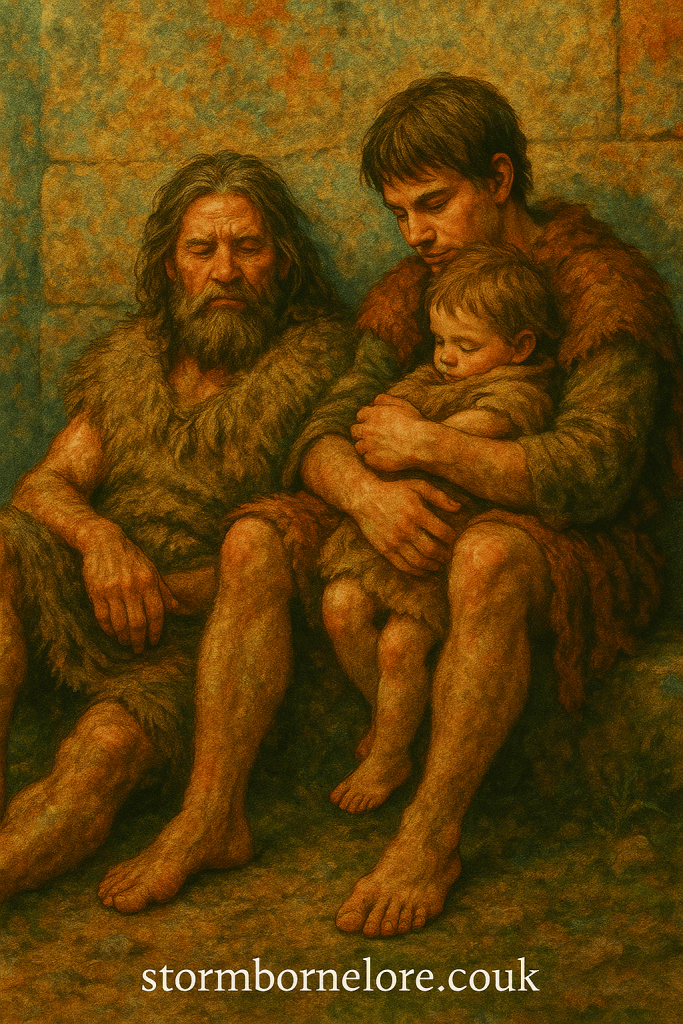
Taranis stood before Drax, his bare feet silent on the cold earth. A soft golden light shimmered around his small hand as he reached up and gently placed it on Drax’s forehead. His voice was quiet, yet steady words none had taught him falling like raindrops from his lips.
“The dragon and the wolves told me,” he said, eyes glowing faintly with an ancient knowing.
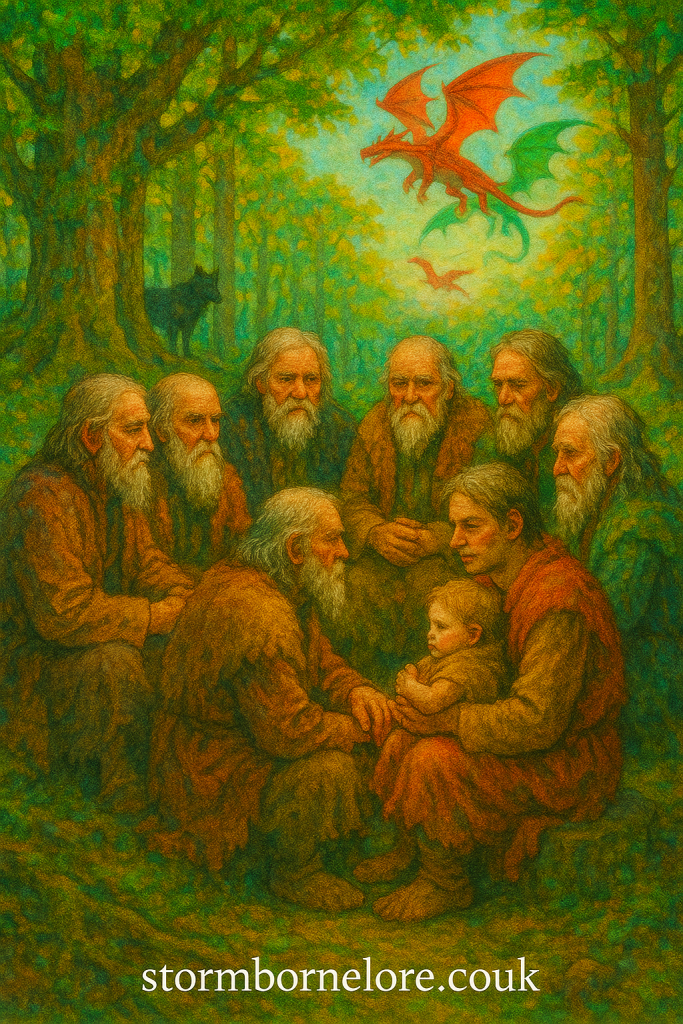
Lore stepped forward, startled. “The dragons? You mean a tribe, little one?”
But Taranis did not answer. Instead, Drax stirred, groaning as colour returned to his face. His eyes fluttered open lucid for the first time in moons and the golden glow around Taranis vanished. The boy collapsed into Lore’s arms, suddenly limp but breathing.
Lore caught him, heart pounding. He looked back at Drax, who now sat up slowly, blinking into the firelight.
“What were they doing to you, Drax?” Lore asked, still holding his youngest brother close.
Drax’s voice was hoarse, but calm. “Cleansing the darkness. They say I must walk the coals soon burn the madness away.”
Lore frowned, tightening his grip on the child. “Well… this little stormborn saved your life. Whatever you believe, that’s truth.”
Just then, Conan their father, the chief appeared in the doorway, drawn by the strange stillness and the fading light.
Taranis stirred, his head against Lore’s chest. “My fault, Father,” he murmured in a drowsy voice. “He was hurting… so I fixed it.”
Father stepped ahead slowly, kneeling before them. His eyes flicking from the barely conscious Drax to the sleeping child in Lore’s arms. His voice was heavy.
“He’s only one year old… and he’s healing the broken?”
Lore nodded. “He called it the gift of wolves and dragons.”
Conan exhaled, rubbing his weathered jaw. “Then we’d best prepare. Whatever storms are coming, they’ll start with him.”
“You calling the council father?” Drax asked “I will be punished he’s just a child “
“You have many matters to deal with Drax. little Taranis actions his disobedience to rules not to come here and what ever he did to you will be dealt with in due course a water cleansing, more gathering to keep him from wandering “
“How do you feel brother?’ Lore asked
“Clear minded, like what ever was heavy in me is gone. I feel love for the little one shame for wanting him dead. I’m not expecting you to trust me”
“Trust is earned, ” father said and looked to two men ran. “let him out but no contact with the others no binds this time. I see his food is low let him gather but watch.”
The men nodded no one other a selected group of tribal elders. Had been permitted to talk to my brother for months. Now the discipline was slowly lifting. The men moved their heads indicating for him to move out still not a word broke.
“Now ostracism starts he outside being watched and we can see him but he can’t interact with us?” Nyx asked
“Yes if he talks to us or the tribe he will receive harsher punishment. One of which was decided to remove his tongue As I’m not killing my own kin. He either follows the council and gets well or he will remain how he is until he dies” father said with a heavy heart “this is the first time I’ve seen him in months and your mothers not seeing him like that a once big strong man now skin and bones this isn’t just punishment for him but for us “
I never thought of it like that the cheif and his wife punished for their sons actions. A powerful man within our tribe powerless to protect his son against the elder councils decisions. After a while we carried the little one out and to home. The largest hut of them placing him on his bed.
That night a meeting was called the elders had demanded with my father. But little Tanaris was still sleeping crying in his sleep and burning up.
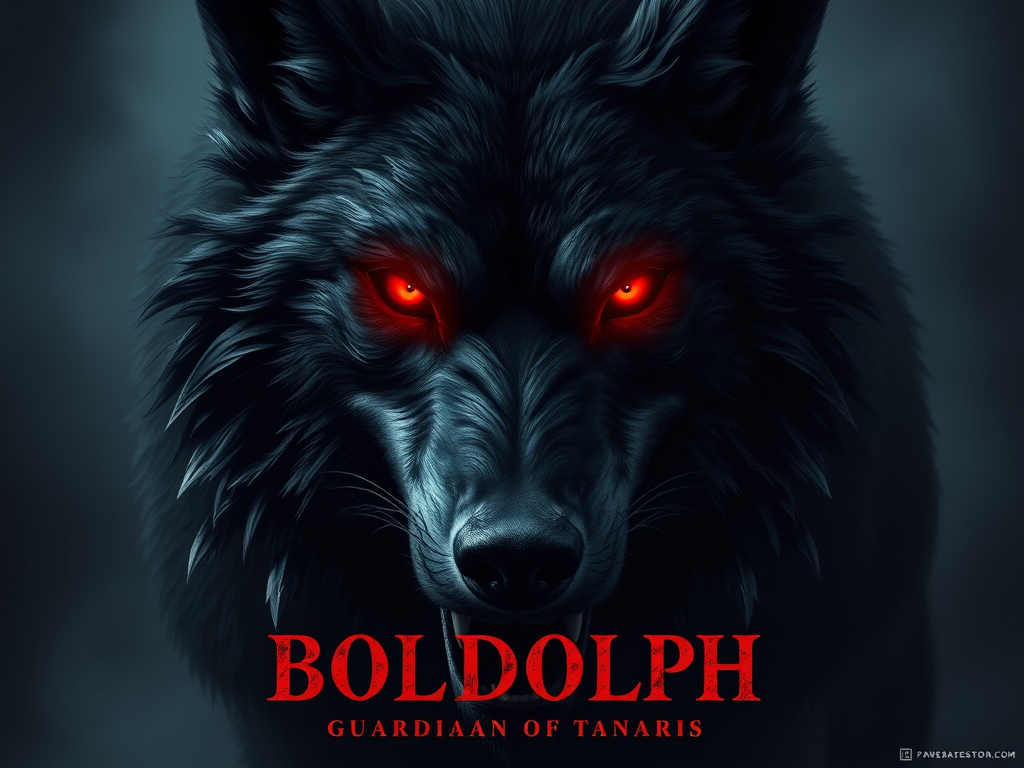
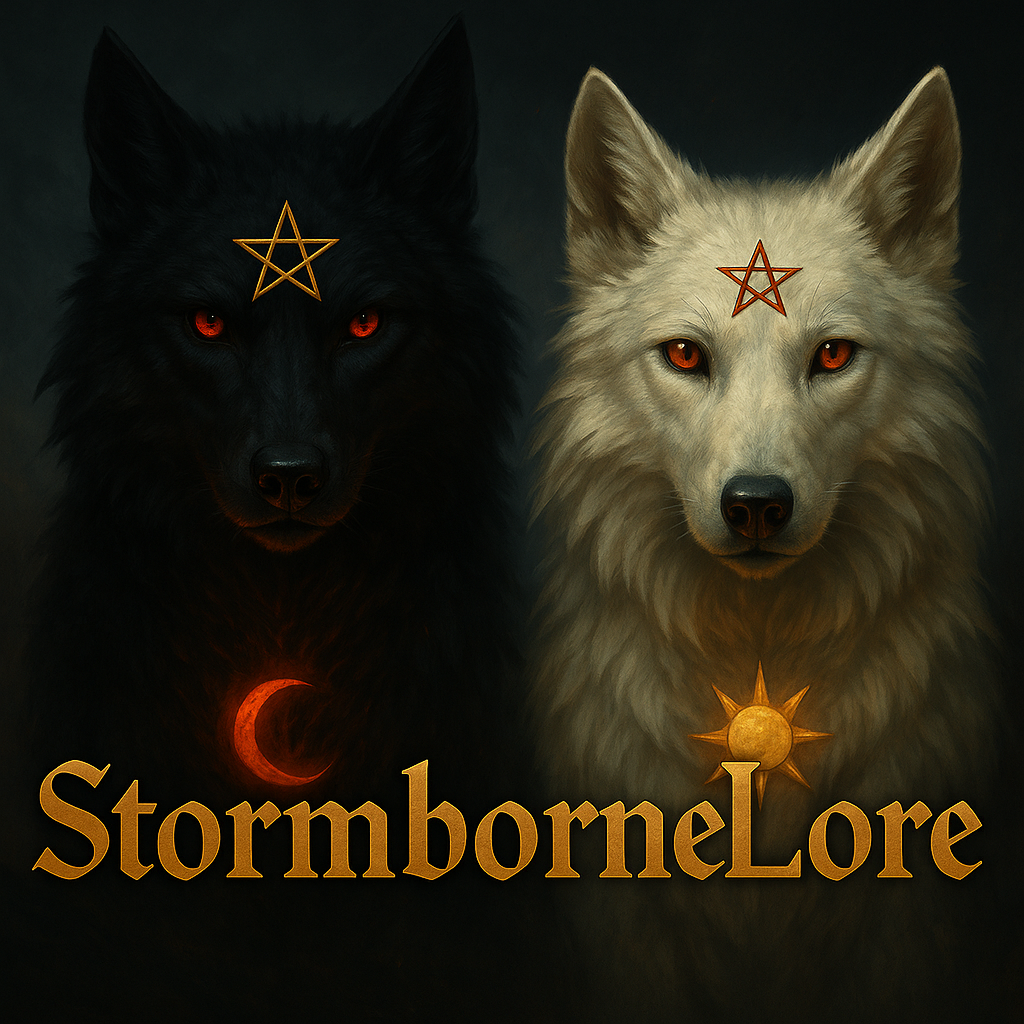
I walked to the edge of our camp “BOLDOLPH WHERE ARE YOU” Lore shouted seeing a giant of a wolf beautiful black like the nights sky with a gold five pointed star and red fiery moon on his chest and red fiery eyes
Boldolph strode over putting his head in mine nudging it
“You’re upset young one” Boldolph said his mind connection with mine
“I am my friend, your the tribes sacred ally. Your wiser than you know but did you tell my brother Taranis how to heal?” Lore asked the wolf
“I did ” a small grey wolf lowered his front half as if bowing to Boldolph. “I’m sorry sire, I heard the bright one crying and sought to help him. He missed Drax “
“He hardly knows Drax, father forbade any meeting between them unless Drax was bound and flanked by men. You had no right to interfere silver ” Lore replied
“He ran straight in to the condemned mans hut. Pure disobedience when I called him to stop. Drax could have killed him but my brother used the chant Drax said its like a heavy weight was lifted. Now Taranis is sick with fever .
“Your father?” Boldolph asked glancing angry ar the white wolf
“The tribal elders have called council I’m worried this weakens fathers position. If they lose trust in father, if they consider my baby brother ” Lores voice dropped as he looked to the earth
Boldolph launched at silver growling and teeth bared ready to rip the older wolf apart but a pure white wolf red five pointed star and gold sun on her chest
“STOP THIS ” she snapped at the other wolves parted
“Morrigan it’s an honor to see you again “Conan said kneeling to her level “Boldolph let’s wait for council if my family and I find ourselves displaced then kill silver by all means if it makes you happy”
The youngest of three lords, the only surviving heir before the word chieftain had even been carved into stone.
I was a protector, a trader,
a traveller to far shores… but above all, I was a husband and a father.
Morrigan.
She was everything. Three children had blessed our home and that was enough.
It was all her body can carry after the night she met the old crone in the woods.
The one whose words still haunt me. “The howl will return to your house, but not in the way you dream.”
I remember that day like thunder.
I had walked the long trail from the hunt., a wolf’s pelt across my shoulders, the carved head resting like a crown.
There was smoke above the village. And shouting.
An old woman beaten, clothes torn was being dragged toward my father’s cave.
“Wait!” I shouted.
I stepped ahead eighteen, tall, muscle-bound, burning with promise. They said I would one day unite the valleys.
“What’s the meaning of this?” I demanded.
A freckled, tattooed man stepped ahead, fury carved into every line of his face.
“This enchantress worked against us in the last battle,” he spat. “She betrayed us, Boldolph. We demand justice for our dead.”
My jaw clenched. I turned to her.
“You?” I growled. “You’re the reason my brothers now sleep the eternal sleep? The reason my mother weeps? The reason the blood of my people feeds the grass?”
She said nothing.
With a roar, I seized her hauled her high above the firepit, as if ready to cast her into flame.
But then “NO!”
A voice like wind cut through the rage.
Morrigan.
Only she reach me. Only she still the fire in my chest.
“This is not you, my love,” she said. “Let the chieftain decide. Please…”
And I listened. Because she was the one thing I would never fight.
I carried the woman into the cave.
The chieftain stood waiting. Red-haired, tattooed in victory and sorrow, wise beyond warriors.
“I have heard your crimes, Whitehair,” he said, voice like stone. “You drugged the warriors. You let the enemy pass through us like wind through grass. You gave our children to fire. You made the wombs of mothers empty.”
Still, the woman did not plead.
“Death is too easy,” he continued.
“You will be taken to the deepest part of the wood. Stripped of your name. Your hands will be marked so that the spirits do not recognise you. You will eat only what you can dig or steal. None shall speak your name, nor carve it. You will walk in silence until the earth swallows you. Or until the wolves forget your scent. So say the spirits. So says the tribe.”
And so she was cast out not as woman, not as witch. As nothing.
But my rage had not cooled.
“Father, banishment is too easy for one who knows these lands,” I said. “Bind her. Take her children. Take her tongue, and theirs,so none curse us again.”
And that’s when she finally spoke.
Her voice was dry like wind over bones. “I curse thee, Boldolph… son of Marnak. And thy wife Morrigan, daughter of Ayr. You shall be wolves until the day you meet a boy. a giant of seven feet, who befriends all animals and dragons. The house of your father will fall.”
The pain came instantly.
My darling wife and I we transformed, howling and breaking, before the entire tribe.
Thousands of years have passed since that day. Many cubs later, we have never seen each other in human form.
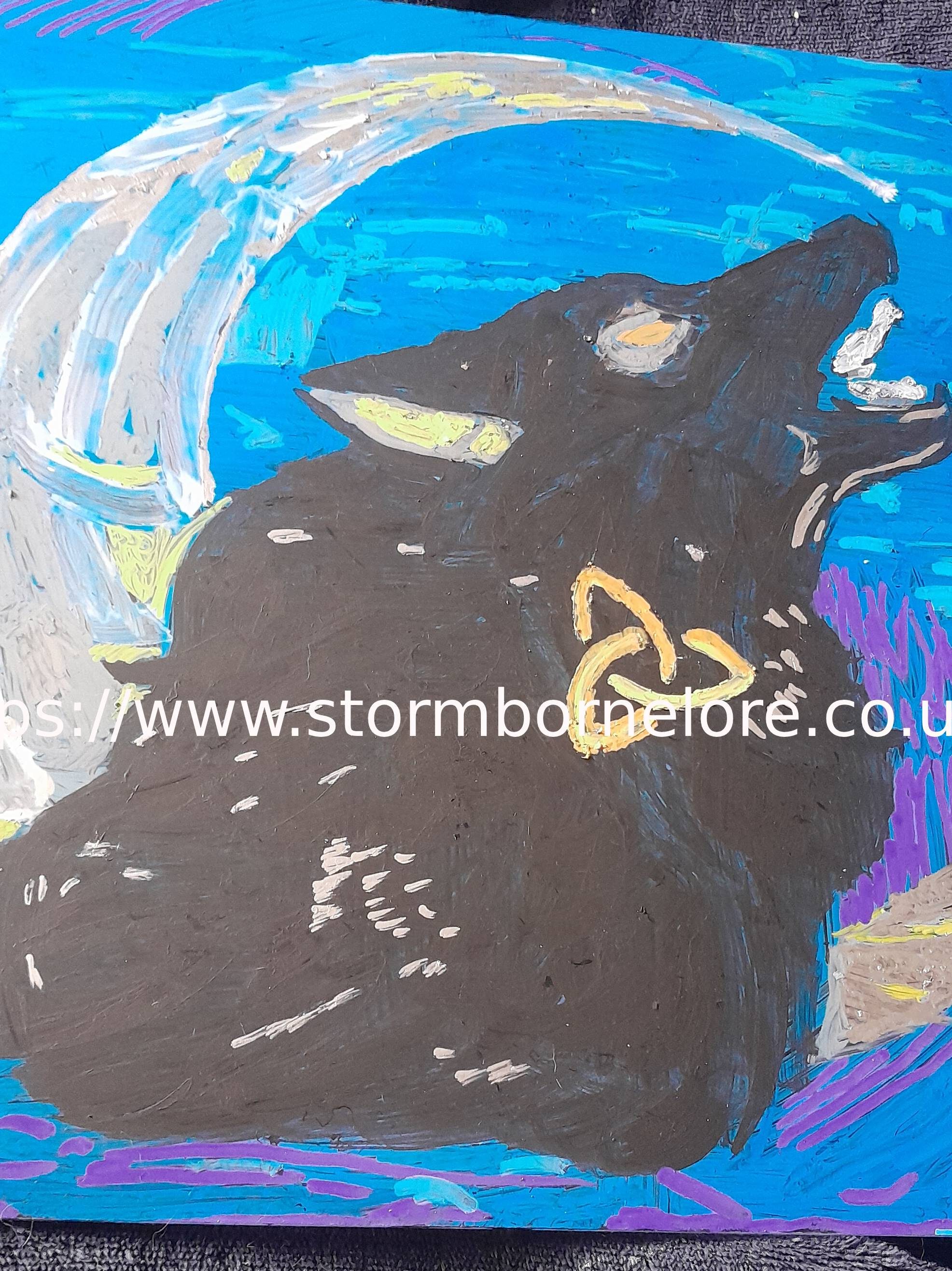
I bear black fur as dark as night. a golden five-pointed star on my head, a red crescent moon on my chest.
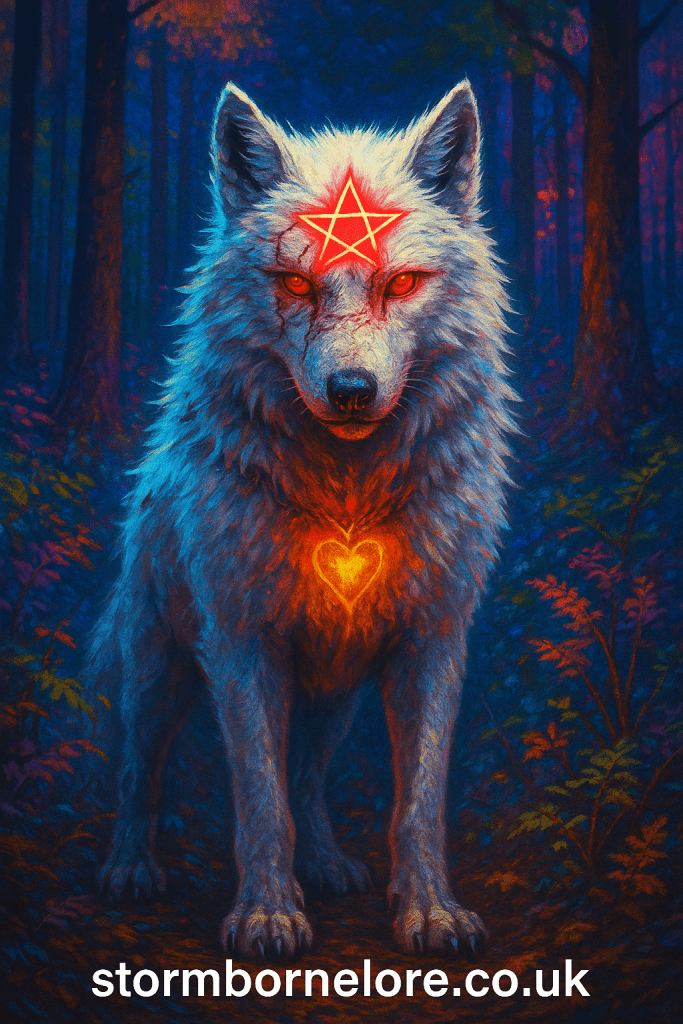
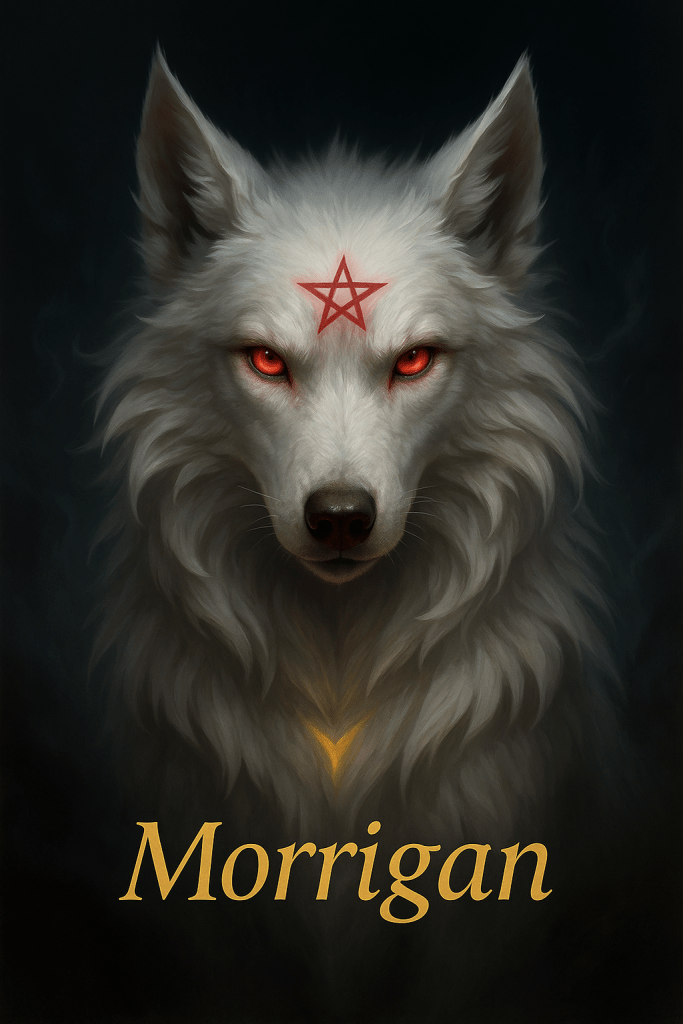
And my Morrigan… She is snow-white, with a red star between her eyes and a golden sun over her heart.
The moon hung low over the marshlands of Cymru, a pale and silent witness to all that stirred beneath. Mist curled along the ground like ghost-breath. Threading through reeds and thorns, cloaking the land in a hush that even time dared not break.
Morrigan stood at the water’s edge, her white fur shimmering with silver dew. The red pentagram upon her brow pulsed faintly with memory not magic, not prophecy, but something older still loss.
She remembered the laughter of her children, once. Their small feet dancing on stone, their breath warm against her skin when she had a face and a name.
That was long before the curse had sealed her fate. A punishment for defying death, for choosing the path of protector instead of prey.
She had not been seen in her human form by another soul in centuries.
The wind carried the scent of heather, salt, and far off fire. It shifted, and she turned her head sharply. From the west, a presence stirred. Not prey. Not predator. Something… remembered.
Her mate, Boldolph, emerged from the shadows. A black wolf with eyes like fire and a gold sigil carved into the fur of his brow. The mark of the king of wolves. He towered beside her, but even he did not speak.
Boldolph, the king of wolves, with glowing red eyes and a mystical sigil on his brow.
They not speak.
They had not touched in human form since the binding.
And still, their silence said more than words ever.
A sudden cry pierced the stillness not a howl, but the breathless whimper of cubs. Morrigan turned. Nestled in the hollow of a fallen tree, her children stirred, sensing the shift in the wind. She padded over, nose to fur, and breathed them back into slumber.
Her heart, once burned hollow by grief, beat now for them.
But the forest would not rest.
Tonight, something ancient woke.
Chapter 1
The Scent of a Storm.
The first rain came softly a warning more than a downpour. Tapping gently against the heather and bracken as dusk bled into the marshes. Morrigan crouched low on a rise of dry stone, her pale red eyes scanning the windswept valley below.
Somewhere to the north, a herd of deer was shifting. Their hooves left trembles in the ground. Their scent curled up through the fog.
But Morrigan wasn’t hunting tonight.
She was waiting.
Beneath her, in the hollowed belly of a mossy yew, three wolf cubs whimpered and stirred. Her children not the kind born of curse or storm, but of blood and memory. The youngest one, all white save for a copper ear, squeaked for her warmth. Morrigan tucked her body closer, curling like a shield around them.
Above her, the clouds began to crackle with unnatural colour. A shade of light not seen since…
Not since the last time the veil split.
The Shape of the Wind A sudden gust brought a foreign scent.
Not prey.
Not predator.
Something old.
Something… broken.
Her hackles rose.
Across the ridge. Boldolph stood, silhouetted against the sky like a god of the old wilds. His black fur glistening with rain, red eyes aflame with alertness. He hadn’t seen her in human form for hundreds of years. Neither had she seen him. The curse did not allow it.
But she felt him now that familiar gravity, that fierce ache of loyalty and loss.
“Do you feel it?” her voice stirred the wind, though no one else hear it.
He gave no answer, only turned his head westward toward the forests. Vasts woodlands of what would one day be called Cannock Chase.
Chapter 2
The boy in the trees
They saw him before he saw them.
A shadow moving through the trees. Too small to be a warrior. Too slow to be a deer.
He was staggering. Starving. But the flame in his eyes refused to die.
Morrigan stepped ahead, paws silent on the stone. The cubs whimpered behind her. Boldolph moved to block her path, lips curled, teeth bared but not at her.
At fate.
At what it meant.
At what it would cost.
Another child. Another risk. Another ache that never leave.
She looked again.
Not a warrior. Not yet.
Just a boy.
But storms followed him.
She turned back to her cubs. Nestled, safe for now. She licked each one gently, then closed the hollow with fallen bark. The marsh would protect them. She whispered an old name into the soil to guard them a name she hadn’t used in centuries.
Then, she stepped into the mist.
Boldolph growled low, a warning.
She brushed against him as she passed her head beneath her head beneath his muzzle, a gesture older than language. Boldolph did not move, but the tension in his shoulders eased. Just for a moment. Enough.
The storm scent was growing stronger.
Morrigan slipped into the trees, her paws silent against the mulch of leaf and root. Branches clawed at her fur like hands from a forgotten dream, but she did not flinch. She knew these woods. She had bled in them. Breathed in them. Hidden in them.
The boy was not far.
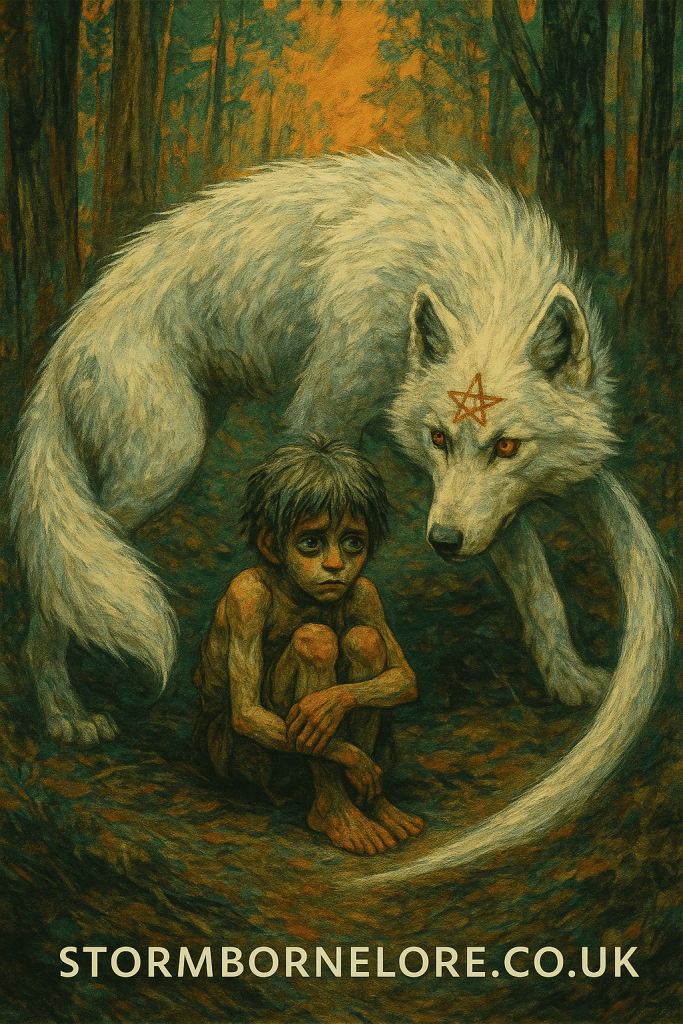
She found him collapsed beside a fallen trunk. his arms wrapped around his ribs as though trying to hold himself together. Dirt and blood streaked his face. His feet were bare, blistered, and blue with cold. He had a stick in one hand sharpened crudely, but not recently used.
Even in sleep, his jaw was clenched. Even in pain, his spirit did not bend.
Morrigan circled him in the shadows, one silent loop, then two. She tilted her head. A vision stirred fleeting and broken of a campfire once lit in the hollows of men’s hearts. A voice crying in a tongue lost to fire and flood.
A name.
Taranis.
It did not belong to this boy yet.
But it would.
She drew closer.
The Unseen Form had she still worn her human face, she have wept. But wolves did not weep. They watched. They endured.
Still, some griefs slipped through the fur.
She lowered herself beside the boy, her body a wall against the wind. Carefully, she placed her muzzle against his shoulder. His skin was fever-hot, but beneath it pulsed a stubborn rhythm.
He lived.
From the trees behind, Boldolph appeared, silent as the dusk. He said nothing, but his stare asked everything.
“What are you doing?”
She answered without words.
What we once promised what the old ways demand.
Another life. Another orphan. Another soul cast out by fear and ignorance.
The forest whispered around them voices of old gods and buried secrets. Morrigan raised her head and howled, low and haunting, a call only the wild would understand. It wasn’t a summoning.
It was a vow.
For three days, they watched over the boy.
She hunted while Boldolph guarded. He fetched water from the shallows, carried in his great jaws. She chewed softened bark and nettle, placing it near the boy’s lips. He drank in his fever-dreams, whispering names not yet earned, warnings not yet understood.
On the second night, he opened his eyes.
Just a sliver.
And saw her.
Not as a wolf. Not as a monster.
But as something else.
He reached a hand out. Weak. Trembling.
She did not pull away.
On the third morning, he stood.
Not steady. Not tall. But standing, nonetheless.
And behind him, the sky split with light.
Stormborne
He walked between them then between Boldolph and Morrigan as though he had always belonged.
The name passed once more through Morrigan’s mind like a wind returning home:
Taranis.
Storm-born. Marked. A child of prophecy and exile.
She didn’t yet know the shape of his story. Only that it would be vast. Only that it had begun.
And that somewhere in its ending, her curse would find its purpose.
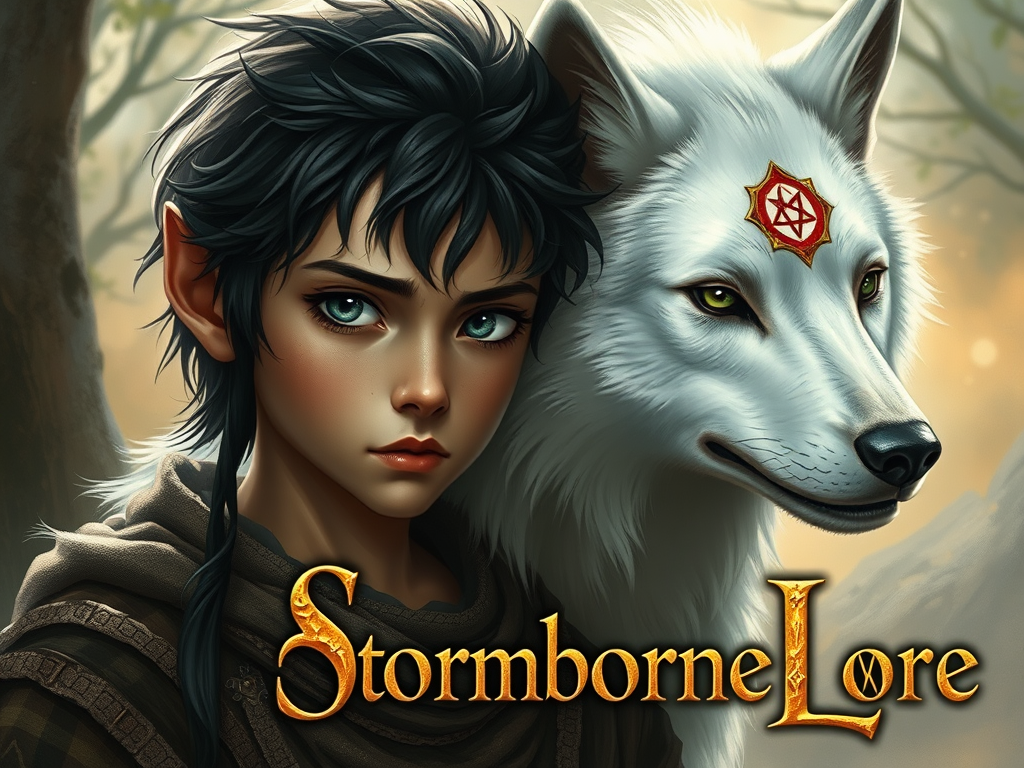
The bond between Taranis and Morrigan, symbolizing the awakening of ancient legacies in ‘StormborneLore’.
Diolch am ddarllen.
Os gwnaeth y stori hon eich cyffwrdd, eich ysbrydoli, neu aros fel sibrwd yn y coed ystyriwch hoffi, rhannu, neu danysgrifio i ddilyn y daith.
💬 Got thoughts, theories, or echoes of your own? Drop a comment and join the legend.
🌩️ The storm remembers every soul who listens.
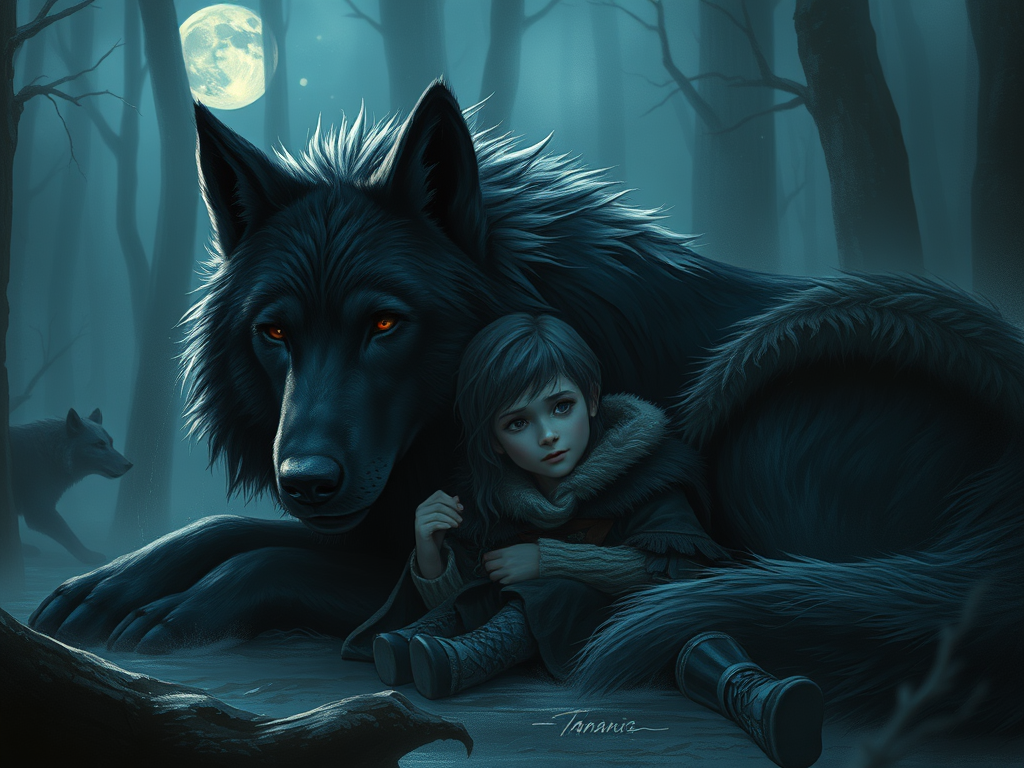
A moment of connection between Tanaris and two mystical wolves under a full moon, symbolizing a bond forged by destiny.
Authors note: Unfortunately I needed to use Google Translate for the Welsh so appologise if I got any of it wrong.










 StormborneLore