The fires in Emberhelm burned low, their glow tracing the hall’s carved beams in dull amber. Outside, wind howled through the moors, carrying the echo of the horn that had once called the clans to war. Now it was only memory.
Lord Drax Stormborne sat alone in the council chamber, a single goblet of wine untouched beside him. The maps and missives lay strewn across the oak table. Roman reports, messages from border scouts, pleas for grain from villages too frightened to send men to market.
He had not slept. Sleep meant dreams, and dreams brought Taranis.
His brother’s face haunted him not in death, but in defiance. Bound, bloodied, yet unbroken. There was strength in that memory, but guilt too.
“You always were the fire,” Drax murmured, voice low. “And I the stone that smothered it.”
A faint shuffle broke the silence. Caelum lingered at the doorway, unsure if he was welcome. “Father,” he said softly. “Marcos sent word. The Romans will move east toward the river forts. He says it’s only a patrol.”
Drax’s lips curved into something that have been a smile. “Marcos says many things to make Rome sound smaller than it is.”
He rose, the movement slow, heavy with sleepless weight. “Tell the men to prepare rations, but not weapons. We will not meet them with steel not yet.”
Caelum hesitated. “Uncle Taranis wouldn’t wait.”
“No,” Drax said, turning toward the window, where mist swirled over the dark moorlands. “He would burn the world to free one man. I must keep the world standing long enough for him to have one to return to.”
The boy nodded but did not understand. Few ever would.
Drax rested his hands on the cold stone sill, the wind tugging at his hair. Somewhere beyond the horizon, his brother still fought, still endured. And Drax the eldest, the anchor bore the burden of every storm that raged beyond his reach.
“Forgive me, brother,” he whispered to the wind. “I keep the hearth burning, not because I’ve forgotten you… but because I know you’ll come back to it.”
“Taranis is our baby brother, no matter what some think,” Drax growled, his voice low and edged with iron. His gaze locked on Rain across the firelight, sharp enough to cut stone. “You betrayed him when he was a child and you betray him now.”
Rain’s jaw tightened, but he did not speak. The silence stretched between them, thick with memory and regret.
The old priest, Maeron, lifted his hand gently. “He forgives you, Rain,” he said, his tone weary yet steady. “He wanted Drax, Draven, and Lore to know he will endure what they give him. So that you three will survive. He says to make choices that will keep you all safe and your people.”
Drax’s expression did not soften, though his eyes flickered with something that have been pain. “He forgives far too easily.”
Maeron inclined his head. “Forgiveness is not weakness, my lord. It is the weapon of those who can’t be broken. The Romans won’t rule forever. Prepare for what comes next.”
At the edge of the fire, Caelum shifted uneasily, his young face caught between fear and pride. “But what about my uncle’s meals?” he asked suddenly. “Uncle was exiled from the Circle years before they caught him. I was a baby then. Now I’m fourteen he shouldn’t be forgotten again.”
The words silenced the hall. Even Rain, for all his bitterness, not meet the boy’s gaze.
Drax rose slowly, the firelight glinting off his scars. “He will not be forgotten,” he said at last. “Not while the storm still bears our name.”
“But won’t they strip him of his name?” Caelum pressed, voice trembling now. “If Rome erases it, how will anyone know he lived?”
Drax looked down at his son the fire’s glow. Reflected in the boy’s wide eyes and placed a steady hand on his shoulder.
“Names can be taken,” he said quietly. “But legacies can’t. The Romans think power is carved in stone. Ours is carved in memory.”
He turned back to Maeron. “Tell him that. Tell him Emberhelm remembers.”
The priest nodded, rising to leave. But before he turned, his gaze swept the circle of men gathered in the hall. “When the storm returns,” he said softly, “I hope you are ready to stand beneath it.”
When Maeron’s footsteps faded into the night, the hall remained silent. The storm outside broke, rain hammering against the shutters like the echo of distant drums.
Drax stood by the window long after the others had gone. He could not see the fort from here, but he could feel it the iron cage that held his brother. The empire pressing closer each season. Yet as lightning flashed over the valley, he smiled grimly.
Because storms, no matter how long they’re caged, always find their way home.
The road to Viroconium was slick with rain. Drax rode beneath a low sky, his cloak heavy with water, the wind biting at his face. Beside him, Maeron’s hood was drawn deep, the priest’s silence carrying the weight of things better left unspoken.
When they reached the outskirts of the Roman fort, the air stank of smoke and iron. The rhythmic clash of hammers and the cries of soldiers echoed through the mist. But above it all, there was another sound low, strained, human.
Drax reined his horse sharply, his eyes narrowing.
At the edge of the square, raised above the mud and the murmuring crowd. Hung a man bound to a crude wooden cross. Blood streaked his arms, his body marked by lashes and bruises. His hair clung to his face in the rain. But the set of his jaw the defiant lift of his head was unmistakable.
Taranis.
Drax’s heart clenched as the legionnaire stepped forward, spear in hand. “He struck a guard and tried to run,” the man said stiffly. “By Roman law, the punishment is public display.”
“Law,” Drax echoed, his voice quiet, almost a whisper but Maeron flinched at the tone. “You call this law?”
The soldier hesitated, but before he could respond, Maeron laid a hand on Drax’s arm. “Careful,” he murmured. “The walls have ears.”
Drax dismounted, boots sinking into the mud. He walked forward until he stood before the cross, rain washing the grime from his face. Taranis raised his head slowly, eyes bloodshot but burning with that same inner fire that no empire could snuff out.
“Brother,” Drax whispered.
Taranis gave a faint, broken smile. “You shouldn’t have come.”
“And leave you to the crows?” Drax’s voice cracked like thunder. “Never.”
Maeron stepped forward, murmuring Latin prayers under his breath for the watching soldiers. Though his words were laced with druidic meaning ancient phrases meant to shield, not to save. His fingers brushed the iron nails that bound Taranis’s wrists. “These are not deep,” he said quietly. “They did not mean to kill him. Only to shame.”
Taranis’s laugh was hoarse. “They can’t shame what they don’t understand.”
The centurion appeared, cloak heavy with rain. “This man belongs to Rome,” he declared. “You will step back, Lord of Emberhelm.”
Drax turned slowly, the weight of centuries in his gaze. “And yet Rome forgets whose land it stands upon.”
The centurion stiffened. “Do you threaten?”
“No.” Drax’s tone softened to a dangerous calm. “I remind.”
The priest raised his hands quickly. “My lord only seeks mercy,” Maeron said. “Let him pray with his brother before the gods.”
After a pause, the centurion gestured sharply. “You have one hour.”
When the soldiers withdrew to the gatehouse, Drax knelt beside the cross. The rain had turned to sleet, stinging against his skin. “Hold on,” he murmured. “We’ll get you down when the watch changes.”
Taranis shook his head weakly. “No. Not yet. If you cut me down, they’ll know you came. They’ll burn Emberhelm.”
“Then let them come,” Drax growled.
But Taranis only smiled faintly. “Storms must wait for the right sky, brother.”
Maeron placed a hand on Drax’s shoulder. “He’s right. Endurance, not rage. That is his rebellion.”
Drax bowed his head, jaw clenched. He hated the wisdom in those words. He hated that Taranis could still smile through chains and nails.
As dusk fell, lightning cracked beyond the hills, white and wild. The storm gathered again over Viroconium.
And though Rome saw only a prisoner’s suffering. Those who remembered the old ways knew the truth: A storm had been crucified and still, it did not die.
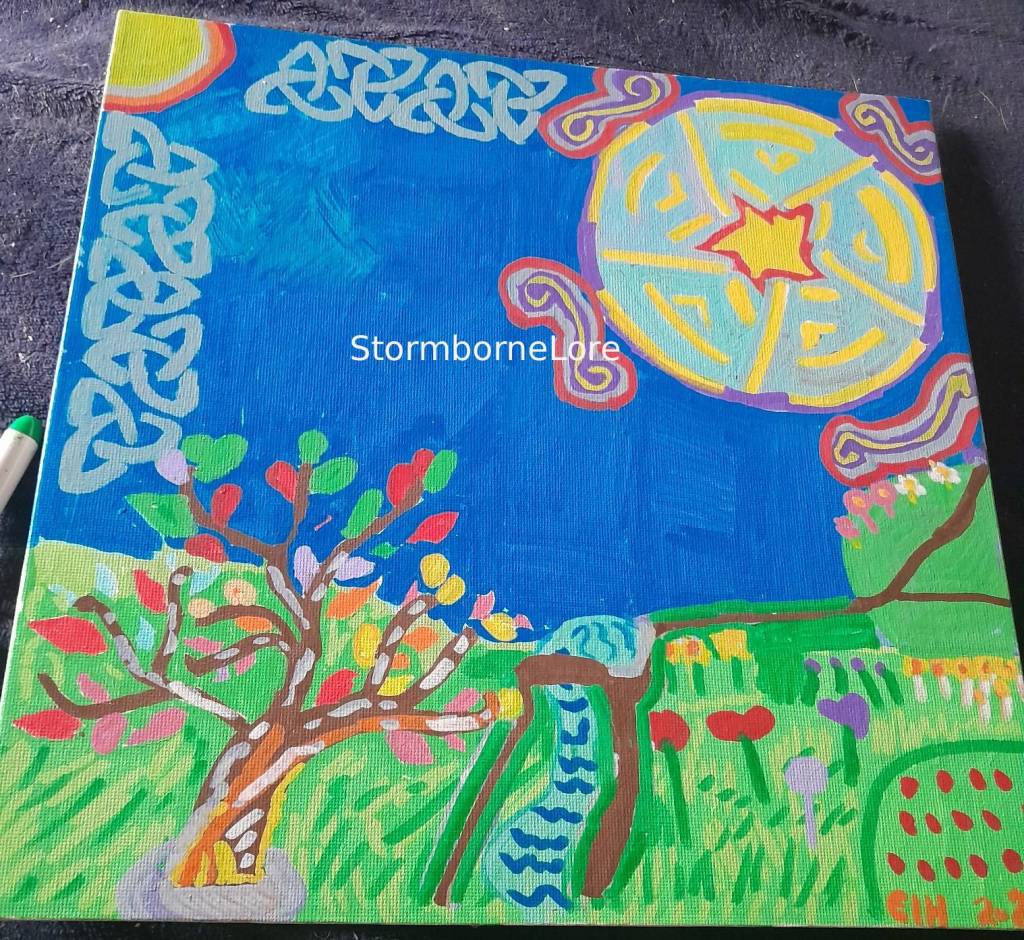
A vibrant painting depicting a colorful tree beneath a bright blue sky, symbolizing life and renewal.
Rest Beneath the Tree
At last they came to the tree.
It rose from the earth as though the hill itself had forced it skyward roots tangled deep, bark silvered with age, branches spread wide like the arms of a giant blessing or warning all who passed beneath. The ground around it was hushed, as if even the wind dared not trespass too loudly here.
Storm staggered to its shade and lowered himself to the roots. The weight of his wounds and weariness pressed him down, yet the tree seemed to hold him as gently as a cradle. He breathed slow, leaning against the trunk, and for the first time since the hill of ashes he felt his heart’s trembling ease.
The others made camp nearby, but left him undisturbed. Brianna spread her cloak by the fire, her eyes flicking often toward where he lay. Cadan tended the embers, muttering half-prayers, half-jests. The boy slept curled by the packs, his face still wet with the salt of grief.
Storm closed his eyes.
The world changed.
The tree shone with light, its roots glowing as though molten, its crown alive with whispering voices. Wolves circled him in the half-dark Boldolph and Morrigan among them, their eyes like coals, their howls joining others long gone. Above the branches wheeled Pendragon and Tairneanach, wings stirring thunder in a sky that was not a sky.
The gold ring gleamed on his finger once more. Its weight was not a burden but a bond. And the tree’s voice, deep as the earth itself, rolled through his marrow:
Rest, child of storm. The road is not ended. Every root remembers. Every leaf bears witness. You are bound to us, as we are bound to you.
Storm reached out and pressed his palm to the bark. He felt its strength answer, steadying his own. When his eyes opened, dawn was breaking.
Brianna stood ready with her blade. Cadan was already packing. The boy stirred from sleep.
Storm rose slowly, his body aching but his spirit steadier, and gave the tree one last look. The mark of his hand remained upon the trunk, a faint glow where blood and dream had mingled.
When the Roman legions marched into Britain in AD 43 under Emperor Claudius, they did not find an empty land. They found a patchwork of proud tribes, each with its own rulers, gods, and customs.
To the west of Watling Street lay the Cornovii, rooted in Shropshire and Staffordshire. To the south, around the salt-rich lands of Droitwich and Gloucestershire, stood the Dobunni. Both tribes would feel the weight of Rome’s advance.
Salt and Survival
Salt was life. It preserved food, healed wounds, and was as valuable as coin. The Romans renamed Droitwich Salinae and placed it under heavy control, taxing the salt trade and guarding it with military force.
For the Celts, who had long drawn wealth from the brine springs, this was both a theft and an insult. To strike the salt routes was to strike at Rome itself.
Resistance and Betrayal.
Not all Britons resisted. Some tribal leaders saw the might of Rome and chose to make an alliance. They took Roman names, built villas, and dressed in the style of their conquerors.
Others fought tooth and nail, their warriors painted, their gods called upon in the forests and on the hills. This clash between loyalty to tradition and the lure of Roman power split kin and tribe alike betrayal often hurt more than Roman swords.
Gods of Two Worlds.
The Romans rarely erased local gods. Instead, they blended them into their own pantheon.
Taranis, Celtic god of thunder, was aligned with Jupiter, wielder of lightning.
Sulis, worshipped at Bath, was merged with Minerva, goddess of wisdom.
Even the war goddess Andraste found echoes in Roman Mars and Bellona.
For many, this was a mask. Outwardly Roman, inwardly Celtic still. Temples rose with Latin names carved into stone, yet behind closed doors, the old rituals carried on offerings at sacred groves, whispered invocations at standing stones.
Daily Life Under Rome.
Markets bustled with pottery, wine, and oil imported from Gaul and Spain. Roman roads cut straight through the land, binding together forts, towns, and villas. Yet step off the road and you might still find Celtic roundhouses, farmers living as their ancestors had, and druids carrying wisdom that defied Rome’s order.
Legacy.
Celtic–Roman Britain was not either fully conquered or fully free. It was a place of merging, conflict, and uneasy coexistence. Rome imposed its order, but the spirit of the land the forests, the rivers, the stones still whispered the old names.
For some, like the warriors of legend, this was a time of rebellion. For others, a time of survival. And for figures like Taranis Stormborne, also known as Storm caught between gods and men, Rome and Celt, it was the crucible that forged myths still told today.

 StormborneLore