A vibrant abstract illustration featuring layered colors and an arrow design, symbolizing direction and change.
The children were asleep when Drax arrived.
The house was small, only one room wide, built of timber and stone Draven had carried with his own hands. Smoke curled from the hearth. His wife sat beside the fire, mending a tear in their daughter’s cloak. The scent of broth lingered in the air, soft and warm.
Draven opened the door before Drax could knock. He had felt him coming, the way a wolf senses winter.
They did not greet one another at first.
Drax stepped inside, shoulders heavy with travel and silence. His eyes went to the sleeping children. To the carved wooden animals on the shelf. To the woven basket of herbs drying near the window.
A life earned. A life held carefully. A life that could be broken by a single word.
Draven’s wife looked up, needle paused above the cloth. As she looked to Drax a heavy silence stilled in the room. She had always known this peace was borrowed.
Drax removed his gloves. He spoke quietly as he looked to his brother a man who stood 5foot 9 inches, slim build with dark hair..
“War is coming.”
There was no answer right away.
Draven sat beside the fire. His wife rested her hand over his — steady, steady, steady — and he closed his eyes.
Not in anger. Not in dread. But in that deep, wordless grief of a man who knew peace was never his to keep.
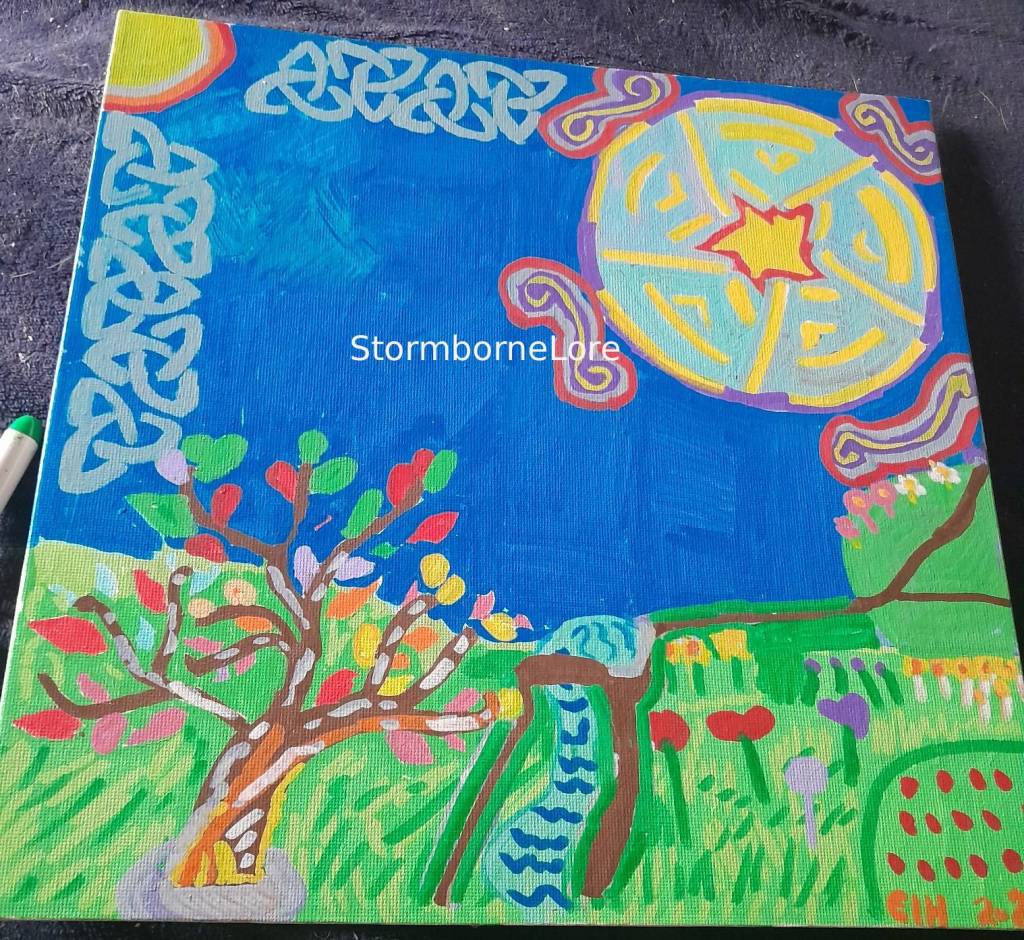
A vibrant painting depicting a colorful tree beneath a bright blue sky, symbolizing life and renewal.
Rest Beneath the Tree
At last they came to the tree.
It rose from the earth as though the hill itself had forced it skyward roots tangled deep, bark silvered with age, branches spread wide like the arms of a giant blessing or warning all who passed beneath. The ground around it was hushed, as if even the wind dared not trespass too loudly here.
Storm staggered to its shade and lowered himself to the roots. The weight of his wounds and weariness pressed him down, yet the tree seemed to hold him as gently as a cradle. He breathed slow, leaning against the trunk, and for the first time since the hill of ashes he felt his heart’s trembling ease.
The others made camp nearby, but left him undisturbed. Brianna spread her cloak by the fire, her eyes flicking often toward where he lay. Cadan tended the embers, muttering half-prayers, half-jests. The boy slept curled by the packs, his face still wet with the salt of grief.
Storm closed his eyes.
The world changed.
The tree shone with light, its roots glowing as though molten, its crown alive with whispering voices. Wolves circled him in the half-dark Boldolph and Morrigan among them, their eyes like coals, their howls joining others long gone. Above the branches wheeled Pendragon and Tairneanach, wings stirring thunder in a sky that was not a sky.
The gold ring gleamed on his finger once more. Its weight was not a burden but a bond. And the tree’s voice, deep as the earth itself, rolled through his marrow:
Rest, child of storm. The road is not ended. Every root remembers. Every leaf bears witness. You are bound to us, as we are bound to you.
Storm reached out and pressed his palm to the bark. He felt its strength answer, steadying his own. When his eyes opened, dawn was breaking.
Brianna stood ready with her blade. Cadan was already packing. The boy stirred from sleep.
Storm rose slowly, his body aching but his spirit steadier, and gave the tree one last look. The mark of his hand remained upon the trunk, a faint glow where blood and dream had mingled.
The sky over Emberhelm was the colour of old iron, restless with the promise of rain.
Drax stood on the outer wall, eyes on the valley below, where the last of the summer haze clung to the river. Beside him, Taranis rested both hands on the stone, watching the horizon as though it might bite.
“You’re quieter than usual,” Drax said.
“I’m listening.”
“To what?”
“The wind,” Taranis murmured. “It changes when something’s coming.”
A raven cut the sky, wings beating hard against the weather. It landed on the wall, a thin strip of leather tied to its leg. Drax caught it, untied the strip, and read the message aloud:
Strangers on the ridge. Armed. Not raiders. Moving slow.
Taranis’s jaw flexed. “Slow means they know we’re watching.”
“Could be traders.”
“Could be worse.” His gaze didn’t leave the valley. “Tell the scouts to shadow them. No contact. Not yet.”
Drax nodded, but his eyes caught something else his brother’s hand, hovering near the hilt of his sword even now, when there was no battle to fight.
The Sacred Grove
The grove smelled of damp earth and crushed mint where the rains had touched the leaves. Nessa sat with Caelum in the shadow of an ancient oak, rocking the carved crib gently with her boot.
“You were born into a dangerous world,” she whispered to the child. “But so was I.”
The voice came from behind her, thin as wind through reeds. “Danger shapes the strong, girl.”
Nessa turned. An old woman stood between two leaning yews, her green cloak patched and frayed, her hair a braid of white and ash. Her eyes were the pale grey of morning frost.
She stepped forward without asking, bent low over the crib, and traced the runes with a fingertip.
“Sky-born,” she murmured. “Storm-blessed. He will outlive his father’s crown… but not his father’s shadow.”
Nessa’s hand closed over the dagger at her belt. “What does that mean?”
The woman only smiled a sad, knowing curve of the mouth and stepped back into the trees. By the time Nessa reached the grove’s edge, she was gone.
The Council Stones
The gold circle gleamed beneath a bruised sky. Thirteen seats. Twelve filled.
Rayne’s voice carried first. “We should send the child away. Somewhere safe.”
“Safe?” Drax’s tone was a low growl. “You mean hidden.”
“Hidden is alive,” Rayne countered. “And alive is better than lying in the earth when prophecy catches him.”
Draven shifted in his seat, eyes down. “He’s a spark in dry grass. If the wrong hands reach him”
Lore’s voice cut through. “If fear writes the next chapter for us, we lose the right to call ourselves the Ring. Better we strengthen our walls than scatter our own blood to the winds.”
“You speak like someone who’s never buried a child,” Rayne said flatly.
Drax’s hand tightened on the stone armrest. “And you speak like someone who’d rather be rid of a burden than bear it.”
The silence that followed was sharp enough to bleed.
Rayne’s Quarters
Taranis didn’t knock. The door slammed against the wall as he stepped inside.
“You think I won’t hear what you say about my son?”
Rayne looked up from his table, unbothered. “Your son? Or your weakness?”
Taranis’s hand hit the table hard enough to rattle the cups. “If you move against him”
“If I wanted him gone,” Rayne interrupted, “he would be gone. I don’t need the Ring’s blessing for that.”
Taranis’s eyes narrowed. “Then you’re waiting.”
Rayne leaned back, smiling without warmth. “You’ve already faltered, brother. All I have to do is let the sky finish the work.”
The Outer Gate
The scouts returned at nightfall, mud on their boots and rain in their hair.
“They’ve reached the lower valley,” one said. “Twenty of them. And they’re asking for the Stormborne child by name.”
The Ring gathered in the torchlit hall, arguments sparking like flint. Some called for parley, others for steel.
Taranis stood apart, Caelum in his arms, the boy’s small hand gripping the edge of his father’s cloak.
“They will not take him while I breathe,” he said, and there was no room for doubt in his voice.
Final Beat
As orders rang through Emberhelm, Rayne stood in the shadows of the hall, Draven at his side.
“The warlord has chosen love over reason,” Rayne murmured. “Now we wait for the sky to fall.”
Outside, lightning flashed over the valley once, twice before the rain came.
Grael walked up the hill toward the restrained boy. He knelt before the clan’s leader.
“You called, and I came. Is this the boy you spoke of?” Grael asked, glancing toward the child bound to the stone.
“Yes. The other clans call him Stormborne, or say he’s cursed. He’s been with us seven years now,” the leader replied.
“The mask?” Grael asked.
“He threatened to kill the clan. And me. The mask is punishment. He hasn’t had food or water for two days. He killed a farmer.”
“Boy!” Grael barked at a nearby child. “Go fetch broth and ashcake. I can’t train a half-starved slave.” He smirked, adding, “But he remains under punishment.”
As the boy ran back to the village, Grael stepped forward. In a single motion, the mask was unhooked. Grael knelt by the water.
“Are you thirsty?” he asked.
Taranis looked to his master, seeking permission to speak.
“Answer him,” came the order.
“Yes, sir. Very,” Taranis whispered. The rope pulled tight at his throat, but he managed a faint smile as Grael offered water.
“Why did you take the man’s life?” Grael asked.
“I didn’t mean to. I was trained to obey the family. I heard my master’s eldest say, ‘Kill the farmer.’ I followed the order.” Taranis hoped Grael might listen—unlike the others.
“So your punishment is for following orders?” Grael rubbed his chin.
“The ridge is, sir. This stone is.”
“And the mask?”
“I spoke defiance. I threatened the clan. I’m just an exile. They want me to remember it.”
“I know who you are. The mask stays. But under my command, you’ll be fed and watered. Training will be punishing ĺso harsh you’ll wish you were back on this rock.” Grael studied the boy.
“Roake,” he called to the clan chief, “this boy is already half-starved. But if he is who you say he is, he’ll become a beast of a warrior. How long left on the rock?”
“Until sunrise. One more night in the mask two sunrises in total. But tonight we celebrate. You’ve arrived, and we have business.”
“Indeed,” Grael said. “And he is my business. Have you seen the dragons and wolves nearby?”
“Yes. They raised this one until my son, Solaris, and I found him. He was curled into a white wolf, half-dead from fever and hunger.”
“They still cry for him, Father,” Solaris said, approaching with a bowl of porridge and wild berry drink. Without a word, other slaves joined him and began to feed Taranis.
“Take him down once he’s eaten. Keep the binds on. He’ll fight Rock if he wins, the mask is removed. If he fails, we add stone to his punishment,” Grael said, glancing at the boy’s hands.
Taranis was cut down and led back to the training circle. Grael himself loosened the ropes. “Until I trust you,” he warned, “you’ll remain bound—even in battle.”
Taranis stayed silent as a spear was tossed toward him and the match began. Rock, a short but muscular man, charged and struck Taranis’s arm. Taranis moved fast, twisting around each blow, using his restraints to his advantage. Blow for blow, he met the attack until finally, Rock crashed to the ground.
Taranis hesitated.
“Kill him! He’s worthless!” the clan leader shouted.
“No one’s worthless,” Taranis said, breathing hard. “No matter what we are.”
“Sixty lashes!” the chieftain roared. “Spread over three days.”
“Chief,” Grael interrupted, “don’t tie him to the rock. Let him walk through the village under my warriors’ guard. At dawn, he fights two of my men. Let him train and work in the mask if you must but feed him. Water him.”
Grael turned to Taranis. “You talk like a chieftain, but you wear binds. You are the property of your master just like his house is his, just like this land is his. Never forget it. You’re a strong warrior, but you’ve much to learn. Tonight, you will serve my meal masked and restrained.”
The warriors dragged Taranis by the tether to the flogging tree. His arms were stretched wide as the branch was brought down.
Taranis bit his tongue, stifling screams. He hadn’t just disappointed Grael he’d embarrassed him. His eyes scanned the slaves watching faces of black and white, eyes wide, breaths held. His legs buckled. His will broke.
“Lift him! He still has ten to go!” the punisher growled.
They hoisted him upright again, forced to endure every final strike. Among the gathered slaves, whispers began.
“We are not just meat… We are people. Like our masters.”
“ANYONE DARES DEFY ME, YOU’LL GET THE SAME!” the chieftain bellowed. But the whispering didn’t stop.
Something had been seeded.
Later, Taranis was carried to a hut. A woman entered with herbs and cloth.
“I know you can’t talk with the mask on,” she said, kneeling beside him. “But Grael sent me to tend your wounds. What you said… gave the others hope. Dangerous hope.”
Taranis nodded, noticing the slave brand on her arm.
“Water and food,” she said, motioning to a guard. The mask was removed briefly.
“Careful. He bites like a wolf,” the man muttered, tightening the tether.
She ignored him and began to feed Taranis warm, fruity porridge. Blissful after starvation. As a warrior-slave, he received small privileges others didn’t.
Moments later, guards grabbed him again.
“Dig the fire pit.”
Taranis met the man’s eyes and didn’t move.
“GRAEL! HE’S REFUSING ORDERS!”
“DO AS YOU’RE TOLD!” Grael barked.
Taranis obeyed. Pain burned through every movement, but he didn’t complain. Hours passed.
“Now the troops need water,” Grael said.
A yoke was placed across Taranis’s shoulders, buckets tied at either side.
“ANY spillage, whip him,” Grael ordered, knowing full well the task was nearly impossible.
That night, as the feast began, the druid sang of warriors and spirits. Taranis, masked and tethered, served Grael’s meal.
“Have you tried this before, boy?” Grael asked, eyeing the meat on his plate.
Taranis shook his head, unable to answer.
“Hold it, slave,” one of the chieftain’s sons barked.
“I challenge the slave to a fight to the death,” the eldest declared.
“He will win. Are you sure?” Grael asked.
“My son wants justice for the farmer. Let him fight,” the chieftain said proudly.
“So be it,” Grael agreed. “After the meal, we’ll have entertainment.”
“What does he get if he wins?” a child asked.
“He’ll live to breathe another day,” Grael replied. “Perhaps an extra ration.”
It didn’t sound like much—even to Taranis but it was more than most.
“Then let him fight without the binds,” Solaris challenged. “Or are you afraid?”
“Very well. No restraints.”
Taranis nodded. At least the fight would be fair. He stepped into the fighting stones. Grael unshackled him.
“I hope you win,” he said. “You could give us the edge in battle. If you lose at least you’ll die with honour.”
“Yes, sir.”
Taranis refused a weapon. His opponent came in fast with a staff, but he ducked, twisted, and struck. The collar remained, but without the tether, he moved freely. They clashed with raw force until the chief’s son crashed to the ground, groaning and bleeding.
Taranis stood over him. One final stamp would end it.
“I refuse to kill the chieftain’s son,” he said, dropping to one knee.
“I command you kill him!” Grael shouted.
“I cannot. I will not take a sacred life unless in battle.”
“You may be a slave,” Grael said slowly, “but you act with honour. A killer obeys orders. A warrior knows restraint. You know the difference.”
“Place him back in binds. He lives to breathe another day,” the chieftain said. “And tend to my son, who lives with the shame of defeat. The gods have spoken Taranis followed his orders. It is proven.”
As wolves howled in the distance, the crowd fell silent.
“Take him to the hut,” Grael ordered. “Not the rock. He’s a warrior. He will still be punished but he’s earned the right to stand.”
I stood where thunder carved the sky, Where old oaths broke, and none asked why. The staff I raised was not for war, But for the ghosts I still fight for.
Boldolph’s eyes were iron flame, They spoke of love, not seeking fame. His growl a warning, not a threat A brother’s bond I won’t forget.
The wolves still watch. The dragons wake. Each vow we make, each path we take A storm-born soul must never stray From fire-wrought truth or shadowed way.
Let others rule with golden tongue, I lead where pain and praise are sung. For every scar upon my frame Is carved from love, not just from flame.
The stone halls of Emberhelm still held the breath of thunder. The storm had passed, but the scent of damp earth and smoke clung to every crack and carving.
Outside, the banners of the three Houses shifted gently in the wind. Flame, Shadow, and Storm. Inside, the High Warlord of Caernath sat upon the seat of judgment, the storm-carved throne of his ancestors.
Taranis wore no crown. His only adornment was the silver cuff upon his wrist, the one shaped like twisted flame. Around him stood those who had fought beside him, bled for him, defied death with him.
Lore stood silent to the left, hands folded into his long dark sleeves. Boldolph crouched at the side of the hall like a black statue, eyes ever scanning. Draven leaned near the great hearth, murmuring with a war-priest. Rayne stood furthest back, half-shadowed, watching everything.
“My brother did not steal,” she said, eyes red from the wind. She clutched a doll made of grass and thread. “He only took what the wolves left. We were hungry.”
Her mother knelt beside her, face pale, silent with shame.
Taranis rose. “Where is the boy now?”
A man stepped forward. Greying, armed, not unkind. “In the cells, my lord. The bread he took belonged to House Umbra’s stores.”
Lore turned his head slowly. “Bread unused for days. Moulding in a bin.”
“Aye,” said the man. “But rules are rules.”
Taranis stepped down from the dais. He did not look at the guards. He knelt to the girl.
“What is your name?”
“Aella,” she whispered.
“Aella,” he said, “your brother is no thief. He is a survivor. And from this day, your family eats under the protection of Emberhelm.”
He turned to the court. “Let the stores be opened to those in hunger. Starvation is not a crime. And those who would hoard while others suffer will answer to me.”
The next petition was colder.
Two men from the borderlands bowed stiffly. One bore a jagged scar along his scalp.
“My lord, Black Claw banners were seen near the Witherwood. We ask permission to hunt them down.”
A murmur rose. Boldolph straightened.
Taranis narrowed his eyes. “How many?”
“A dozen. More. Hiding in the ruins.”
Rayne shifted, his hand brushing the old collar scar on his neck.
“No,” said Taranis.
Gasps.
“We do not chase ghosts and bleed men for vengeance. Not now. Not today. Fortify the border. Send scouts. But no hunt.”
The men looked uneasy.
Draven raised his voice. “What if they attack?”
“Then we crush them,” said Taranis, steel in his voice. “But we do not start the fire.”
Boldolph gave a faint growl of approval.
Later, as the court thinned, an old woman with clouded eyes was led forward.
“I was once a healer,” she said. “Cast out in the time before. I seek no pardon, only a place.”
Morrigan stepped ahead from the shadows.
“I know her,” she said. “She taught me names of plants I still use.”
Taranis looked to the court. “Is there any who speak against her?”
Silence.
“Then let her be welcomed to Hearthrest,” he said. “Let her wisdom serve again.”
The old woman wept.
As the hall emptied, Lore remained behind.
“You did well,” he said.
“I did what had to be done.”
“Which is often the hardest thing.”
Taranis sat again upon the throne. He looked to the high carved beams, where the banners of the Stormborne rustled gently.
“The war will come again,” he said.
“It always does.”
“Then let this peace be something worth protecting.”
Lore nodded. “So we fight, not for power. But for dignity.”
Taranis gave a half smile.
“For bread. For brothers. For those who can’t fight. That’s what this court is for.”
And above them all, in the rafters where the light touched the carvings of wolves and dragons, the storm winds whispered through the stone:
The courtyard had long emptied. The ash of the fire pits still glowed faintly, casting soft light on stone walls and weary limbs.
Taranis sat alone, legs stretched, a jug of broth in one hand,. the other flexing and sore from the clash with Boldolph.
The crack of staffs still echoed in his bones.
Footsteps approached not boots, but clawed paws. Heavy, padded, unmistakable.
Boldolph.
Without a word, the old wolf-man knelt beside him, a strip of clean linen in hand. He took Taranis’s wrist and began to bind the bruises, slow and methodical, like a ritual done a hundred times.
“You didn’t hold back,” Taranis said after a moment.
“You didn’t ask me to.”
The silence between them was old, familiar. Like the stillness before a storm. Or the hush before a boy became a warlord.
“I needed them to see I bleed too,” Taranis muttered, wincing as the linen tightened. “That I fall. That I get back up.”
Boldolph grunted.
“They already know you bleed,” he said. “They just needed to see you still feel it.”
Taranis looked toward the sky. Smoke trailed like threads into the blackness. One dragon circled high above, a quiet sentinel.
“I keep thinking,” he said, “about when I was exiled. Alone in the wilds. All I had was that storm inside me and the promise that no one was coming.”
He looked down at the staff beside him.
“And now… now there’s you. Solaris. Lore. Drax. Rayne. Even Draven. I have everything I never thought I would. And I don’t know how to hold it without crushing it.”
Boldolph didn’t speak at first. Just poured a second jug of broth and handed it to him.
Then he said, low and hoarse: “Every beast that’s ever bared teeth knows fear. Not of pain. Of losing what it’s fought to protect.”
He paused, eyes distant.
“I was exiled once too. Long before you were born. I clawed through snow and silence, not knowing if I was cursed or chosen. I still don’t.”
Taranis turned to him.
“You stayed. Even cursed. Even as a wolf.”
Boldolph nodded.
“Because someone had to. And because I believed that one day, the one I guarded would understand the weight of the fire he carried.”
The flames crackled beside them. Taranis took a slow sip of broth.
“I understand it now.”
Boldolph gave a grunt soft, almost approving. Then he stood, stretched, and turned toward the shadows.
“You’re not alone anymore, High Warlord,” he said. “Stop trying to fight like you are.”
Then he was gone, back into the night, tail flicking behind him like a whisper of old magic.
Taranis sat a while longer.
Then he smiled.
Not like a warlord. Not like a weapon.
Like a man who had bled, fallen, and been lifted again by the hand of a wolf.
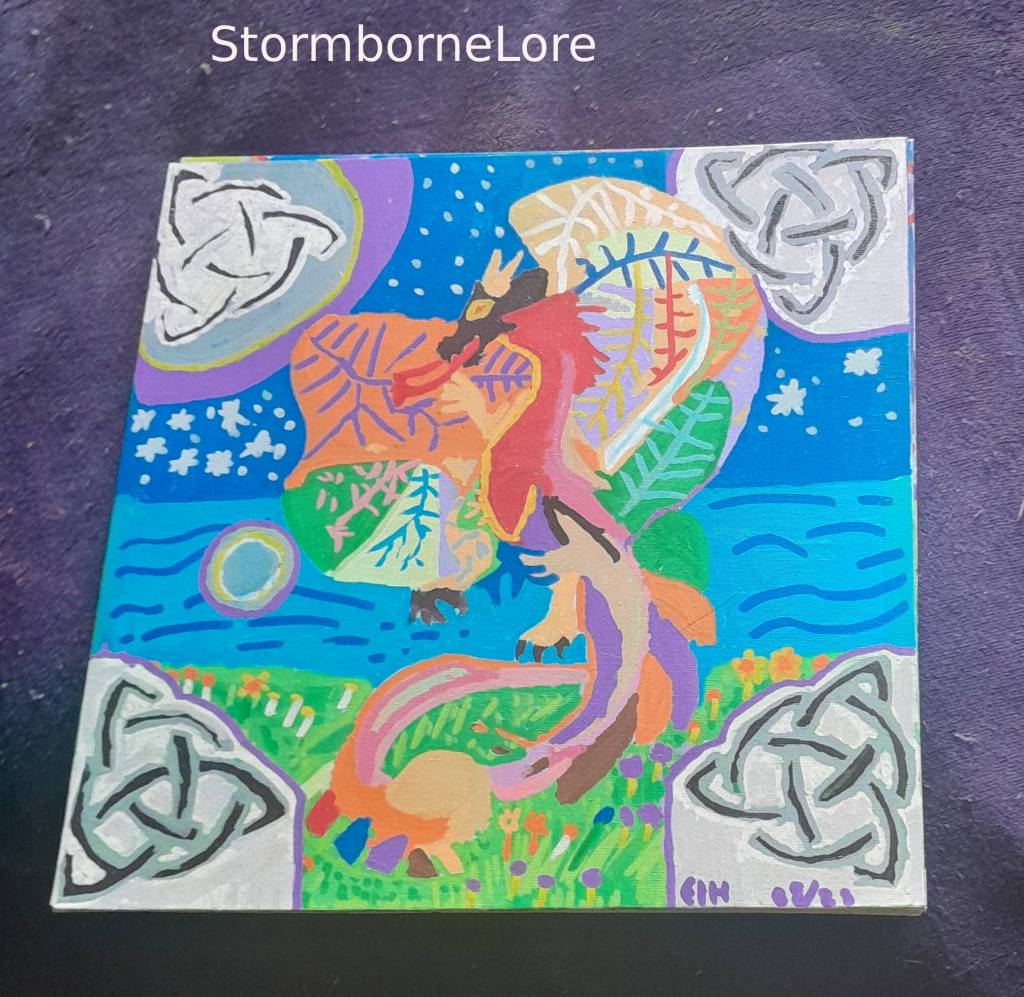
A vibrant artwork reflecting the themes of struggle and resilience in the narrative of StormborneLore.
House of Shadow
I do not speak of heroes. I speak of those who walked in silence. Of boots torn at the sole, and breath taken with care lest the wind betray them.
I walked the road to Umbra alone, but never unmarked. Each tree knew my name, each stone held a memory, and the crows whispered what the living dared not say.
My brothers called it exile. The warlords called it treason. The wolves knew better. They call it the long return.
I did not carry banners. I carried wounds.
I did not seek the throne. I sought peace and found shadows that bled like I did.
And when the night fell thick with frost, and even the stars looked away, I did not pray for light.
A heartfelt thank you for engaging with the narrative of StormborneLore, inviting readers to support the storytelling journey.
The morning mist clung to the valley like a second skin. Emberhelm’s courtyard steamed with breath and sweat, the scent of stone, ash, and boiled roots heavy in the air. Around the inner circle, newly chosen warriors waited nervous, eager, some barely out of boyhood. Others bore scars older than Taranis himself.
At the centre stood the High Warlord of Caernath. His cloak cast aside, sleeves rolled, storm-grey eyes fixed on the line before him.
“No blades today,” he said. “Not until your hands know what weight feels like.”
He tossed a staff to the first in line. Then another. And another. Each warrior caught their weapon or fumbled it those who dropped theirs were told, simply, “Again.” And made to run.
On the other side of the training ground, beneath the shadow of the stone wolf banner, Boldolph paced in silence.
His pack half-men, half-beasts, with eyes like old moons watched him without blinking. He spoke low, but his voice carried like thunder over ice.
“You are not pets. Not soldiers. You are guardians.” A pause. “You see a child in harm’s way, you do not wait for orders. You act. That is the law of the wolf.”
One of the younger wolves whimpered. Boldolph turned sharply. “Fear is not failure. Freezing is. Move even if it hurts.”
Across the field, Taranis raised his voice again.
“This is Ignis. This is fire. You’re not here to impress me. You’re here to withstand the storm, and stand through it.”
He glanced at Boldolph.
“Or do you want to spar with his lot instead?”
A low growl rippled from the wolf-warriors.
The chosen laughed nervously until Boldolph nodded. One of his warriors, a massive figure with a half-healed burn across his chest. stepped ahead, gripping a staff as thick as a child’s leg.
Taranis smiled. “Right then. Let’s see who learned to dance.”
The wolf-warrior advanced, silent but for the low crunch of earth beneath padded feet. His height matched any war-chief. His eyes amber, slit like a blade of dusk fixed on the line of young recruits now stepping back.
Taranis caught Boldolph’s eye.
The old wolf-man crossed his arms, his growl half amusement, half challenge.
“Too much for them?” Taranis asked.
“They need to know pain has teeth. And that not all enemies snarl first.”
The recruits shifted nervously. One tried to step ahead, but Taranis raised a hand.
“No,” he said. “Not yet.”
Then, slowly, he removed the silver cuff from his wrist. The one shaped like twisted flame and dropped it into the dust.
The courtyard hushed.
Boldolph straightened, his expression unreadable.
“You mean to fight me?” he said, stepping ahead, voice low.
Taranis rolled his shoulder and took a training staff from the rack. “Not to wound,” he replied. “To remind.”
Boldolph took his own heavier, gnarled like a branch torn from an ancient tree.
They circled.
The recruits, wolf-men, and even dragons above watched in stillness.
Then Boldolph struck fast, low, aiming to knock out Taranis’s legs. But the warlord leapt, twisting mid-air, landing in a crouch with a grin. He swept his staff up, tapping Boldolph’s ribs before stepping back.
“Sloppy,” he said. “You’re slower in your old age.”
Boldolph snarled, but it wasn’t anger. It was the old dance. The rhythm of claw and command.
He lunged again this time a full force blow. Their staffs cracked like thunder as they met. Sparks flew from the impact. Recruits flinched. One dragon above rumbled softly, folding its wings to watch closer.
They moved like storm and shadow:
Taranis fluid, forged in battlefields and flame.
Boldolph grounded, brutal, unshakable like the old hills.
Neither aimed to kill. But neither held back.
A final clash and both stopped, locked staff to staff, breathing heavy, eyes locked.
“You’ve grown,” Boldolph said, finally. “Not just in size.”
“And you’ve not changed,” Taranis replied, sweat on his brow. “Still the rock I lean on.”
He broke the hold, stepped back, and offered a hand.
Boldolph took it without hesitation. The courtyard erupted in cheers both from humans and wolves alike.
Taranis turned to the watching recruits. “This,” he said, gesturing between them, “is how you lead. Not with fear. But with fire, with honour, and with those who would bite your enemies long before they betray your trust.”
Boldolph gave a rare smile.
“And don’t forget,” he growled to the recruits, “the wolves are watching.”
By the fire at Emberhelm, the night before the ley lines awakened
We drank not for glory, but for breath. For blood that still ran, and brothers not yet turned to ash.
No crown weighed our heads that night. No blade hung between us. Only silence, and the crackle of wood older than war.
Lore sat still eyes on the shadow that never left his side. Drax, hands calloused, held the storm like a sleeping child. Draven, scar-bound, leaned on root and stone. Rayne, half-light, watched the stars as if to ask if they would wait for him to rise.
And I, I …. who had been all things and nothing looked at them not as soldiers, but as home.
We did not speak of battles. We did not weep for lost years. We passed the bread. We tore the fish. We shared warmth not made of fire.
And before the parting, we carved no words. For there are some truths that can’t be spoken without breaking.





 StormborneLore