Tag: historical fiction

  • The Arena of the Bound Storm

    The Arena of the Bound Storm

    The morning mist hung thick over the Roman fort, curling around the walls and the sentries like ghostly serpents.

    Taranis Storm’s wrists ached where iron had bitten into bruised flesh, his ankles raw from chains. Yet the fire inside him refused to be tamed. Marcos had warned him that this day would test more than his body. It would probe the limits of fear, endurance, and wit.

    The centurion led him across the courtyard. Other prisoners lined the path, eyes wide with terror or jealousy. Weak men, broken men, some shaking in expectation of death. None dared speak.

    “Today, you fight for Rome’s amusement,” the centurion barked, voice carrying over the square. “The arena awaits. Survive, or die beneath their eyes.”

    Taranis allowed a faint smirk, almost imperceptible. Chains or no chains, sword, axe, or spear he had survived worse. The storm was within him, and storms do not break.

    The first trial: Damnatio ad Bestias.

    Lions, their muscles rippling beneath tawny manes, were released into the sand. Their growls rolled like thunder, a sound meant to unnerve men and mark the end of hope. Taranis was pushed forward, unarmed, the chains clinking with each step. The crowd leaned forward, eager for carnage.

    The first lion lunged. Taranis dropped low, letting its momentum carry it past him. Spinning the chain to trip the beast, a subtle but devastating movement learned in the wilds of Staffordshire. Another lunged, jaws snapping, claws tearing sand.

    He moved like the wind low, sharp, unpredictable. He stood baiting, dodging, spinning chains like whips, forcing the predators into missteps against one another.

    Blood rose in clouds around him, yet he remained untouched. When the final lion recoiled and the centurion’s mouth twitched a mix of disbelief and begrudging respect. Taranis exhaled slowly, chains clinking, storm-controlled and silent.

    The second trial: Gladiatorial combat.

    He was given crude weapons a short sword nicked from years of use. A small round shield marred by countless hits, a spear bent at the tip. Combatants approached with mockery, expecting an untrained barbarian to stumble, falter, and bleed.

    Taranis did not falter. He did not rush. Each movement was a calculation, using the terrain, his chains, the enemies’ weight and momentum against them. The first pair charged together, one with sword, one with shield.

    Taranis pivoted, letting the chains tighten around their legs. As he ducked beneath the sword, delivering a clean strike to the opponent’s flank.

    The second soldier hesitated, startled by the unexpected precision. Taranis did not smile he simply waited for the next assault, reading, predicting, exploiting every weakness.

    A guard whispered to another, “He’s no ordinary man… he fights like the storm itself.”

    By midday, the arena was a battlefield of skill, endurance, and cunning. A third pair entered, wielding axes. Taranis dodged and parried, chains tangling in the sand and catching his enemies off-balance. His movements were fluid, almost artistic — a storm in motion, controlled yet deadly.

    Between bouts, he observed fellow prisoners some cowering, some quietly strategizing, watching him with awe. He nodded subtly, acknowledging their respect without breaking focus. Alliances were unnecessary here; survival was enough.

    Two massive bears were released simultaneously, roaring, claws digging into the arena floor. Taranis analyzed their pattern one slower, one feinting left before striking right. He baited them, using his chains to trip and distract, pushing one into the other’s path. The crowd gasped as claws met flesh, teeth snapping on fur instead of his own body. His footwork was precise; his breathing measured; his mind sharpened like a blade.

    When the bears finally withdrew, exhausted or bested by circumstance, Taranis stood alone in the sand. Sweat streaked with blood and mud clung to his skin. He raised his head, grey eyes surveying the watching centurion. There was no fear in him. Only storm.

    The centurion approached cautiously, expression unreadable. “Enough. You will live… for now. But know this: Rome does not forgive defiance. Your survival is theirs, not yours.”

    Taranis’s gaze swept over the spectators and fellow prisoners alike. Some bowed in awe, some averted their eyes in fear. Marcos leaned against the wall, one eye glinting with pride. Even in chains, Taranis Storm had not been broken.

    That night, in the darkness of the cell barracks, he traced patterns in the dirt beneath his chains. The arena had been a spectacle for Rome, yes, but also a proving ground for him. Every movement, every dodge, every strike had been a lesson in patience and precision. Each enemy, each beast, each whisper of fear from the crowd had been data to be remembered, stored, and used.

    The storm waited. It always waited. Taranis knew the chains bind him. swords scratch his skin, lions and bears roar, but they could not break him.

    He smiled faintly to himself, letting the chains clink softly. Rome had given him a stage, a spectacle, and a lesson. And when the right moment came, the storm would strike and it would not be for their amusement.
    Further Reading
    The Prophecies and Tales of Taranis Unfolded

  • Chains and Storms

    Chains and Storms

    Dawn broke over the Roman camp like a blade drawn through fog.
    Grey light pooled across churned mud and sharpened stakes, catching on helmets and spearheads lined in perfect order.

    The night’s rain had thinned to mist, and every droplet clinging to the leather tents shimmered like glass. The smell of smoke, sweat, and iron hung heavy in the air the scent of empire.

    Taranis stirred. His back ached where the whip had bitten, skin raw beneath crusted blood. Yet the fire inside him burned brighter than pain the storm had not passed. It gathered.

    Across from him, Marcos watched with his one good eye. The old fighter’s face a map of old wars and fading loyalties. “Rome wants to see storms broken,” he murmured, voice gravel-deep. “They’ll test you again today. But storms… storms don’t break. They shift. They wait.”

    Taranis tilted his head, a faint smirk cutting through exhaustion.
    “And if they try?”

    Marcos shrugged, rough amusement in his tone. “Then you show them the wind can cut as deep as the sword.”

    Trumpets blared as the camp came alive in a heartbeat. Orders barked in Latin, armor clattered, horses stamped restlessly against their ropes. Two guards approached, eyes cold, hands twitching near the whips at their belts.

    “On your feet,” one barked.

    Taranis rose slowly. Chains clinked. His shoulders squared, each movement deliberate. The iron at his wrists and ankles was heavy a reminder that for now, he belonged to Rome.

    Yet even bound, he carried the air of something untamed. The guards kept their distance, as though the storm in his eyes strike.

    They led him toward a cleared space at the edge of the camp.
    A makeshift ring had been marked out with stakes and rope a place for training, punishment, or testing.

    The centurion stood nearby, expression carved from granite. The boy from last night watched from behind a cart, pale fingers gripping the wood. He didn’t dare speak.

    The centurion’s voice carried over the murmurs. “The barbarian survived crucifixion,” he said in clipped Latin. “He has killed Roman soldiers with sword, axe, and bow. Let us see if his storm can be harnessed or if it dies in the mud.”

    Taranis met his gaze.


    “Let him watch,” he murmured in Brythonic the tone sharp, almost ceremonial. The centurion frowned, not understanding, but the words left a chill in the air.

    A guard offered him a practice axe, a short sword, and a small round shield. The weapons were worn, dulled, mockeries of what he once wielded but they would do.

    He ran a thumb along the axe’s handle, testing the balance.
    The first bout began.

    Two legionaries stepped into the ring, boots sinking into wet earth. They grinned, confident, soldiers against a chained barbarian.
    Taranis didn’t move until they struck.

    The first swing came from the right clean, practiced.


    He stepped aside, caught the motion with the rim of his shield, and turned it aside. The counter came low and fast a backhand with the axe that cracked into the soldier’s guard, splintering the wood. Mud sprayed. Gasps followed.

    The second soldier lunged from behind. But Taranis ducked, dragging his chain taut to trip him, then drove an elbow into his ribs.


    He rose without looking back. Breathing steady. Eyes cold.

    He didn’t grin.
    He didn’t boast.
    He simply waited.

    The crowd quieted. Even the centurion lowered his stylus for a moment.

    “Again,” he said.

    Another pair entered. Then another.
    By the third round, Taranis’s arms burned and his wrists bled where the chains bit into skin. Yet his movements only grew sharper measured, adaptive, each strike like thunder rolling closer.

    Marcos leaned toward a watching soldier. “That’s no wild man,” he muttered. “That’s a storm that learned to fight back.”

    By midday, silence had fallen across the ring. The spectators no longer laughed. They watched uneasy, enthralled, afraid.

    The centurion finally raised a hand. “Enough,” he ordered. “Feed him. Let him rest. He will fight again tomorrow with steel.”

    Taranis tilted his head, the faintest smirk touching his mouth.
    “Feed the storm,” he murmured, “and see what it grows into.”

    The boy crept closer, slipping a crust of bread from his tunic and setting it by his side.


    Taranis nodded once not gratitude, but recognition. A gesture between survivors.

    As they led him away, one of the younger guards spoke quietly, incapable of concealing his curiosity. “They say you fought crucifixion itself and lived. What man survives that?”

    Taranis turned his head slightly. The grey in his eyes caught the light.
    “Not a man,” he said. “A storm that forgot to die.”

    Marcos barked a laugh, shaking his head. “Gods help Rome,” he said. “They’ve chained lightning and think it’ll sit still.”

    When they finally removed his restraints for cleaning, Taranis flexed his wrists, skin bruised and torn. He studied the marks, then smirked.

    “At least they removed the restraints,” he said quietly. “I grew up fighting in them.”

    The centurion said nothing.
    The sky grumbled overhead thunder rolling distant but deliberate.

    Then, softly, as if remembering something half-buried in blood and rain, Taranis spoke again.

    “They put me up,” he said, eyes fixed north. “Nailed me in on the hill at Salinae”

    Marcos frowned. “And yet here you are.”

    Taranis flexed his fingers, old scars catching the light.
    “I ripped myself off,” he said simply.

    Silence cracked through the camp. Guards shifted. Somewhere, a dog began to howl.

    “Rome thinks it crucified me,” he murmured.
    “But the dead don’t stay nailed not when the gods still have use for them.”

    Thunder answered. Closer this time.

    Rome had not yet learned that storms do not serve.
    They return.

    Futher Reading

    The Prophecies and Tales of Taranis Unfolded

  • Boldolph the Wolf-Man

    Boldolph the Wolf-Man

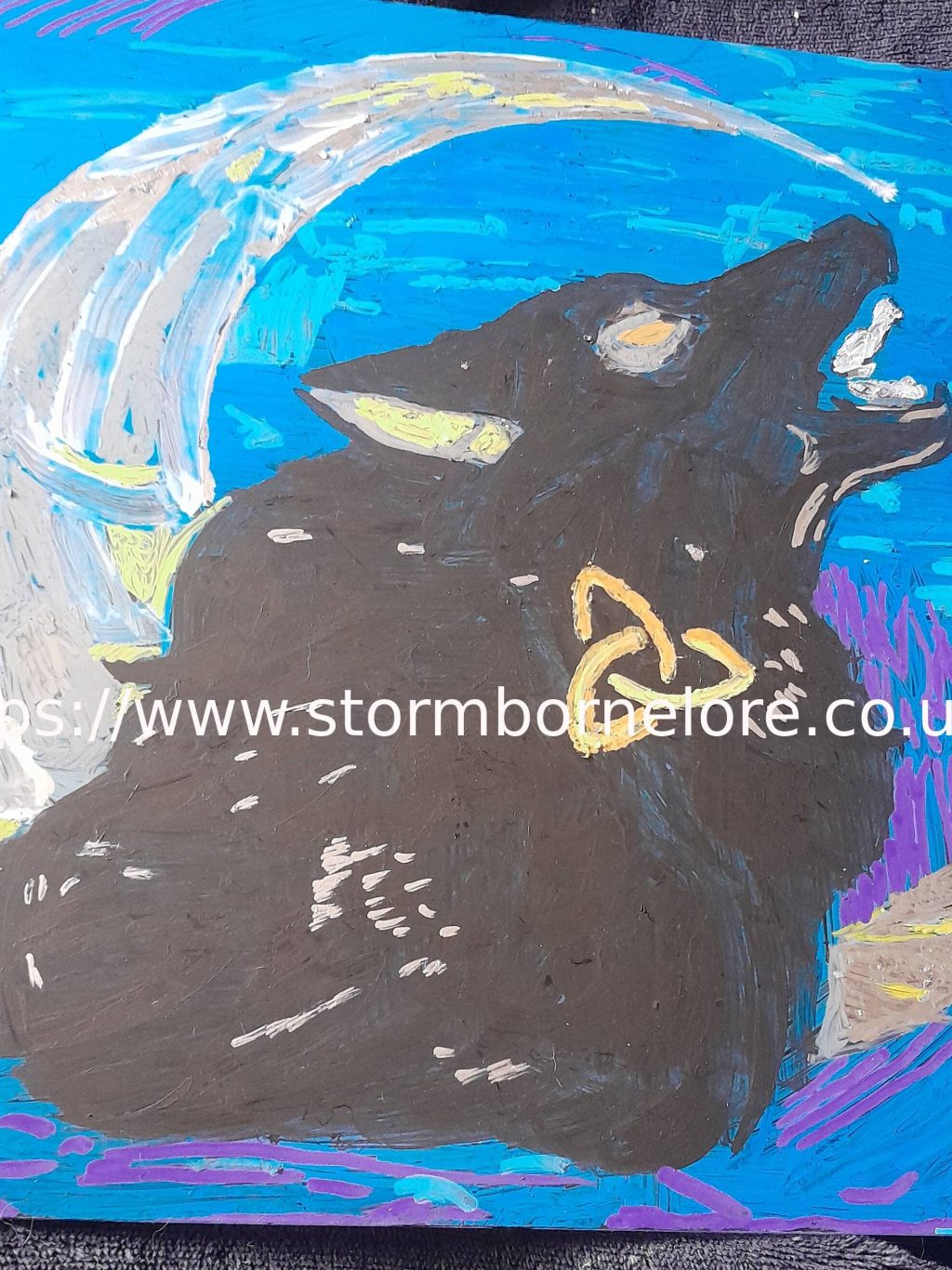
    The mists rolled thick across the highland of Staffordshire, curling like ghost fingers over rock and root. Beneath their shifting veil stood a figure that did not belong to the world of men not entirely. He was massive, broad-shouldered, with the raw frame of a warrior and the head of a beast. His fur was obsidian black, streaked with silver scars and ash.

    Red eyes burned beneath his brow. His breath came out in steam as if the forge fire lived in his lungs.

    Boldolph.

    The wolf-man. The cursed one. The guardian of the Stormborne line.

    That morning, he had awoken not as man, nor wholly beast, but as something sacred. Taranis had spoken only two words to him before the sunrise: “It begins.”

    And now he stood at the edge of Rykar’s Field, muscles tensed, waiting for the signal.

    Bronze glinted on the hilltop warriors from the Black Clawclan had gathered in force, armed with spears and teeth alike. Raiders, born of bloodlust, who left villages razed and children buried beneath burnt thatch.

    A low growl rumbled in Boldolph’s throat.

    Today, they would be stopped.

    Below him, the Stormborne forces gathered. Taranis on the ridge with Pendragon and Tairneanach perched behind him.

    , Lore chanting beside a fire that would not die. Drax tightening his bracers, muttering curses and prayers as one. Among the warriors stood farmers, hunters, fire-callers, bone-weavers all who had chosen to rise.

    But none were like Boldolph.

    He crouched low, the carved bronze blade strapped to his back. humming faintly forged by Drax, blessed by Lore, named Ashsplitter. His claws, though not natural, were tipped in obsidian. His howls call Morrigan from the far trees and silence men’s hearts.

    And when the horn blew, he moved like a shadow torn free of the dark.

    He crashed into the enemy line like a storm of fang and bronze. The first man he struck did not even scream just fell, bones splintered beneath the weight of the blow. Boldolph spun, slashed, roared, tore. Blood hit the grass like spilled wine.

    The Black Clawclan were fierce but they were not ready.

    “By the ancestors!” one shouted, staring in horror. “A beast walks!”

    A spear was hurled. Boldolph caught it midair, snapped the shaft, and flung it back. It pierced armor and flesh. The man fell.

    He was not alone.

    From the trees came Morrigan white and wraithlike, her eyes alight with moonfire. Together, they circled the enemy, not as humans, not as animals but as something other. Something older.

    Across the field, Taranis raised his sword high.

    “For every child taken,” he shouted, “for every flame snuffed out WE RISE!”

    The Stormborne charged. Bronze clashed with bronze. Flesh tore. Voices sang the old war cries.

    Boldolph didn’t hear them. He was lost to instinct now the heartbeat of the land pounding in his ears. His claws met bone. His teeth found leather and neck. He leapt and rolled and dove through fire.

    A warrior came at him with twin blades, marked in red clay and hate. Boldolph let him come. At the last second, he dropped low, sprang upward, and slammed both fists into the man’s chest. The impact shattered ribs and silence.

    Then came the Champion.

    Tall, scarred, wrapped in tattoos of wolf skulls. He grinned as he strode ahead, axe glinting.

    “You’re no god,” the Champion sneered. “Just a cursed mutt.”

    Boldolph stood, blood dripping from his chin.

    “I am neither,” he growled, “but you will kneel before this mutt.”

    They clashed.

    Steel to fang. Roar to warcry. The battle stilled around them as the two titans fought. Blades rang. Earth shook. Bones cracked.

    At last, Boldolph caught the Champion’s axe arm, twisted and snapped it. With a howl, he drove the dagger into the man’s chest.

    Silence.

    Then the howl.

    Long. Ancient. Reverberating through stone, marrow, memory.

    After the battle, the field was quiet.

    The dead lay in solemn rows, the fires lit to honor their spirits. Taranis stood at the center, cloak torn, eyes fierce. Lore marked the ground with runes of ash. Drax drank in silence.

    And Boldolph… sat alone beneath a tree.

    His fur was streaked with blood. His eyes no longer burned they watched the stars. Morrigan lay beside him, her white coat stained with battle.

    A small child approached. Her face was smudged with soot. Her eyes, wide with awe.

    “Are you a monster?” she asked.

    Boldolph tilted his head.

    “No,” he said softly. “I am what protects you from monsters.”

    She sat beside him.

    In that moment with the fire crackling, and the dead honored. the Stormborne still alive Boldolph, the cursed wolf-man, found peace.

    For just a while.

    © StormborneLore. Written by Emma for StormborneLore. Not for reproduction. All rights reserved.

     If this spoke to you, please like, share, and subscribe to support our mythic journey.

  • The Bond Between Taranis and Boldolph.

    The Bond Between Taranis and Boldolph.

    The fire had long gone out, and the cold crept in like a snake through the underbrush. Taranis sat with his back to a stone outcrop, shivering in silence. His breath came in misted gasps, though he dared not build another fire. Fire drew eyes. And eyes mean death.

    He was only nine winters old skin and bones beneath a damp wolf-pelt, alone since exile. Alone… or so he believed.

    Until that night.

    A low growl rolled from the darkness.

    Taranis reached for his stick-spear crude, splintered, tipped with flint and rose to a crouch. The growl came again, closer. Deep. Measured. Not hunger. Not rage. Warning.

    The trees parted.

    A shadow, massive and black, emerged from the mist.

    The wolf.

    Not just any wolf this one had eyes like embered blood. A scar down his left side that caught the moonlight. He have snapped Taranis in two.

    But he didn’t.

    Instead, the wolf circled once, then lay down, his tail wrapping around his legs. He did not blink. He just watched.

    Taranis lowered his spear.

    “You’re not here to eat me,” he said, voice hoarse from days without speech.

    The wolf said nothing, but his ears twitched.

    Taranis crept closer, sat back down beside the dying fire pit. He wrapped the pelt tighter and leaned ahead.

    “I don’t know why they hate me,” he whispered.

    The wolf’s eyes did not move.

    “I saved my brother. I didn’t ask for the fire, or the storm. I just… did what I was told.”

    Still the wolf said nothing, but his breathing was calm, deliberate like he was listening.

    Taranis closed his eyes.

    In the morning, he woke to warmth. Not from a fire, but from the wolf curled around him, sheltering him from the frost.

    From that day onward, Boldolph never left his side.

    He didn’t need to speak. His presence was enough. His strength, a shield. His silence, a vow.

    Taranis never asked him why.

    But deep down, he knew.

    Boldolph had seen something in him not just a boy, not just a fire-starter. Something ancient. Something kin.

    And Taranis, though still just a child, reached out and rested a hand on the wolf’s thick fur.

    “Thank you,” he whispered.

    The wolf let him.

    Thank you for reading.© 2025 Emma Hewitt / StormborneLore. All rights reserved.Unauthorized copying or reproduction of this content is prohibited.

    If you enjoyed this story, like, share, or leave a comment. Your support keeps the storm alive and the chronicles continuing.

  • Nature and Memory: A Reflection in Poetry

    Nature and Memory: A Reflection in Poetry

    A Poem by Taranis Stormborne

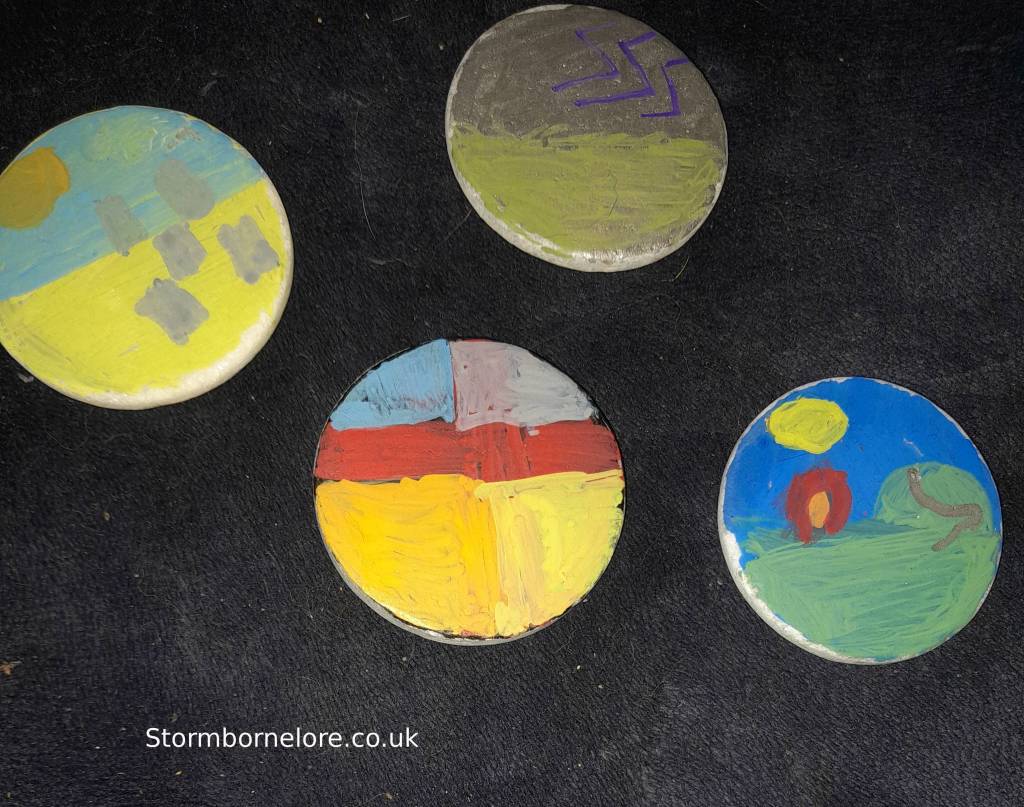
    Four painted stones displayed on a black surface, each featuring different colorful designs.
    Colorfully painted stones representing various landscapes, reflecting themes of nature and memory.


    They carved the stone while I still breathed,

    The blood not dried on mother’s brow.
    My name was spoken not with love,
    But like a curse the tribe would disavow.

    The fire crackled but not for me,
    No meat passed down by elder’s hand.
    I watched the smoke rise like a ghost
    Above a world I’d never understand.

    Their eyes were flint.

    Their backs like stone.
    My brothers looked, then looked away.
    I was not child. I was not kin.
    I was the price they chose to pay.

    I walked into the weeping trees,
    Each branch a wound I could not see.
    The ground did not resist my weight.
    The wilds at last remembered me.

    A boy of eight. A heart struck down.
    But storms remember where they’re born.


    The silence wrapped around my bones.
    And made me something more than scorn.

    They taught me I was less than breath,
    But wind and wolf still knew my name.
    The rain did not deny my steps.
    The storm would never speak of shame.


    Have you ever felt cast out not in body, but in soul?
    Share your thoughts. The fire still burns, and there’s room beside it.

    Thank you for walking this path through exile and memory with us.

    © written and created by ELHewitt