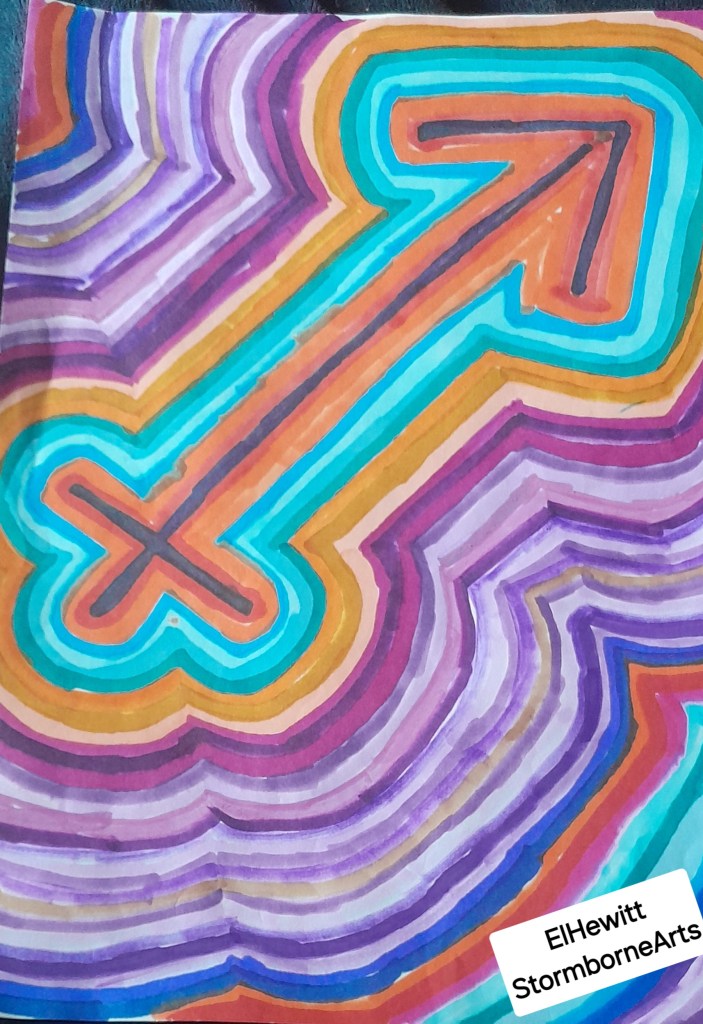
A vibrant abstract illustration featuring layered colors and an arrow design, symbolizing direction and change.
The children were asleep when Drax arrived.
The house was small, only one room wide, built of timber and stone Draven had carried with his own hands. Smoke curled from the hearth. His wife sat beside the fire, mending a tear in their daughter’s cloak. The scent of broth lingered in the air, soft and warm.
Draven opened the door before Drax could knock. He had felt him coming, the way a wolf senses winter.
They did not greet one another at first.
Drax stepped inside, shoulders heavy with travel and silence. His eyes went to the sleeping children. To the carved wooden animals on the shelf. To the woven basket of herbs drying near the window.
A life earned. A life held carefully. A life that could be broken by a single word.
Draven’s wife looked up, needle paused above the cloth. As she looked to Drax a heavy silence stilled in the room. She had always known this peace was borrowed.
Drax removed his gloves. He spoke quietly as he looked to his brother a man who stood 5foot 9 inches, slim build with dark hair..
“War is coming.”
There was no answer right away.
Draven sat beside the fire. His wife rested her hand over his — steady, steady, steady — and he closed his eyes.
Not in anger. Not in dread. But in that deep, wordless grief of a man who knew peace was never his to keep.
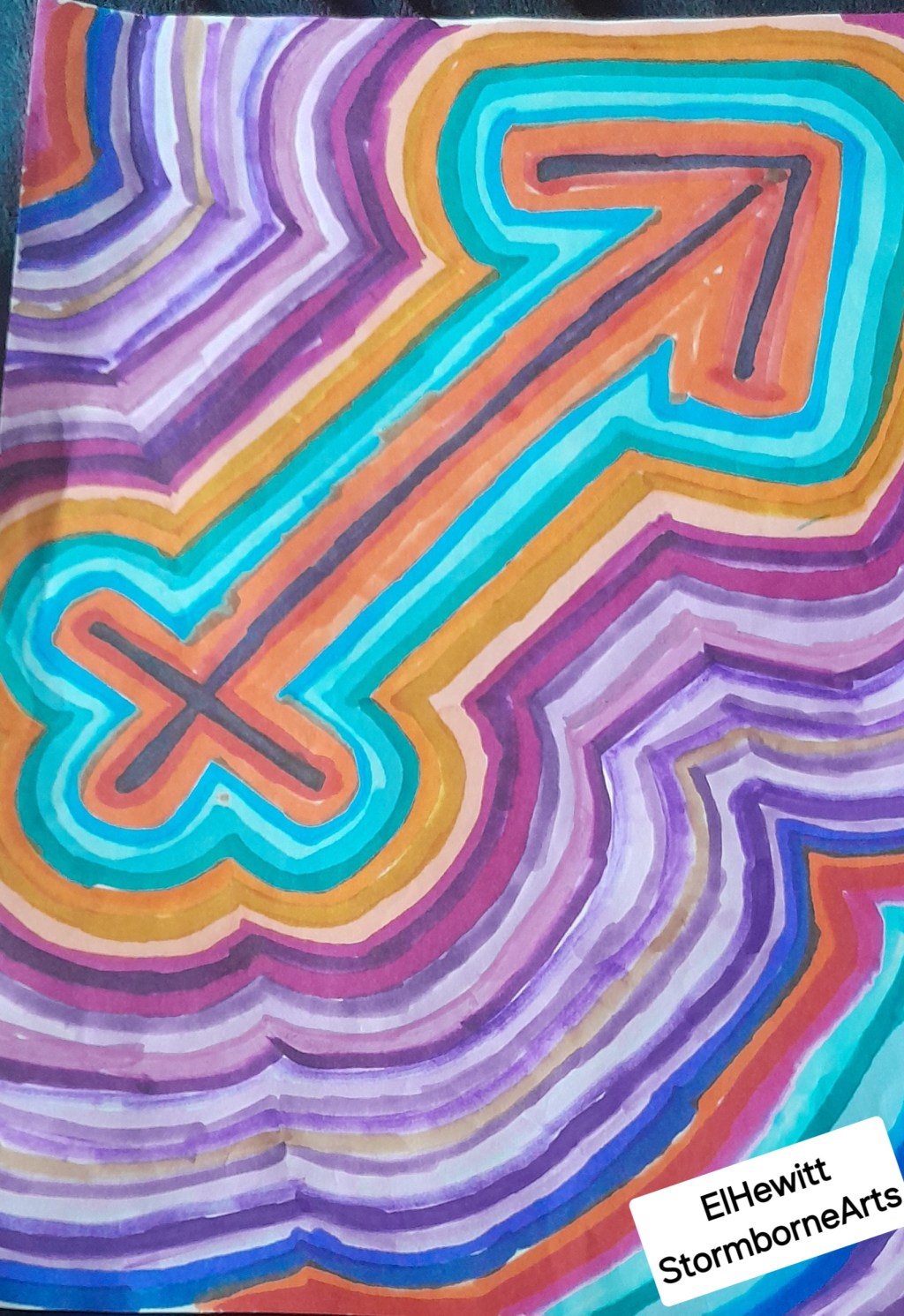
Vibrant abstract artwork featuring layers of colorful concentric patterns and a bold arrow design.
Not all protectors stand in front of you. Some stand behind, in the treeline, unseen.
Draven Stormborne is the quiet brother the watcher in the woods, the one who listens before he speaks, the one who guards what others never notice is in danger.
He does not seek glory, or power, or command.
He simply protects.
Because someone must.
Identity & Role
Archetype: The Wolf / The Ranger / The Guardian
What he represents
Survival, compassion, natural balance
His purpose: To keep the living world safe
His burden: He does so alone
Where Taranis is fire, Draven is root and soil. Where Drax builds walls, Draven keeps the forest whole. Where Lore remembers the dead, Draven protects the living.
He speaks little. But when he does, it is always truth.
Strengths
Silent hunter
Patient, observant, precise
Deep empathy for the vulnerable (even when it hurts him)
Unshakable calm until someone threatens what he loves
Draven does not fight for honor. He fights when children are cold. When villages are cornered. When forests are taken. When no one else knows danger is coming.
He is the last line. Always.
Wound
Draven lives his life on the edges of others’ lives.
He watches families grow old. He watches friends die. He walks away so they never have to see him remain the same.
He carries the loneliness of the immortal who chooses love anyway.
He is not forgotten he is simply unseen.
Whispers Across History
Draven does not appear in chronicles. He appears in folk tales.
Stories of:
A silent hunter who returns missing children
A man who drives wolves away with nothing but a look
Footprints in snow where no village scouts had been
A stranger who buried the dead when plague took a town
A figure seen at the treeline during winter famine watching, ensuring no one froze unseen
He is myth, rumor, guardian, ghost.
But he was always real.
How Others Speak of Him
“He does not ask for thanks. He does not wait for it.”
“When the forest goes quiet he is there.”
“Some gods protect nations. Draven protects one life at a time.”
This Is Only the Edge of His Story
Draven’s life does not unfold on battlefields or in king’s halls.
It unfolds:
in the hush of snow,
in the shade of old trees,
in the quiet moments between tragedy and survival.
If you follow him, you follow the wild, the ache, the truth of what it means to care without being seen.
There are some men who are born to stand with kings. There are some who are born to stand against them.
Taranis Stormborne was born to be the storm that breaks empires.
He is the brother who takes the front line, who holds the shield, who rises when others fall.
He carries the old fire of the tribes the wild courage of a world that refuses to surrender.
He has walked through ages of blood and frost. He has seen kingdoms rise and collapse into dust. He has fought under a hundred banners, yet swears loyalty to none.
Because Taranis does not protect rulers.
He protects people.
Identity & Role
Archetype: The Blade / The Storm / The Protector
What he stands for: Courage, defiance, resistance
His purpose: To stand where others can’t
His burden: He feels every loss. Even after centuries, he remembers every face.
Taranis is not a hero — he is the cost of heroism.
Strengths
Unbreakable will
Fierce loyalty to those who can’t defend themselves
Instinctive battlefield intuition
The ability to endure and return when others would break
Wound
He can save many but never enough. He carries grief the way others carry scars.
No matter what age he walks through, war finds him. Or, he is what war is searching for.
Whispers Across History
Taranis is never officially recorded but his shadow is.
There are stories of:
The lone warrior who held a bridge against an army and vanished into the woods.
The man in the Perry Woods who supplied gunpowder to rebels and walked away unseen.
The shieldwall breaker whose roar turned battles.
The wandering guardian who frees the enslaved and disappears before dawn.
The soldier who dies, and then is seen again years later unchanged.
Sometimes he is called a king. Sometimes a demon. Sometimes a ghost.
But he is always Stormborne.
How Others Speak of Him
“When the world is burning, look for the thunder. He will be there.”
“He does not lead armies. He ignites them.”
“If you hear the storm, it is already too late to run.”
This Is Only the Beginning
Taranis’s story is not told in a single lifetime. or a single kingdom or a single war.
His path crosses:
empires,
rebellions,
oceans,
and centuries.
But those stories are not kept here.
They are found in the fragments the tales, the memories, the scars, the songs, scattered across StormborneLore.
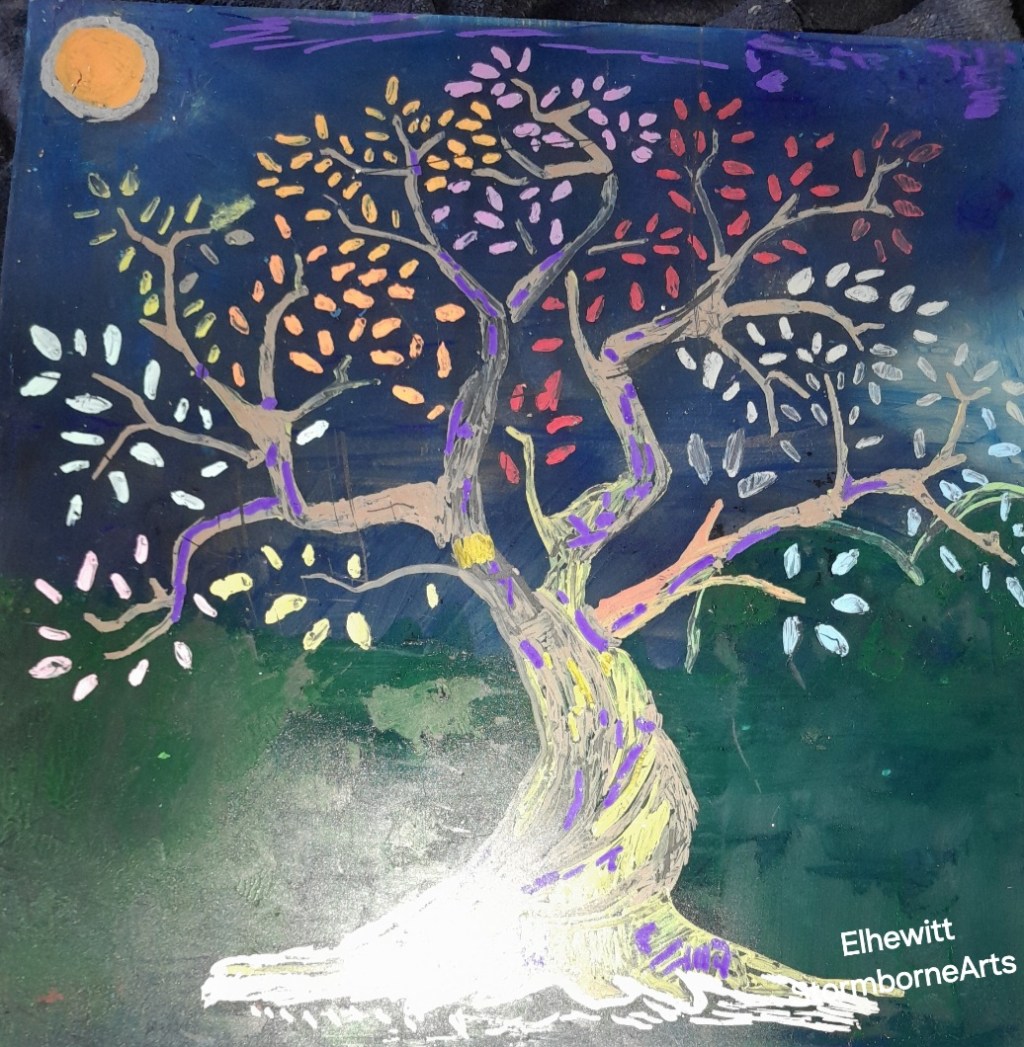
A vibrant, artistic depiction of a tree with colorful leaves set against a dark background, symbolizing the mystical elements of nature.
By E.L. Hewitt — StormborneLore
Dawn came slow over Cannock Chase, the sky still holding tight to the colours of night.
Mist clung to the ground, pale as breath on cold glass. The trees stood quiet as watchers in old cloaks.
Lore walked barefoot through the wet grass, collecting what the earth offered.
Yarrow first pale and feathery, growing in shy clusters where the sunlight would later reach. Good for blood and fever, and for protection against spirits that lingered too close.
He cut it gently, whispering, “For the ones who yet breathe.”
Rowan bark next, peeling in thin curls beneath his knife. The tree shivered, though no wind touched it.
Rowan remembers, the old women used to say and Lore believed them.
Last came the resin pine tears hardened in the bark of a fallen giant, still sweet, still golden.
He held it to his nose, breathing in the scent of memory. Smoke. Rain. Home.
Above him, the crows gathered.
Three at first. Then five. Then a dozen, their wings murmuring like pages turning.
They did not caw. They simply watched.
Lore did not fear them. The crows of the Chase were older than any Druid’s words. Older than Rome’s roads. Older even than the songs of the first tribes.
They followed him as he walked between the birches. Their trunks ghost-white, rising from the mist like bones of giants sleeping beneath the soil.
The air felt listening.
The trees breathed slow.
The old gods waited.
Lore spoke softly, almost too low to hear: “Stormfather. Bound-Brother. Wild King. I hear you.”
The leaves stirred, though the air was still.
And then
A whisper. Not with sound, but with bone and blood.
He rises.
Lore’s heart tightened. No fear only certainty.
The crows took flight at once, black wings cutting the dawn sky. They flew south, toward the marsh track near Landywood, toward the low birches where the Black Shields rested.
The dawn came slow and grey, dragging itself through the fog. As Taranis stood by the brook, cloak heavy with rain, listening to the groan of trees in the wind.
The men were stirring mud streaked, bone-tired, but still breathing. Caedric coughed, spitting into the fire’s ash.
“Reckon we’ve outfoxed ‘em, lord. Romans don’t fancy these woods no more than wolves do.”
Taranis gave a crooked grin. “Aye, an’ I’ll keep it that way. Chase belongs to the storm, not the eagle.”
He slung his satchel, nodding north. “Pack up. We take the old path up past Wyrley Hill, through the firs. If the gods favour us, we’ll reach the ford ‘fore night.”
“An’ if they don’t?” muttered one of the younger lads.
Taranis looked over his shoulder, eyes pale as lightning. “Then we make ‘em.”
They set off through the trees, boots sucking at the mire, breath fogging in the cold. Above, the sky split in pale streaks of silver and white, like a scar the world hadn’t healed.
By midday, the Chase fell behind them and the road opened wide broken Roman stones, weeds clawing through the cracks.
Caedric slowed, squinting. “Watling Street, once. My da said it stretched all the way to the sea.”
Taranis ran a gloved hand over one of the stones. “Sea don’t matter. Storm reaches farther.”
He turned to the others. “Keep low. Scouts’ll be watchin’ the high ground.”
They crossed in silence, shadows sliding between the birch trunks. A crow cried overhead, sharp and lonely.
Then movement was seen over the ridge. A figure on the ridge, half-hidden by mist. A glint of bronze.
Caedric hissed, “Bloody Romans?”
Taranis lifted a hand, quieting him. “Nah,” he said after a long look. “One man. Cloak’s too dark. Looks more like one o’ ours.”
The shape moved closer. A limp. Familiar.
“Taranis?” a voice called, rough as gravel. “By all that’s left o’ the gods, it is you.”
From the fog stepped an older warrior, scar cut deep across his jaw. “Byrin,” Taranis breathed. “Didn’t think the storm’d spare you.”
Byrin laughed, short and hollow. “It near didn’t. Lost three good lads south o’ Salinae, an’ near my own arm with ‘em. But word spreadsfolk say you’re gatherin’ again. Stormborne, back from the grave.”
Taranis gave a small, weary smile. “Not the grave yet, though Rome keeps diggin’.”
He looked at his men mud-smeared faces, eyes bright with a spark that hadn’t been there yesterday.
“Then it’s true,” said Byrin, glancing north. “You mean to march again?”
Taranis nodded. “Not march. Rise. Rome’s road breaks here our land, our law. Time we made ‘em remember.”
He drew a small blade, slicing a mark into the nearest stone a spiral, storm’s sigil.
Caedric watched, grinning. “Yow think they’ll see that, lord?”
Taranis met his gaze, voice low as thunder.
“Aye. An’ when they do, they’ll know the storm’s still breathin’.”
The wind rose, carrying the scent of rain and ash. Somewhere in the distance, thunder answered deep, slow, and close.
The Black Country dialect woven through this story carries the sound of the land Taranis once called home old speech born from forge and field.
Where words still echo the rhythm of hammers, storms, and stories told by firelight.
Much of The Broken Road is inspired by the landscapes around Cannock Chase, Wyrley, and Watling Street places where the ancient and modern meet in the same mist.
The mists of Cnocc clung low across the fields when Taranis turned north. Rain soaked the cloak across his shoulders, each drop heavy as guilt. Behind him, the standing stones of the old circle faded into grey half memory, half warning.
A handful of men followed, what was left of the Black Shields. Some limped. Some bled quietly into the mud. Yet none complained.
They cut through the marsh track at Landywood, the ground sucking at their boots.
“Bloody mire,” grumbled one of them Caedric, a smith from the Chase. “If Rome don’t catch us, we’ll drown in the bog.”
Taranis gave a faint smile. “Better the bog than their chains. Least the land buries its dead with honour.”
The men laughed, low and rough, their voices carrying through the mist. Overhead, crows turned circles against a sky bruised with stormlight.
By midday, they reached the edge of Cannock Chase. The trees rose dark and close, their branches whispering in the wind.
Here, the old tongue lived still the rustle of leaves. Carried the same sounds as the words once spoken in Mercia before Rome built her roads.
“Best not light a fire,” said another man. “The smoke’ll draw ‘em down Watling Street.”
Taranis shook his head. “The legions keep to stone. They fear what grows wild. That’s our road, not theirs.”
They made camp near the brook, the water brown with silt.
Taranis knelt, washing his hands, watching the red earth swirl away downstream.
He thought of Drax his brother in law and blood. Who wasvstanding in that Roman armour like a stranger wearing their father’s ghost.
“Praefect Drax,” he muttered. “You walk in the eagle’s shadow now. But one day, even eagles fall.”
As the others settled, Taranis sat alone beneath a birch tree. The thunder rolled again to the south, echoing over the hills of Pennocrucium.
He closed his eyes and let the sound find him not as omen, but as promise.
“Let Rome march,” he said softly. “The storm remembers.”
By nightfall, the brook had gone still only the soft hiss of drizzle on leaves broke the quiet.
The Black Shields huddled beneath the birches.Their cloaks steaming faintly where the rain met the last of the day’s warmth.
A small fire burned low, more ember than flame. They sat close to it, speaking little. The world had shrunk to mist and memory.
From the shadows, a young scout pushed through the undergrowth, mud streaking his face.
“Riders,” he whispered, breath sharp with fear. “South o’ Watling Street. Legion banners silver eagle, red field. A dozen strong, maybe more.”
Taranis looked up, his eyes catching what light the fire still gave. “Which way?”
“East,” said the boy. “Toward Pennocrucium.”
That word hung like ash. Rome’s fort Drax’s post.
Caedric spat into the fire. “Then your brother’s hounds are sniffin’ their trail back home.”
“Mind your tongue,” Taranis said, but without heat. “Drax walks a path I wouldn’t, but he walks it for his sons. Rome holds chains tighter than iron.”
The men nodded. They’d all felt those chains some on their wrists, some around their hearts.
The fire popped softly. Rain whispered down through the canopy, finding its way to the coals.
“Shall we move?” asked Caedric. “Not yet.”
Taranis rose, brushing mud from his knees. “If they ride to Pennocrucium, they won’t look for us here. And if Drax stands where I think he does, he’ll turn them aside before dawn.”
He turned his gaze toward the south, where the hills of Cnocc faded into night.
The stormlight there flickered once a pale flash through the clouds.
“See that?” murmured one of the men. “Thunder over Penn. He’s sendin’ you a message, I reckon.”
Taranis smiled faintly. “Aye. Or a warning.”
He knelt by the fire and drew a spiral in the dirt the old mark, the storm’s sign.
“Tomorrow we move north,” he said. “Watling Street’s theirs, but the woods are ours. We’ll strike where the road breaks near the old fort make Rome remember who walks her border.”
The men grinned, weary but alive again. For a heartbeat, the fire caught, burning bright as dawn.
Above them, thunder rolled once more. It sounded like a heartbeat slow, vast, unending.
Dawn crept slow over Cnocc, a thin gold edge behind the rain clouds. Mist clung to the standing stones, turning the world to shadow and breath.
Drax waited alone within the circle, his Armour dark with dew. Around him, the forest held its silence not even the birds dared speak before the storm.
A shape emerged from the trees. Bare-headed, cloak torn by wind, eyes bright with the same lightning that lived in the sea.
“Taranis,” Drax said quietly.
“Brother.”
They faced each other across the stones, a dozen paces apart soldier and exile, lawman and outlaw, blood and storm.
“You sent the boy,” Drax began. “You risked Rome’s wrath to deliver a letter. Why?”
“Because words still travel where armies can’t,” Taranis replied. “And because you needed to see the truth before Rome writes it for you.”
Drax’s hand went to the hilt at his belt, but he did not draw. “The truth is that you lead rebellion.”
“The truth,” Taranis said, stepping closer, “is that Rome rots from within. You see it, even in Pennocrucium the taxes, the prisons, the wards rising against their own peacekeepers. You know their order is just another storm wearing iron.”
“Law keeps the world from tearing itself apart.”
Taranis smiled faintly. “Then tell me, brother which law spared our people?”
The question hung like a blade between them.
Drax’s voice dropped. “You’ll bring ruin on every soul north of the wall.”
“And you’ll call it justice when the legions do it first.”
Lightning cracked behind the hills, casting their faces in white fire. For a heartbeat, they were children again mud on their hands, the taste of rain on their tongues.
Then it was gone.
Drax exhaled slowly. “If I turn my back on Rome, they’ll come for my sons.”
“Then send them to me,” Taranis said. “I’ll keep them safe and teach them what it means to be Stormborne.”
Drax met his brother’s gaze, every oath and scar warring inside him. “You ask too much.”
“I ask what blood demands.”
The wind rose, carrying the scent of thunder and pine. Somewhere beyond the ridge, a horn sounded Roman, sharp and close.
Taranis looked toward it, then back at his brother. “You didn’t come alone.”
Drax’s jaw tightened. “I had no choice.”
“You always had a choice.”
He turned, cloak whipping in the wind, and vanished into the mist.
Drax stood amid the stones, thunder rolling like a closing gate. For the first time in years, he no longer knew which storm he served.
The horn still echoed when Drax turned toward the ridge. Rain came again sharp, cold, unending washing the footprints from the mud where his brother had stood.
From the southern slope came the sound of Armour. The steady rhythm of Roman discipline: shields clashing, orders barked, hooves grinding stone.
Centurion Varro rode up through the mist, helm crested, voice clipped. “Praefect! You were told to wait at the lower ford. Our scouts saw movement rebels, by the look.”
Drax said nothing. His men shifted behind him, uneasy under the Centurion’s glare.
Varro’s gaze swept the clearing. “You’ve been here long, sir?”
“Long enough.”
“Any sign of the outlaws?”
Drax’s hand brushed the rain-darkened hilt of his sword. “None that concern Rome.”
Varro frowned. “Sir?”
“Withdraw your men to the ridge. If they move through the forest, they’ll spook what they can’t catch.”
Varro hesitated, suspicion flickering behind his eyes. “The Governor will want a report.”
“He’ll have one,” Drax said, voice like iron. “But not from you.”
Varro opened his mouth, then thought better of it. He saluted stiffly and wheeled his horse. The soldiers followed, vanishing into the haze.
When the last sound of their march had gone, Drax turned back to the standing stones. The mist seemed thicker now, the air charged and whispering.
He drew his sword not for battle, but for memory. The blade caught a sliver of light and, for a heartbeat, reflected the spiral carved into the nearest stone.
From the forest edge came a faint flicker of movement a figure, hooded and still. Not Taranis, but one of his kin. She raised her hand, palm out, the mark of the storm inked in black across her skin.
A silent vow.
Drax sheathed his sword. “Tell him,” he said quietly, though she not hear, “that I won’t be his enemy again.”
The woman vanished into the fog.
Behind Drax, Maren approached, cloak dripping. “Father… what will you tell Rome?”
“The truth,” Drax said, mounting his horse. “Just not all of it.”
As they rode back toward Pennocrucium, thunder rolled once more not from the sky, but from the earth itself. The storm was awake again.
The rain had not stopped since Caerwyn. Each morning it slicked the cobblestones of the fort. washing dust and ash into the gutters, as though Rome cleanse itself of guilt.
Praefect Drax Stormborne stood beneath the awning of the garrison, watching the centurions drill in the yard below. The sound of shields and iron echoed against the mist, rhythmic, hollow, and far too familiar.
“Word from the coast?” he asked without looking.
His aide the same grey-eyed veteran who had once served under him at Cannock stepped ahead. “None yet, sir. But reports spread through the camps. They say a ship found half-burned near the cliffs. No bodies. Just marks on the hull.”
“Marks?”
The man nodded. “A spiral carved deep into the wood. Like a storm-ring.”
Drax’s hand tightened around the railing. The symbol of the old clan. The one Rome had forbidden.
Behind him came the sound of boots lighter, hesitant. His second son, Maren, saluted awkwardly. “Father, the magistrate awaits. There’s unrest in the lower wards. They want judgment from the lawman.”
“The lawman,” Drax murmured. “Tell them the law doesn’t bend to whispers.”
“But it bends to Rome,” Maren said quietly.
Drax turned, eyes hard. “Careful, boy.”
The silence between them held the weight of unspoken things of oaths broken and storms returning. Drax looked at the lad and saw both his past and his punishment.
Finally, he exhaled. “Your uncle stirs the seas. I’ll not have him stir the streets as well. We hold the line.”
Maren hesitated, then stepped closer. “And if he calls us brother, not enemy?”
Drax looked past him, toward the horizon where thunder still rolled over the coast. “Then I’ll answer him as both.”
A horn sounded from the walls. Another patrol missing along the northern road.
Drax drew his cloak, the Roman crimson dulled by rain. “Have the riders ready by dusk,” he said. “We go to Pennocrucium The Empire claim the law but the storm still knows my name.”
The thunder rolled again, closer this time, shaking the banners loose from their poles. The banners of Pennocrucium hung limp in the rain Rome’s edge of order against the wild heart of Pennocrucium .”
The rain eased to a whisper by dawn. Mist lay low over the road, a grey ribbon winding north through the pines.
Drax rode at the front of the column, his cloak heavy with last night’s storm. The standards of Rome sagged in the wet, crimson turned dull and earth-brown.
Behind him, twenty riders moved in silence. Men who had followed him through three campaigns and would follow him into a fourth. Even if none of them knew whose banner they truly served anymore.
The track narrowed as they neared the Chase. Crows wheeled above, their cries lost in the fog. Somewhere beyond the mist lay Pennocrucium the old land, the hill once sacred to his kin. Before Rome built its roads through the heart of it.
At his side, Maren broke the quiet. “They say the woods here are haunted.”
“They are,” Drax said. “By memory.”
The boy frowned, unsure if it was jest or truth.
By noon, they reached the stone marker where the Roman paving gave way to mud and root. There Drax reined in, eyes narrowing at the shape half-buried in the verge. An old shield, blackened by time, its boss marked with the faint spiral of the Stormborne ring.
“Leave it,” Drax murmured as one of the soldiers bent to lift it. “The dead have earned their ground.”
From the treeline came the sound of a horn low, distant, old. Not Roman.
The men stiffened. Maren’s hand went to his blade.
Drax only listened. The tone carried memory, not threat a call. One he had not heard since he was young enough to run barefoot across the Chase. A day when he named the wind his brother.
He turned to his son. “We camp here. No fires. No noise.”
“Sir?”
“They’ll come to us,” Drax said. “The Black Shields never forgot the way home.”
As the mist thickened, he dismounted and placed a hand on the wet earth. Beneath his palm, the ground hummed faintly the old song of the storm returning.
“If Taranis walks these woods,” he whispered, “then I’ll find him before Rome does.”
Thunder rolled somewhere far off not from the sea this time, but from the hills.
The river carried him through the marshes like an old friend whispering secrets of home. The oar bit into the brown water, steady, unhurried. Ahead, smoke rose in thin curls Roman campfires. His brother’s camp.
Taranis smiled faintly. Drax always did love his rules and rituals.
He pulled the boat onto the bank, the mud sucking at his boots, and paused to listen. The faint clang of armor, the laughter of children. The low murmur of Latin prayers so out of place in this land of bog and stone.
Then he saw him. Drax, standing by the fire, cloak draped in perfect folds, a soldier carved out of duty itself.
“Hello, brother,” Taranis called, his voice light but carrying weight enough to stir the air.
Drax turned, hand on his sword. Typical.
“Taranis. Show yourself.”
“Why?” he asked from the shadows. “So you can look at me and scowl like the Roman you’ve become?”
The words were easy, but his chest ached as he stepped ahead. He had dreamed of this moment through a hundred lonely nights on the island his brother alive, unbroken.
“I see you have sons,” he said softly. “And a fine uniform. Praefect now, are we? Rome’s loyal hound.”
Drax’s eyes hardened. “You acknowledge their law, then?”
“I acknowledge survival,” Taranis said. “But I bow to no empire.”
His gaze flicked toward the boys—curious, brave, full of questions. One of them smiled at him, and for a moment, the years fell away. He saw his brother laughing beside him on the cliffs above Letocetum. Before the legions came, before blood was traded for banners.
“You shouldn’t have come,” Drax said.
“I didn’t come for Rome.” He met his brother’s eyes. “I came for what’s left of us.”
The words hung between them, raw and quiet.
The youngest boy tugged at Drax’s cloak. “He doesn’t look like a villain, father.”
Taranis almost laughed. “No, lad. Villains rarely do.”
Then thunder rolled, deep and distant, like memory returning.
Drax looked to the horizon, and Taranis knew he felt it too—the pull of storm and blood.
“The storm’s coming,” one soldier muttered.
Taranis turned toward them, eyes bright with mischief and grief. “No,” he said. “The storm’s already here.”
He stepped back into the trees, the forest closing around him. When the boy’s voice called after him—“How did you escape the island?”—he turned once more, smiling through the rain.
“I built a boat,” he said simply. “Remember that when the world tries to cage you.”
Then he was gone.
Behind him, the Roman camp crackled in the rain, and his brother’s name lingered on the wind.


 StormborneLore