The clang of steel echoed across the Roman training yard. The sun was still low, its pale light glinting off helmets and polished shields. Taranis moved like shadow and storm, his chains rattling as he fought against three centurions in succession.
Every strike he gave was measured, precise but every parry cost him pain. The iron bindings cut into his wrists, leaving a thin red line that deepened with each movement. He refused to yield.
Caelum stood at the edge of the sand pit. His tunic far too fine for this place a youth of maybe sixteen, bright-eyed and restless. His gaze never left Taranis.
“uncle Marcos,” he said quietly, turning to the older man beside him. “Can those chains come off him?”
Marcos didn’t answer at once. His face was lined from years in service, his eyes as sharp as the swords he trained with. “Chains are the only reason he’s still alive, Caelum,” he said finally. “Without them, some fool would call it fear instead of discipline.”
“But he’s fighting for us now.” Caelum’s voice carried, defiant. “For Rome, at least.”
In the pit, Taranis struck low, sweeping a soldier’s legs out from under him. Before turning the momentum into a twist that sent the next centurion stumbling backward.
The last one hesitated, shield raised, watching the way. Taranis breathed steady, like a man waiting for the storm to break.
The chain coiled once, twice then snapped out, wrapping the shield edge and dragging it down. The sound of the soldier hitting the ground was followed by silence.
Caelum took a step ahead. “He’s more Roman than half your men.”
Marcos shot him a warning look. “Careful, boy. You sound like your mother.”
The youth smirked faintly. “She says the same.”
When the training was done, the soldiers dispersed, muttering under their breath half respect, half fear. Taranis knelt in the dust, hands bound before him. Marcos approached, tossing him a canteen.
“You could have killed them,” Marcos said.
Taranis drank, the water streaking through the dust on his face. “You didn’t tell me to.”
Marcos grunted, half a laugh, half frustration. “One day, that mouth of yours will get you killed.”
“Maybe,” Taranis replied. “But not today.”
Caelum stepped closer, watching the bruised wrists, the marks the chains left behind. “You’re not like the others. You don’t fight for their gods.”
Taranis looked at him not unkindly. “No. Mine are older. And they don’t care who wears the crown.”
The boy tilted his head. “If I asked you to fight for me instead of Rome?”
Marcos snapped, “Enough!” But Taranis only smiled slow, deliberate, dangerous.
“Then, little wolf,” he said softly, “you’d better be ready to pay the price.”
Above them, thunder rolled faintly in the distance, though the sky was still clear.
The morning mist hung low across the valley, veiling the lands of Emberhelm in silver. From the high balcony of his hall, Lord Drax Stormborne watched the world stir awake.
Smoke from hearths curling above thatched roofs. The faint clang of the smithy below, and the distant echo of a horn calling men to the fields.
The realm had been quiet these past weeks, though quiet was not peace. Rome’s presence had spread like frost silent, glittering, and deadly to touch. Their banners were seen on the roads again, their soldiers marching east toward the fort that caged his brother.
Drax’s hands rested on the stone rail. Scarred knuckles gripping the cold edge as if the granite itself were his only anchor.
“Uncle Taranis forgives us all, father.”
The small voice broke the silence. His son stood behind him Caelum, barely thirteen summers. But already bearing the solemn eyes of a man twice his age. The boy held out a folded parchment, its wax seal cracked, its edges smudged with soot.
Drax took it carefully. The writing inside was firm but uneven, written in haste. Forgive nothing. Remember everything. Below, a single mark a lightning bolt drawn in charcoal.
Drax’s chest tightened. His brother’s hand. His brother’s defiance.
“Who gave you this?”
“One of the Roman guards, father,” Caelum replied. “He said… he said Uncle still lives. He fights every day.”
Before Drax answered, boots echoed behind them. Roberto stepped into the chamber, his armour dull and unpolished, the scent of road dust still clinging to him.
“My lord,” he began, voice low, “I spoke with one of the centurions. They see him as a danger now too much influence, even in chains. They’ve moved him deeper into the fort. Isolation. Only the soldiers see him.”
“Do they mistreat him?” Drax asked, though he already knew the answer.
Roberto hesitated. “They tried to crucify him last week. He survived. Yesterday, they threw him to the lions chained, unarmed. He walked out again.”
The hall fell silent. The fire popped in the hearth, throwing orange light across the stone floor. Drax turned back toward the window. his reflection caught in the misted glass grey at the temples, lines of command etched deep across his brow.
“They can’t kill him,” Roberto said quietly. “So they make him suffer.”
Drax exhaled slowly, the weight of his station pressing like iron against his ribs. “Then we’ll keep him alive in every way they can’t stop. Food, silver, messages whatever can reach him, it will.”
He turned to his son. “Caelum, you will remember this. A lord’s duty is not to speak loudest, but to act where no one sees.”
The boy nodded, solemn and still.
That afternoon, Drax rode out beyond the keep. The fields of Emberhelm stretched before him. The broad plains that once echoed with the clash of blades when the Stormborne banners flew proud.
The Farmers bowed as he passed, and he nodded in turn. To them, he was not just a lord. He was the last shield between their freedom and Roman law.
At the river’s edge, he dismounted, crouching where the waters ran dark and cold. He saw his reflection distorted in the ripples older, heavier, but not yet broken.
He remembered when Taranis had knelt in that same river,7 years ago. Swearing an oath to the gods of wind and storm. “We are not born to yield,” he had said, the water lapping at his wrists. “Even if Rome takes the land, they’ll never take the sky.”
Drax closed his eyes. The oath still lived within him, though it had been buried under the weight of command.
When he returned to the hall, he found Aislin. Stood waiting by the hearth his wife, wrapped in a shawl of woven wool. Her hair touched by the faintest trace of silver.
“You’ve heard the news,” she said softly.
He nodded.
“Will you go to him?”
Drax’s jaw tightened. “Not yet. The fort is surrounded. My every step is watched. To move too soon would doom us all.”
“And if you wait too long?”
He met her gaze, steady and unflinching. “Then he dies a legend. And legends, my love, outlast empires.”
She said nothing more. She simply placed her hand over his, and for a moment, the storm in his chest calmed.
That night, the wind rose.
From the balcony, Drax watched lightning fork across the distant hills. He thought of his brother, chained and bloodied, standing alone beneath the roar of lions and the jeers of men. And he swore, silently and fiercely, that this would not be the end.
The Romans thought they had captured a man. They had not realised they had locked away a tempest.
And storms… always find their way home.
The council chamber was dim, lit only by the flicker of oil lamps. Shadows stretched long across the stone floor, dancing like restless spirits.
“Are priests allowed to see Taranis?” Lore asked the centurion, his tone calm but deliberate.
The Roman officer hesitated, eyes flicking between Drax’s advisor and the lord himself. “Only those sanctioned by command, sir. The prisoner is considered… volatile. Dangerous to morale.”
“Dangerous,” Drax repeated quietly . His gaze fixed on the parchment that still bore his brother’s mark a black streak of charcoal shaped like lightning. “That is one word for faith unbroken.”
The centurion shifted, uneasy beneath the weight of the lord’s tone. He had served Rome for years. But there was something about the Stormborne that unnerved him men who spoke softly yet carried storms behind their eyes.
“Tell your commander,” Drax said at last, his voice cool as the mist outside. “that Emberhelm’s temple will pray for Rome’s victory. And for the salvation of the condemned. It would honour the gods to have a priest available for confession before transport.”
The officer nodded stiffly. “I will… relay the demand, my lord.”
When the door closed, Lore exhaled, rubbing his temples. “You plan to send one of ours.”
“Of course.” Drax turned toward the hearth, watching the flames burn low. “If Rome bars us with iron, we’ll walk through with words. Find one of the druids who wears a Roman mask one who can keep silent under pain.”
Lore bowed his head slightly. “A dangerous game.”
“All games are,” Drax murmured, eyes still on the fire, “when the stakes are blood.”
Two days later, beneath a grey dawn, a solitary figure rode from Emberhelm. He wore the plain robes of a Roman cleric, his face shadowed beneath a hood. No weapon hung at his side, no coin jingled in his pouch.
With only a small satchel of herbs, a ring wrapped in cloth, and a wax-sealed blessing marked his purpose.
His name was Maeron. Once a druid of the old faith now known to Rome as Marcus. A man who had survived the purges by trading his oak staff for a prayer scroll.
The road to Viroconium wound through dead forests. The mist-shrouded valleys, the silence broken only by the clatter of hooves and the distant calls of crows.
When he reached the Roman fort, guards searched him roughly, tearing through his satchel and stripping him of his cloak. Finding nothing amiss, they granted him ten minutes with the prisoner.
The cell smelled of iron, straw, and old blood. Chains hung from the walls like spiderwebs.
Taranis sat in the corner, wrists bound, his head bowed. A thin cut traced his cheek, half-healed, crusted with dust. He did not look up when the door opened.
“You come to pray?” His voice was low, worn smooth like riverstone.
“I come to remind you,” Maeron whispered.
Taranis lifted his head slowly, and for a moment the fire in his eyes banished the gloom. Maeron knelt before him and drew from his sleeve a small gold ring. its inner band engraved with the sigil of storm and flame.
Drax’s mark.
“Drax?”
“He watches,” Maeron said softly. “He waits. He sends this so you’ll know you are not forgotten. Food and coin move under Rome’s banners carried by men who owe him debts. You will have what you need to endure.”
Taranis reached for the ring. The chains clinked, faint as falling rain. “Tell him I am no longer enduring. I am learning.” His voice strengthened, each word edged with iron. “They think they cage me. But they are teaching me their weaknesses.”
He leaned closer, his gaze sharp, unyielding. “Tell Lore, Drax, and Draven I shall endure so they are safe. Tell them… the storm remembers.”
Maeron bowed deeply. “The gods still listen, even in Rome’s shadow.”
Taranis’s lips curled faintly. “Then let them listen to thunder.”
Outside, as Maeron was escorted back through the gates, lightning cracked across the horizon. The guards muttered that the storm came early that season.
Drax, miles away, looked up from his balcony at the same flash of light. whispered beneath his breath “Brother… I hear you.”
Thank you for reading if you have enjoyed please like, comment and subscribe.
The march south had stripped the world of meaning. Days blurred into rain and dust, dawn into dusk, until even time seemed shackled beside him.
By the time they reached the Roman fort near Corinium, Taranis Storm no longer knew how many nights had passed.
Only the rhythm of iron and boots. The murmur of Latin commands, and the distant echo of thunder in his bones.
The fort loomed ahead stone and order built upon the bones of chaos. Walls cut sharp against the grey horizon, guarded by rows of pikes and men who moved like clockwork. To Taranis, it felt wrong. A place without wind, without life.
Every sound was contained, controlled, sterile. Even the air smelled of discipline oil, smoke, and iron.
The storm in him recoiled.
They dragged him through the gates in chains. Soldiers gathered, curious and cautious. Some spat, others stared. Whispers followed him like ghosts daemon, barbarus, filius tempestatis. Son of the storm.
He smiled faintly. They weren’t wrong.
The cell they threw him into was little more than a pit of stone and shadow. The walls sweated damp, the floor slick with moss.
Above, a slit of light cut through the dark too narrow to touch the ground. He sat in the half-dark, wrists raw and heavy with iron. The silence of Rome pressed close, cold and absolute.
He did not pray. He waited.
When the footsteps came, they came as they always did measured, deliberate, Roman. The door creaked open, spilling lamplight like a wound across the floor.
Three entered.
A centurion, broad and cold-eyed, his crimson cloak pristine even in the grime. A scribe, pale and thin, clutching a wax tablet as if it were a shield.
And a woman cloaked, silent, her gaze as sharp as a blade. Her presence was wrong for this place; too poised, too knowing.
“Taranis of the Stormborne,” the centurion began, voice clipped and ceremonial.
“You stand accused of rebellion against Rome. The murder of imperial soldiers, and the disruption of trade along the Salt Road. Do you understand these charges?”
Taranis raised his head. His hair hung in dark, tangled strands, but his eyes were steady the colour of gathering thunder.
“I understand,” he said. “You’re afraid.”
The scribe faltered mid-stroke. The centurion’s jaw tensed. Only the woman’s expression remained still.
“You will answer with respect,” the Roman said.
“I already have.”
The blow came fast a strike across the face that turned his head with the sound of split skin.
Taranis straightened slowly, blood sliding from the corner of his mouth. His stare did not break.
The silence that followed was heavier than the hit.
The woman stepped forward. When she spoke, her accent carried the soft inflection of the East Greek, or something older.
“You fought well,” she said. “Even Rome admits that. There are ways to survive this. Serve us. Lead men under our banner. Take Roman land, a Roman name. You need only kneel.”
Taranis smiled faintly, the expression more weary than cruel.
“Rome offers gold to every man it fears. But my kind do not kneel. We weather.”
She tilted her head slightly. “Weather breaks.”
He met her eyes. “Only if it stops moving.”
For the first time, something flickered in her expression curiosity, maybe even a trace of respect.
The centurion, however, had no such patience. “Enough. He will be moved south to Londinium in three days. If he refuses Rome’s mercy, he will die as a slave.”
The woman’s gaze lingered on him a moment longer before she turned away. “He won’t bend,” she said quietly. “Not yet.”
They left him in the dark once more. The door slammed shut. The iron bolts fell into place.
Taranis exhaled slowly. The air was thick with the scent of blood and damp stone.
He tasted iron on his tongue metal, blood, defiance.
The light from above had shifted again, sliding across the wall like the movement of time itself.
He whispered, barely a sound. Not to gods, nor ghosts, but to the storm that still lived within his chest. It was quiet now, resting waiting. But it would come again. It always did.
When the night settled deep, the sound of rain returned, gentle against the stones.
In that rhythm, he found memory of his brothers’ faces in the torchlight. Drax’s steady eyes, Rayne’s trembling defiance, Draven’s silence. He had told them he would return. He intended to keep that promise.
The fort around him slept in its illusion of control.
But beyond the walls, clouds were gathering over the hills slow, patient, inevitable.
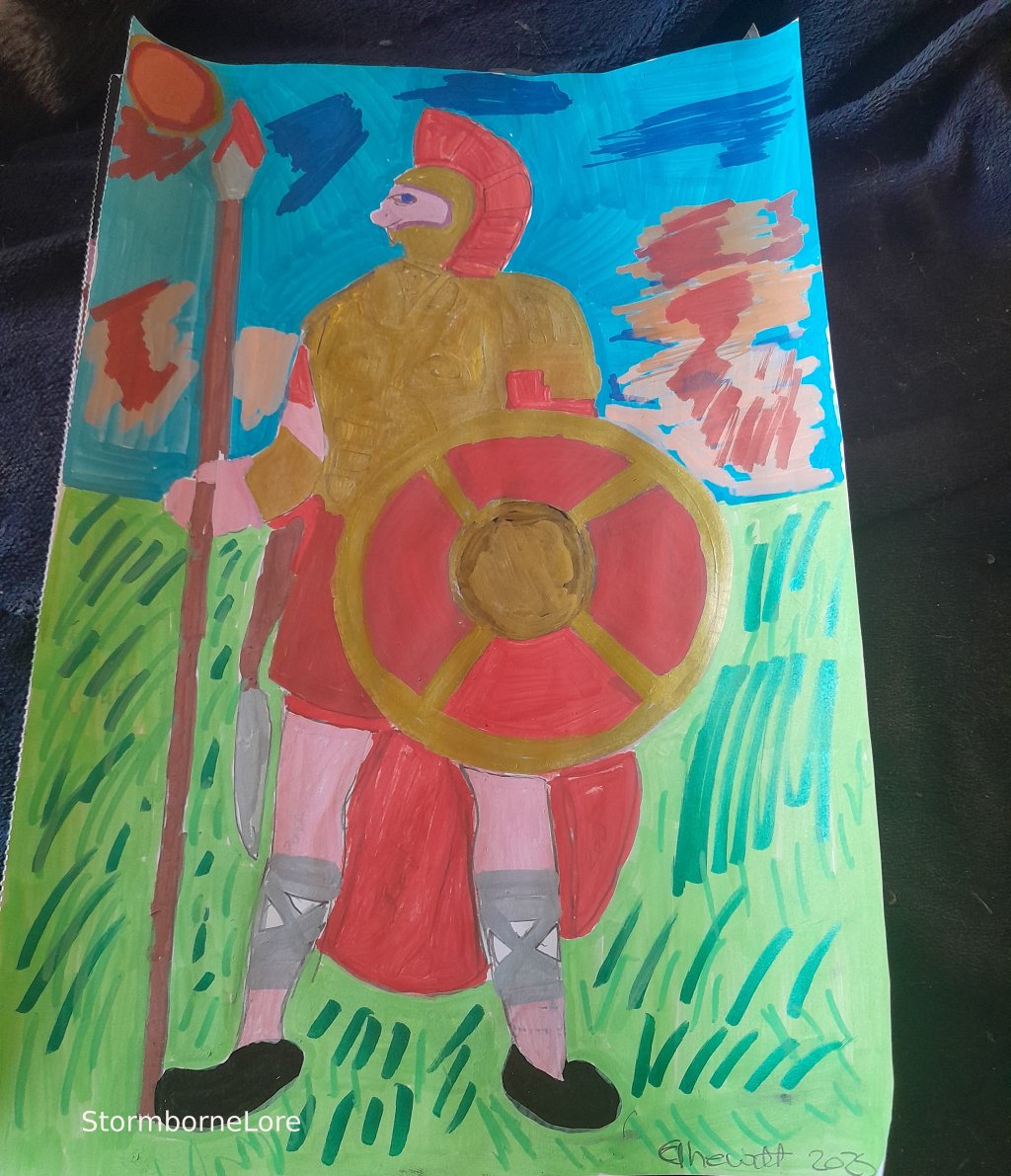
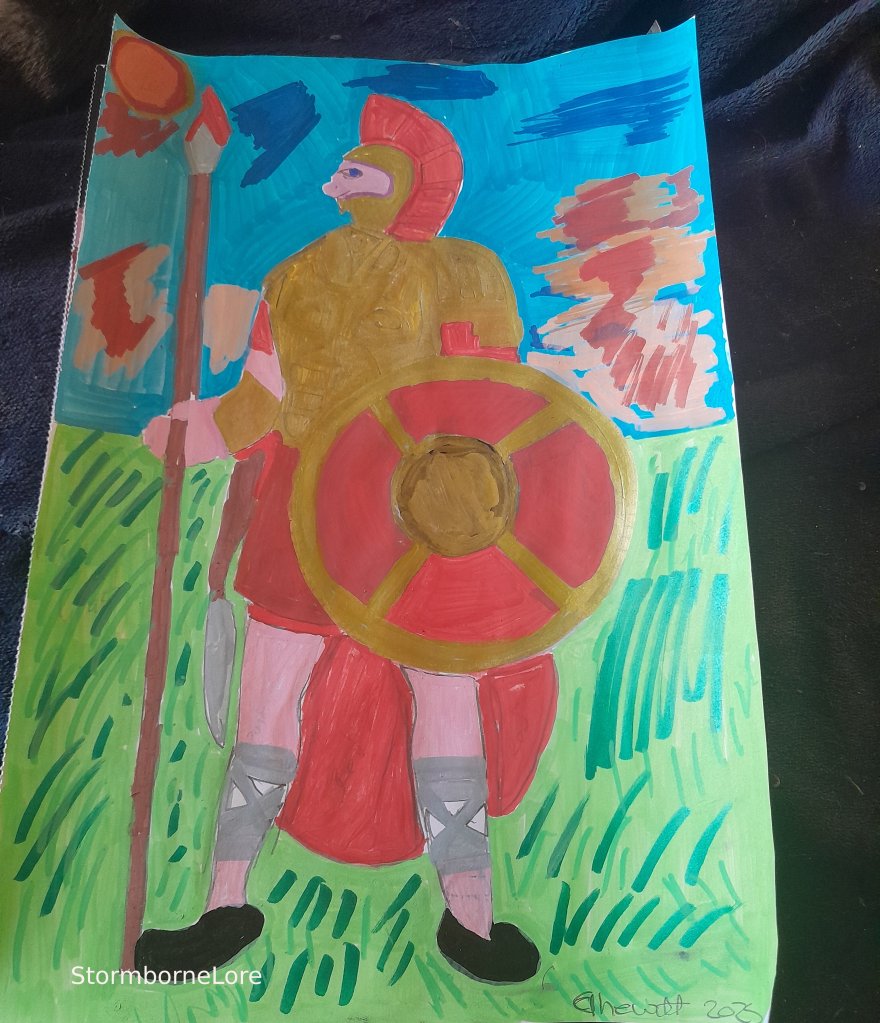
A vibrant depiction of a lone Roman soldier standing ready against a stormy backdrop, symbolizing the strength and fragility of empires.
Medium: Acrylic on paper
Size: A4
Description: A lone Roman soldier stands vigilant against a stormy sky, spear and shield at the ready. The piece captures both the strength and fragility of empire one figure set against the vast shifting forces of history.
A colorful thank you note encouraging readers to like and subscribe, featuring a sunny sky and green landscape.




 StormborneLore