Tag: E L Hewitt

  • Taranis Stormborne: The Storm’s Farewell By E. L. Hewitt

    Taranis Stormborne: The Storm’s Farewell By E. L. Hewitt

    The rain had eased by morning, though the ground still steamed where the storm had passed.

    The Mist clung to the Chase like breath, thick and cold, rolling through the hollows where the Romans once marched proud. Taranis stood by the broken road, cloak heavy with water, hair plastered to his brow.

    He could still see the ruts of cart wheels half-buried in mud Rome’s mark, carved deep into the land.

    “Won’t last,” he muttered, toeing one of the stones. “Nowt they build ever does.”Byrin came up behind, shoulders hunched against the chill.

    “They’ve gone, lord. Last cohort took the south road yestere’en. Fort’s empty now.”Taranis grinned, the kind of grin that didn’t reach his eyes.

    “Aye, I know. Felt it in the wind. Empire’s breath cut short.”He knelt, pulling a scrap of bread from his pouch, laying it on the old stone. Where once the eagle banners stood. Then he poured a splash of mead beside it.

    “For them as fought, an’ them as fell,” he said quiet-like.

    “An’ for the land, what outlives us all.”Byrin shifted his weight.

    “Spirit night, innit? Galan Gaeaf, like th’owd folk say. When t’dead walk an’ th’winds carry their names.”Taranis nodded, eyes on the fire they’d lit a low orange glow crackling through damp wood.

    “Aye. Let ’em walk. Let ’em see what’s come o’ Rome. Maybe they’ll find peace in the storm’s breath.”One by one, the men came forward, tossing bits of bread, small charms, even blades into the flames.

    Their offerings for their kin, for luck, for the year turning.

    “Break the road,” Taranis said after a time. “Let the dead cross free. Rome’s way ends here.”The sound of stone splitting echoed through the trees like thunder.

    Byrin wiped sweat from his brow. “Yow reckon we’ll be free now, lord?”

    Taranis looked north, where the sky lightened just enough to show the edge of winter coming.

    Free?” he said, voice low. “No mon’s ever free o’ summat storm, king, or ghost. But th’land’ll be ours again, leastways till next lot fancies it.” He turned toward the fire once more.

    The wind caught it, scattering sparks into the mist like stars. Somewhere, a raven called deep and hollow. Taranis lifted his blade, resting it against his shoulder.

    “Come on,” he said. “Let’s feed the fire one last time, then go. Night’s drawin’ in, an’ spirits’ll be walkin’ soon.”Behind ’em, the last stretch of Roman stone cracked under hammer blows.

    As steam was rising from the breaks like breath from a wounded beast.Taranis didn’t look back. He just walked, slow and steady, into the mist where thunder rolled soft and low, like the old gods stirrin’ in their sleep.

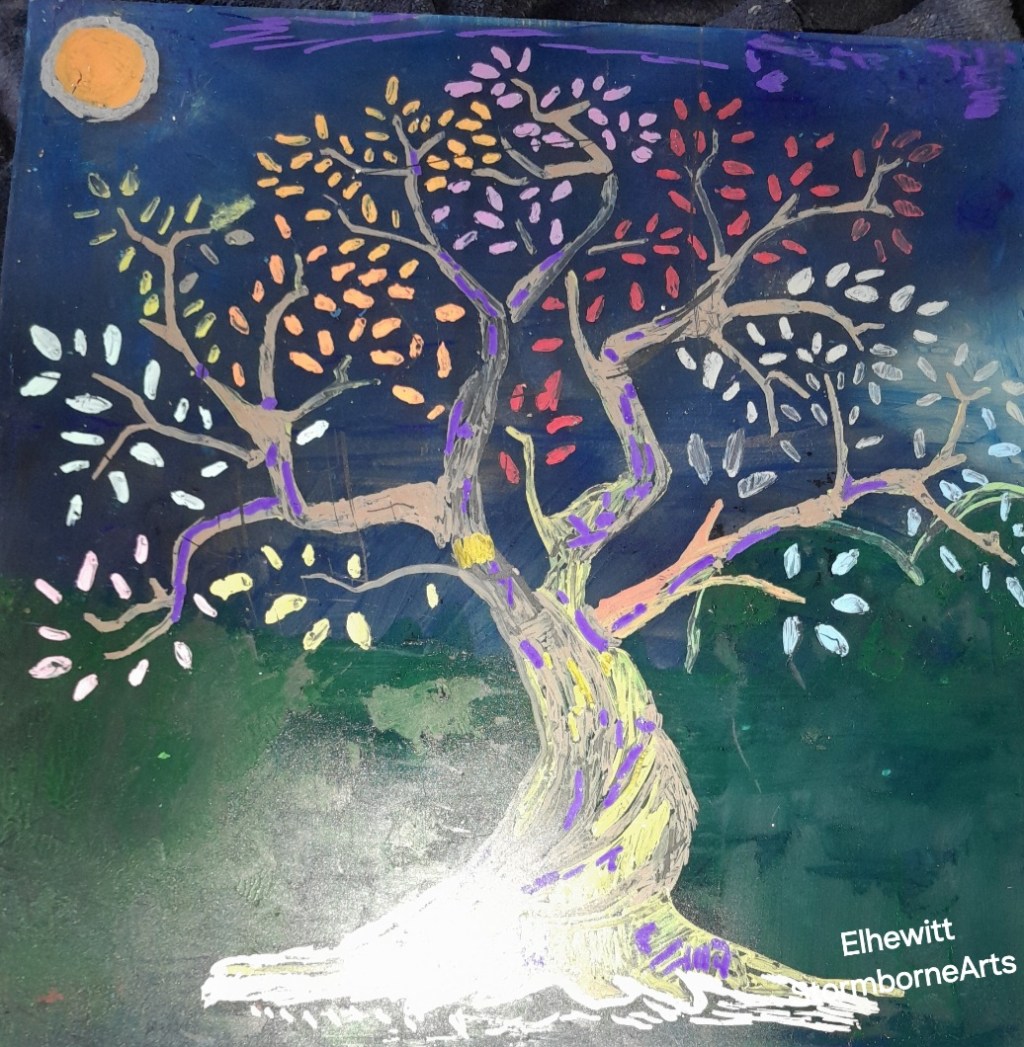
    © 2025 E. L. Hewitt / Stormborne Arts. All rights reserved.Unauthorized copying or reproduction of this artwork and text is prohibited.

    Thank you for reading.If you enjoyed this story, like, share, or leave a comment. Your support keeps the storm alive and the chronicles continuing.

    To read more about Taranis see The Prophecies and Tales of Taranis Unfolded
  • Galan Gaeaf Celebrations: History and Superstitions

    Galan Gaeaf Celebrations: History and Superstitions

    Nos Galan Gaeaf Hapus

    During Roman Britain, people celebrated a festival very like Samhain it was called Galan Gaeaf.


    When the Romans invaded England, they began to see its celebrations blend with their own traditions:

    Feralia a Roman festival to honour the dead, sharing the same reverence for ancestors.

    Pomona a Roman celebration for the goddess of fruit and trees. which gave rise to the tradition of bobbing for apples.

    Galan Gaeaf is an Ysbrydnos a spirit night. when the veil between worlds thins and spirits walk the earth.
    The term first appears in literature as Kalan Gayaf. In the laws of Hywel Dda, and is related to Kalan Gwav.


    In Christian tradition, it became All Saints’ Day, but for those who still celebrate Calan Gaeaf. It remains the first day of winter a time of endings, beginnings, and remembrance.

    Let us not forget our past our warriors, our farmers, and the land itself that gives us life.

    Ancient Traditions

    As a harvest festival, farmers would leave a patch of uncut straw. Then race to see who can cut it fastest. The stalks were twisted into a mare, the Caseg Fedi.


    One man would try to sneak it out in his clothes. If successful, he was rewarded; if caught, he was mocked.

    Another tradition, Coelcerth, saw a great fire built. Each person placed a stone marked with their name into the flames. If any name-stone was missing by morning, it was said that person would die within the year.


    Imagine the chill of dawn as people searched the ashes for their stones!

    Then there was the terror of Y Hwch Ddu Gwta. The black sow without a tail and her companion, a headless woman who roamed the countryside. The only safe place on Galan Gaeaf night was by a roaring hearth indoors.

    Superstitions were everywhere:
    Touching or smelling ground ivy was said to make you see witches in your dreams.


    Boys would cut ten ivy leaves, discard one, and sleep with the rest beneath their pillows to glimpse the future.


    Girls grew a rose around a hoop, slipped through it three times. cut the bloom, and placed it under their pillow to dream of their future husband.

    It was also said that if a woman darkened her room on Hallowe’en night and looked into a mirror. Her future husband’s face would behind her.
    But if she saw a skull, it meant she would die before the year’s end.

    In Staffordshire, a local variation involved lighting a bonfire and throwing in white stones . If the stones burned away, it was said to foretell death within a year.

    Food and Feasting

    Food is central to the celebration. While I don’t make the traditional Stwmp Naw Rhyw. a dish of nine vegetables I make my own variation using mixed vegetables and meat.

    There’s little real difference between the Irish Gaelic Samhain and the Welsh Calan Gaeaf.


    Each marks the turn of the year the death of one cycle and the birth of another.


    Over time, every culture left its mark: the Anglo-Saxons with Blōdmonath (“blood month”). Later Christian festivals layered upon the old ones.

    The Borderlands of Cheslyn Hay

    I was born in a small village called Cheslyn Hay, in South Staffordshire. WHhich I think is about five miles from what the Norse called the Danelaw, the frontier lands.


    Before the Romans came, much of Staffordshire and indeed much of England was part of ancient Welsh territory.
    Though little is known of this period, imagination helps fill the gaps between the facts.

    The Danelaw was established after the Treaty of Wedmore (878 CE). Between King Alfred of Wessex and the Viking leader Guthrum.

    It divided England roughly from London northwards, trailing the Thames, through Bedfordshire, along Watling Street (A5), and up toward Chester.

    Watling Street the old Roman road that passes through Wall (near Lichfield). Gailey was often described as the de facto border between Mercia (to the west) and the Danelaw (to the east).

    Cheslyn Hay lies just west of Watling Street, near Cannock and Walsall. Placing it right on the edge of Mercian territory within sight of Danelaw lands.
    Because of that proximity, the area would have been influenced by both sides.


    Norse trade routes and settlers passed nearby, along Watling Street and the River Trent.


    Villages like Wyrley, Penkridge, and Landywood show both Old English and Celtic/Norse roots.

    It’s easy to imagine that my ancestors have traded or farmed alongside Norse settlers. after all, many Vikings were farmers too.


    Part of my family came from Compton and Tettenhall Wood. Where a local battle is still spoken of today; the other side from Walsall.


    Archaeological finds near Stafford and Lichfield suggest Viking artefacts and burial mounds, linking the landscape to that history.

    So while Cheslyn Hay wasn’t technically within the Danelaw. It stood upon the Mercian frontier what I like to call “the Border of the Ring” . where Saxon, Norse, and Brythonic traditions once met and mingled.

    My Celebration Tonight

    As I live in a flat, I’ll light a single candle instead of a bonfire. Cook a small feast vegetables and pork with a potato topping.


    For pudding, I’ll have blueberries, strawberries, and banana with an oat topping and warm custard.


    I’ll raise a glass to my ancestors and set a place at the table for any who wish to join.

    Thank you for reading.
    Nos Galan Gaeaf Hapus

  • Samhain: The Veil Between Storms

    Samhain: The Veil Between Storms

    An abstract painting featuring concentric arches in a variety of colors, including purple, blue, green, and brown, creating a layered effect.
    A vibrant, abstract depiction of layered arcs in various colors, symbolizing the interconnectedness of realms during Samhain.

    By E.L. Hewitt Ancient Magic and Myth of the Stormborne

    When the nights deepen and the last harvest fades, the air thickens with memory.


    The Celts called it Samhain the turning of the year. When the veil between living and spirit thins to a breath.

    In the Stormborne lands, it was known as The Veil Between Storms. A night when thunder sleeps, and whispers rise in its place.


    The old fires were lit not for warmth, but to guide the ancestors home.

    Ritual of the Returning Flame

    At dusk, light a single candle or hearth flame.


    Place it near an open window or door.
    Whisper the names of those who walked before you kin, friend, or forgotten soul.
    Then say:

    “The storm remembers, and so do I.”

    Let the flame burn through the hour, then bury its wax or ashes in the soil before dawn.


    It is said that the ground carries those names to the deep roots of the world.
    where the Stormborne keep their watch.

    Offerings and Symbols

    Rowan berries for protection.

    Salt for cleansing.

    Apples sliced and shared to honour the cycle of life and death.

    Mist water or rainwater collected on the night itself the Tear of the Storm.

    Lore and Reflection

    To the Romans, Samhain was superstition.
    To the Stormborne, it was a covenant proof that nothing truly ends, only changes form.
    They spoke of a wind that carried voices across centuries.
    of ancestors who stood unseen beside the cairns, listening for thunder.

    “All storms are echoes,” they said,
    “and the dead are never gone — only waiting for the next sky.”

    So when you hear rain on the stones or wind through the birch,
    pause and remember.
    You are standing in the same breath that moved your ancestors.
    The storm still knows your name.

    Copyright Note

    © 2025 E. L. Hewitt / Stormborne Arts. All rights reserved.
    Unauthorized copying or reproduction of this artwork and text is prohibited.

    Thank you for reading.© 2025 Emma Hewitt / StormborneLore. All rights reserved.Unauthorized copying or reproduction of this content is prohibited.

    If you enjoyed this story, like, share, or leave a comment. Your support keeps the storm alive and the chronicles continuing.

    If you want to read more about Lore please see Ancient Magic and Myth of the Stormborne

  • Rome’s Shadow: Taranis and the Fight for Freedom

    Rome’s Shadow: Taranis and the Fight for Freedom

    By E.L. Hewitt — StormborneLore

    The mists of Cnocc clung low across the fields when Taranis turned north.
    Rain soaked the cloak across his shoulders, each drop heavy as guilt. Behind him, the standing stones of the old circle faded into grey half memory, half warning.

    A handful of men followed, what was left of the Black Shields. Some limped. Some bled quietly into the mud. Yet none complained.

    They cut through the marsh track at Landywood, the ground sucking at their boots.

    “Bloody mire,” grumbled one of them Caedric, a smith from the Chase. “If Rome don’t catch us, we’ll drown in the bog.”

    Taranis gave a faint smile. “Better the bog than their chains. Least the land buries its dead with honour.”

    The men laughed, low and rough, their voices carrying through the mist.
    Overhead, crows turned circles against a sky bruised with stormlight.

    By midday, they reached the edge of Cannock Chase. The trees rose dark and close, their branches whispering in the wind.

    Here, the old tongue lived still the rustle of leaves. Carried the same sounds as the words once spoken in Mercia before Rome built her roads.

    “Best not light a fire,” said another man. “The smoke’ll draw ‘em down Watling Street.”

    Taranis shook his head. “The legions keep to stone. They fear what grows wild. That’s our road, not theirs.”

    They made camp near the brook, the water brown with silt.

    Taranis knelt, washing his hands, watching the red earth swirl away downstream.

    He thought of Drax his brother in law and blood. Who wasvstanding in that Roman armour like a stranger wearing their father’s ghost.

    “Praefect Drax,” he muttered. “You walk in the eagle’s shadow now. But one day, even eagles fall.”

    As the others settled, Taranis sat alone beneath a birch tree. The thunder rolled again to the south, echoing over the hills of Pennocrucium.

    He closed his eyes and let the sound find him not as omen, but as promise.

    “Let Rome march,” he said softly. “The storm remembers.”

    By nightfall, the brook had gone still only the soft hiss of drizzle on leaves broke the quiet.

    The Black Shields huddled beneath the birches.Their cloaks steaming faintly where the rain met the last of the day’s warmth.

    A small fire burned low, more ember than flame. They sat close to it, speaking little. The world had shrunk to mist and memory.

    From the shadows, a young scout pushed through the undergrowth, mud streaking his face.

    “Riders,” he whispered, breath sharp with fear. “South o’ Watling Street. Legion banners silver eagle, red field. A dozen strong, maybe more.”

    Taranis looked up, his eyes catching what light the fire still gave. “Which way?”

    “East,” said the boy. “Toward Pennocrucium.”

    That word hung like ash. Rome’s fort Drax’s post.

    Caedric spat into the fire. “Then your brother’s hounds are sniffin’ their trail back home.”

    “Mind your tongue,” Taranis said, but without heat. “Drax walks a path I wouldn’t, but he walks it for his sons. Rome holds chains tighter than iron.”

    The men nodded. They’d all felt those chains some on their wrists, some around their hearts.

    The fire popped softly. Rain whispered down through the canopy, finding its way to the coals.

    “Shall we move?” asked Caedric.
    “Not yet.”

    Taranis rose, brushing mud from his knees. “If they ride to Pennocrucium, they won’t look for us here. And if Drax stands where I think he does, he’ll turn them aside before dawn.”

    He turned his gaze toward the south, where the hills of Cnocc faded into night.

    The stormlight there flickered once a pale flash through the clouds.

    “See that?” murmured one of the men. “Thunder over Penn. He’s sendin’ you a message, I reckon.”

    Taranis smiled faintly. “Aye. Or a warning.”

    He knelt by the fire and drew a spiral in the dirt the old mark, the storm’s sign.

    “Tomorrow we move north,” he said. “Watling Street’s theirs, but the woods are ours. We’ll strike where the road breaks near the old fort make Rome remember who walks her border.”

    The men grinned, weary but alive again.
    For a heartbeat, the fire caught, burning bright as dawn.

    Above them, thunder rolled once more.
    It sounded like a heartbeat slow, vast, unending.

    Copyright Note

    © 2025 E. L. Hewitt / Stormborne Arts. All rights reserved.
    Unauthorized copying or reproduction of this artwork and text is prohibited.

    Thank you for reading.© 2025 Emma Hewitt / StormborneLore. All rights reserved.Unauthorized copying or reproduction of this content is prohibited.

    If you enjoyed this story, like, share, or leave a comment. Your support keeps the storm alive and the chronicles continuing.

    If you want to read more about Taranis please see The Prophecies and Tales of Taranis Unfolded