The mist lay thick over Britannia’s hills, silver and cold in the dawn light. Drax Stormborne rode through it in silence, his cloak trailing behind his horse like a banner of shadow. The seal of his office a bronze wolf set in iron hung heavy at his breast. Praefect of the Western Marches.
Rome had granted him the title, but the people called him something older. The Lawkeeper. The Storm’s Hand. Sometimes, when whispers rose of rebellion or strange omens in the south. they spoke another name High Sheriff, as though the tongue of the future already sought him.
For weeks, Drax had heard the same rumours. A golden-eyed warrior training exiles in secret. Smugglers vanishing near the coast. Symbols carved in ash and stone a black shield marked by lightning.
He reined in his horse upon a ridge and looked east, where the mists thinned toward the sea. Somewhere beyond those waters, Taranis Stormborne still lived. His brother. His blood. His curse.
Duty demanded silence, but loyalty demanded truth. He not betray his oath to Rome, nor he ignore the storm rising beyond its borders.
“They call it rebellion,” he murmured, gloved hand tightening on the reins, “but it feels like fate.”
The wind rose, cold and sharp. Somewhere distant, thunder rumbled faint, like a memory.
“If this is the end of empires,” Drax said softly. “then let the Stormborne stand ready to shape what comes after.”
He turned his horse toward the fading sun, the wolf badge glinting on his chest. Law and blood would soon meet, and the legend of the Stormborne name would start anew.
The morning broke pale and cold, a thin mist rolling across the fields like a ghost that had forgotten its name. My horse shifted beneath me, uneasy. The world felt quieter than it should have been not the quiet of peace, but the kind born from expectation. Something waited ahead.
I had traveled for weeks now, keeping to forgotten roads, trading false names and favours for shelter. Rome’s messengers had ceased for a time, and that silence was heavier than any command. I began to wonder if I had been released… or abandoned.
At night, when the campfire dwindled, I caught myself tracing the symbol of the Ring into the dirt a circle broken clean through. No matter how many times I erased it, my hand drew it again. Habit or guilt, I couldn’t tell. Perhaps both.
Rumours reached me in fragments: a rebellion rising in the north, whispers that Drax had taken to leading the scattered tribes, and that Lore had vanished into the mists of the west, chasing prophecies no man could name. Draven was silent. And Taranis… Taranis had become a legend again.
They said he had escaped Rome’s chains, that his eyes burned brighter than ever, that lightning followed where he walked. I did not believe all of it but I wanted to. The world is easier to bear when its ghosts refuse to stay buried.
One night, beneath a blood-red moon, I reached the edge of the marshlands near Ravenmere. The air there was heavy, each breath tasting of iron and old secrets. The ruins of an outpost stood crooked against the skyline Roman stones built upon older foundations. It felt… familiar.
Inside, beneath moss and dust, I found carvings of the Circle faint, half-effaced by time. Words I had spoken in another life echoed in my memory: “We are the Ring. Bound by oath, unbroken by fear.”
I knelt, running my hand over the stone, feeling the groove of each line. “I broke it,” I whispered. “But perhaps it was already breaking.”
Something stirred in the shadows not human, not beast, but presence. A warmth against the air, like breath drawn from memory itself. For the first time since Emberhelm, I felt the Ring respond.
A whisper, faint but unmistakable, rippled through the ruin. “The Circle is never broken, only divided. The storm remembers.”
I rose slowly, the hairs on my arms prickling. Whatever force had once bound us had not died it waited, fragmented, patient. And now, it was calling.
When I rode from Ravenmere at dawn, I carried no banner, no ally, no command. Only purpose.
The Ring was broken but not gone. And if Taranis still lived, if the others still walked their paths… then the storm was far from finished.
“Taranis is our baby brother, no matter what some think,” Drax growled, his voice low and edged with iron. His gaze locked on Rain across the firelight, sharp enough to cut stone. “You betrayed him when he was a child and you betray him now.”
Rain’s jaw tightened, but he did not speak. The silence stretched between them, thick with memory and regret.
The old priest, Maeron, lifted his hand gently. “He forgives you, Rain,” he said, his tone weary yet steady. “He wanted Drax, Draven, and Lore to know he will endure what they give him. So that you three will survive. He says to make choices that will keep you all safe and your people.”
Drax’s expression did not soften, though his eyes flickered with something that have been pain. “He forgives far too easily.”
Maeron inclined his head. “Forgiveness is not weakness, my lord. It is the weapon of those who can’t be broken. The Romans won’t rule forever. Prepare for what comes next.”
At the edge of the fire, Caelum shifted uneasily, his young face caught between fear and pride. “But what about my uncle’s meals?” he asked suddenly. “Uncle was exiled from the Circle years before they caught him. I was a baby then. Now I’m fourteen he shouldn’t be forgotten again.”
The words silenced the hall. Even Rain, for all his bitterness, not meet the boy’s gaze.
Drax rose slowly, the firelight glinting off his scars. “He will not be forgotten,” he said at last. “Not while the storm still bears our name.”
“But won’t they strip him of his name?” Caelum pressed, voice trembling now. “If Rome erases it, how will anyone know he lived?”
Drax looked down at his son the fire’s glow. Reflected in the boy’s wide eyes and placed a steady hand on his shoulder.
“Names can be taken,” he said quietly. “But legacies can’t. The Romans think power is carved in stone. Ours is carved in memory.”
He turned back to Maeron. “Tell him that. Tell him Emberhelm remembers.”
The priest nodded, rising to leave. But before he turned, his gaze swept the circle of men gathered in the hall. “When the storm returns,” he said softly, “I hope you are ready to stand beneath it.”
When Maeron’s footsteps faded into the night, the hall remained silent. The storm outside broke, rain hammering against the shutters like the echo of distant drums.
Drax stood by the window long after the others had gone. He could not see the fort from here, but he could feel it the iron cage that held his brother. The empire pressing closer each season. Yet as lightning flashed over the valley, he smiled grimly.
Because storms, no matter how long they’re caged, always find their way home.
The road to Viroconium was slick with rain. Drax rode beneath a low sky, his cloak heavy with water, the wind biting at his face. Beside him, Maeron’s hood was drawn deep, the priest’s silence carrying the weight of things better left unspoken.
When they reached the outskirts of the Roman fort, the air stank of smoke and iron. The rhythmic clash of hammers and the cries of soldiers echoed through the mist. But above it all, there was another sound low, strained, human.
Drax reined his horse sharply, his eyes narrowing.
At the edge of the square, raised above the mud and the murmuring crowd. Hung a man bound to a crude wooden cross. Blood streaked his arms, his body marked by lashes and bruises. His hair clung to his face in the rain. But the set of his jaw the defiant lift of his head was unmistakable.
Taranis.
Drax’s heart clenched as the legionnaire stepped forward, spear in hand. “He struck a guard and tried to run,” the man said stiffly. “By Roman law, the punishment is public display.”
“Law,” Drax echoed, his voice quiet, almost a whisper but Maeron flinched at the tone. “You call this law?”
The soldier hesitated, but before he could respond, Maeron laid a hand on Drax’s arm. “Careful,” he murmured. “The walls have ears.”
Drax dismounted, boots sinking into the mud. He walked forward until he stood before the cross, rain washing the grime from his face. Taranis raised his head slowly, eyes bloodshot but burning with that same inner fire that no empire could snuff out.
“Brother,” Drax whispered.
Taranis gave a faint, broken smile. “You shouldn’t have come.”
“And leave you to the crows?” Drax’s voice cracked like thunder. “Never.”
Maeron stepped forward, murmuring Latin prayers under his breath for the watching soldiers. Though his words were laced with druidic meaning ancient phrases meant to shield, not to save. His fingers brushed the iron nails that bound Taranis’s wrists. “These are not deep,” he said quietly. “They did not mean to kill him. Only to shame.”
Taranis’s laugh was hoarse. “They can’t shame what they don’t understand.”
The centurion appeared, cloak heavy with rain. “This man belongs to Rome,” he declared. “You will step back, Lord of Emberhelm.”
Drax turned slowly, the weight of centuries in his gaze. “And yet Rome forgets whose land it stands upon.”
The centurion stiffened. “Do you threaten?”
“No.” Drax’s tone softened to a dangerous calm. “I remind.”
The priest raised his hands quickly. “My lord only seeks mercy,” Maeron said. “Let him pray with his brother before the gods.”
After a pause, the centurion gestured sharply. “You have one hour.”
When the soldiers withdrew to the gatehouse, Drax knelt beside the cross. The rain had turned to sleet, stinging against his skin. “Hold on,” he murmured. “We’ll get you down when the watch changes.”
Taranis shook his head weakly. “No. Not yet. If you cut me down, they’ll know you came. They’ll burn Emberhelm.”
“Then let them come,” Drax growled.
But Taranis only smiled faintly. “Storms must wait for the right sky, brother.”
Maeron placed a hand on Drax’s shoulder. “He’s right. Endurance, not rage. That is his rebellion.”
Drax bowed his head, jaw clenched. He hated the wisdom in those words. He hated that Taranis could still smile through chains and nails.
As dusk fell, lightning cracked beyond the hills, white and wild. The storm gathered again over Viroconium.
And though Rome saw only a prisoner’s suffering. Those who remembered the old ways knew the truth: A storm had been crucified and still, it did not die.
The heavy wooden door slammed shut behind him, sealing Taranis in a narrow cell. That smelled of damp stone and old iron.
The sound echoed like a distant drum . For a long moment, silence claimed the space as if daring him to break it. No guards, no soldiers, no jeers. Just the cold walls, the narrow slit high in the stone, and the faint, rhythmic pulse of the world beyond.
Taranis lowered himself onto the floor, legs folded, wrists free of chains but shackled at the ankles. The red marks from yesterday’s lashes ached like embers under his skin, a constant reminder of Roman cruelty. Yet he welcomed the pain; it was familiar, honest. Fear, he knew, had no place here.
A sliver of morning light cut across the cell. Illuminating dust motes that danced lazily like sparks from a distant fire. He watched them drift, tracing patterns he alone can read. Shapes of storm clouds, of wolves circling, of the great oak at the cairn.
Memory and instinct intertwined. Here, in solitude, he listened. Not just to the camp, but to the wind, the earth. Even the faint murmur of the brook beyond the palisade.
The door rattled. A shadow fell across the stone floor.
“Eat,” the guard said, tossing a small bowl of gruel onto the floor. He lingered, eyes sharp, measuring Taranis with a caution that bordered on fear. For a moment, the barbarian’s gray eyes met his, unyielding and calm.
The guard shifted uneasily and left. Taranis did not touch the food. Instead, he pressed his palms to the stone. The feeling its cold strength, imagining it anchoring him to the earth while the world beyond spun on.
Hours dragged. The sun arced across the sky outside, shifting the thin line of light that fell into the cell.
Taranis lay back, listening to every sound. From the distant clatter of armor, the muted shouts of guards. The whisper of wind through the treetops past the camp. Even the faint murmur of water in the brook he remembered from home. Each sound became a pulse, a heartbeat he measured and wait upon.
Isolation tested patience. It forced the mind inward, to a place where anger is contained and sharpened into strategy.
He closed his eyes, recalling every strike he had delivered. Every arrow loosed, every lesson of wind and rain and earth. That had been hammered into him long before Roman chains. The storm inside did not weaken it grew.
Marcos appeared at the bars as dusk began to fall, shackles clinking with each step. His one good eye flicked across Taranis’ face, noting the lines of exhaustion and defiance alike.
“Rome believes it can break you with walls and emptiness,” Marcos said quietly. “They do not know the storms from which you come.”
Taranis allowed a faint smirk. “Walls mean nothing to a storm,” he whispered, almost to himself, letting the words settle in the damp air.
Marcos crouched, lowering his voice. “Patience. They will test you again. Always. But storms… storms wait for the right moment to strike.”
From outside the cell, a shout echoed, steel striking wood. The centurion’s voice barked orders to the camp. Taranis’ ears picked out every detail. The rhythm of the soldiers’ movements, the soft shuffle of feet on mud, the clink of armor.
Observation became weapon as much as axe or bow. He cataloged every detail, storing them in the back of his mind.
Night fell, but the world did not sleep. Moonlight cut across the cell in a pale line. He flexed his ankles against the shackles, testing the limits. Each movement was a meditation, a rehearsal of strikes, sidesteps, and throws.
He imagined the centurion in the ring. The Roman soldiers flanking him, and planned counterattacks not just for survival, but for leverage.
The boy from the earlier day appeared at the doorway, clutching a piece of bread. He offered it quietly, eyes wide with tentative trust. Taranis did not take it, but he pressed his fingers briefly against the boy’s in silent acknowledgment. Even in chains and isolation, small acts of loyalty and courage mattered.
Taranis pressed his palms to the cold stone once more, listening to the pulse of the world beneath the camp. Every sound was a warning, every shadow a lesson. Rome had tried to crush him with crucifixion, lash, and intimidation. It had failed.
And as the night deepened. A low rumble of distant thunder rolled across the horizon, almost imperceptible at first, then gathering in strength. He smiled faintly, feeling it in his chest. Rome had not yet learned this: storms do not serve. They return.
Taranis closed his eyes, letting the cold stone and the rising wind guide him. He did not know when they would return to test him, or what cruelty they would devise next.
But one thing was certain: the storm had only paused. The reckoning would come. When it did, Rome would feel the force of a tempest it had tried to chain.
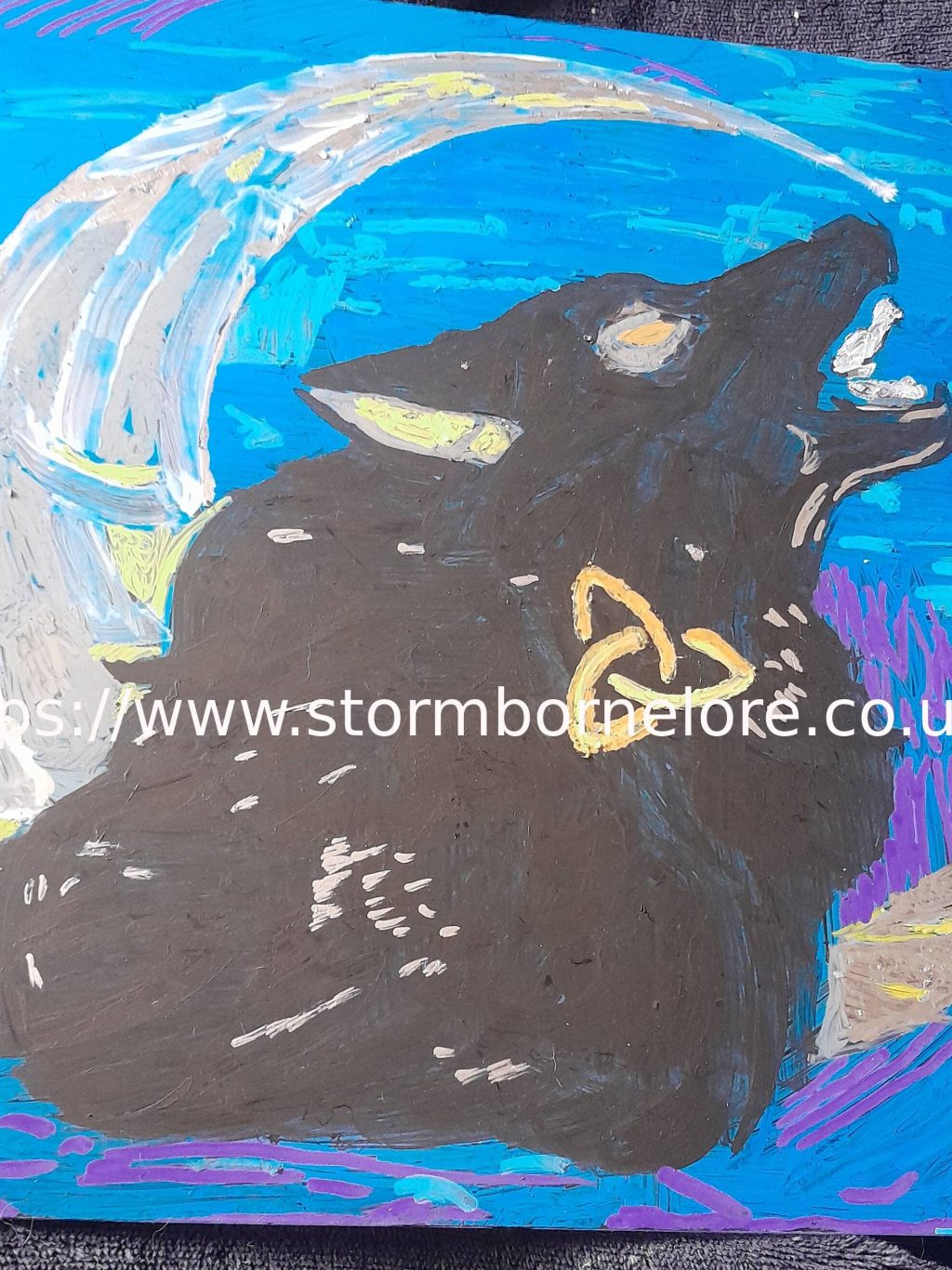
A vibrant illustration of Boldolph the black wolf howling at the moon. Embodying the mischievous spirit of the character from the poem.
(As sung by the kitchen fires)
Boldolph the black wolf sniffed the stew, His belly growled: “This meat will do!” He tiptoed past the snoring men, And dipped a paw in the broth again.
Morrigan caught him, gave a glare, “You thieving pup, don’t you dare!” But Boldolph smirked with sausage pride, And gobbled half the pot inside.
The cooks awoke to clatter and howl, The stew was gone, the bowl was foul. They found a trail of bones and crumbs, And one big wolf with sleepy gums.
Now every night the guards are warned, “Keep watch on Boldolph, ever adorned. For if you blink or turn your back, He’ll steal your soup and leave no snack!”






 StormborneLore