The rain had eased by morning, though the ground still steamed where the storm had passed.
The Mist clung to the Chase like breath, thick and cold, rolling through the hollows where the Romans once marched proud. Taranis stood by the broken road, cloak heavy with water, hair plastered to his brow.
He could still see the ruts of cart wheels half-buried in mud Rome’s mark, carved deep into the land.
“Won’t last,” he muttered, toeing one of the stones. “Nowt they build ever does.”Byrin came up behind, shoulders hunched against the chill.
“They’ve gone, lord. Last cohort took the south road yestere’en. Fort’s empty now.”Taranis grinned, the kind of grin that didn’t reach his eyes.
“Aye, I know. Felt it in the wind. Empire’s breath cut short.”He knelt, pulling a scrap of bread from his pouch, laying it on the old stone. Where once the eagle banners stood. Then he poured a splash of mead beside it.
“For them as fought, an’ them as fell,” he said quiet-like.
“An’ for the land, what outlives us all.”Byrin shifted his weight.
“Spirit night, innit? Galan Gaeaf, like th’owd folk say. When t’dead walk an’ th’winds carry their names.”Taranis nodded, eyes on the fire they’d lit a low orange glow crackling through damp wood.
“Aye. Let ’em walk. Let ’em see what’s come o’ Rome. Maybe they’ll find peace in the storm’s breath.”One by one, the men came forward, tossing bits of bread, small charms, even blades into the flames.
Their offerings for their kin, for luck, for the year turning.
“Break the road,” Taranis said after a time. “Let the dead cross free. Rome’s way ends here.”The sound of stone splitting echoed through the trees like thunder.
Byrin wiped sweat from his brow. “Yow reckon we’ll be free now, lord?”
Taranis looked north, where the sky lightened just enough to show the edge of winter coming.
Free?” he said, voice low. “No mon’s ever free o’ summat storm, king, or ghost. But th’land’ll be ours again, leastways till next lot fancies it.” He turned toward the fire once more.
The wind caught it, scattering sparks into the mist like stars. Somewhere, a raven called deep and hollow. Taranis lifted his blade, resting it against his shoulder.
“Come on,” he said. “Let’s feed the fire one last time, then go. Night’s drawin’ in, an’ spirits’ll be walkin’ soon.”Behind ’em, the last stretch of Roman stone cracked under hammer blows.
As steam was rising from the breaks like breath from a wounded beast.Taranis didn’t look back. He just walked, slow and steady, into the mist where thunder rolled soft and low, like the old gods stirrin’ in their sleep.
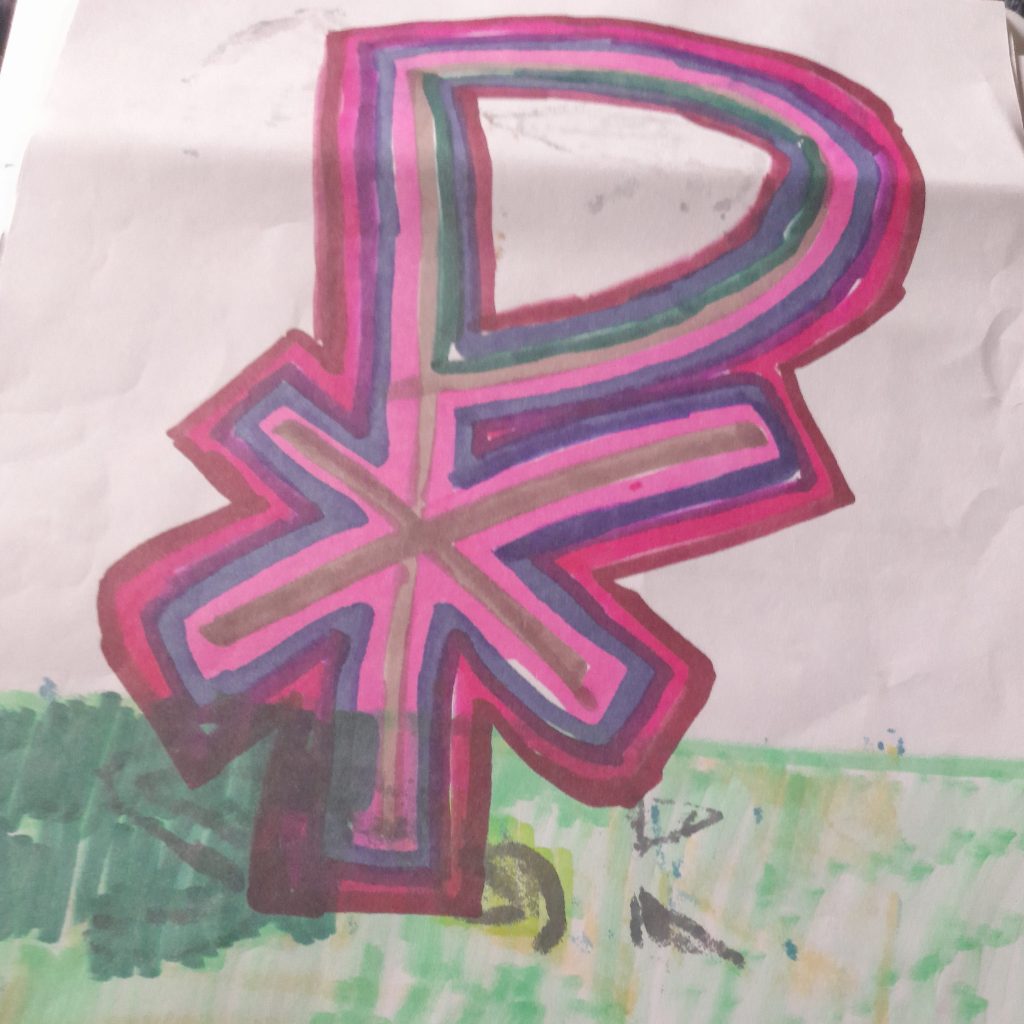
A vibrant artistic depiction of a stylized object, blending intricate designs with bright colors, invoking themes of lore and magic.
The Quiet Flame
The wind that swept over Emberhelm carried no warmth, only the ghost of fire long spent. I stood where the circle had once been whole, where twelve stones still defied the weight of empire, and one lay split a wound upon the land.
The others had gone. Drax to fury, Draven to silence, Rayne to his choices, and Taranis to chains. I remained, bound not by steel but by memory. It was not courage that kept me here; it was knowing that something sacred had been broken and that it was not yet done with us.
The Romans called this valley conquered. They built their roads and forts as if they could hammer meaning from earth and stone. But meaning does not bow to empire. It whispers, it lingers, it waits. And I have learned to listen.
I knelt beside the thirteenth stone, tracing the crack with my fingers. The split hummed faintly, as though it still remembered the storm that birthed it. I could almost hear Taranis’s voice beneath the wind, a murmur of thunder too distant to strike.
“Brother,” I whispered, “if the storm is caged, does the sky mourn its silence?”
A shadow passed across the ridge perhaps a hawk, perhaps a sign. In the old days, I would have asked the druids for meaning, but now I was the only one left to ask.
Rayne’s betrayal still cut deep, though part of me understood it. He had always been the one to see the long game, the patient serpent coiled beneath the waves. I did not forgive him, but neither could I condemn him fully. Perhaps this is how the gods feel when they look upon men weary, knowing, endlessly disappointed.
Night crept over the hills. I lit no fire; the Romans watched for smoke. Instead, I watched the stars, the same constellations our ancestors had trusted when the world was still young. Somewhere beyond those lights, I felt the pulse of something waking old magic, stirring beneath stone and soil, called forth by blood and betrayal alike.
The Circle was broken, yes. But its power had not vanished; it had merely changed shape. The storm that once lived in Taranis’s heart now whispered through the bones of the earth. I could feel it gathering, quiet but sure, as if the land itself prepared to rise.
In that silence, I spoke the old words not prayer, not spell, but remembrance. A promise carved into breath:
“When the storm returns, it will not ask who was loyal. It will ask who remains.”
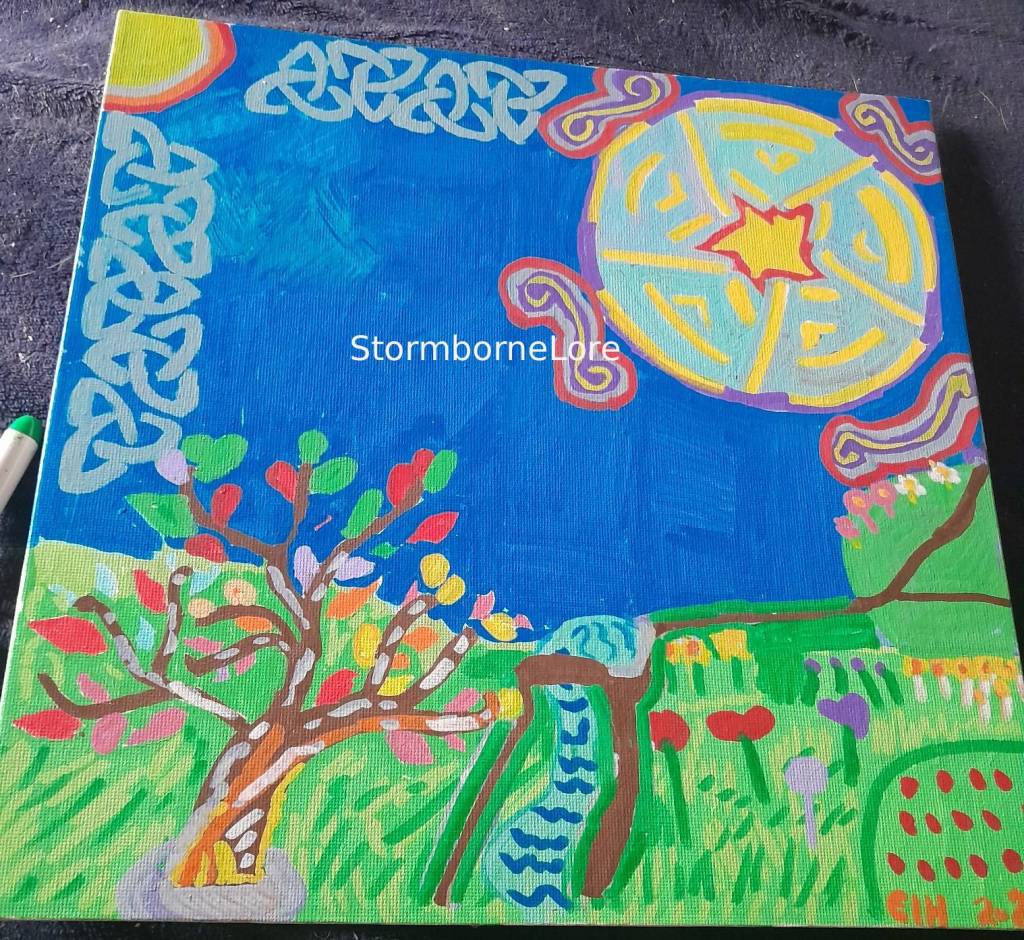
A vibrant painting depicting a colorful tree beneath a bright blue sky, symbolizing life and renewal.
Rest Beneath the Tree
At last they came to the tree.
It rose from the earth as though the hill itself had forced it skyward roots tangled deep, bark silvered with age, branches spread wide like the arms of a giant blessing or warning all who passed beneath. The ground around it was hushed, as if even the wind dared not trespass too loudly here.
Storm staggered to its shade and lowered himself to the roots. The weight of his wounds and weariness pressed him down, yet the tree seemed to hold him as gently as a cradle. He breathed slow, leaning against the trunk, and for the first time since the hill of ashes he felt his heart’s trembling ease.
The others made camp nearby, but left him undisturbed. Brianna spread her cloak by the fire, her eyes flicking often toward where he lay. Cadan tended the embers, muttering half-prayers, half-jests. The boy slept curled by the packs, his face still wet with the salt of grief.
Storm closed his eyes.
The world changed.
The tree shone with light, its roots glowing as though molten, its crown alive with whispering voices. Wolves circled him in the half-dark Boldolph and Morrigan among them, their eyes like coals, their howls joining others long gone. Above the branches wheeled Pendragon and Tairneanach, wings stirring thunder in a sky that was not a sky.
The gold ring gleamed on his finger once more. Its weight was not a burden but a bond. And the tree’s voice, deep as the earth itself, rolled through his marrow:
Rest, child of storm. The road is not ended. Every root remembers. Every leaf bears witness. You are bound to us, as we are bound to you.
Storm reached out and pressed his palm to the bark. He felt its strength answer, steadying his own. When his eyes opened, dawn was breaking.
Brianna stood ready with her blade. Cadan was already packing. The boy stirred from sleep.
Storm rose slowly, his body aching but his spirit steadier, and gave the tree one last look. The mark of his hand remained upon the trunk, a faint glow where blood and dream had mingled.
When the Roman legions marched into Britain in AD 43 under Emperor Claudius, they did not find an empty land. They found a patchwork of proud tribes, each with its own rulers, gods, and customs.
To the west of Watling Street lay the Cornovii, rooted in Shropshire and Staffordshire. To the south, around the salt-rich lands of Droitwich and Gloucestershire, stood the Dobunni. Both tribes would feel the weight of Rome’s advance.
Salt and Survival
Salt was life. It preserved food, healed wounds, and was as valuable as coin. The Romans renamed Droitwich Salinae and placed it under heavy control, taxing the salt trade and guarding it with military force.
For the Celts, who had long drawn wealth from the brine springs, this was both a theft and an insult. To strike the salt routes was to strike at Rome itself.
Resistance and Betrayal.
Not all Britons resisted. Some tribal leaders saw the might of Rome and chose to make an alliance. They took Roman names, built villas, and dressed in the style of their conquerors.
Others fought tooth and nail, their warriors painted, their gods called upon in the forests and on the hills. This clash between loyalty to tradition and the lure of Roman power split kin and tribe alike betrayal often hurt more than Roman swords.
Gods of Two Worlds.
The Romans rarely erased local gods. Instead, they blended them into their own pantheon.
Taranis, Celtic god of thunder, was aligned with Jupiter, wielder of lightning.
Sulis, worshipped at Bath, was merged with Minerva, goddess of wisdom.
Even the war goddess Andraste found echoes in Roman Mars and Bellona.
For many, this was a mask. Outwardly Roman, inwardly Celtic still. Temples rose with Latin names carved into stone, yet behind closed doors, the old rituals carried on offerings at sacred groves, whispered invocations at standing stones.
Daily Life Under Rome.
Markets bustled with pottery, wine, and oil imported from Gaul and Spain. Roman roads cut straight through the land, binding together forts, towns, and villas. Yet step off the road and you might still find Celtic roundhouses, farmers living as their ancestors had, and druids carrying wisdom that defied Rome’s order.
Legacy.
Celtic–Roman Britain was not either fully conquered or fully free. It was a place of merging, conflict, and uneasy coexistence. Rome imposed its order, but the spirit of the land the forests, the rivers, the stones still whispered the old names.
For some, like the warriors of legend, this was a time of rebellion. For others, a time of survival. And for figures like Taranis Stormborne, also known as Storm caught between gods and men, Rome and Celt, it was the crucible that forged myths still told today.
Battles became rare. Raids grew smaller, born less from conquest and more from desperation. The crops suffered under strange seasons. Hunger took more than steel ever could. But with hardship came strange progress sharper tools, tighter village bonds, cleverer defences. Old powers shifted. The land quieted, not in peace, but in waiting.
And in that uneasy quiet, Taranis was content.
For the first time in years, he did not lead an army. He pursued a girl instead one with a scar beneath her eye and a laugh like war drums. She gave as good as she got, and that delighted him. The village wives said she would either tame him or kill him. The bards were divided on which would be the better story.
Meanwhile, I, Drax, his brother by blood and blade, walked a different path. I raised my people among the hills and rivers of Caernath. Children on hips, grain in hand, my wife laughing in doorways. I had earned my peace, or so I believed.
Lore, always the wisest of us, had vanished into his libraries. He said little, but he read much stars, omens, bones, spells. His son was growing fast, and Lore spoke often of unity, of law, of councils instead of kings.
Even Draven kept to himself in those days, unsure of where to cast his loyalty. And Rayne, well… Rayne’s silence was never a good sign.
Then the rumours came.
Another village, wiped clean. A warlord found burnt and broken, no enemies in sight. Smoke and whispers. They say a giant walked the battlefield, crowned in fire and storm. One witness swore she saw a great horned beast at his side. Another swore it was a dragon, wings spread across the sky like nightfall.
The name on their tongues? Taranis.
And with his name, the same plea echoed once again from the mouths of elders, farmers, and war-chiefs alike: “Take the crown.”
He refused. For the thirteenth time.
No matter their offerings gold, land, blood-oaths he turned his back on kingship. He called no banners. Built no fortress. No throne. Yet still he came when battle called. He turned tides, struck down tyrants, disappeared again into wind and legend.
And so, we formed the Ring not a court of nobles, but of equals. Thirteen warriors, leaders, seers, and voices of the old ways. It stood for balance, for judgment, for law older than any written word. At its centre: a circle of sacred stones, each carved with the oath of Stormborne.
And there, in that ring, Taranis spoke not often but when he did, the skies listened.
We thought we were building something unbreakable.
But we were wrong.
Because while we looked outward at the world beyond the hills, a darker storm gathered within us. In the silence of Lore’s spells, in the smile behind Rayne’s eyes, in the omens Draven refused to speak aloud.
The Thirteenth Ring was strong. But it only took one brother’s betrayal to crack the stone. And so the storm began to turn inward.
“Where’s the mother?” I asked.
“Her village was attacked. They slaughtered her while she screamed my name,” Taranis said.
The circle of stones stood solemn beneath a heavy sky bruised with gathering storm clouds. Within the sacred ring, thirteen seats carved with ancient runes and oaths bore silent witness as the brothers gathered once more.
Taranis sat with the weight of years pressing upon him, the child cradled carefully in Drax’s strong arms a fragile ember amidst the gathering darkness. The air was thick, charged with the unspoken dread of a prophecy unfolding.
Lore was the first to break the silence, stepping forward with measured grace. His voice was calm but sharp as flint, each word deliberate and coldly reasoned.
“Brother,” Lore said, eyes fixed on Taranis, “you speak of betrayal as if the serpent has already struck. Who do you suspect? Who harbors this poison within our bloodline?”
Rayne’s lips twitched into a mocking smile, his gaze a knife’s edge glinting in the half-light.
“Perhaps,” Rayne replied smoothly, “the betrayal lies not in our veins but in the stubbornness of one who refuses the crown. The storm we fear may well be born of his silence.”
Draven shifted uneasily on his stone, fingers twisting nervously as he swallowed hard.
“I… I cannot imagine we would turn against our own,” Draven stammered. “We are brothers forged in battle. Our oaths hold us true.”
Taranis’s gaze snapped sharply to Draven, eyes burning with bitter warning. “Blood is thicker than loyalty,” Taranis said quietly, “but fate is the thinnest thread of all easily severed, and often broken by the weakest hand.”
I stood from my seat, the strength in my voice like a hammer striking an anvil. “I swear to all here, I will raise this child as my own, guard him with my life. No harm will come to him under my watch.”
Rayne’s eyes narrowed dangerously. “Loyalty is a coin with many faces, brother,” Rayne said softly, stepping closer. “What of your people? Your wife and child? When the scales are tipped, whose cries will you hear first?”
Lore raised a hand, tracing the worn runes on his stone seat with thoughtful fingers.
“We stand at a crossroads. The old gods grow silent; new faiths rise from the south and east. It is no betrayal to seek survival. Perhaps adaptation is the true path.”
Taranis’s jaw clenched, muscles taut with anger and grief. “Survival without honor is death,” he growled. “One of you will fracture this Ring. When that stone breaks, the whole will crumble. Mark my words.”
A sudden gust of wind swept through the circle, rattling the ancient stones like a voice from the past. The child stirred in my arms, a small cry cutting through the tension like a knife.
The brothers’ eyes flickered to the babe innocent yet burdened with the weight of prophecy.
Silence fell again, thick with dread and unspoken accusations.
Rayne smiled then, colder and sharper than any blade. “So be it,” he whispered. “Let the storm come. I will be ready.”
From the edge of the circle, Draven lowered his gaze, his hands trembling. Behind closed eyes, fear and uncertainty warred in his heart a battle he dared not share.
Lore’s eyes scanned the sky, already darkening with rolling thunder. “We must decide soon,” Lore murmured, “for if we do not act, the fates will decide for us.”
Taranis stared out over the ring, his voice low but resolute.
“The time of peace is over. The Ring must hold or all we built will fall to ruin.”
He stood slowly, setting the child gently in my arms before turning toward the path out of the circle.
As he walked away, his figure a storm-shadow against the fading light, the brothers remained each wrestling with the secrets they now carried.


 StormborneLore