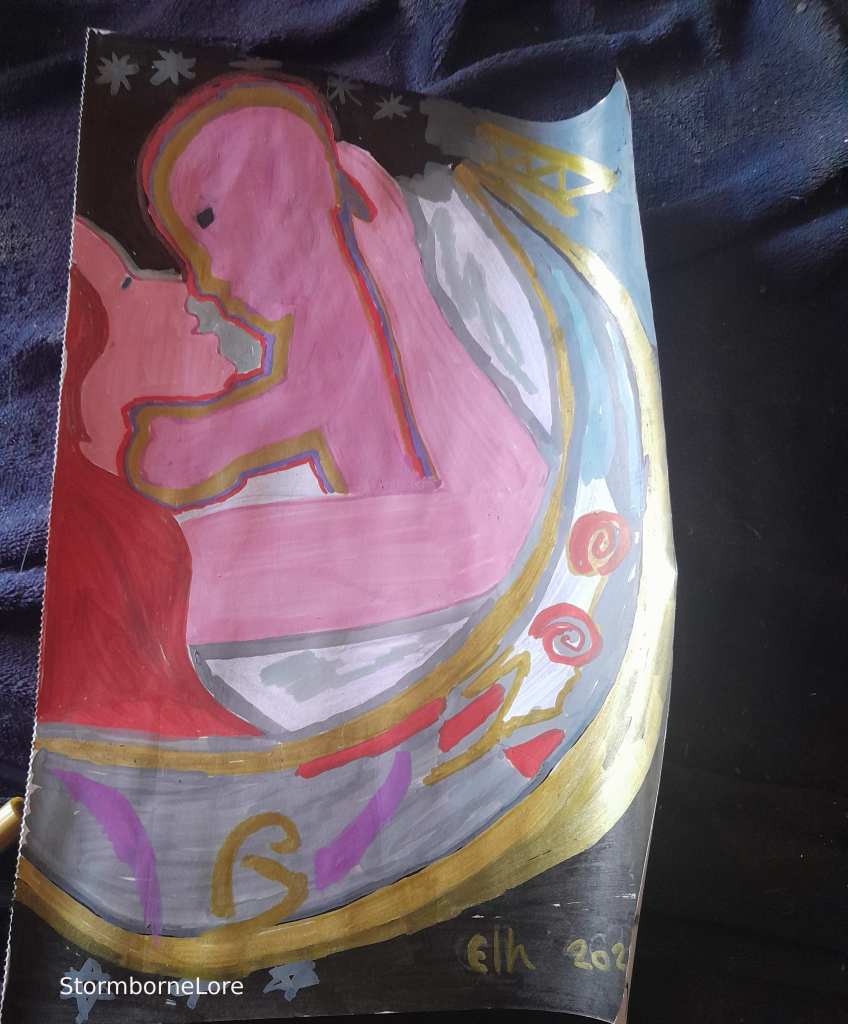
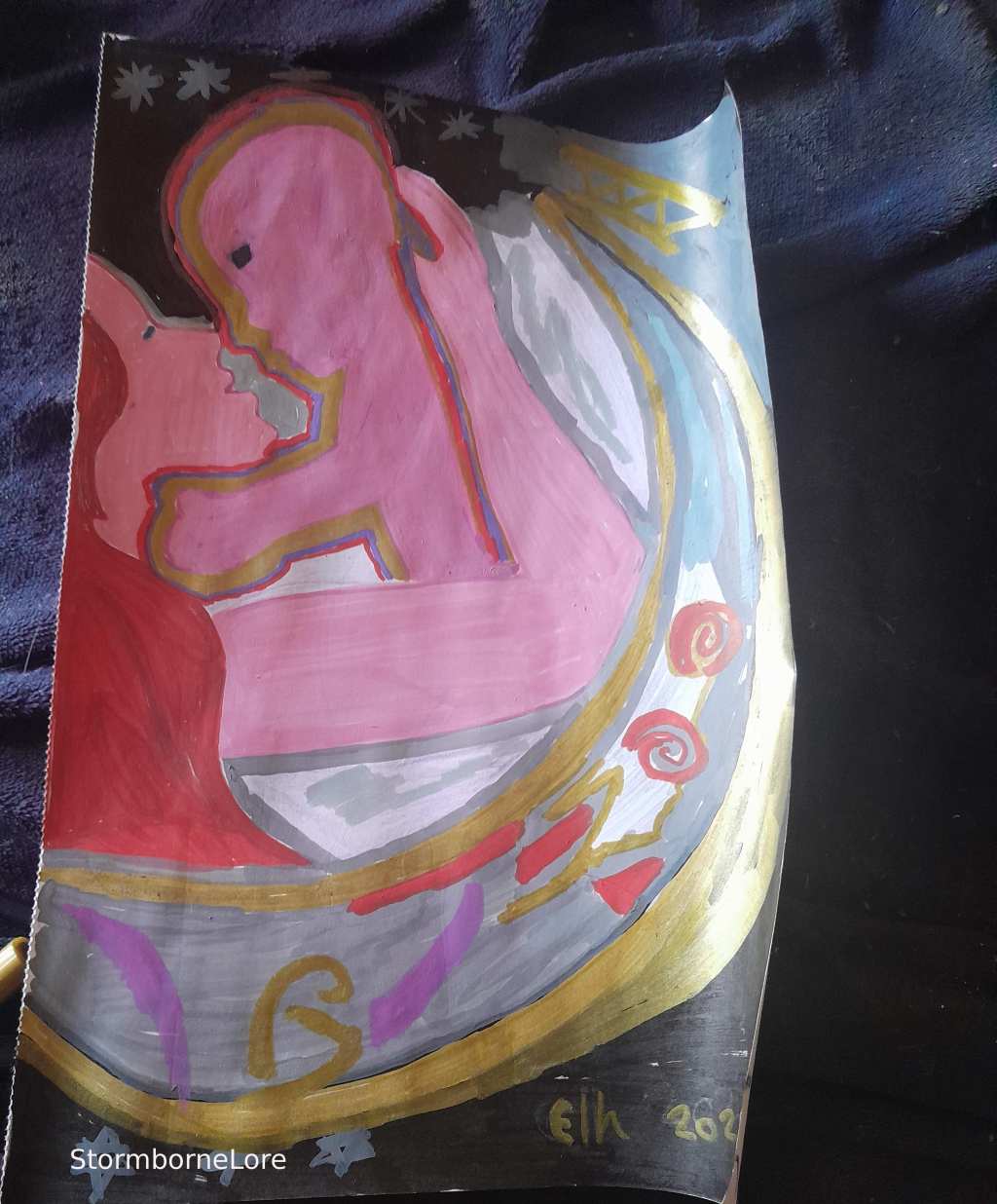
- Medium: Acrylic on paper
- Size: A4
- Description:
A mother cradles her child beneath the glow of moon and stars, framed in swirling gold. This piece speaks of tenderness, resilience, and the eternal bond between generations.
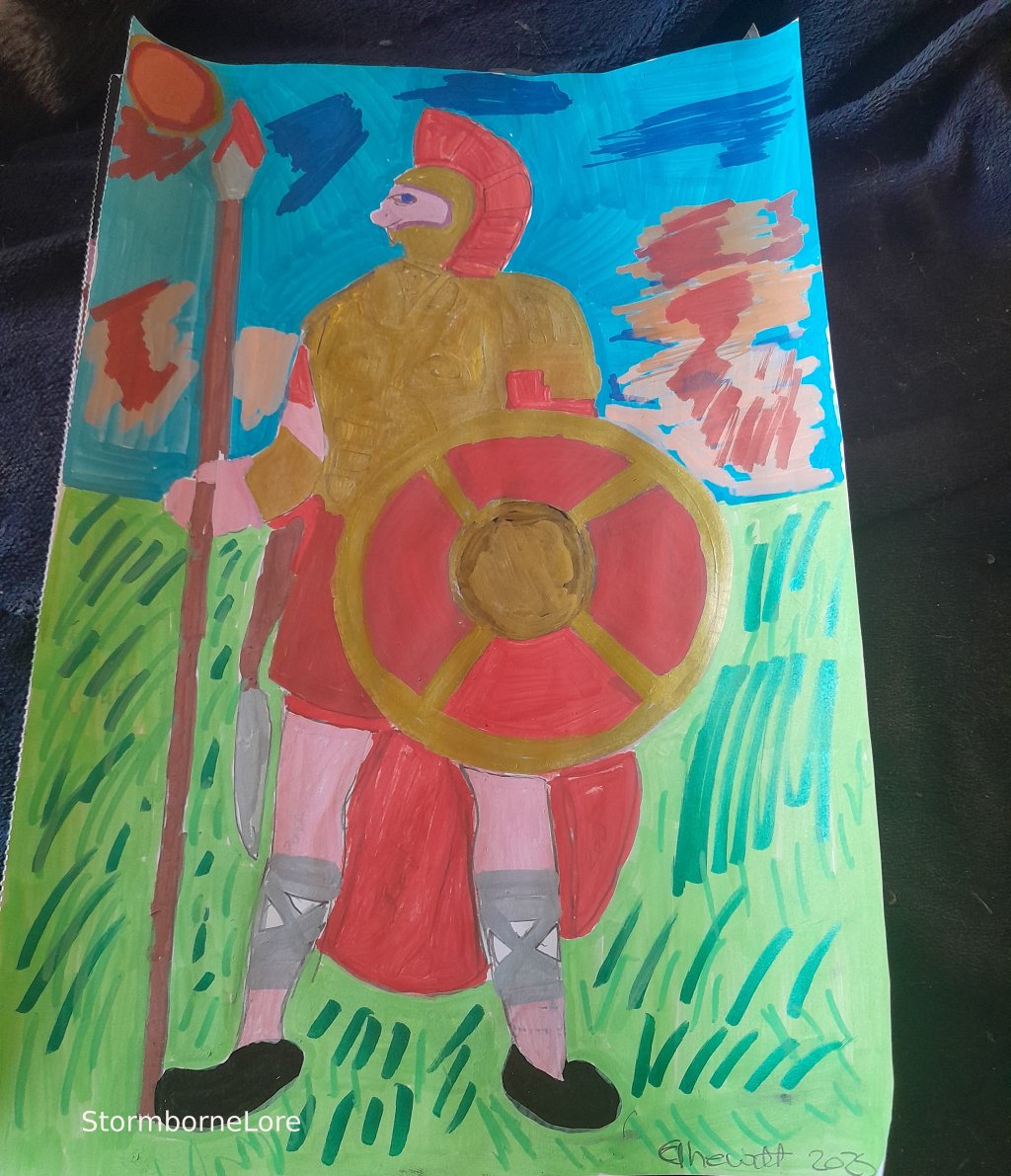
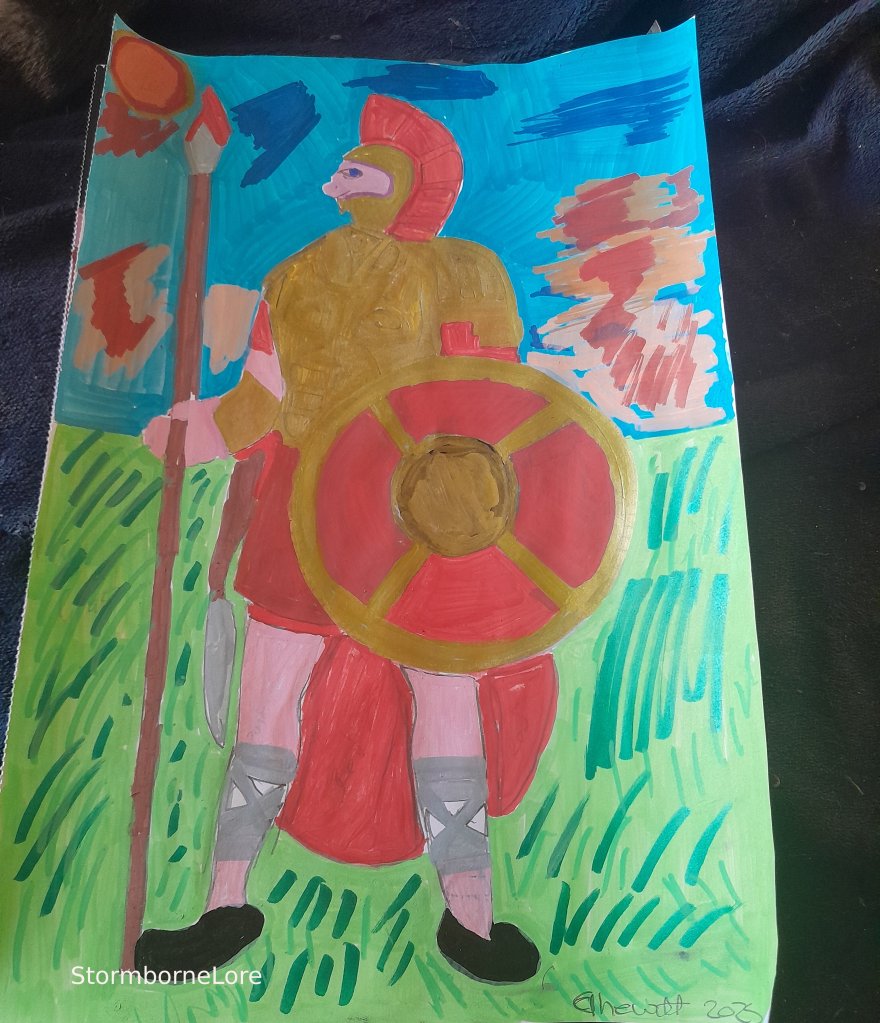
Medium: Acrylic on paper
Size: A4
Description:
A lone Roman soldier stands vigilant against a stormy sky, spear and shield at the ready. The piece captures both the strength and fragility of empire one figure set against the vast shifting forces of history.
When the Roman legions marched into Britain in AD 43 under Emperor Claudius, they did not find an empty land. They found a patchwork of proud tribes, each with its own rulers, gods, and customs.
To the west of Watling Street lay the Cornovii, rooted in Shropshire and Staffordshire. To the south, around the salt-rich lands of Droitwich and Gloucestershire, stood the Dobunni. Both tribes would feel the weight of Rome’s advance.
Salt was life. It preserved food, healed wounds, and was as valuable as coin. The Romans renamed Droitwich Salinae and placed it under heavy control, taxing the salt trade and guarding it with military force.
For the Celts, who had long drawn wealth from the brine springs, this was both a theft and an insult. To strike the salt routes was to strike at Rome itself.
Not all Britons resisted. Some tribal leaders saw the might of Rome and chose to make an alliance. They took Roman names, built villas, and dressed in the style of their conquerors.
Others fought tooth and nail, their warriors painted, their gods called upon in the forests and on the hills. This clash between loyalty to tradition and the lure of Roman power split kin and tribe alike betrayal often hurt more than Roman swords.
The Romans rarely erased local gods. Instead, they blended them into their own pantheon.
Taranis, Celtic god of thunder, was aligned with Jupiter, wielder of lightning.
Sulis, worshipped at Bath, was merged with Minerva, goddess of wisdom.
Even the war goddess Andraste found echoes in Roman Mars and Bellona.
For many, this was a mask. Outwardly Roman, inwardly Celtic still. Temples rose with Latin names carved into stone, yet behind closed doors, the old rituals carried on offerings at sacred groves, whispered invocations at standing stones.
Markets bustled with pottery, wine, and oil imported from Gaul and Spain. Roman roads cut straight through the land, binding together forts, towns, and villas. Yet step off the road and you might still find Celtic roundhouses, farmers living as their ancestors had, and druids carrying wisdom that defied Rome’s order.
Celtic–Roman Britain was not either fully conquered or fully free. It was a place of merging, conflict, and uneasy coexistence. Rome imposed its order, but the spirit of the land the forests, the rivers, the stones still whispered the old names.
For some, like the warriors of legend, this was a time of rebellion. For others, a time of survival. And for figures like Taranis Stormborne, also known as Storm caught between gods and men, Rome and Celt, it was the crucible that forged myths still told today.
© 2025 Emma Hewitt. All rights reserved.This story and all characters within the StormborneLore world are the original creation of Emma Hewitt. No part of this publication may be reproduced, distributed, or transmitted in any form or by any means without the prior written permission of the author, except in the case of brief quotations used in reviews or scholarly works.


From Lore’s Grimoire
“This spell is not for summoning. It is for letting go without falling apart.”
Lore of Caernath
To be spoken at sunset during the days of Lammas, when the light begins to wane and the first harvest calls forth remembrance.
A small dish of grain, oats, or bread crumbs
A red, gold, or black thread
A candle or small fire
A smooth stone or autumn leaf
Quiet
I offer what was taken,
and thank what was spared.
I do not beg the sun to stay.
I bless its going.
I tie this thread to grief made grain,
to love made bread,
to strength that does not burn but feeds.
(Hold the thread. Name what you release, softly.)
I will not carry what cannot come with me.
I bind it to the field, to the wind, to the ash.
(Tie the thread around the stone or leaf. Burn or bury it.)
Let the fire fade and leave the warmth behind.
“The spell need not rhyme to be true.
Speak clearly.
And mean it.”

The change was slow.
Battles became rare. Raids grew smaller, born less from conquest and more from desperation. The crops suffered under strange seasons. Hunger took more than steel ever could. But with hardship came strange progress sharper tools, tighter village bonds, cleverer defences. Old powers shifted. The land quieted, not in peace, but in waiting.
And in that uneasy quiet, Taranis was content.
For the first time in years, he did not lead an army. He pursued a girl instead one with a scar beneath her eye and a laugh like war drums. She gave as good as she got, and that delighted him. The village wives said she would either tame him or kill him. The bards were divided on which would be the better story.
Meanwhile, I, Drax, his brother by blood and blade, walked a different path. I raised my people among the hills and rivers of Caernath. Children on hips, grain in hand, my wife laughing in doorways. I had earned my peace, or so I believed.
Lore, always the wisest of us, had vanished into his libraries. He said little, but he read much stars, omens, bones, spells. His son was growing fast, and Lore spoke often of unity, of law, of councils instead of kings.
Even Draven kept to himself in those days, unsure of where to cast his loyalty. And Rayne, well… Rayne’s silence was never a good sign.
Then the rumours came.
Another village, wiped clean. A warlord found burnt and broken, no enemies in sight. Smoke and whispers. They say a giant walked the battlefield, crowned in fire and storm. One witness swore she saw a great horned beast at his side. Another swore it was a dragon, wings spread across the sky like nightfall.
The name on their tongues?
Taranis.
And with his name, the same plea echoed once again from the mouths of elders, farmers, and war-chiefs alike:
“Take the crown.”
He refused.
For the thirteenth time.
No matter their offerings gold, land, blood-oaths he turned his back on kingship. He called no banners. Built no fortress. No throne. Yet still he came when battle called. He turned tides, struck down tyrants, disappeared again into wind and legend.
And so, we formed the Ring not a court of nobles, but of equals. Thirteen warriors, leaders, seers, and voices of the old ways. It stood for balance, for judgment, for law older than any written word. At its centre: a circle of sacred stones, each carved with the oath of Stormborne.
And there, in that ring, Taranis spoke not often but when he did, the skies listened.
We thought we were building something unbreakable.
But we were wrong.
Because while we looked outward at the world beyond the hills, a darker storm gathered within us. In the silence of Lore’s spells, in the smile behind Rayne’s eyes, in the omens Draven refused to speak aloud.
The Thirteenth Ring was strong. But it only took one brother’s betrayal to crack the stone. And so the storm began to turn inward.
“Where’s the mother?” I asked.
“Her village was attacked. They slaughtered her while she screamed my name,” Taranis said.
The circle of stones stood solemn beneath a heavy sky bruised with gathering storm clouds.
Within the sacred ring, thirteen seats carved with ancient runes and oaths bore silent witness as the brothers gathered once more.
Taranis sat with the weight of years pressing upon him, the child cradled carefully in Drax’s strong arms a fragile ember amidst the gathering darkness. The air was thick, charged with the unspoken dread of a prophecy unfolding.
Lore was the first to break the silence, stepping forward with measured grace.
His voice was calm but sharp as flint, each word deliberate and coldly reasoned.
“Brother,” Lore said, eyes fixed on Taranis, “you speak of betrayal as if the serpent has already struck. Who do you suspect? Who harbors this poison within our bloodline?”
Rayne’s lips twitched into a mocking smile, his gaze a knife’s edge glinting in the half-light.
“Perhaps,” Rayne replied smoothly, “the betrayal lies not in our veins but in the stubbornness of one who refuses the crown. The storm we fear may well be born of his silence.”
Draven shifted uneasily on his stone, fingers twisting nervously as he swallowed hard.
“I… I cannot imagine we would turn against our own,” Draven stammered. “We are brothers forged in battle. Our oaths hold us true.”
Taranis’s gaze snapped sharply to Draven, eyes burning with bitter warning.
“Blood is thicker than loyalty,” Taranis said quietly, “but fate is the thinnest thread of all easily severed, and often broken by the weakest hand.”
I stood from my seat, the strength in my voice like a hammer striking an anvil.
“I swear to all here, I will raise this child as my own, guard him with my life. No harm will come to him under my watch.”
Rayne’s eyes narrowed dangerously.
“Loyalty is a coin with many faces, brother,” Rayne said softly, stepping closer. “What of your people? Your wife and child? When the scales are tipped, whose cries will you hear first?”
Lore raised a hand, tracing the worn runes on his stone seat with thoughtful fingers.
“We stand at a crossroads. The old gods grow silent; new faiths rise from the south and east. It is no betrayal to seek survival. Perhaps adaptation is the true path.”
Taranis’s jaw clenched, muscles taut with anger and grief.
“Survival without honor is death,” he growled. “One of you will fracture this Ring. When that stone breaks, the whole will crumble. Mark my words.”
A sudden gust of wind swept through the circle, rattling the ancient stones like a voice from the past.
The child stirred in my arms, a small cry cutting through the tension like a knife.
The brothers’ eyes flickered to the babe innocent yet burdened with the weight of prophecy.
Silence fell again, thick with dread and unspoken accusations.
Rayne smiled then, colder and sharper than any blade.
“So be it,” he whispered. “Let the storm come. I will be ready.”
From the edge of the circle, Draven lowered his gaze, his hands trembling.
Behind closed eyes, fear and uncertainty warred in his heart a battle he dared not share.
Lore’s eyes scanned the sky, already darkening with rolling thunder.
“We must decide soon,” Lore murmured, “for if we do not act, the fates will decide for us.”
Taranis stared out over the ring, his voice low but resolute.
“The time of peace is over. The Ring must hold or all we built will fall to ruin.”
He stood slowly, setting the child gently in my arms before turning toward the path out of the circle.
As he walked away, his figure a storm-shadow against the fading light, the brothers remained each wrestling with the secrets they now carried.
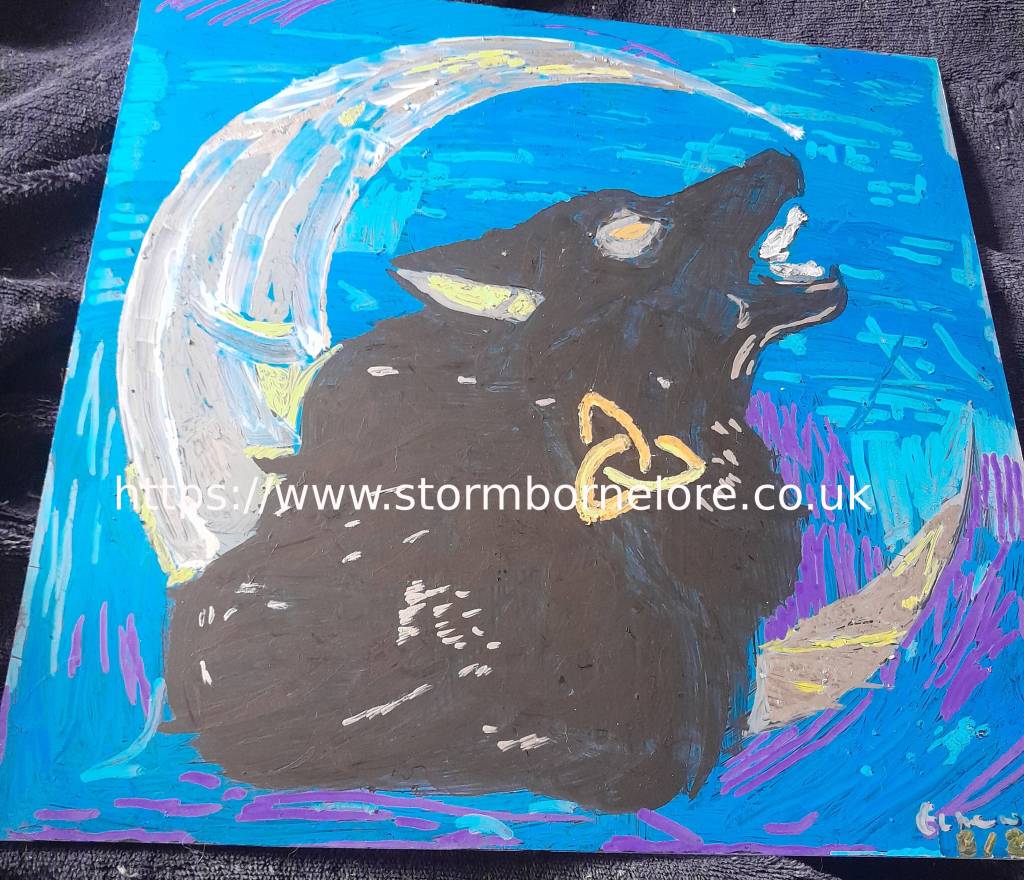
I once wore skin like warriors do,
A man of blade, of blood, of pride.
But pride turned sour, and wrath I knew,
Till wolf became the shape I hide.
My Morrigan, lost in fur and bone,
Her eyes still see the stars I swore.
We haunt the edge, we roam alone,
Two cursed hearts that hunt no more.
But when the babe was cast to pine,
Alone beneath the howling wind,
I made an oath this soul is mine.
I’ll guard him where no love has been.
Let fire fall, let time undo,
Let gods forget the names they gave.
So long as breath remains in you,
I am the shadow that will not cave.
 StormborneLore