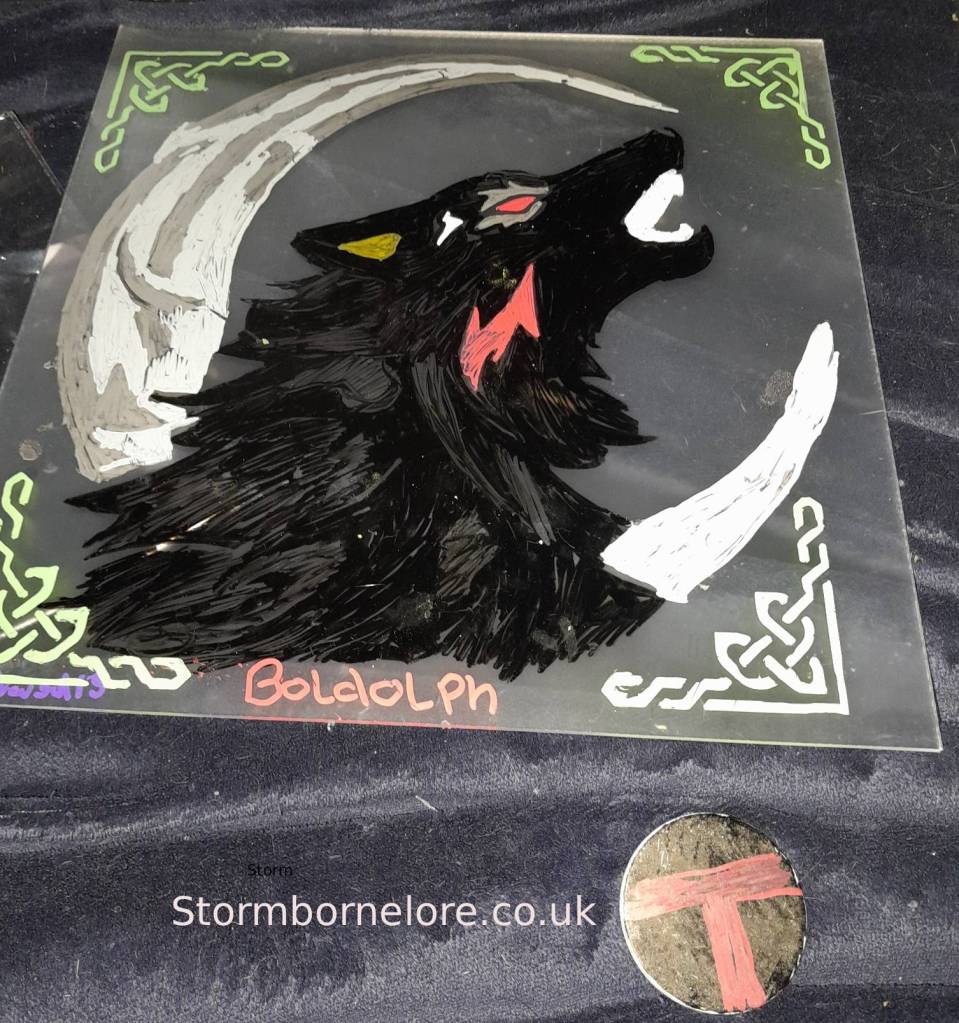
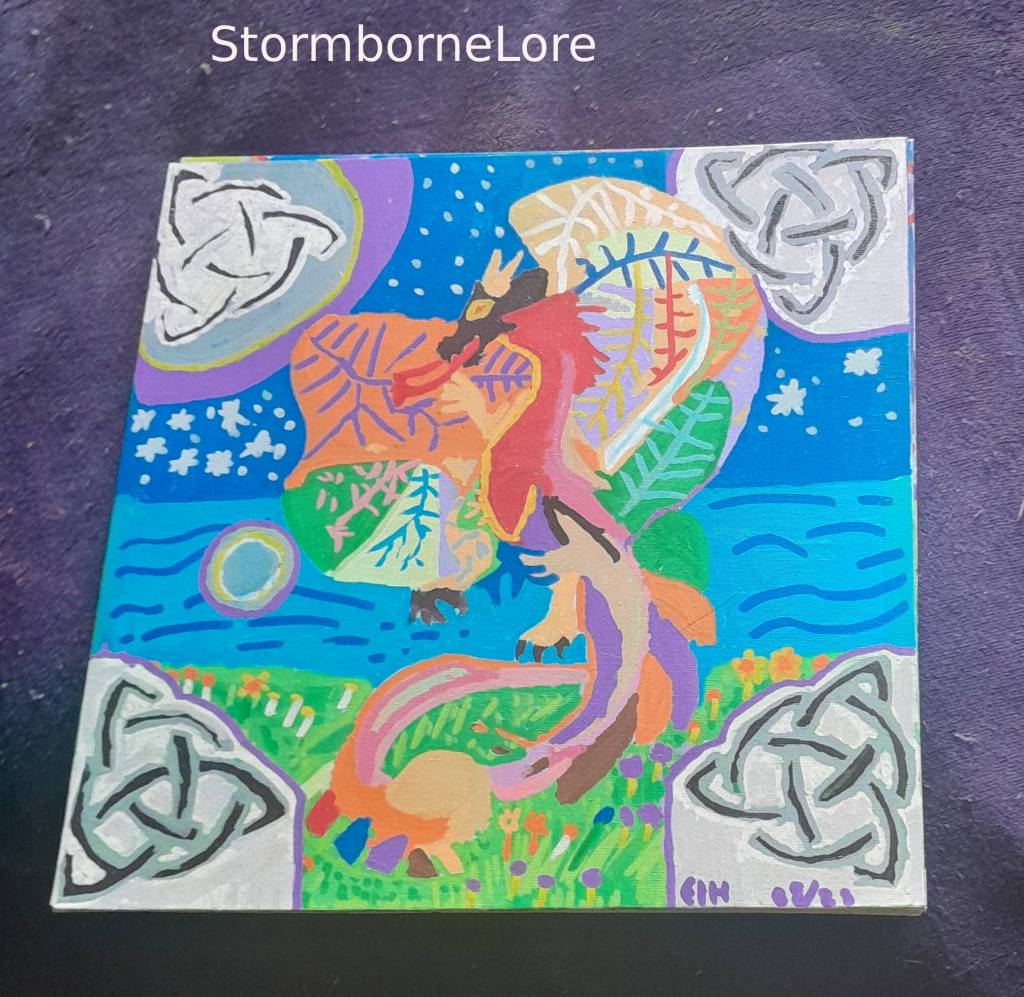
Boldolph the Wolf brother, shield, spirit of the wild. Painted on clear acrylic, one of a kind. Part 11 of The Chronicles of the Gold Ring is now live where the wolf walks again in the trees.”
The Wolf in the Trees
The rain had not stopped since the hill. It drummed on oak leaves, hissed across the ash of the fire, slicked every blade of iron until the men and women of the Black Shields looked like shadows burnished in oil. The night smelled of wet earth and smoke, of wounds bound with linen that would not stay clean.
Storm slept little. When he closed his eyes, the hammer fell, and the nails drove, and he woke with the sound of iron in his skull. So he stayed upright with his back to the birch, watching the drip of water through branches, listening to foxes bark and owls call, waiting for morning.
At dawn, a shape lingered beyond the edge of the fire’s reach. Low, black, moving between trunks with the patience of hunger. Storm’s hand went to the haft of his knife before he realised what he saw.
A wolf.
Not the lean carrion-pickers that shadowed armies, but broad in the shoulder, thick in the ruff, eyes burning with a colour no dog had ever worn. It did not growl. It did not flee. It stood in the bracken and watched him.
“Boldolph,” Storm breathed, though he knew the beast before him was no man, no brother, no shieldmate returned. But something in the tilt of the head, in the way it lifted its nose as if to scent not flesh but memory, made his chest tighten.
The others woke one by one. Cadan saw it first and rose with his knife ready. “Leave it,” Storm said. His voice was rough with the weight of command. Brianna squinted through the rain. “Is it a sign?” Storm shook his head. “It is a wolf. That is enough.”
But when the wolf turned and padded into the thicket, Storm followed. He did not tell the others to stay; they knew.
The trail wound between dripping ferns and stones slick with moss. Once, the wolf vanished altogether, and Storm thought he had been chasing a ghost but then the shape appeared again on a rise of ground, waiting. Guiding. Testing.
At last they came to a hollow ringed with oaks older than any fort or cross. Their roots knotted together like clenched fists. At the centre lay a cairn of stones blackened with age.
The wolf set its paws upon the mound, lifted its muzzle, and gave one long, shivering call. Not to the pack for there was no pack—but to the world itself. Then it was gone, as if the trees had folded and swallowed it whole.
Storm touched the cairn. Cold. Wet. His fingers came away with lichen and soil. And something else. A groove cut deep, filled with rain. A mark he knew from chalk scratched on gateposts and painted on stolen shields. A ring.
The Gold Ring.
He knelt, pressing his forehead to the stone. For a breath he smelled not wet earth but smoke from a hall long gone, heard not rain but the laughter of those who had died before him. Nessa. Morrigan. Boldolph. Rayne.
The voices came like wind through hollow wood: Hold fast. The story is not done.
Storm rose. His wrist throbbed where the nail had kissed bone, but his grip was steady when he returned to the camp.
Brianna looked at him, sharp-eyed. “What did you find?” “A place,” Storm said. “A promise buried under stones.” Cadan spat into the fire. “More promises.” “Not words,” Storm answered. “A mark. The old ring. It waits for us.”
The rain eased then. Just enough to let the fire breathe.
That night, when the Black Shields moved again, they did not march as hunted rebels, but as something else. A rumour clothed in rain, a shadow given teeth. And always at the edge of the path, in the corner of sight, Storm thought he saw the wolf pacing them between the trees.
When the Roman legions marched into Britain in AD 43 under Emperor Claudius, they did not find an empty land. They found a patchwork of proud tribes, each with its own rulers, gods, and customs.
To the west of Watling Street lay the Cornovii, rooted in Shropshire and Staffordshire. To the south, around the salt-rich lands of Droitwich and Gloucestershire, stood the Dobunni. Both tribes would feel the weight of Rome’s advance.
Salt and Survival
Salt was life. It preserved food, healed wounds, and was as valuable as coin. The Romans renamed Droitwich Salinae and placed it under heavy control, taxing the salt trade and guarding it with military force.
For the Celts, who had long drawn wealth from the brine springs, this was both a theft and an insult. To strike the salt routes was to strike at Rome itself.
Resistance and Betrayal.
Not all Britons resisted. Some tribal leaders saw the might of Rome and chose to make an alliance. They took Roman names, built villas, and dressed in the style of their conquerors.
Others fought tooth and nail, their warriors painted, their gods called upon in the forests and on the hills. This clash between loyalty to tradition and the lure of Roman power split kin and tribe alike betrayal often hurt more than Roman swords.
Gods of Two Worlds.
The Romans rarely erased local gods. Instead, they blended them into their own pantheon.
Taranis, Celtic god of thunder, was aligned with Jupiter, wielder of lightning.
Sulis, worshipped at Bath, was merged with Minerva, goddess of wisdom.
Even the war goddess Andraste found echoes in Roman Mars and Bellona.
For many, this was a mask. Outwardly Roman, inwardly Celtic still. Temples rose with Latin names carved into stone, yet behind closed doors, the old rituals carried on offerings at sacred groves, whispered invocations at standing stones.
Daily Life Under Rome.
Markets bustled with pottery, wine, and oil imported from Gaul and Spain. Roman roads cut straight through the land, binding together forts, towns, and villas. Yet step off the road and you might still find Celtic roundhouses, farmers living as their ancestors had, and druids carrying wisdom that defied Rome’s order.
Legacy.
Celtic–Roman Britain was not either fully conquered or fully free. It was a place of merging, conflict, and uneasy coexistence. Rome imposed its order, but the spirit of the land the forests, the rivers, the stones still whispered the old names.
For some, like the warriors of legend, this was a time of rebellion. For others, a time of survival. And for figures like Taranis Stormborne, also known as Storm caught between gods and men, Rome and Celt, it was the crucible that forged myths still told today.
They marched him up the salt-hill at Dodderhill, where the Roman timber bites into the skyline like bad teeth. Below, Salinae steams. The brine pits cough a white breath across the roofs, and every back in the town goes still; men with salt-burned hands, women with brined wrists, children with their mouths parted. All of them looking up. All of them waiting to see a lesson.
Storm’s wrists are raw from the iron. His shirt is torn where they hauled it over his head, the air is cold on old scars and new. There is a cut across his ribs from the morning’s struggle and the dried salt in it stings like sand.
A centurion with a wine-scarred mouth calls the charge in a language that thinks it is the only one that matters.
“Rebel. Murderer. Enemy of Rome.” The words land like stones. Men with square shields drag the condemned in a line. Three farmers. A boy who threw a stone. Storm.
“Use the cross for the big one,” the centurion says. “Make them see.”
They set the upright in the earth, ramming it with a post-driver until the ground answers. The carpenter’s nails gleam in a little wooden tray, thick as a man’s thumb. The hammer is clean. The executioner’s eyes flick to Storm and away again as if he’s looked at the sun too long.
Storm keeps his chin up because he will not bend. He smells oak smoke from the town, the sour of men in mail, the resin of fresh-split palings. He tastes brine on his teeth. A gull wheels and screams once, the cry torn thin by the wind.
A voice from the crowd below: not words, just a keening. Another voice, hoarse, calls his name the way a prayer is called: “Shield!”
He does not look down. He looks at the sky. Cloud, thin and grey and harmless. For now.
“Hold him,” the centurion says.
Four soldiers pin his arms. The fifth takes Storm’s right hand and forces it open against the cross-beam. The leather strap bites his palm. The executioner lifts the first nail. It is cold when it kisses the crease of Storm’s wrist.
Storm hears the old world in the edges of the day. The ring he once wore feels like a phantom weight on his finger. He sees Nessa’s hair in the corner of his sight when the wind shifts. He hears Boldolph and Morrigan somewhere he can’t walk to anymore. Rayne’s voice is the whisper in the hinge of the jaw: brother, hold still and we will live. Brother, lie down.
The hammer rises.
Thunder is far off. Not here, not yet. A single pulse on the horizon like a heart behind a ribcage. The executioner breathes. The hammer falls.
It meets iron and the iron skids, glancing off the nail head. The blow dents the wood and slams into Storm’s bones. He grunts despite himself. Blood beads. The executioner squints, checks the nail, lifts again.
The second stroke strikes home. Iron bites meat. The sky pulls tight.
A woman cries out below. “Enough! He fought for us!”
“Silence,” the centurion barks, not looking down.
Storm tastes copper. His vision narrows, then widens until he can see each hair on the executioner’s wrist, each pore, each fleck of sawdust stuck to the hammer’s face. It is the old sight, the red edge. He could go there—into the roar where nothing hurts until after—but he does not. He holds on. He wants to watch.
“Left,” the centurion says.
They take his other hand. Fingers spread. The nail’s cold mouth finds the vein. The hammer rises
and the wind turns.
Not a gust. A pivot. The kind of turning that changes seasons. Smoke from the brine pans below folds back on itself. Sparrows flatten to the earth. The hairs along Storm’s arms lift.
The first crack of thunder lands atop the fort like an axe into a block. Every man jolts. A standard topples with a clatter of bronze. The executioner flinches, the nail slips, and instead of flesh he drives it through the softened knot of the beam.
The shock carries up his arm. He swears. The soldier holding Storm’s elbow looks at the sky. The sky looks back.
Cloud blooms fast from the western line, rolling in on a bruise-coloured belly. A wolf-long shape seems to run along its edge and is gone. Another crack. Closer.
“Finish it,” the centurion snaps. But there’s a catch in it now, and he makes a sign with his two fingers as if to pinch off something unseen.
The hammer lifts for the third time.
Lightning hits the palisade post a spear’s throw away. Wood screams. Splinters go like hail. Men duck behind shields by training, but training breaks when the sky speaks in a voice older than their gods. A mule rears and snaps its lead. The nail tray overturns; iron skitters like teeth on stone.
Storm moves then.
He lets the red edge take him for a heartbeat just enough. He wrenches, twisting his pinned right wrist so the cut tears long and clean instead of deep. The leather strap splits where sweat has rotted it.
He brings his head forward under the beam, drives his shoulder into the soldier’s throat, hears the wet cough, feels the grip loosen. He kicks back, heel to knee, and the man behind him falls with a scream.
There is always a moment in a fight when the world decides. This is it.
He drives the crown of his head into the executioner’s face; the man drops the hammer, hands going to his nose. Storm grabs the hammer with his left hand, blood slicking the haft, and swings the weight into the chain on his left wrist. Once. Twice. The chain holds. The third blow finds the link that was barely peened shut, and it parts with a sweet, bright sound.
“Hold him!” the centurion bellows, but half his men are looking at the burning post and the other half are looking at the sky.
Shapes break from the heather below the berm three, five, a dozen men with black-painted shields and hunters’ faces. Brianna’s braid is bound with leather; Cadan’s scar shows white through ash. They come without horns or shouts, all knife and certainty.
Brianna hits the left flank like a thrown stone, her knife opening a belly before the man knows his shield is gone. Cadan slides under a spear and cuts the hamstring clean, then is up again and laughing because sometimes that is the only way to keep breath inside you.
“Storm!” Brianna barks.
He throws the hammer. She catches it by the neck and brings it down on a helmet rim, bending iron into eyebrow and eye. She tosses it back and he takes the chain a second time and frees his right.
The centurion finds his voice at last and orders the archers, but the bowstrings are wet now, the fletchings torn sideways by the sideways rain that has arrived without crossing the ground between. Arrows go high and crooked. One finds a farmer’s boy in the line of the condemned. The boy sits down as if to rest and does not get up again.
Storm would carry that if he let himself. Later, he thinks, later, and steps toward the centurion.
“Stand,” the centurion says, not to him but to what moves in his bones.
“I do,” Storm says.
They meet as men meet: iron-toothed and close. The centurion is trained. Storm is made. The first cut is Storm’s forearm across the centurion’s sword-hand, breaking the rhythm, and the second is Storm’s head against the man’s nose—again, because men are made of the same mistakes and the third is Storm’s thumb to the centurion’s eye. The man goes down with a sound nothing like command.
“Back!” a junior officer yelps. “Back to the fort!”
They drag their wounded. They leave their dead. They do not look at the cross. The storm does what storms do it eats the edges of everything.
From the town below, the people cannot see the cut and the grapple, only the outline of men against rain and the lightning that makes ghosts of them. Then those ghosts are gone into the gorse and the broom, and the hill is left with a burning post and an empty beam and a rumour that begins to run faster than hooves.
They bind Storm’s wrist tight with a strip of his own shirt and the last clean linen any of them have. The bleeding slows. His hands shake after it stops. He sits with his back against a birch, watching steam lift off his skin.
“Could have died,” Cadan says, not accusing, not gentle.
“Didn’t,” Storm answers.
Brianna crouches and studies the wound. “You’ll have two scars for one story,” she says. “The tale-singers will thank you.”
Storm looks at the knot of linen. He thinks of a nail driven through the heel of a stranger in a land he will never see, of crosses on a hill where a different empire stakes its truth. He thinks of Nessa’s mouth and Rayne’s eyes and of wolves that do not answer. He feels the tremor in himself and wonders if it will ever stop.
“Was it you?” Cadan asks. “The sky?”
Storm chews that like gristle and spits it out. “No,” he says. “It was the sky.”
Brianna huffs once, almost a laugh. “Then the sky is with us.”
They move as the light fails, cutting north and a little west, keeping to hedges and the backs of fields, avoiding every lane the Romans know.
The storm rolls away toward the Severn; behind it, the wood drips and the undergrowth smells green and clean as if nothing dies.
By the time they reach the low, wet ground where the oaks thicken half a day’s walk from the salt town, close enough to smell wood-smoke when the wind is right night has set.
They choose a place where yew anchors a little rise and an old fallen oak makes a table the size of a man. Cadan lights a small fire that no one will see unless they are meant to. Brianna lays out bread and dried meat and a handful of early wild garlic leaves, because ritual has to start with something you can eat.
Storm stands, because oaths are made on feet.
“We were a ring,” he says. “We were a house. We were a promise to people who do not want us anymore. Today I was meant to die to teach them to fear, and I did not. I don’t know if that is luck or the gods or a debt that will come due later.”
He looks at each of them. There are eleven counting him. Some are men who fought with him when the wolves still ran the ridge. Some are women who learned a knife because no one else would come. One is a boy who was a boy yesterday and is not anymore.
“I’m done waiting for any man’s mercy,” Storm says. “If you stay with me now, you stay knowing there will be no pardon. No ring to call us home. We will be hunted by chiefs and by Rome and by the stories men tell when they are afraid. We will strike and vanish.
We will take food from those who hoard it and give it to those who starve. We will cut chains where we find them. We will keep the lanes dangerous for those who would make them safe for empire. We will be the shadow that says not yet.”
He sets his palm on the fallen oak. Blood from the bandage seeps fresh and red and bright against the old grey wood.
“I name us,” he says, and the words come easy because they are true before he speaks them. “The Black Shields. Not for hiding” he taps the painted face of Brianna’s board, dull black with ash and pitch “but for what we carry in front of us so the ones behind can live.”
Brianna puts her hand over his. “Black Shields,” she says.
Cadan’s hand stacks next. “Black Shields.”
One by one, the others follow, rough palms and finer, scarred knuckles and bitten nails, hands that have stolen and fed and fought and held.
When they step back, the tree holds their blood in a dark print that already looks like a sigil.
A wind runs through the oak leaves though nothing else stirs. Somewhere far off a fox barks and another answers. In the dip of silence after, Storm thinks he hears just for a breath the long, low note of a wolf.
He looks up into the black roof of the wood and does not ask for a sign. He has had enough signs for one day.
“Sleep,” he tells them. “We move before light. The salt road will wake angry.”
Brianna nods, already spreading a cloak for the boy who is not a boy. Cadan checks the edges of the camp, his knife out, his shoulders easy for the first time since the hill.
Storm sits again with his back to the birch. His wrist throbs in time with his heart. When he closes his eyes, the hammer falls, and falls, and falls, and does not find him.
Below, the town spreads the story because towns are made to spread stories. By morning it will have a name it did not have yesterday the Hill of Ashes. By night there will be new chalk marks cut into the backs of gateposts that mean leave bread, and others that mean soldiers, and others that mean the Black Shields have passed.
He lets sleep take him only when the fire dies to a patient red and the rain begins again, soft and fine, washing the last blood from the bark.
From this moment Taranis Stormborne became known as Storm among his men.
The night was raw and sharp with frost, the air thick with the scent of pine and woodsmoke drifting from distant hearths. Taranis rode ahead, the black shield strapped to his back catching what little moonlight broke through the bare branches.
Behind him, the Black Shields moved like a shadow given form. Seven riders their shields painted black and marked with the storm-sigil in dull grey ash. Among them, Brianna kept pace, her raven-dark hair bound in a warrior’s braid, eyes fixed on the road ahead.
Their target lay where the old trader’s road bent toward the river. a Roman supply convoy, fat with grain, salted pork, and amphorae of oil. The guards wore the same polished arrogance as all Rome’s men helmets gleaming, spears upright, their march a perfect, disciplined rhythm.
Taranis raised his fist. The forest seemed to hold its breath. Then his hand dropped, and the night erupted.
Arrows hissed from the treeline, felling the lead guard before the others could shout. Brianna’s blade flashed as she rode through the side of the column, cutting down a soldier who tried to raise his horn. Taranis slammed into the rearmost wagon, sending it lurching into the ditch.
The fight was short, brutal. When it ended, the snow was churned with blood and the mules stood trembling, steam curling from their nostrils.
“Take the lot,” Taranis said. “Every last sack.”
The Shields loaded what they could onto their own wagons, but instead of retreating into the forest as usual, Taranis turned his horse toward the lowland villages along the marsh. They moved in silence, the wagons creaking under the weight of Rome’s stolen bounty.
The first door they knocked on belonged to a bent-backed widow with two hungry children. Brianna handed her a sack of grain without a word.
At the next farmstead, a half-crippled shepherd received a barrel of salted pork. By the time they reached the edge of Emberhelm’s border, half the load was gone.
The rest, Taranis delivered at dawn to Lore’s men at the southern watch, and to Drax’s quartermaster in the hills.
When Brianna caught up to him by the river, she frowned.
“You give more than you keep. That’s not how outlaws survive.”
Taranis shrugged, eyes on the water.
“Then I’m not an outlaw. I’m a storm. Storms take, but they leave the earth ready to grow again.”
She studied him for a long moment before nodding once.
“Then let’s see how long the earth lets you live.”
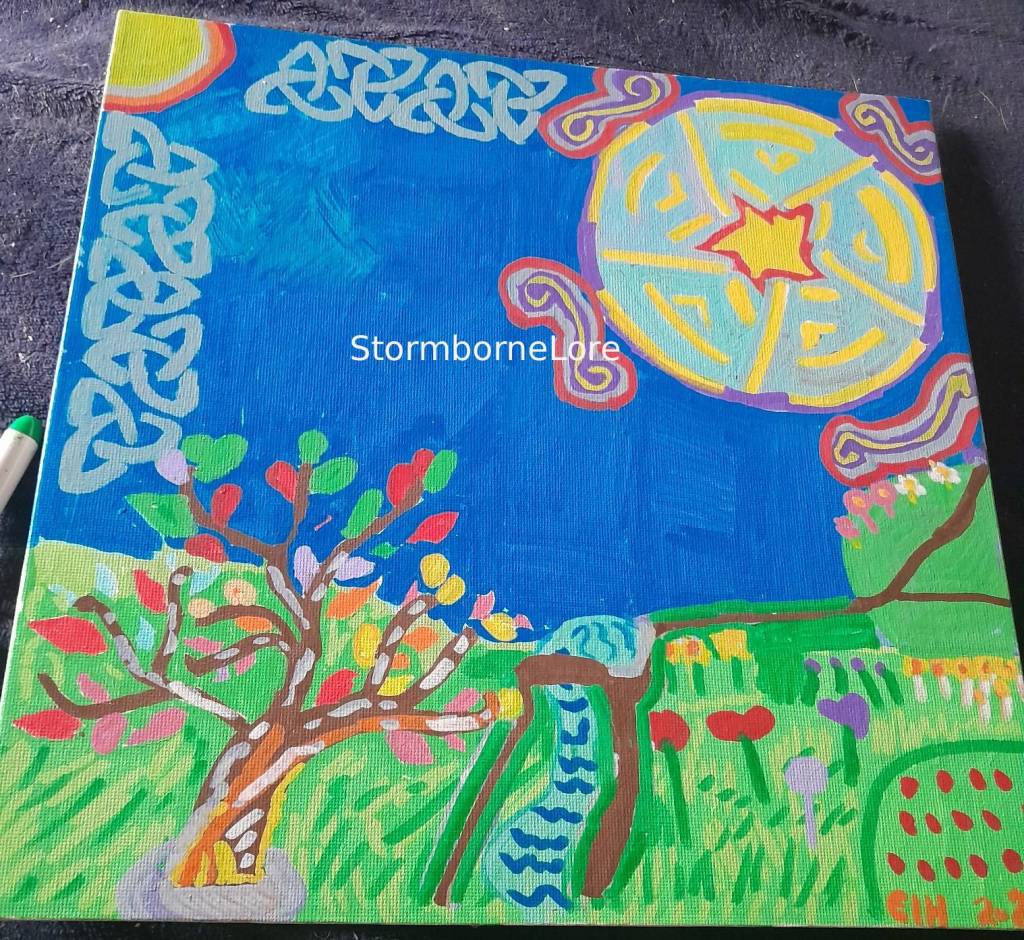
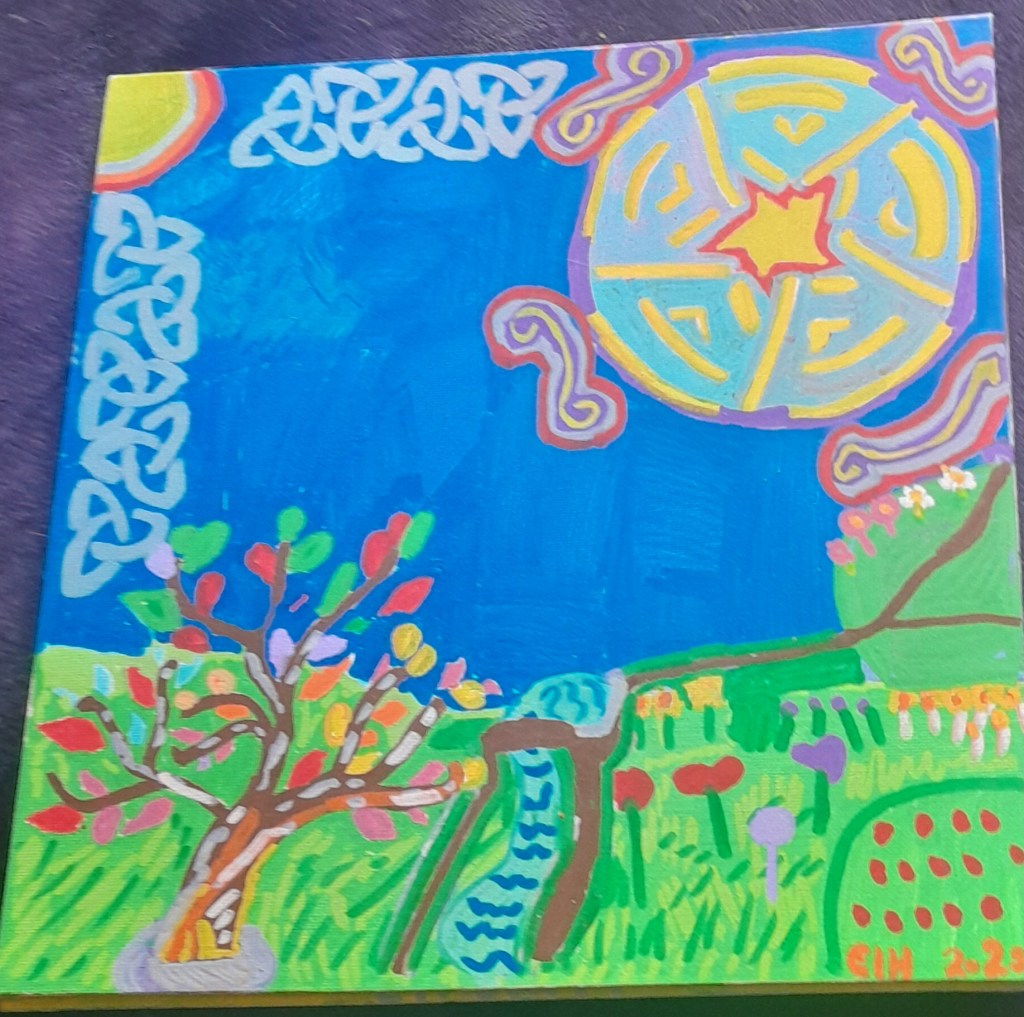
An artistic representation featuring a vibrant blue sky, a radiant sun, and a colorful tree, embodying the themes of nature and rebirth.
The fires of the Ring had long since burned low. Smoke and judgment still clung to the stones, but the voices were gone scattered into the dark like leaves. The echoes of debate, of accusations half-spoken and oaths half-broken, were swallowed by wind.
Only Taranis remained.
He stood at the centre of the stone circle, not as a warlord or seer or storm-marked legend, but as a man uncertain of what to do next.
At his feet, a small crib newly carved, rough-edged but lovingly made sat in the shadow of an ancient standing stone.
Runes spiralled along its frame like protective thorns. Inside, the child slept, his breath barely stirring the wolfhide blanket that covered him.
Taranis stared. Watched. Listened to nothing but the sound of his son’s heartbeat soft, fragile, real.
“He’s mine,” he whispered.
The words fell like an oath.
He hadn’t spoken them aloud until now. Not to the Ring. Not even to himself. But the moment he looked into the child’s eyes, he had known.
There in that small, storm-dark gaze was the same flicker that had burned in his own since birth. A fire that would not die, even when beaten. Even when left in chains.
“I wasn’t sure,” he said, as if the child could hear him. “But now I am.”
Footsteps approached quiet but familiar. He didn’t turn.
Drax entered the ring with Aisin beside him. Her dark braid caught what little moonlight remained. She wore no armor, no crown but her presence always arrived like both.
They stood silently for a while, watching him.
“We thought you’d already gone,” Aisin said gently.
“I couldn’t,” Taranis replied. “Not yet.”
He gestured toward the crib, voice taut.
“I know what you’re thinking. That I’m out of character. That I’ve gone soft.”
He turned toward them now. His eyes were storm-lit, ringed with exhaustion. But beneath that a rawness neither of them had ever seen.
“He’s mine,” Taranis repeated. “There’s no denying it now.”
Aisin moved to the crib. She looked down at the child with the quiet reverence of a priestess before a sacred flame. One hand reached out, slow and certain, to brush the boy’s brow.
“He’s strong,” she said. “But quiet. Like he already knows too much.”
Taranis exhaled hard. His voice wavered a rare thing.
“If it’s too much… if he’s too much to carry…” “We’re not strangers to raising children,” Drax said. “This one isn’t just any child,” Taranis replied. “He’s my child. And I was no angel.”
He looked to Aisin, then Drax his oldest brother, his iron pillar.
“I can take him elsewhere. To a quiet place. Far from the weight of prophecy. Far from the Ring. Just say the word.”
Drax frowned.
“You’d give him up?”
“I’d shield him,” Taranis corrected. “From this. From me.”
Aisin turned to him, calm and sharp all at once.
“You fear yourself more than your enemies?”
“Yes,” he said. “Because I dream of betrayal, but never the face. I wake with my hand on my blade. I feel hunted in my own mind.”
He swallowed.
“I don’t trust myself near him. Not like this.”
Drax stepped forward and gripped his brother’s arm.
“Then trust us.”
Aisin nodded. “He stays. He is blood. That’s enough.”
Taranis closed his eyes. A moment of stillness passed between them.
Then he whispered, “His name is Caelum.”
The name rang like truth in the circle.
Drax smiled faintly. “Sky-born. Storm-blessed.”
“Let’s hope he lives to become more than that,” Taranis murmured.
Later – The Grove Beyond Emberhelm
Rayne stood in the dark, half-shrouded by the charred remnants of an old grove. Draven hovered nearby, shoulders hunched.
“So. He’s claimed him,” Rayne said, not asking.
“He named him Caelum,” Draven replied.
Rayne smiled thin, sharp.
“That’s dangerous. Naming something is binding it to fate.”
“He’s a child, Rayne.”
“No,” Rayne said. “He’s a threat. A future. A soft spot waiting to be pierced.”
Draven said nothing. He looked at the ash, not the stars.
“You said we’d only observe,” he whispered.
Rayne stepped closer, boots silent against the earth.
“And we are. But sometimes watching is how you choose the moment. Let the warlord get sentimental. Let him love.”
He leaned in, voice silk-wrapped iron.
“Love makes good men hesitate. And hesitation… kills kings.”
Battles became rare. Raids grew smaller, born less from conquest and more from desperation. The crops suffered under strange seasons. Hunger took more than steel ever could. But with hardship came strange progress sharper tools, tighter village bonds, cleverer defences. Old powers shifted. The land quieted, not in peace, but in waiting.
And in that uneasy quiet, Taranis was content.
For the first time in years, he did not lead an army. He pursued a girl instead one with a scar beneath her eye and a laugh like war drums. She gave as good as she got, and that delighted him. The village wives said she would either tame him or kill him. The bards were divided on which would be the better story.
Meanwhile, I, Drax, his brother by blood and blade, walked a different path. I raised my people among the hills and rivers of Caernath. Children on hips, grain in hand, my wife laughing in doorways. I had earned my peace, or so I believed.
Lore, always the wisest of us, had vanished into his libraries. He said little, but he read much stars, omens, bones, spells. His son was growing fast, and Lore spoke often of unity, of law, of councils instead of kings.
Even Draven kept to himself in those days, unsure of where to cast his loyalty. And Rayne, well… Rayne’s silence was never a good sign.
Then the rumours came.
Another village, wiped clean. A warlord found burnt and broken, no enemies in sight. Smoke and whispers. They say a giant walked the battlefield, crowned in fire and storm. One witness swore she saw a great horned beast at his side. Another swore it was a dragon, wings spread across the sky like nightfall.
The name on their tongues? Taranis.
And with his name, the same plea echoed once again from the mouths of elders, farmers, and war-chiefs alike: “Take the crown.”
He refused. For the thirteenth time.
No matter their offerings gold, land, blood-oaths he turned his back on kingship. He called no banners. Built no fortress. No throne. Yet still he came when battle called. He turned tides, struck down tyrants, disappeared again into wind and legend.
And so, we formed the Ring not a court of nobles, but of equals. Thirteen warriors, leaders, seers, and voices of the old ways. It stood for balance, for judgment, for law older than any written word. At its centre: a circle of sacred stones, each carved with the oath of Stormborne.
And there, in that ring, Taranis spoke not often but when he did, the skies listened.
We thought we were building something unbreakable.
But we were wrong.
Because while we looked outward at the world beyond the hills, a darker storm gathered within us. In the silence of Lore’s spells, in the smile behind Rayne’s eyes, in the omens Draven refused to speak aloud.
The Thirteenth Ring was strong. But it only took one brother’s betrayal to crack the stone. And so the storm began to turn inward.
“Where’s the mother?” I asked.
“Her village was attacked. They slaughtered her while she screamed my name,” Taranis said.
The circle of stones stood solemn beneath a heavy sky bruised with gathering storm clouds. Within the sacred ring, thirteen seats carved with ancient runes and oaths bore silent witness as the brothers gathered once more.
Taranis sat with the weight of years pressing upon him, the child cradled carefully in Drax’s strong arms a fragile ember amidst the gathering darkness. The air was thick, charged with the unspoken dread of a prophecy unfolding.
Lore was the first to break the silence, stepping forward with measured grace. His voice was calm but sharp as flint, each word deliberate and coldly reasoned.
“Brother,” Lore said, eyes fixed on Taranis, “you speak of betrayal as if the serpent has already struck. Who do you suspect? Who harbors this poison within our bloodline?”
Rayne’s lips twitched into a mocking smile, his gaze a knife’s edge glinting in the half-light.
“Perhaps,” Rayne replied smoothly, “the betrayal lies not in our veins but in the stubbornness of one who refuses the crown. The storm we fear may well be born of his silence.”
Draven shifted uneasily on his stone, fingers twisting nervously as he swallowed hard.
“I… I cannot imagine we would turn against our own,” Draven stammered. “We are brothers forged in battle. Our oaths hold us true.”
Taranis’s gaze snapped sharply to Draven, eyes burning with bitter warning. “Blood is thicker than loyalty,” Taranis said quietly, “but fate is the thinnest thread of all easily severed, and often broken by the weakest hand.”
I stood from my seat, the strength in my voice like a hammer striking an anvil. “I swear to all here, I will raise this child as my own, guard him with my life. No harm will come to him under my watch.”
Rayne’s eyes narrowed dangerously. “Loyalty is a coin with many faces, brother,” Rayne said softly, stepping closer. “What of your people? Your wife and child? When the scales are tipped, whose cries will you hear first?”
Lore raised a hand, tracing the worn runes on his stone seat with thoughtful fingers.
“We stand at a crossroads. The old gods grow silent; new faiths rise from the south and east. It is no betrayal to seek survival. Perhaps adaptation is the true path.”
Taranis’s jaw clenched, muscles taut with anger and grief. “Survival without honor is death,” he growled. “One of you will fracture this Ring. When that stone breaks, the whole will crumble. Mark my words.”
A sudden gust of wind swept through the circle, rattling the ancient stones like a voice from the past. The child stirred in my arms, a small cry cutting through the tension like a knife.
The brothers’ eyes flickered to the babe innocent yet burdened with the weight of prophecy.
Silence fell again, thick with dread and unspoken accusations.
Rayne smiled then, colder and sharper than any blade. “So be it,” he whispered. “Let the storm come. I will be ready.”
From the edge of the circle, Draven lowered his gaze, his hands trembling. Behind closed eyes, fear and uncertainty warred in his heart a battle he dared not share.
Lore’s eyes scanned the sky, already darkening with rolling thunder. “We must decide soon,” Lore murmured, “for if we do not act, the fates will decide for us.”
Taranis stared out over the ring, his voice low but resolute.
“The time of peace is over. The Ring must hold or all we built will fall to ruin.”
He stood slowly, setting the child gently in my arms before turning toward the path out of the circle.
As he walked away, his figure a storm-shadow against the fading light, the brothers remained each wrestling with the secrets they now carried.
Taranis looked to Boldolph and smiled. There was fire behind his storm-grey eyes.
But he didn’t move.
Instead, he turned his gaze toward the centre of camp. A wide ring of bark and stone had been cleared where the warriors gathered in a hush that pressed against the skin. Grael stood tall at its edge, arms folded, flanked by his elite. One Seer stood silently with her staff grounded. Another stood beside her, cloaked in black and waiting.
Boldolph’s voice was low.
“You know this is bait.”
“I know,” Taranis said. “Let them bite.”
He raised his voice so all could hear.
“So where are the others, Grael? There were six of them. Six men who buried me alive. Are they here?”
Grael said nothing. His jaw clenched but no order came. The silence stretched like a drawn bowstring.
Taranis stepped forward. His torn cloak dragged behind him. Dirt still clung to his skin. The obsidian pendant swung from his chest, sharp as a blade and darker than the sky.
“You trained them. You gave them command. You stood idle when they dragged me from my fire and threw me in the earth like a beast.”
A ripple of movement stirred the crowd. Solaris moved silently to the left of Boldolph, his eyes alert. Morrigan circled the outer edge, her gaze sharper than any blade. The wolves were close, not quite in the circle, but near enough to strike.
The cloaked Seer stepped forward, her voice smooth and cold as river ice.
“And what are you now? A firewalker? A spirit in flesh? A wolf’s loyal mutt? You defied your masters. You broke laws. You call yourself marked as if it were a blessing. It is a curse.”
Taranis turned to face her. His tone was calm, but his voice carried like distant thunder.
“I am marked. Yes. Marked by flame and by fang. Marked by gods your kind no longer dare name.”
He looked across the ring, locking eyes with those who once saw him as nothing more than a chained boy.
“I wore the collar. I bore the mask. I bled into your soil and came back stronger. The dragon did not strike me down. It bowed.”
The first Seer the one who had first spoken of prophecy moved forward without a word. She laced her bone staff on the earth between them, the sound like a drumbeat in the dirt.
“Then let truth be spoken. Words before war. This circle is the law.”
The Circle Two lines formed. One stood behind the cloaked Seer and the old ways. The other stood in silence, eyes uncertain but shifting, behind the Seer who had named him Stormborne.
Grael remained between them all. He spoke nothing. But the weight of his silence was a blade in the dust.
The rival Seer raised her chin, her cloak fluttering as a sudden gust caught the air.
“Storms are sent as punishment. They do not crown kings. They drown them.”
Taranis stepped into the centre and lifted the obsidian pendant high.
“Then why did the storm not drown me?”
He turned slowly, meeting the eyes of warriors, elders, hunters, servants — and children.
“You speak of punishment. But where was your justice when a boy was chained for speaking truth? Where was your mercy when they threw me into a grave and danced over it?”
A murmur passed through the gathering, slow and spreading like rising smoke.
A healer stepped forward. She clutched a satchel of herbs, her hands trembling, but her voice rang clear.
“I stitched that boy once. His ribs were bruised. His wrists bled. I said nothing. I was afraid. But I will not stay silent again.”
Taranis gave her a solemn nod.
“Then speak now. Let every voice rise. This land will not be ruled by silence.”
The cloaked Seer opened her mouth to answer, but no sound came. She felt the tide turn and stepped back. The people had shifted.
A father stepped forward next, then a girl who’d once carried water to chained boys. An older warrior, limping from an old wound, nodded slowly. For the first time, Grael’s expression flickered — not with rage, but with understanding.
Verdict Grael finally stepped into the circle. The pressure broke like thunder in the air. He scanned the faces around him — warriors he had trained, people he had led. Then he looked to Taranis.
“The six who attacked you are dead or have run. That is not mercy. That is law. They broke it.”
He turned toward the Seers.
“But from this day, we follow one voice. Not the loudest. Not the oldest. The one the flame has not burned. The one the dragon did not kill.”
He turned his eyes on Taranis.
“The one who rose.”
From the back of the crowd, a girl no older than ten stepped forward. Her hair was matted but her eyes were bright with memory. She held a scrap of wolf-fur in her small hands.
“You pulled me from the pit. The dark place. I saw you in the fire. You held the sun in your hand.”
Taranis knelt before her, gently resting a hand over hers.
“Then keep that memory. Let it burn in you, not through you.”
He rose slowly, the firelight catching in his eyes. Then he turned to face the whole circle.
“No more collars. No more chains. No more silence. This is no longer a camp. It is a beginning.”
The wolves howled not out of hunger or fury, but in echo of a vow they once made long ago. A vow that now passed from wolf to man, and from man to child.
The first Seer stepped beside Grael and whispered a single truth.
“Stormborne.”
Solaris stepped closer, his voice a whisper only Taranis could hear.
“So what does that make you now?”
Taranis looked out at the crowd, at the firelit faces, the broken chains now lying in the dust, the wolves resting at the edge of the light. Then he looked to Solaris and smiled.
“A man. A friend. A warrior, if Grael will train me. Perhaps a healer. First in the line of the Order of Dawn.” He paused, gaze rising to the stars above. “Or maybe just someone who lived when he should have died.”
He turned back to Solaris, his voice soft.
“Who knows what tomorrow will give?”
And for the first time since exile, Taranis Stormborne laughed not out of pride, not out of pain, but because for once, the wind didn’t sting.
The wind rolled down from the mountain like a warning.
Three days had passed since the Trial by Fire. Taranis had been seen walking beside Grael’s warhorse, the shattered collar left behind, and the obsidian pendant still warm against his chest. But not everyone had accepted his transformation.
Some called him storm-marked. Others, cursed.
In a low tent near the edge of camp, whispers brewed.
“He defied the gods,” one said.
“Walked through flame and came out smiling,” said another.
“Flame tricks the weak. It blinds.”
The men gathered around the edge of the fire, cloaks pulled close against the creeping mist. They weren’t Grael’s most loyal, nor Solaris’s brothers. They were wolves without a pack mercenaries who had once served the Clawclan, now waiting for coin and chaos.
They didn’t wear Stormborne colours. Not yet.
“Tonight,” muttered Kareth, his eyes gleaming with spite. “We do what fire could not.”
A few nodded.
“He should’ve died in chains. He’s no warrior. He’s a beast.”
“And beasts don’t get reborn.”
They struck after moonrise.
Taranis had gone to the stream to refill his waterskin, alone as he often did, choosing solitude over celebration. The camp had begun to sleep. The guards were half-drunk from fermented berry wine.
They came from the trees six of them. Faces covered, blades drawn.
The first blow caught him across the shoulder, sending him to the ground.
“Traitor,” one hissed. “Freak.”
Taranis fought back with bare fists, striking like the wolf they feared but it was too many. A second dagger found his ribs. A club broke across his spine.
He fell to one knee.
They kicked him until he stopped moving.
Until his breathing went quiet.
Until he bled into the moss and stones.
They dragged the body to the far side of camp, past the standing stones, into a hollow in the woods where no firelight reached.
They left no markers. No words. Just dirt over his body and a curse on their breath.
“He walks no more,” Kareth said. “The storm dies in silence.”
And they returned to camp, blades clean, alibis ready.
No one would find him.
No one would weep.
They believed the gods had finally corrected their mistake.
But Taranis was not dead.
He dreamed of fire.
He dreamed of wolves.
He dreamed of the black dragon watching from above not with pity, but with fury.
And beneath the soil, his fingers twitched.
The early morning sin rose and grael could be heard hollering
“STORMBORNE WHERE ARE YOU?” grael shouted looking around for taranis
“He fled, he’s a coward” one of kareths men said smirking Wolves circled where his body lay leading them to discover taranis body still and cold.
Two days passed “we will find him tether him again no escape this time.” A warrior said as the wolves circled a piece of land “Hes dead grael” a Saris said “He deserves a real burying ” another said
The earth did not keep him.
Not on the first day, when silence reigned. Not on the second, when the wolves came. But on the third the wind changed.
At first, just a shift. A stillness. Then, a scent.
Morrigan arrived first. White fur gleaming against the ash-darkened trees. She paced in a wide circle around the hollow. Then came Boldolph, the black wolf, teeth bared, hackles raised.
They howled.
A low, haunting sound not grief. Warning.
Grael rode at once, followed by Solaris and half the guard. When they reached the hollow, they found the wolves digging. Claws tearing through dirt, paws flinging soil like rain.
Grael dismounted. Something in his chest cracked.
“Taranis…”
Solaris dropped to his knees beside the wolves, hands trembling.
“Help me dig!”
No one moved until the first scrap of cloth was exposed. A torn edge of tunic, blood-black, crusted to the earth.
Then the digging began in earnest.
It took three men and two wolves to drag the body out.
He was pale. Lips cracked. Blood dried to his skin. The obsidian pendant still hung around his neck, dirt pressed into the ridges.
One eye was swollen shut. Bruises ran like vines across his chest and arms.
But he was breathing.
Shallow. Ragged. But alive.
Solaris shouted for the healer. Grael stared at the boy like he was seeing a ghost.
“No burial mound,” he said softly. “No cairn. Just a shallow grave… and a storm too stubborn to die.”
The healer worked in silence, hands quick and firm. Crushed pine and fireweed were pressed into the wounds, stitched with thread made from gut and hope. Taranis didn’t speak. He didn’t need to. Each time the wind shifted, the wolves growled low in their throats, sensing the old power flicker just beneath his skin.
By nightfall, they had moved him to a guarded hut near the heart of camp. Four warriors stood watch. Grael gave orders that anyone who tried to enter unbidden would be struck down no questions asked.
Solaris sat beside the boy, wiping dried blood from his temple.
“You stubborn bastard,” he whispered. “Even the grave gave up on you.”
Taranis didn’t reply. But his eyes opened barely and fixed on the obsidian pendant now laid upon his chest.
Grael returned before moonrise.
“Speak if you can,” he said.
Taranis’s voice was a thread. “They buried me.”
“I know.”
“They didn’t even check.”
“I know that too.”
“Will you punish them?”
Grael paused. “I already have.”
He tossed something at Solaris’s feet a piece of fur, torn and bloodied.
“Kareth?”
“Gone,” Grael said. “Dragged into the trees by Boldolph. I don’t expect him back.”
Silence settled between them again.
“I should be dead,” Taranis murmured.
Grael nodded slowly. “You were.”
That night, as the wind moaned through the valley, a scout returned from the northern ridge.
“There’s smoke again,” she said. “Not ours. Not Clawclan. Something… older.”
She hesitated before finishing.
“There’s no fire. But trees are blackened. Stones cracked. Something passed through.”
“What kind of something?” Grael asked.
The scout swallowed.
“The kind that flies without wings.”
By dawn, word had spread. Taranis had survived. Taranis had risen.
They called it impossible. Witchcraft. Proof of corruption.
But some whispered another name.
Stormborne.
He stood the next morning.
Not for long, and not without pain, but he stood.
Morrigan watched from the doorway. She did not enter only nodded once, her red eyes gleaming.
“Even the wolves thought you were lost,” Solaris said.
“I was,” Taranis replied, voice raw. “But I heard them. In the soil. Calling.”
He stepped out into the morning light slow, stiff, but upright. The warriors turned to look. One dropped to a knee. Another stepped back in fear.
Grael met him near the edge of the camp.
“We’re riding soon. There are still wars to fight.”
Taranis nodded. “Then I’ll ride.”
“No packs,” Grael said. “No chains.”
Solaris handed him his cloak. “And no grave can hold you.”
Taranis turned to the standing stones, where birds now circled. Thunder echoed in the far hills.
He placed his palm against the earth the earth that had tried to hold him.
“Not today,” he whispered. “I am not done.”
In Emberhelm, the elders would speak of that day for generations.
The day the Stormborne rose from the grave. The day the wolves howled not for mourning but for warning.
And from that moment on, no one dared bury him again.
The trial fire still burned in the hearts of the warriors long after the flames had faded.
They left the stone circle at sunrise, the air thick with silence. Taranis walked unbound now, but still marked the collar firm around his neck, his wrists bruised, the pendant of obsidian pressing warm against his chest beneath the tunic Solaris had given him.
No one spoke of the dragon.
They didn’t need to. Its shadow had burned itself into every man’s memory.
By midday, they reached the edge of a sprawling war camp carved between high ridges and pine forest. Smoke rose from scattered fires. Grael dismounted first and gave the order for rest and supplies. Taranis stood nearby, posture straight, though his limbs ached from the days of trials and visions.
A hush followed him wherever he moved. Some men nodded. Others turned away.
One older warrior spat at his feet and muttered, “Dragon-kissed freak.”
Taranis didn’t respond. But Grael saw and said nothing.
Inside the central tent, the tension grew.
“You should exile him,” said Kareth, a clan captain with blood on his hands and ambition in his eyes. “Or bind him again. The men are talking.”
“This boy walks free after breaking formation, defying orders, and drawing the attention of beasts older than the gods?”
Grael looked up from the war map.
“Exactly. He walked through fire and survived. He fought off Clawclan while half my guard bled out in the dirt. He was named by a Seer. You want to leash him again? You do it.”
Kareth hesitated. “If he leads a rebellion, it’ll be your head.”
“No,” Grael said. “It’ll be his. If he earns death, he’ll find it. But if he earns something more, I won’t stand in the way.”
That night, Taranis sat near the outer fire, the pendant warm against his chest again. Solaris approached with a fresh poultice and a torn piece of roasted meat.
A growl echoed in the hills not wolf, not wind. Something deeper. Some warriors looked up. A few rose to check their weapons.
A young scout came running from the ridge.
“Smoke! North side. Something’s burning!”
They scrambled toward the hill’s edge and saw it.
A rival clan’s border camp was ash and ruin. No screams, no survivors. Only smoldering black earth and claw marks in the rock.
“Raiders?” Solaris asked.
“No,” Taranis said quietly. “It’s a warning.”
Grael joined them, silent, jaw tight.
Kareth was already shouting. “This is what he brings! The dragon follows him. Death follows him!”
“No,” Taranis said. “The dragon doesn’t follow me. It watches.”
“Same thing.”
Grael raised a hand. “Enough. We return to Emberhelm. There, the chieftains will decide what happens next.”
The journey to Emberhelm took two days. The stone fortress carved into the mountains stood stark against the dawn ancient, proud, watching the valley like a sentinel.
When they entered, the whispers turned to stares.
Children peeked from behind barrels. Elders crossed their arms. A group of shieldmaidens flanking the gate parted only after Grael rode forward and gave the sign.
Taranis dismounted, cloak billowing slightly behind him. No chains. No mask. Only the obsidian pendant.
In the Great Hall, the Five Voices of the War Council sat in a semi-circle.
Old warriors. Mothers of fallen sons. Leaders of lesser clans.
One stood Sern, a matriarch with fire in her eyes and silver in her braid.
“We saw the storm,” she said. “We saw the dragon’s wings. We heard the Seer’s cry.”
Another voice cut in a young man named Fenric, blood cousin to the boy Taranis had crippled.
“He’s cursed. He bled our kin, broke our laws, walked with beasts. Now you bring him here unbound?”
Grael stepped forward. “I bring you a warrior.”
“Not yet,” Sern said. “Not until the rite is finished.”
“What rite?” Taranis asked.
She pointed to the firepit at the centre of the chamber.
“You were bound by man. Now let the flame judge if you are bound by fate.”
They handed him a staff and stripped him to the waist. The collar remained. So did the pendant.
The fire was lit with dried hawthorn, wolf hair, and elder root.
He stepped into the circle.
“Do you claim name or no name?” Lady Sern asked.
Taranis raised his head. “I claim the storm.”
A gust of wind blew through the open doors behind him.
“Then speak your vow.”
Taranis closed his eyes.
“I was chained as beast. I was broken by man. But I rise not to rule only to walk free. I serve the flame, the wolves, the storm. If I break my word, may the dragon turn from me.”
He thrust the staff into the fire.
It did not burn.
Instead, the flame spiraled into the air and far above, the sky answered with a distant roar.
The hall went silent.
Lady Sern bowed her head.
“Then you are no longer beast. Nor slave. Nor tool.”
She placed her hand on his collar.
“From this day, you are Stormborne.”
She broke the collar with a hammer of bronze.
The pieces fell to the stone floor like the last chains of a life left behind.
Does that mean he’s free?” Solaris asked.
Taranis placed a hand to his neck, fingers brushing the worn ridge where the collar had once pressed deep.
“Or am I to be exiled?”
A hush fell again, broken only by the wind rustling through the pine above.
“Exile him,” came a voice from the gathered crowd, “and I will hunt him myself.”
All heads turned.
It was not Grael who spoke, nor one of the regular warband. It was a man cloaked in dark fur, standing apart from the others near the treeline scarred face, sun-dark skin, hair braided with bone. A chieftain from another clan.
“He bears the storm’s mark. He’s no beast. No slave. And not mine to cast out.” His voice was low, graveled with age and fire. “But if you send him away, don’t expect him to come back.”
Taranis didn’t flinch. His eyes locked on the stranger’s. He neither bowed nor raised his head. Just… endured.
Grael stepped forward.
“He’s not exiled,” the general said. “Nor is he yet free. The trial burned away the mask, but chains leave scars longer than flame.”
“And what is he now?” Solaris asked.
Grael looked to the warriors, the gathered villagers, the scouts and wounded men who had seen the dragon descend.
“He is Stormborne,” he said. “Named not by man, but by thunder. And while I draw breath, that name will be honoured.”
There was a ripple in the crowd not agreement, not rejection. Just change. Unease becoming belief.
Taranis turned to Solaris. “Then I stay?”
Solaris nodded. “If you want to.”
“I don’t know what I want,” the boy admitted. “I only know I’m still breathing.”
Beside him, the black scale the one left by the dragon was now strung on a simple leather thong, hanging from his belt like a forgotten relic. He touched it once, gently.
A woman stepped forward from the watching crowd. She carried no weapons only a clay bowl filled with ash and herbs.
“I came from the ridge when I heard the trial fire was lit,” she said. “If the dragon marked him, then his wounds must be sealed properly. Not with chains. With earth.”
She knelt before Taranis and dipped two fingers into the bowl. Ash and sage stained her fingertips. She reached up and slowly touched each side of his jaw where the mask had pressed hardest.
“You have walked through smoke,” she whispered. “Now rise through flame.”
Taranis stood, a little taller than before.
Grael gave a curt nod. “We break camp tomorrow. Clawclan still stirs in the lowlands. But the boy rides his own horse now. No packs. No tether.”
“And the collar?” Solaris asked.
Grael glanced at it now lying in the dirt.
“Leave it where it fell.”
As the crowd began to scatter, a new chant rose quietly from the younger warriors near the fire.


 StormborneLore