The circle of stones stood under a bruised sky. The thirteenth stone, already cracked from the battle at Emberhelm, seemed to strain against itself as though it knew what was coming. Thirteen seats. Only twelve filled.
Taranis Storm to his outlaws stood at the centre. His cloak was damp from rain, his wrist still bandaged from the Hill of Ashes. Around him, the brothers of the Ring shifted like wolves uneasy in their own skins.
Drax spoke first. “The Black Shields raid in your name. The people whisper of you, not of us. The balance is broken.”
“It was never balanced,” Taranis replied. His voice was low, bitter. “We bled for fields that gave us no bread. Rome takes salt from our earth while we quarrel. If I raid, it is to feed our people, not to wear a crown.”
Lore’s eyes flicked to the sky. “And yet the crown follows you, brother. The omens have turned. The storm no longer waits.”
Then Rayne stepped forward, the firelight showing the sly curve of his smile. “No storm lasts forever. Some of us have chosen survival.”
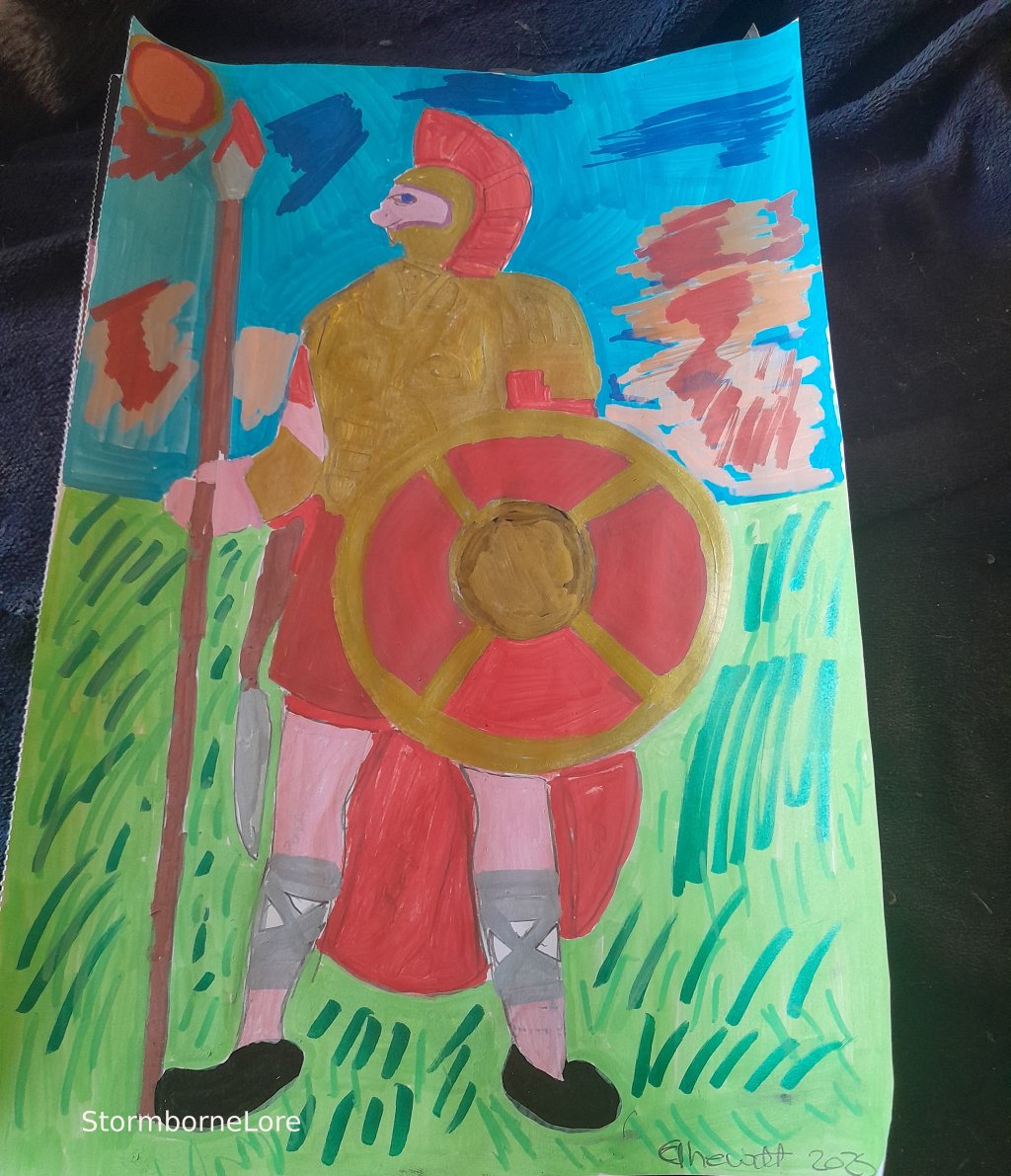
From the shadows came the tramp of iron boots. The air filled with the rhythm of Rome square shields, horsehair crests, iron blades that gleamed even in the grey. The circle of stones was surrounded.
Draven’s face went pale. His lips moved as if to speak, but no words came.
“You led them here,” Taranis said.
Rayne did not deny it. “Our people will live beneath Rome’s law. Better chains of iron than graves of ash.”
The thirteenth stone split with a sound like thunder. Dust trickled down its face. The Ring was broken.
Battle erupted. Drax drew steel, Lore called fire from the runes, Aisin shielded the cradle where Caelum slept. Nessa’s blade sang bright before she was dragged into the fray, her cry lost in the clash.
Taranis fought like the storm itself blade flashing, shield breaking, each stroke cutting down another soldier. But for every man he felled, three more closed in. Nets weighted with lead tangled his limbs. Chains of iron bit deep.
He roared once, a sound that shook the stones. Lightning split the sky as if the gods themselves mourned. Then the Romans dragged him down. His black shield shattered under their boots.
“Take him alive,” the centurion barked. “Rome has use for beasts like this.”
When the fighting ended, the circle lay in ruin. Smoke curled from broken fires. Brothers lay wounded or scattered. The thirteenth stone was nothing but rubble.
Taranis, Storm of Emberhelm, was shackled in chains and marched south along the salt road. Behind him, the old world fell silent. Ahead lay the lash, the arena, and the roar of foreign crowds.
He lifted his head once to the sky and whispered through bloodied lips:
“If I must fight, let it be as storm, not as slave.”
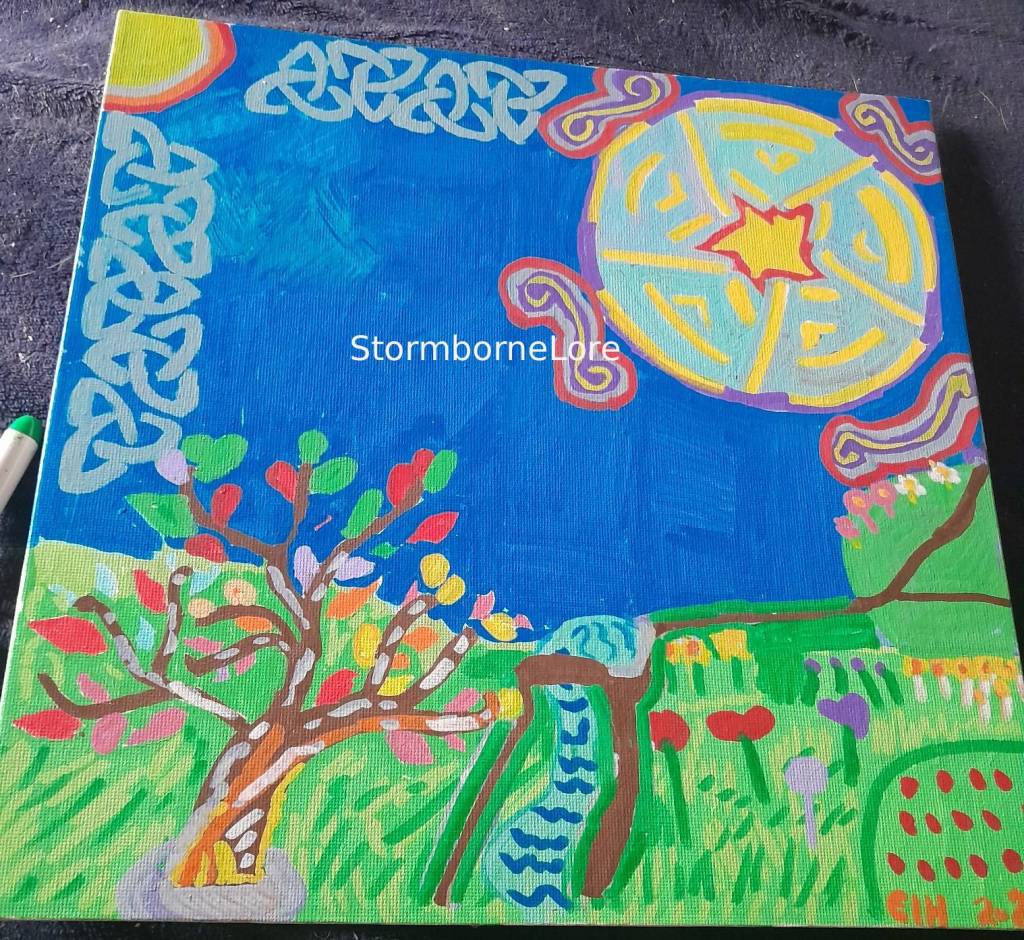
A vibrant painting depicting a colorful tree beneath a bright blue sky, symbolizing life and renewal.
Rest Beneath the Tree
At last they came to the tree.
It rose from the earth as though the hill itself had forced it skyward roots tangled deep, bark silvered with age, branches spread wide like the arms of a giant blessing or warning all who passed beneath. The ground around it was hushed, as if even the wind dared not trespass too loudly here.
Storm staggered to its shade and lowered himself to the roots. The weight of his wounds and weariness pressed him down, yet the tree seemed to hold him as gently as a cradle. He breathed slow, leaning against the trunk, and for the first time since the hill of ashes he felt his heart’s trembling ease.
The others made camp nearby, but left him undisturbed. Brianna spread her cloak by the fire, her eyes flicking often toward where he lay. Cadan tended the embers, muttering half-prayers, half-jests. The boy slept curled by the packs, his face still wet with the salt of grief.
Storm closed his eyes.
The world changed.
The tree shone with light, its roots glowing as though molten, its crown alive with whispering voices. Wolves circled him in the half-dark Boldolph and Morrigan among them, their eyes like coals, their howls joining others long gone. Above the branches wheeled Pendragon and Tairneanach, wings stirring thunder in a sky that was not a sky.
The gold ring gleamed on his finger once more. Its weight was not a burden but a bond. And the tree’s voice, deep as the earth itself, rolled through his marrow:
Rest, child of storm. The road is not ended. Every root remembers. Every leaf bears witness. You are bound to us, as we are bound to you.
Storm reached out and pressed his palm to the bark. He felt its strength answer, steadying his own. When his eyes opened, dawn was breaking.
Brianna stood ready with her blade. Cadan was already packing. The boy stirred from sleep.
Storm rose slowly, his body aching but his spirit steadier, and gave the tree one last look. The mark of his hand remained upon the trunk, a faint glow where blood and dream had mingled.
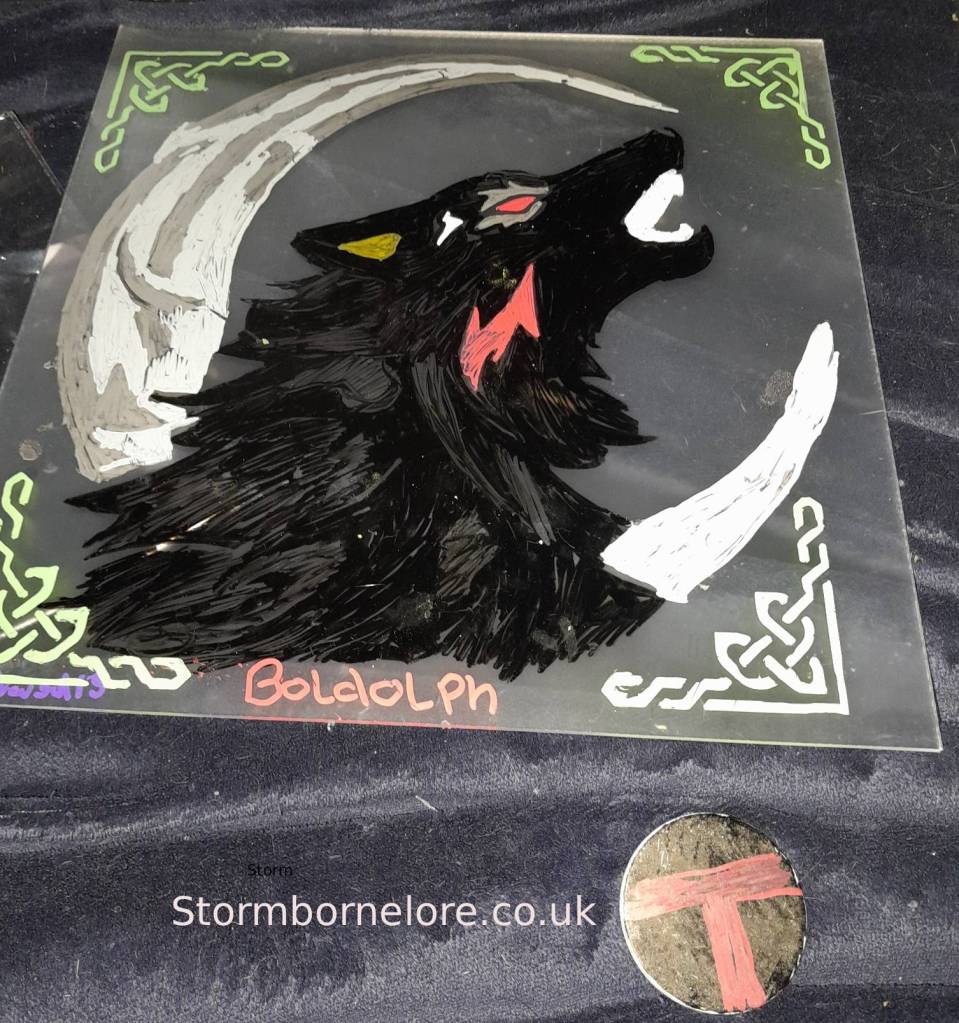
Boldolph the Wolf brother, shield, spirit of the wild. Painted on clear acrylic, one of a kind. Part 11 of The Chronicles of the Gold Ring is now live where the wolf walks again in the trees.”
The Wolf in the Trees
The rain had not stopped since the hill. It drummed on oak leaves, hissed across the ash of the fire, slicked every blade of iron until the men and women of the Black Shields looked like shadows burnished in oil. The night smelled of wet earth and smoke, of wounds bound with linen that would not stay clean.
Storm slept little. When he closed his eyes, the hammer fell, and the nails drove, and he woke with the sound of iron in his skull. So he stayed upright with his back to the birch, watching the drip of water through branches, listening to foxes bark and owls call, waiting for morning.
At dawn, a shape lingered beyond the edge of the fire’s reach. Low, black, moving between trunks with the patience of hunger. Storm’s hand went to the haft of his knife before he realised what he saw.
A wolf.
Not the lean carrion-pickers that shadowed armies, but broad in the shoulder, thick in the ruff, eyes burning with a colour no dog had ever worn. It did not growl. It did not flee. It stood in the bracken and watched him.
“Boldolph,” Storm breathed, though he knew the beast before him was no man, no brother, no shieldmate returned. But something in the tilt of the head, in the way it lifted its nose as if to scent not flesh but memory, made his chest tighten.
The others woke one by one. Cadan saw it first and rose with his knife ready. “Leave it,” Storm said. His voice was rough with the weight of command. Brianna squinted through the rain. “Is it a sign?” Storm shook his head. “It is a wolf. That is enough.”
But when the wolf turned and padded into the thicket, Storm followed. He did not tell the others to stay; they knew.
The trail wound between dripping ferns and stones slick with moss. Once, the wolf vanished altogether, and Storm thought he had been chasing a ghost but then the shape appeared again on a rise of ground, waiting. Guiding. Testing.
At last they came to a hollow ringed with oaks older than any fort or cross. Their roots knotted together like clenched fists. At the centre lay a cairn of stones blackened with age.
The wolf set its paws upon the mound, lifted its muzzle, and gave one long, shivering call. Not to the pack for there was no pack—but to the world itself. Then it was gone, as if the trees had folded and swallowed it whole.
Storm touched the cairn. Cold. Wet. His fingers came away with lichen and soil. And something else. A groove cut deep, filled with rain. A mark he knew from chalk scratched on gateposts and painted on stolen shields. A ring.
The Gold Ring.
He knelt, pressing his forehead to the stone. For a breath he smelled not wet earth but smoke from a hall long gone, heard not rain but the laughter of those who had died before him. Nessa. Morrigan. Boldolph. Rayne.
The voices came like wind through hollow wood: Hold fast. The story is not done.
Storm rose. His wrist throbbed where the nail had kissed bone, but his grip was steady when he returned to the camp.
Brianna looked at him, sharp-eyed. “What did you find?” “A place,” Storm said. “A promise buried under stones.” Cadan spat into the fire. “More promises.” “Not words,” Storm answered. “A mark. The old ring. It waits for us.”
The rain eased then. Just enough to let the fire breathe.
That night, when the Black Shields moved again, they did not march as hunted rebels, but as something else. A rumour clothed in rain, a shadow given teeth. And always at the edge of the path, in the corner of sight, Storm thought he saw the wolf pacing them between the trees.
They marched him up the salt-hill at Dodderhill, where the Roman timber bites into the skyline like bad teeth. Below, Salinae steams. The brine pits cough a white breath across the roofs, and every back in the town goes still; men with salt-burned hands, women with brined wrists, children with their mouths parted. All of them looking up. All of them waiting to see a lesson.
Storm’s wrists are raw from the iron. His shirt is torn where they hauled it over his head, the air is cold on old scars and new. There is a cut across his ribs from the morning’s struggle and the dried salt in it stings like sand.
A centurion with a wine-scarred mouth calls the charge in a language that thinks it is the only one that matters.
“Rebel. Murderer. Enemy of Rome.” The words land like stones. Men with square shields drag the condemned in a line. Three farmers. A boy who threw a stone. Storm.
“Use the cross for the big one,” the centurion says. “Make them see.”
They set the upright in the earth, ramming it with a post-driver until the ground answers. The carpenter’s nails gleam in a little wooden tray, thick as a man’s thumb. The hammer is clean. The executioner’s eyes flick to Storm and away again as if he’s looked at the sun too long.
Storm keeps his chin up because he will not bend. He smells oak smoke from the town, the sour of men in mail, the resin of fresh-split palings. He tastes brine on his teeth. A gull wheels and screams once, the cry torn thin by the wind.
A voice from the crowd below: not words, just a keening. Another voice, hoarse, calls his name the way a prayer is called: “Shield!”
He does not look down. He looks at the sky. Cloud, thin and grey and harmless. For now.
“Hold him,” the centurion says.
Four soldiers pin his arms. The fifth takes Storm’s right hand and forces it open against the cross-beam. The leather strap bites his palm. The executioner lifts the first nail. It is cold when it kisses the crease of Storm’s wrist.
Storm hears the old world in the edges of the day. The ring he once wore feels like a phantom weight on his finger. He sees Nessa’s hair in the corner of his sight when the wind shifts. He hears Boldolph and Morrigan somewhere he can’t walk to anymore. Rayne’s voice is the whisper in the hinge of the jaw: brother, hold still and we will live. Brother, lie down.
The hammer rises.
Thunder is far off. Not here, not yet. A single pulse on the horizon like a heart behind a ribcage. The executioner breathes. The hammer falls.
It meets iron and the iron skids, glancing off the nail head. The blow dents the wood and slams into Storm’s bones. He grunts despite himself. Blood beads. The executioner squints, checks the nail, lifts again.
The second stroke strikes home. Iron bites meat. The sky pulls tight.
A woman cries out below. “Enough! He fought for us!”
“Silence,” the centurion barks, not looking down.
Storm tastes copper. His vision narrows, then widens until he can see each hair on the executioner’s wrist, each pore, each fleck of sawdust stuck to the hammer’s face. It is the old sight, the red edge. He could go there—into the roar where nothing hurts until after—but he does not. He holds on. He wants to watch.
“Left,” the centurion says.
They take his other hand. Fingers spread. The nail’s cold mouth finds the vein. The hammer rises
and the wind turns.
Not a gust. A pivot. The kind of turning that changes seasons. Smoke from the brine pans below folds back on itself. Sparrows flatten to the earth. The hairs along Storm’s arms lift.
The first crack of thunder lands atop the fort like an axe into a block. Every man jolts. A standard topples with a clatter of bronze. The executioner flinches, the nail slips, and instead of flesh he drives it through the softened knot of the beam.
The shock carries up his arm. He swears. The soldier holding Storm’s elbow looks at the sky. The sky looks back.
Cloud blooms fast from the western line, rolling in on a bruise-coloured belly. A wolf-long shape seems to run along its edge and is gone. Another crack. Closer.
“Finish it,” the centurion snaps. But there’s a catch in it now, and he makes a sign with his two fingers as if to pinch off something unseen.
The hammer lifts for the third time.
Lightning hits the palisade post a spear’s throw away. Wood screams. Splinters go like hail. Men duck behind shields by training, but training breaks when the sky speaks in a voice older than their gods. A mule rears and snaps its lead. The nail tray overturns; iron skitters like teeth on stone.
Storm moves then.
He lets the red edge take him for a heartbeat just enough. He wrenches, twisting his pinned right wrist so the cut tears long and clean instead of deep. The leather strap splits where sweat has rotted it.
He brings his head forward under the beam, drives his shoulder into the soldier’s throat, hears the wet cough, feels the grip loosen. He kicks back, heel to knee, and the man behind him falls with a scream.
There is always a moment in a fight when the world decides. This is it.
He drives the crown of his head into the executioner’s face; the man drops the hammer, hands going to his nose. Storm grabs the hammer with his left hand, blood slicking the haft, and swings the weight into the chain on his left wrist. Once. Twice. The chain holds. The third blow finds the link that was barely peened shut, and it parts with a sweet, bright sound.
“Hold him!” the centurion bellows, but half his men are looking at the burning post and the other half are looking at the sky.
Shapes break from the heather below the berm three, five, a dozen men with black-painted shields and hunters’ faces. Brianna’s braid is bound with leather; Cadan’s scar shows white through ash. They come without horns or shouts, all knife and certainty.
Brianna hits the left flank like a thrown stone, her knife opening a belly before the man knows his shield is gone. Cadan slides under a spear and cuts the hamstring clean, then is up again and laughing because sometimes that is the only way to keep breath inside you.
“Storm!” Brianna barks.
He throws the hammer. She catches it by the neck and brings it down on a helmet rim, bending iron into eyebrow and eye. She tosses it back and he takes the chain a second time and frees his right.
The centurion finds his voice at last and orders the archers, but the bowstrings are wet now, the fletchings torn sideways by the sideways rain that has arrived without crossing the ground between. Arrows go high and crooked. One finds a farmer’s boy in the line of the condemned. The boy sits down as if to rest and does not get up again.
Storm would carry that if he let himself. Later, he thinks, later, and steps toward the centurion.
“Stand,” the centurion says, not to him but to what moves in his bones.
“I do,” Storm says.
They meet as men meet: iron-toothed and close. The centurion is trained. Storm is made. The first cut is Storm’s forearm across the centurion’s sword-hand, breaking the rhythm, and the second is Storm’s head against the man’s nose—again, because men are made of the same mistakes and the third is Storm’s thumb to the centurion’s eye. The man goes down with a sound nothing like command.
“Back!” a junior officer yelps. “Back to the fort!”
They drag their wounded. They leave their dead. They do not look at the cross. The storm does what storms do it eats the edges of everything.
From the town below, the people cannot see the cut and the grapple, only the outline of men against rain and the lightning that makes ghosts of them. Then those ghosts are gone into the gorse and the broom, and the hill is left with a burning post and an empty beam and a rumour that begins to run faster than hooves.
They bind Storm’s wrist tight with a strip of his own shirt and the last clean linen any of them have. The bleeding slows. His hands shake after it stops. He sits with his back against a birch, watching steam lift off his skin.
“Could have died,” Cadan says, not accusing, not gentle.
“Didn’t,” Storm answers.
Brianna crouches and studies the wound. “You’ll have two scars for one story,” she says. “The tale-singers will thank you.”
Storm looks at the knot of linen. He thinks of a nail driven through the heel of a stranger in a land he will never see, of crosses on a hill where a different empire stakes its truth. He thinks of Nessa’s mouth and Rayne’s eyes and of wolves that do not answer. He feels the tremor in himself and wonders if it will ever stop.
“Was it you?” Cadan asks. “The sky?”
Storm chews that like gristle and spits it out. “No,” he says. “It was the sky.”
Brianna huffs once, almost a laugh. “Then the sky is with us.”
They move as the light fails, cutting north and a little west, keeping to hedges and the backs of fields, avoiding every lane the Romans know.
The storm rolls away toward the Severn; behind it, the wood drips and the undergrowth smells green and clean as if nothing dies.
By the time they reach the low, wet ground where the oaks thicken half a day’s walk from the salt town, close enough to smell wood-smoke when the wind is right night has set.
They choose a place where yew anchors a little rise and an old fallen oak makes a table the size of a man. Cadan lights a small fire that no one will see unless they are meant to. Brianna lays out bread and dried meat and a handful of early wild garlic leaves, because ritual has to start with something you can eat.
Storm stands, because oaths are made on feet.
“We were a ring,” he says. “We were a house. We were a promise to people who do not want us anymore. Today I was meant to die to teach them to fear, and I did not. I don’t know if that is luck or the gods or a debt that will come due later.”
He looks at each of them. There are eleven counting him. Some are men who fought with him when the wolves still ran the ridge. Some are women who learned a knife because no one else would come. One is a boy who was a boy yesterday and is not anymore.
“I’m done waiting for any man’s mercy,” Storm says. “If you stay with me now, you stay knowing there will be no pardon. No ring to call us home. We will be hunted by chiefs and by Rome and by the stories men tell when they are afraid. We will strike and vanish.
We will take food from those who hoard it and give it to those who starve. We will cut chains where we find them. We will keep the lanes dangerous for those who would make them safe for empire. We will be the shadow that says not yet.”
He sets his palm on the fallen oak. Blood from the bandage seeps fresh and red and bright against the old grey wood.
“I name us,” he says, and the words come easy because they are true before he speaks them. “The Black Shields. Not for hiding” he taps the painted face of Brianna’s board, dull black with ash and pitch “but for what we carry in front of us so the ones behind can live.”
Brianna puts her hand over his. “Black Shields,” she says.
Cadan’s hand stacks next. “Black Shields.”
One by one, the others follow, rough palms and finer, scarred knuckles and bitten nails, hands that have stolen and fed and fought and held.
When they step back, the tree holds their blood in a dark print that already looks like a sigil.
A wind runs through the oak leaves though nothing else stirs. Somewhere far off a fox barks and another answers. In the dip of silence after, Storm thinks he hears just for a breath the long, low note of a wolf.
He looks up into the black roof of the wood and does not ask for a sign. He has had enough signs for one day.
“Sleep,” he tells them. “We move before light. The salt road will wake angry.”
Brianna nods, already spreading a cloak for the boy who is not a boy. Cadan checks the edges of the camp, his knife out, his shoulders easy for the first time since the hill.
Storm sits again with his back to the birch. His wrist throbs in time with his heart. When he closes his eyes, the hammer falls, and falls, and falls, and does not find him.
Below, the town spreads the story because towns are made to spread stories. By morning it will have a name it did not have yesterday the Hill of Ashes. By night there will be new chalk marks cut into the backs of gateposts that mean leave bread, and others that mean soldiers, and others that mean the Black Shields have passed.
He lets sleep take him only when the fire dies to a patient red and the rain begins again, soft and fine, washing the last blood from the bark.
From this moment Taranis Stormborne became known as Storm among his men.

 StormborneLore