Tag: Ancient Britain

  • The Broken Circle: Rayne’s Fight for Survival

    The Broken Circle: Rayne’s Fight for Survival

    The Shattered Path

    The roads ahead were quiet, the wind carrying the scent of burnt heather and distant sea. Each hoofbeat of my mount reminded me that the choice I had made was mine alone, and yet its echo stretched far beyond my chest.

    Whispers followed me like shadows. Some were real the wary eyes of villagers, the wary glances of traveling merchants. Others were imagined, the scornful voices of my brothers, of Taranis, of the Ring itself. I did not flinch. Survival was colder than fear, sharper than guilt.

    The circle was gone, fractured beneath my hand, yet its memory clung to the land. I felt it in every hollow, every mound, every stone left untouched, as if the earth itself remembered the covenant we had sworn. I had broken it not for power, not for spite, but for a chance to bend fate toward life.

    Rome was patient. I knew that. And I knew too that the storm I had once sought to command in Taranis’s fury could now rise in me, subtle, quiet, lethal if misjudged. The choice of the traitor is never simple. It is measured in survival, in timing, in knowing the cost before the world dares to demand it.

    Ahead, a ridge cut the horizon, the pale sun glinting over the salt flats. I pulled my cloak tighter, letting the chill remind me that I was still breathing, still moving, still in control of this shattered path.

    The Ring was broken. But perhaps, in that fracture, a new pattern could emerge. One I alone might trace.

    I rode past the remnants of burned villages and overturned carts, careful to keep to the high ground. From this distance, nothing looked alive; yet every shadow could be a scout, every rustle a whisper of accusation. I had betrayed the circle, but I had not betrayed survival. That distinction, razor-thin, I carried like a blade at my side.

    Even so, the memory of Taranis lingered. I imagined him, bound in chains, his eyes storm-grey beneath a sky that mirrored his wrath. Some part of me hoped he hated me. Another part the part I refused to acknowledge wished he would understand.

    I reached the edge of a woodland and dismounted. The quiet crackle of dead leaves underfoot reminded me of my childhood in Compton, of paths once walked under open skies, where choice had been play, not consequence. Here, choice was survival. Choice was betrayal.

    A messenger approached, a thin man with a letter sealed in the eagle of Rome. I took it with careful fingers, breaking the seal only when I was certain no eyes watched. The words were simple, direct, and chilling:

    “Keep the Ring moving. Keep the pieces apart. Rome watches, and the storm will be rewarded or crushed at our discretion.”

    I folded the letter slowly, feeling its weight far heavier than the paper it was written on. Rome had not forgotten, and neither had the Circle though I was its only witness now.

    I paused at a stream, letting my mount drink, listening to the water whisper over stones. I thought of my brothers, of Drax, of Lore, of Draven. Each had reacted differently to Taranis’s capture, to my choice. Some with anger, some with fear, some with silent, unspoken questions. And some… had already begun to take paths I could not predict.

    Even here, on the open road, I felt the pull of power, subtle and insidious. The Ring had been broken, yes, but its legacy endured. That legacy could guide me—or consume me.

    As night fell, I made camp beneath a lone oak, its twisted branches scratching the dark sky like fingers of fate. I allowed myself a single, quiet thought before sleep claimed me:

    The storm does not always strike. Sometimes it waits, gathers, watches… and then it returns, quiet, inevitable, unstoppable.

    The following morning, I rode again, the mist curling around the trees like living breath. Villagers had begun to recognize me, whispers trailing my passage. Traitor. Survivor. Coward. Protector. All names carried weight, none carried comfort. I ignored them. Survival required more than comfort; it required cold calculation.

    By mid-morning, I encountered a small party of mercenaries scouts from a northern lord, curious about the broken Circle. They eyed me cautiously, their hands brushing the hilts of swords. I allowed a faint smile, enough to disarm suspicion. Words were sharper than steel when wielded carefully.

    “I go where the path leads,” I said, voice steady. “I am alone. None should follow.”

    They studied me, hesitated, then nodded, scattering into the woods. Even in my isolation, the choices of others shifted around me. Allies, enemies sometimes the line blurred, sometimes it vanished entirely.

    Hours later, I made camp near a ruined chapel, overgrown with ivy and stones worn smooth by centuries. Flames licked at damp wood as I pondered the Circle, Taranis, and the pieces of the Ring now scattered across Britain. I could feel their influence, subtle, almost like a heartbeat beneath the earth. The storm of Emberhelm was not gone. It only waited.

    A shadow moved near the edge of the firelight. I tensed, hand brushing the hilt of my dagger. The figure emerged: an old acquaintance, one of the scouts I had trained alongside in youth. His face betrayed both awe and fear.

    “You broke the Circle,” he whispered, voice shaking. “And yet… you ride on.”

    “I did what was necessary,” I said simply. “The Circle survives only in memory if we all fall. I intend to endure.”

    He nodded, unease clinging to his gaze. “And Taranis?”

    The name struck like a lance, but my expression remained calm. “He lives. That is enough for now. The storm is his. And perhaps it will return to me when I need it most.”

    Night deepened. I lay beneath the ivy-draped stones, listening to the forest breathe. Each rustle, each call of distant creatures reminded me that life persisted, even when the world was fractured.

    Survival, I reminded myself again, was not glory. It was endurance, patience, and the quiet shaping of what must come next.

    And somewhere, far beyond the reach of my sight, the echoes of Emberhelm stirred, waiting for the right moment to rise again.
  • The Quiet Storm

    The Quiet Storm

    The heavy wooden door slammed shut behind him, sealing Taranis in a narrow cell. That smelled of damp stone and old iron.

    The sound echoed like a distant drum . For a long moment, silence claimed the space as if daring him to break it. No guards, no soldiers, no jeers. Just the cold walls, the narrow slit high in the stone, and the faint, rhythmic pulse of the world beyond.

    Taranis lowered himself onto the floor, legs folded, wrists free of chains but shackled at the ankles. The red marks from yesterday’s lashes ached like embers under his skin, a constant reminder of Roman cruelty. Yet he welcomed the pain; it was familiar, honest. Fear, he knew, had no place here.

    A sliver of morning light cut across the cell. Illuminating dust motes that danced lazily like sparks from a distant fire. He watched them drift, tracing patterns he alone can read. Shapes of storm clouds, of wolves circling, of the great oak at the cairn.

    Memory and instinct intertwined. Here, in solitude, he listened. Not just to the camp, but to the wind, the earth. Even the faint murmur of the brook beyond the palisade.

    The door rattled. A shadow fell across the stone floor.

    “Eat,” the guard said, tossing a small bowl of gruel onto the floor. He lingered, eyes sharp, measuring Taranis with a caution that bordered on fear. For a moment, the barbarian’s gray eyes met his, unyielding and calm.

    The guard shifted uneasily and left. Taranis did not touch the food. Instead, he pressed his palms to the stone. The feeling its cold strength, imagining it anchoring him to the earth while the world beyond spun on.

    Hours dragged. The sun arced across the sky outside, shifting the thin line of light that fell into the cell.

    Taranis lay back, listening to every sound. From the distant clatter of armor, the muted shouts of guards. The whisper of wind through the treetops past the camp. Even the faint murmur of water in the brook he remembered from home. Each sound became a pulse, a heartbeat he measured and wait upon.

    Isolation tested patience. It forced the mind inward, to a place where anger is contained and sharpened into strategy.

    He closed his eyes, recalling every strike he had delivered. Every arrow loosed, every lesson of wind and rain and earth. That had been hammered into him long before Roman chains. The storm inside did not weaken it grew.

    Marcos appeared at the bars as dusk began to fall, shackles clinking with each step. His one good eye flicked across Taranis’ face, noting the lines of exhaustion and defiance alike.

    “Rome believes it can break you with walls and emptiness,” Marcos said quietly. “They do not know the storms from which you come.”

    Taranis allowed a faint smirk. “Walls mean nothing to a storm,” he whispered, almost to himself, letting the words settle in the damp air.

    Marcos crouched, lowering his voice. “Patience. They will test you again. Always. But storms… storms wait for the right moment to strike.”

    From outside the cell, a shout echoed, steel striking wood. The centurion’s voice barked orders to the camp. Taranis’ ears picked out every detail. The rhythm of the soldiers’ movements, the soft shuffle of feet on mud, the clink of armor.

    Observation became weapon as much as axe or bow. He cataloged every detail, storing them in the back of his mind.

    Night fell, but the world did not sleep. Moonlight cut across the cell in a pale line. He flexed his ankles against the shackles, testing the limits. Each movement was a meditation, a rehearsal of strikes, sidesteps, and throws.

    He imagined the centurion in the ring. The Roman soldiers flanking him, and planned counterattacks not just for survival, but for leverage.

    The boy from the earlier day appeared at the doorway, clutching a piece of bread. He offered it quietly, eyes wide with tentative trust. Taranis did not take it, but he pressed his fingers briefly against the boy’s in silent acknowledgment. Even in chains and isolation, small acts of loyalty and courage mattered.

    Taranis pressed his palms to the cold stone once more, listening to the pulse of the world beneath the camp. Every sound was a warning, every shadow a lesson. Rome had tried to crush him with crucifixion, lash, and intimidation. It had failed.

    And as the night deepened. A low rumble of distant thunder rolled across the horizon, almost imperceptible at first, then gathering in strength. He smiled faintly, feeling it in his chest. Rome had not yet learned this: storms do not serve. They return.

    Taranis closed his eyes, letting the cold stone and the rising wind guide him. He did not know when they would return to test him, or what cruelty they would devise next.

    But one thing was certain: the storm had only paused. The reckoning would come. When it did, Rome would feel the force of a tempest it had tried to chain.

    Further Reading

    The Prophecies and Tales of Taranis Unfolded

  • Chains and Storms

    Chains and Storms

    Dawn broke over the Roman camp like a blade drawn through fog.
    Grey light pooled across churned mud and sharpened stakes, catching on helmets and spearheads lined in perfect order.

    The night’s rain had thinned to mist, and every droplet clinging to the leather tents shimmered like glass. The smell of smoke, sweat, and iron hung heavy in the air the scent of empire.

    Taranis stirred. His back ached where the whip had bitten, skin raw beneath crusted blood. Yet the fire inside him burned brighter than pain the storm had not passed. It gathered.

    Across from him, Marcos watched with his one good eye. The old fighter’s face a map of old wars and fading loyalties. “Rome wants to see storms broken,” he murmured, voice gravel-deep. “They’ll test you again today. But storms… storms don’t break. They shift. They wait.”

    Taranis tilted his head, a faint smirk cutting through exhaustion.
    “And if they try?”

    Marcos shrugged, rough amusement in his tone. “Then you show them the wind can cut as deep as the sword.”

    Trumpets blared as the camp came alive in a heartbeat. Orders barked in Latin, armor clattered, horses stamped restlessly against their ropes. Two guards approached, eyes cold, hands twitching near the whips at their belts.

    “On your feet,” one barked.

    Taranis rose slowly. Chains clinked. His shoulders squared, each movement deliberate. The iron at his wrists and ankles was heavy a reminder that for now, he belonged to Rome.

    Yet even bound, he carried the air of something untamed. The guards kept their distance, as though the storm in his eyes strike.

    They led him toward a cleared space at the edge of the camp.
    A makeshift ring had been marked out with stakes and rope a place for training, punishment, or testing.

    The centurion stood nearby, expression carved from granite. The boy from last night watched from behind a cart, pale fingers gripping the wood. He didn’t dare speak.

    The centurion’s voice carried over the murmurs. “The barbarian survived crucifixion,” he said in clipped Latin. “He has killed Roman soldiers with sword, axe, and bow. Let us see if his storm can be harnessed or if it dies in the mud.”

    Taranis met his gaze.


    “Let him watch,” he murmured in Brythonic the tone sharp, almost ceremonial. The centurion frowned, not understanding, but the words left a chill in the air.

    A guard offered him a practice axe, a short sword, and a small round shield. The weapons were worn, dulled, mockeries of what he once wielded but they would do.

    He ran a thumb along the axe’s handle, testing the balance.
    The first bout began.

    Two legionaries stepped into the ring, boots sinking into wet earth. They grinned, confident, soldiers against a chained barbarian.
    Taranis didn’t move until they struck.

    The first swing came from the right clean, practiced.


    He stepped aside, caught the motion with the rim of his shield, and turned it aside. The counter came low and fast a backhand with the axe that cracked into the soldier’s guard, splintering the wood. Mud sprayed. Gasps followed.

    The second soldier lunged from behind. But Taranis ducked, dragging his chain taut to trip him, then drove an elbow into his ribs.


    He rose without looking back. Breathing steady. Eyes cold.

    He didn’t grin.
    He didn’t boast.
    He simply waited.

    The crowd quieted. Even the centurion lowered his stylus for a moment.

    “Again,” he said.

    Another pair entered. Then another.
    By the third round, Taranis’s arms burned and his wrists bled where the chains bit into skin. Yet his movements only grew sharper measured, adaptive, each strike like thunder rolling closer.

    Marcos leaned toward a watching soldier. “That’s no wild man,” he muttered. “That’s a storm that learned to fight back.”

    By midday, silence had fallen across the ring. The spectators no longer laughed. They watched uneasy, enthralled, afraid.

    The centurion finally raised a hand. “Enough,” he ordered. “Feed him. Let him rest. He will fight again tomorrow with steel.”

    Taranis tilted his head, the faintest smirk touching his mouth.
    “Feed the storm,” he murmured, “and see what it grows into.”

    The boy crept closer, slipping a crust of bread from his tunic and setting it by his side.


    Taranis nodded once not gratitude, but recognition. A gesture between survivors.

    As they led him away, one of the younger guards spoke quietly, incapable of concealing his curiosity. “They say you fought crucifixion itself and lived. What man survives that?”

    Taranis turned his head slightly. The grey in his eyes caught the light.
    “Not a man,” he said. “A storm that forgot to die.”

    Marcos barked a laugh, shaking his head. “Gods help Rome,” he said. “They’ve chained lightning and think it’ll sit still.”

    When they finally removed his restraints for cleaning, Taranis flexed his wrists, skin bruised and torn. He studied the marks, then smirked.

    “At least they removed the restraints,” he said quietly. “I grew up fighting in them.”

    The centurion said nothing.
    The sky grumbled overhead thunder rolling distant but deliberate.

    Then, softly, as if remembering something half-buried in blood and rain, Taranis spoke again.

    “They put me up,” he said, eyes fixed north. “Nailed me in on the hill at Salinae”

    Marcos frowned. “And yet here you are.”

    Taranis flexed his fingers, old scars catching the light.
    “I ripped myself off,” he said simply.

    Silence cracked through the camp. Guards shifted. Somewhere, a dog began to howl.

    “Rome thinks it crucified me,” he murmured.
    “But the dead don’t stay nailed not when the gods still have use for them.”

    Thunder answered. Closer this time.

    Rome had not yet learned that storms do not serve.
    They return.

    Futher Reading

    The Prophecies and Tales of Taranis Unfolded

  • Rayne’s Path: Navigating Fate and Change

    Rayne’s Path: Navigating Fate and Change

    The smoke of Emberhelm still clung to the hills when I rode east, following the path we had carved in blood and ash. Behind me, the storm of Taranis’s fury faded, replaced by the steady march of Rome’s legions.

    My heart did not leap at his capture only a calm, cold certainty. Survival, I had told myself. Survival for the people, for the line of the Ring.

    They would call me traitor. They would whisper my name with venom. Let them. History is written by those who endure, not by those who fall screaming in the mud.

    I thought of the thirteenth stone, split and silent, and of my brothers, scattered like crows in a gale.

    Drax’s eyes had burned with anger. Lore’s had flashed with prophecy. Even Draven had known, in the briefest flicker of fear, that the world had shifted. And yet… no fire of regret touched me. Only the quiet pulse of inevitability.

    Taranis would survive, I knew that. He always did. But survival alone was not enough. Rome would temper him, break him, and in that forging, perhaps he would learn that not all storms are born to rage. Some are meant to settle, to bring change unseen.

    I rode on, keeping my gaze forward. The wind carried the salt from the sea, the same salt that Rome coveted. Every step away from the shattered circle was a step into the future I had chosen. And in that future, perhaps the people would live.

    I was no hero. I was no villain. I was Rayne, and the Ring was broken.

  • The Shadows of an Empire

    The Shadows of an Empire

    The rain had followed them south. Turning the clay of Staffordshire into a sucking mire that clung to boots and hooves alike.

    The Romans marched as though it were paved stone beneath them, shields squared, helmets gleaming dull beneath the Grey sky. Between their ranks, chained at wrists and neck, walked Taranis Storm.

    Every step tore at his ankles where the iron bit into flesh. Every breath was smoke and ash and memory. Behind him lay the broken circle of stones, the Black Shields scattered or slain. Ahead, only Rome.

    The villagers came out to see. From hedges and low doors they watched the prisoner dragged past their fields, whispers coming like crows. The Stormborne, Ring-bearer. Betrayed. Some spat into the mud, others lowered their eyes.

    A few, bold enough to remember, lifted hands in the old sign of the ring. when the soldiers were not looking.

    At the front of the column the standard rose a square of blue cloth. That had been painted with a face in iron helm, cheeks daubed red with victory.

    The mask grinned as though in mockery. The Romans called it their mark of order. To Taranis it was something else: the face of the empire that had swallowed his people.

    He fixed his gaze on it as they dragged him past the rise where the heath opened wide. He thought of Boldolph and Nessa, of the wolf in the trees. He remembered the cairn and the promise beneath the oak. The chain jerked and he stumbled, but he did not fall. Not yet.

    The centurion rode beside him, face shadowed beneath his crest.

    “You see the banner, barbarian? Rome wears a smile even when it breaks you.”

    Taranis lifted his head, eyes dark as storm clouds. “Smiles fade. Storms do not.”

    The soldiers laughed, but unease rippled through their ranks all the same. For the wind carried his words across the heath, and even bound in chains, Taranis Storm did not sound broken.

    By dusk the column reached the ridge where the woods thinned and the land opened to heath. Smoke already rose ahead straight, disciplined pillars from square fires. The marching camp of Rome.

    The soldiers moved with the same precision as their shields: digging trenches, raising palisades, planting stakes.

    Every camp was a fortress, stamped into the soil like a brand. The ground of Cheslyn Hay, once quiet pasture, now bristled with iron.

    Taranis was dragged through the gate cut into the new rampart. The ditch still stank of wet clay, the sharpened stakes gleamed with fresh sap.

    Inside, order reigned the tents in perfect rows, fires burning with measured rations, horses tethered and groomed. No laughter. No chaos. Just Rome.

    The banner with the painted helm was planted at the camp’s centre. Beneath it the centurion dismounted, barking orders in clipped Latin. Slaves scurried to fetch water and oil for the men.

    A scribe scratched notes into a wax tablet, not once looking up at the prisoner he recorded.

    Taranis stood, wrists bound, staring at the banner. Its painted grin leered back at him, mockery frozen in blue and black.

    Around him the soldiers muttered in their tongue some calling him beast, others trophy.

    A soldier shoved him down beside the fire trench, close enough to feel its heat on his raw wrists.

    “Sit, storm-man. Tomorrow the legate will decide whether you march to Wroxeter or Luguvalium. Either way, Rome will bleed you for sport.”

    The word spread through the camp: arena.

    Taranis lowered his head, though not in submission. He closed his eyes and listened. Beyond the walls of the camp, the wind still carried the smell of rain-soaked earth.

    The whisper of fox and owl. And beneath that, deeper still, a memory: wolves circling, dragons wheeling, the voice of the tree.

    Rest, child of storm. The road is not ended.

    When he opened his eyes again, the firelight caught the glint of iron. Not on the chains, but in his gaze.

    Even in Rome’s order, storm can find a crack. And cracks spread.

    The fire burned low, and the camp settled into its rhythm. As guards pacing in pairs, dice rattling in the barracks-tents, the low cough of horses in their lines. The rain had eased, leaving the air damp, heavy with smoke.

    Taranis sat in silence until he felt movement beside him. A figure shuffled forward, ankles hobbled, wrists bound with rope rather than iron. The man lowered himself onto the earth with a grunt.

    “Storm of Emberhelm,” he rasped in Brythonic, his accent from the northern hills. “I thought the tales were lies. Yet here you sit, same chains as me.”

    Taranis turned his head. The prisoner was older, his beard streaked white, his face cut with old scars. One eye clouded, blind. The other burned sharp as flint.

    “And who are you,” Taranis asked, “that Rome keeps alive?”

    The man chuckled, though it ended in a wheeze. “They call me Marcos now. Once, I was Maccus of the Ordovices. I led men against the Eagles before your birth.

    Rome does not waste good meat. They break us, bind us, and sell us to the sands. I’ve fought in two arenas. Survived them both.”

    Taranis studied him. The weight of years hung from his shoulders, yet there was steel still. “Then you know what waits.”

    “Aye.” Marcos lifted his bound hands, showing knotted scars across his forearms. “The crowd roars for blood. Some fight once and die. Some fight a hundred times and die slower. But all die.”

    The fire popped. Sparks leapt into the dark.

    Taranis leaned closer, his voice low. “Not all. The storm endures.”

    Marcos’s eye narrowed. “You think to outlast Rome?”

    “No.” Taranis’s mouth twisted into something not quite a smile. “I think to break it.”

    For the first time, the older man was silent. He searched Taranis’s face, weighing his words. Then he gave a slow nod.

    “If you mean what you say, Storm of Emberhelm, then I’ll stand at your side when the time comes. Better to die tearing the eagle’s wings than caged beneath them.”

    Chains clinked as they shifted nearer the fire. Around them the camp slept, unaware that in its shadow two sparks had met. Sparks that yet become flame.

    The guards had thrown scraps of barley bread to the captives, little more than crusts softened with rain. Most fell on them like dogs, clutching and hiding their share as if it were treasure.

    But when the boy, thin as a willow switch, glanced to where Storm sat, his brow furrowed. The man beside him Marcos noticed at once.

    “What’s wrong, lad?” the old warrior asked, shifting his chains.

    The boy’s voice was a whisper. “Why haven’t they fed him?” His gaze fixed on Taranis, who had taken nothing. His hands still resting on his knees, his eyes far away. as if listening to some thunder only he hear.

    Marcos gave a grunt. “Rome plays its games. They starve the strong first. Weak men die quick, but a beast like him…” He lowered his voice. “They want to see how long he lasts. How much fury stays in him when his belly is empty.”

    The boy clutched his crust but then held it out with trembling fingers. “He should eat.”

    Taranis turned his head at last. His eyes, Grey as storm clouds, fell on the offering. He did not take it. Instead, he placed his bound hand gently over the boy’s.

    “Keep it,” he said. His voice was rough, hollow from thirst, yet steady. “Storms do not starve. But you” he pressed the bread back into the boy’s palm, “you must grow.”

    For a moment, silence hung around them. The boy swallowed hard, then nodded, biting into the bread with tears in his eyes.

    Marcos watched, the ghost of a smile tugging at his scarred face. “A storm, indeed,” he muttered.

    Above the camp, thunder rumbled faintly though the sky was clear.

    “I’m fine ” Taranis smirked seeing a whip in someone’s hand and wood

    “What’s going on?” The boy asked

    The guard with the whip dragged a stake of green wood across the mud, planting it near the fire trench. Two soldiers followed, uncoiling rope and hammering pegs into the ground.

    The boy’s eyes widened. “What’s going on?” he whispered, clutching what remained of his bread.

    Marcos’s face hardened. “Discipline.” His single eye slid to Taranis. “Or rather a spectacle.”

    One of the soldiers smirked. “The barbarian thinks himself storm. Tonight, he learns Rome is thunder.”

    They hauled Storm to his feet. Chains clattered, mud spattered across his bare shins. The whip cracked once in the air, sharp as lightning.

    The boy tried to rise, but Marcos gripped his arm and pulled him back down. “Don’t,” he hissed. “They’ll flay you too. Watch, and remember.”

    Taranis did not resist when they bound him to the post. His wrists were raw, but he set his shoulders square. lifting his chin to meet the eyes of the gathered legionaries. The smirk never left his mouth.

    The centurion stepped ahead, whip coiled in his hand, iron studs gleaming wet in the firelight. He spoke in Latin, slow and deliberate, for the advantage of his men:

    “This is Rome’s law. Defiance is answered with the lash.”

    The first strike fell. Leather snapped against flesh. The soldiers cheered.

    Storm did not cry out. His lips moved, barely more than breath: words in the old tongue, prayer or curse, the guards could not tell.

    The boy’s knuckles went white around his crust of bread. Marcos leaned close, his voice low. “Look at him, lad. That is what Rome fears most. A man who will not break.”

    The whip cracked again. Blood ran down his back.

    And yet, when the centurion paused, Taranis raised his head and laughed. a rough, hoarse sound, but laughter all the same.

    “You call this thunder?” he spat. “I’ve stood in storms that would drown your gods.”

    The camp fell uneasy. The centurion snarled and drew back the whip again. But already some of the soldiers shifted, unsettled by the chained man’s defiance.

    The guard sneered as he coiled the whip in his hand, the wood of the handle slick with rain. He pointed it at Taranis.


    “On your feet, barbarian. Let’s see if your tongue is sharper than your back.”

    Taranis smirked, rising slowly, the chains clinking as he straightened to his full height. The firelight threw shadows across his scarred face, making him seem larger than life.

    “Screw you,” he said, the words spat like iron nails.

    The boy gasped, his hands clutching the crust of bread. “What’s going on?” he whispered to Marcos.

    The old warrior’s one good eye didn’t leave Taranis. “Rome’s testing him,” Marcos said quietly. “They want to see if he breaks before the whip… or after.”

    The guard cracked the lash across the ground, sparks leaping from the wet earth. Soldiers nearby turned to watch, eager for the show.

    But Taranis only tilted his head, the faintest grin tugging his lips.
    “Go on,” he said. “Try.”

    And in the silence that followed, the storm seemed to shift, waiting.

    Taranis straightened, chains rattling as he rolled his shoulders. His eyes met the guard’s without a flicker of fear.

    “Screw you, ass,” he growled, voice steady. “I’ve dealt with worse.”

    The words landed like a stone in still water. A few soldiers chuckled uneasily, but others muttered, shifting in place. The boy’s eyes went wide, his crust of bread forgotten in his hands.

    Marcos gave a dry, wheezing laugh. “Storm’s got teeth. Rome should be careful putting its hand too close.”

    The guard snarled and snapped the whip through the air once, twice before bringing it down toward Taranis’s back.

    But Taranis didn’t flinch. He stood, broad shoulders braced, chains biting his wrists, and took the first strike in silence.

    Only the fire cracked. Only the boy whimpered.

    To be continued

    © 2025 Emma Hewitt / StormborneLore. All rights reserved.Unauthorized copying or reproduction of this content is prohibited.

    If you enjoyed this story, like, share, or leave a comment. Your support keeps the storm alive and the chronicles continuing.

    Further Reading

    Chains and Storms

    The Prophecies and Tales of Taranis Unfolded

  • The Compass of Storms

    The Compass of Storms

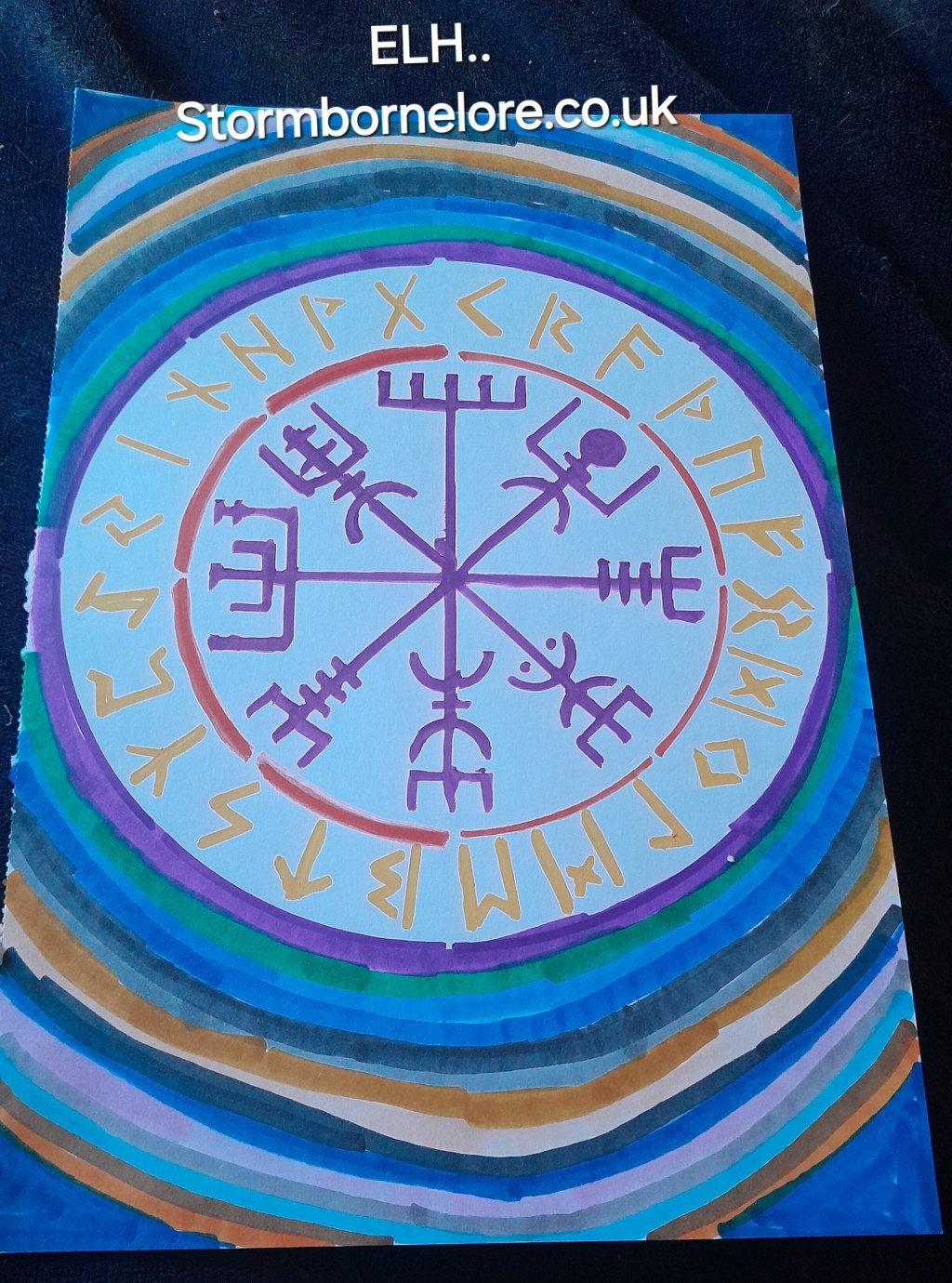
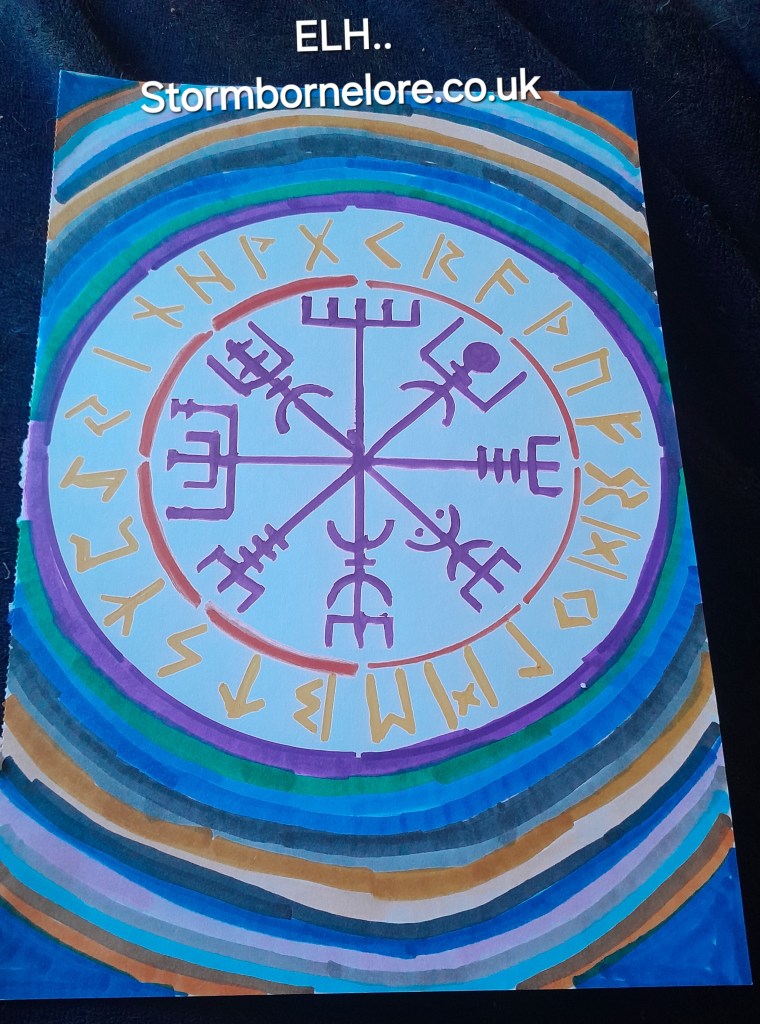
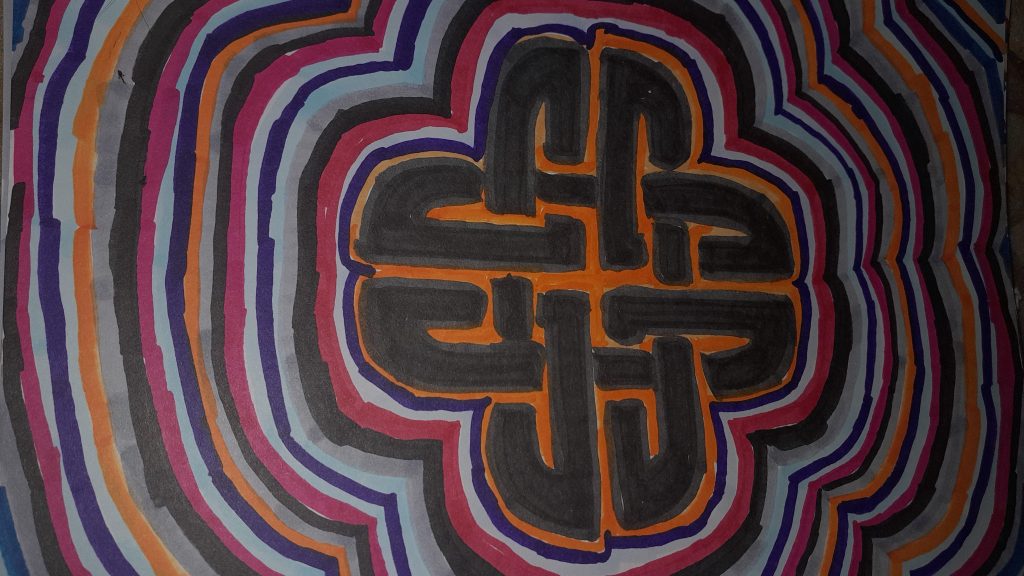
    A colorful painting featuring ancient Norse-inspired runes and the Vegvísir symbol, surrounded by layered storm-colored rings, representing guidance through journeys and exile.
    A vibrant painting featuring Norse-inspired runes and layered storm-colored rings, symbolizing the guidance of the Vegvísir.


    This painting blends ancient Norse-inspired runes with layered storm-coloured rings, echoing the guidance of the Vegvísir the wayfinder. In the StormborneLore world, it speaks of journeys through shadow and exile, always guided by unseen forces

    © StormborneLore – Emma Hewitt 2025.

    A hand-painted circular sign featuring a blue sky, green grass, and a sun, with colorful text that says, 'Thank you for reading. Please like & subscribe. https://www.stormbornelore.co.uk'.
    A colorful thank you note encouraging readers to engage with the StormborneLore community.

    For more Art please see Stormborne Arts

  • The Chronicles of the Gold Ring

    The Chronicles of the Gold Ring

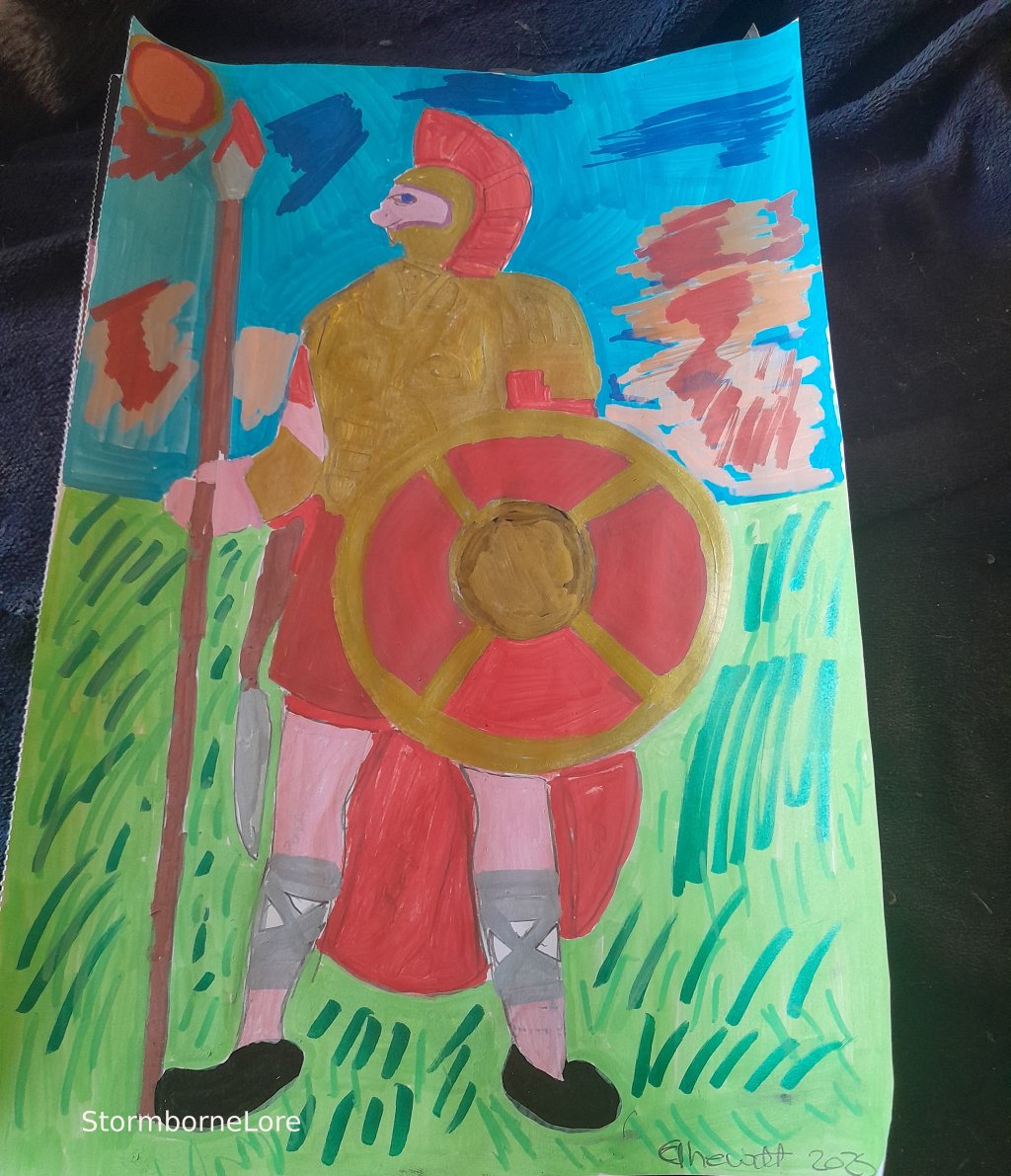
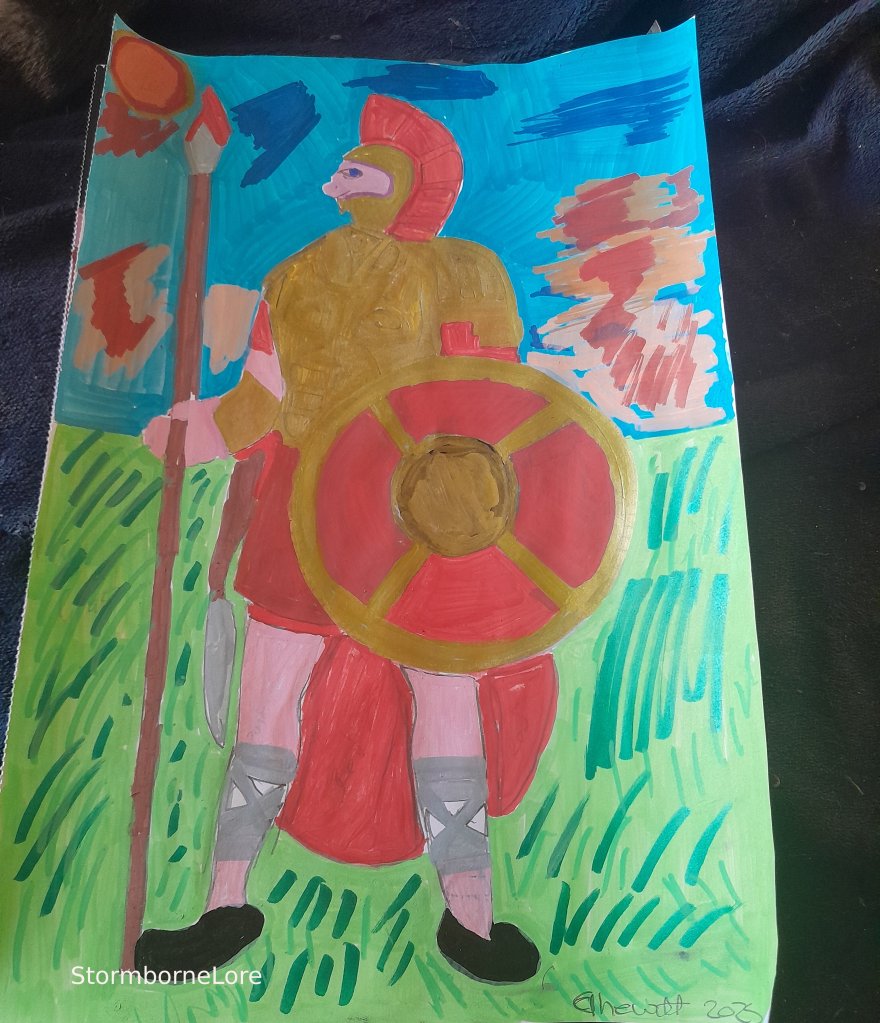
    Acrylic painting of a Roman soldier with red shield and spear, artwork by StormborneLore (Emma Hewitt, 2025). Symbolizes the fall of Taranis Stormborne and the transition from Celtic Britain to Roman Britain in The Chronicles of the Gold Ring."

    Chapter Thirteen – The Shattered Circle

    The circle of stones stood under a bruised sky. The thirteenth stone, already cracked from the battle at Emberhelm, seemed to strain against itself as though it knew what was coming. Thirteen seats. Only twelve filled.

    Taranis Storm to his outlaws stood at the centre. His cloak was damp from rain, his wrist still bandaged from the Hill of Ashes. Around him, the brothers of the Ring shifted like wolves uneasy in their own skins.

    Drax spoke first. “The Black Shields raid in your name. The people whisper of you, not of us. The balance is broken.”

    “It was never balanced,” Taranis replied. His voice was low, bitter. “We bled for fields that gave us no bread. Rome takes salt from our earth while we quarrel. If I raid, it is to feed our people, not to wear a crown.”

    Lore’s eyes flicked to the sky. “And yet the crown follows you, brother. The omens have turned. The storm no longer waits.”

    Then Rayne stepped forward, the firelight showing the sly curve of his smile. “No storm lasts forever. Some of us have chosen survival.”

    From the shadows came the tramp of iron boots. The air filled with the rhythm of Rome square shields, horsehair crests, iron blades that gleamed even in the grey. The circle of stones was surrounded.

    Draven’s face went pale. His lips moved as if to speak, but no words came.

    “You led them here,” Taranis said.

    Rayne did not deny it. “Our people will live beneath Rome’s law. Better chains of iron than graves of ash.”

    The thirteenth stone split with a sound like thunder. Dust trickled down its face. The Ring was broken.

    Battle erupted. Drax drew steel, Lore called fire from the runes, Aisin shielded the cradle where Caelum slept. Nessa’s blade sang bright before she was dragged into the fray, her cry lost in the clash.

    Taranis fought like the storm itself blade flashing, shield breaking, each stroke cutting down another soldier. But for every man he felled, three more closed in. Nets weighted with lead tangled his limbs. Chains of iron bit deep.

    He roared once, a sound that shook the stones. Lightning split the sky as if the gods themselves mourned. Then the Romans dragged him down. His black shield shattered under their boots.

    “Take him alive,” the centurion barked. “Rome has use for beasts like this.”

    When the fighting ended, the circle lay in ruin. Smoke curled from broken fires. Brothers lay wounded or scattered. The thirteenth stone was nothing but rubble.

    Taranis, Storm of Emberhelm, was shackled in chains and marched south along the salt road. Behind him, the old world fell silent. Ahead lay the lash, the arena, and the roar of foreign crowds.

    He lifted his head once to the sky and whispered through bloodied lips:

    “If I must fight, let it be as storm, not as slave.”

    The storm rolled east with him, into Rome.

    © StormborneLore Emma Hewitt, 2025. All rights reserved.

    The Library of Caernath

    Stormborne Arts

    The Chronicles of the Gold Ring Chapter Twelve

  • Stormborne Arts The Tree of Life

    Stormborne Arts The Tree of Life

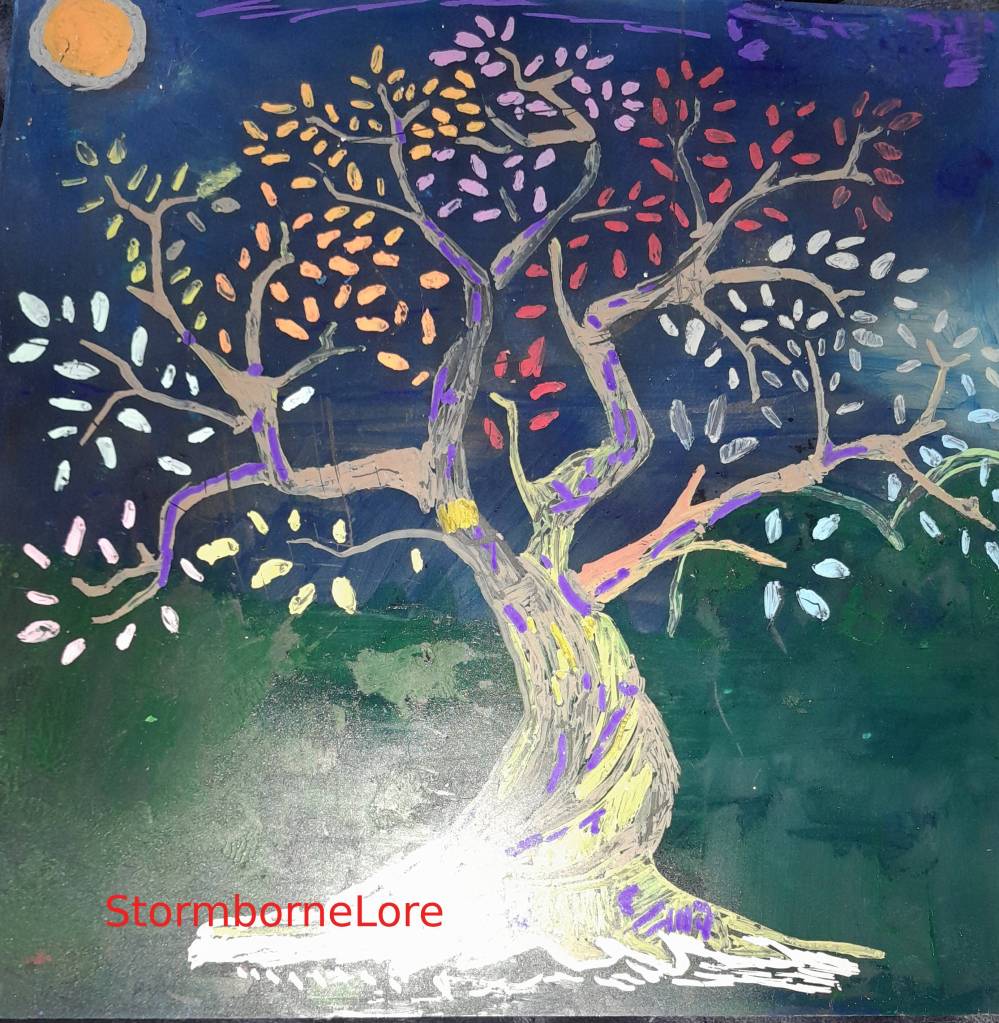
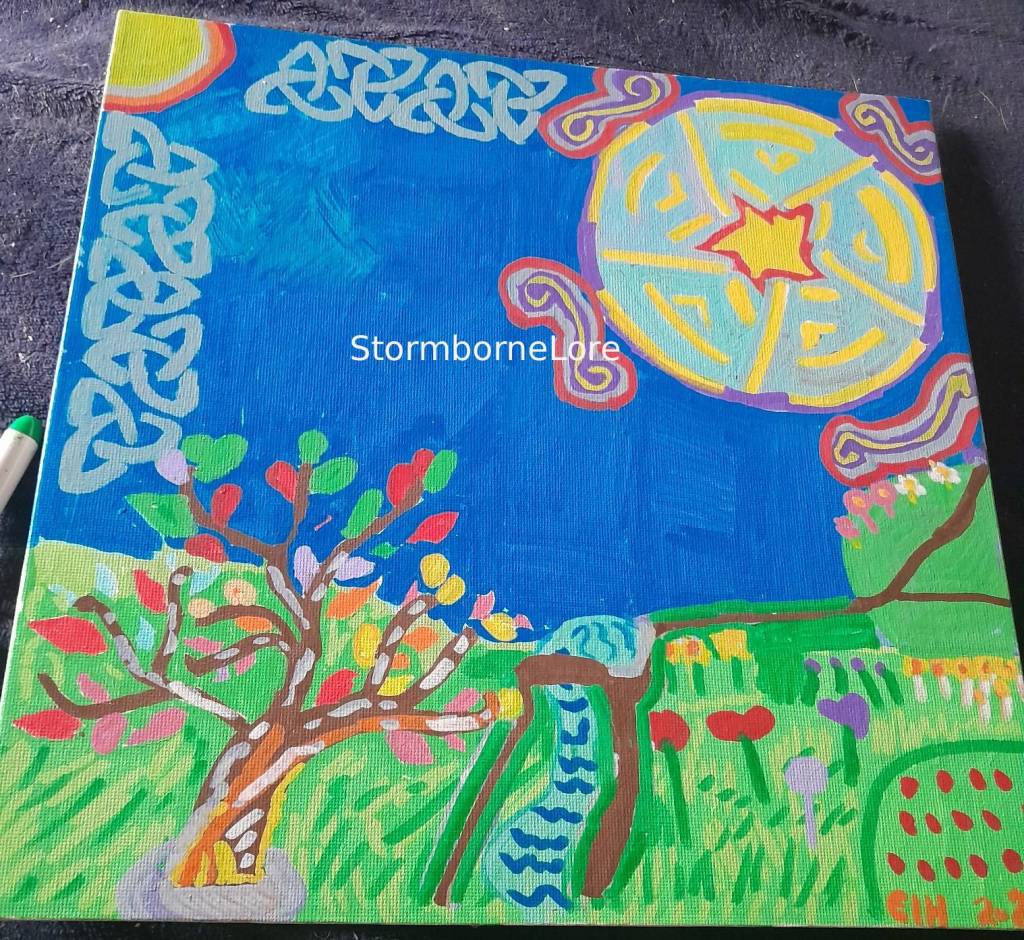
    A colorful, abstract rendering of a stylized tree with various colored leaves, symbolizing the changing seasons, on a dark background with a bright sun in the upper corner.
    Acrylic painting of Yggdrasil, the World Tree, showcasing vibrant seasonal colors and an ethereal moonlit ambiance.

    The tree stands eternal, roots bound deep in the earth, branches reaching into the sky a bridge between worlds, a keeper of memory.

    Painted on a 30x30cm acrylic sheet, this one-of-a-kind artwork captures the spirit of Yggdrasil, the World Tree of Norse and Celtic lore.

    Each colour shift in its leaves carries the changing seasons of life — birth, growth, loss, and renewal. Under moonlight, its form glows with a presence that is both ancient and ever-living.

    This piece is not just art, but a reminder of the ties.

    A round wooden plaque with a colorful hand-painted design featuring a blue sky, sun, and green grass. The text reads 'Thank you for reading. Please like & subscribe. https://www.stormbornelore.co.uk' in various colors.
    A colorful hand-painted piece encouraging viewers to engage with the content, featuring a bright sky, sun, and grassy landscape.

    The tree of life collection is available

    https://www.redbubble.com/shop/ap/173765094

  • Stormborne Arts Painted disk

    Stormborne Arts Painted disk

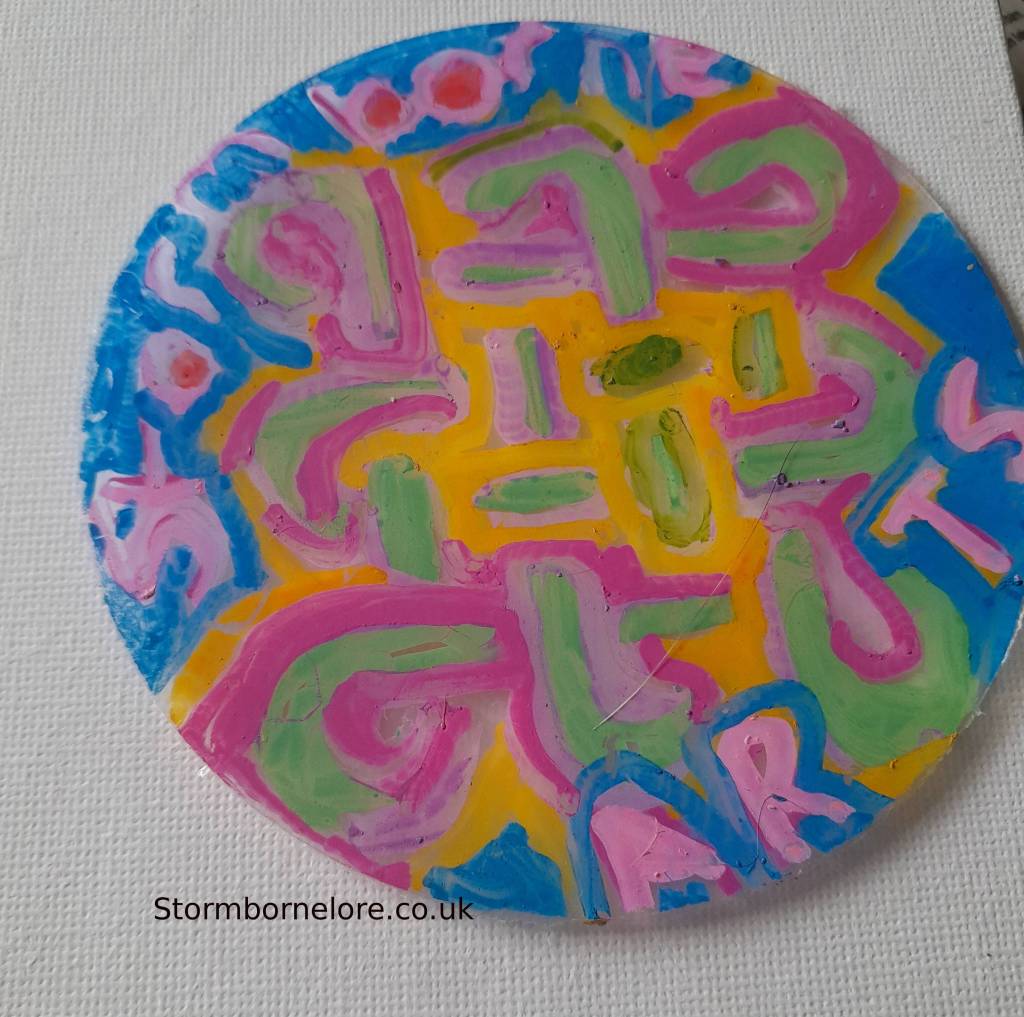
    Acrylic-painted disc featuring vibrant colors and abstract designs, inspired by Celtic knotwork. The design includes the words 'Stormborne Arts' amidst swirling patterns in pink, green, yellow, and blue.
    Hand-painted disc showcasing vibrant abstract designs inspired by Celtic knotwork and mythology.

    This acrylic-painted disc carries the spirit of Celtic knotwork and storm-born colour.


    Each piece I create is a one-of-a-kind original, shaped by myth, lore, and imagination. No two stones, coasters, or canvases are ever alike each holds its own voice, a spark of history reborn in paint.

    Stormborne Arts is my way of weaving ancient legend into modern craft. From runes to trees of life, wolves to woven knots, every piece carries the mark of storm and soul.

    ✨ Hand-painted
    ✨ Original, limited editions
    ✨ Inspired by Celtic & Viking heritage

    More pieces will be shared here on StormborneLore and on my Stormborne Arts page.

    © StormborneLore Emma Hewitt, 2025. All rights reserved.


  • The Chronicles of the Gold Ring Chapter Twelve

    The Chronicles of the Gold Ring Chapter Twelve

    A colorful painting depicting a vibrant tree with multicolored leaves, under a bright blue sky decorated with a sun and abstract patterns. The foreground features lush green grass and stylized flowers, conveying a whimsical and enchanting atmosphere.
    A vibrant painting depicting a colorful tree beneath a bright blue sky, symbolizing life and renewal.

    Rest Beneath the Tree

    At last they came to the tree.

    It rose from the earth as though the hill itself had forced it skyward roots tangled deep, bark silvered with age, branches spread wide like the arms of a giant blessing or warning all who passed beneath. The ground around it was hushed, as if even the wind dared not trespass too loudly here.

    Storm staggered to its shade and lowered himself to the roots. The weight of his wounds and weariness pressed him down, yet the tree seemed to hold him as gently as a cradle. He breathed slow, leaning against the trunk, and for the first time since the hill of ashes he felt his heart’s trembling ease.

    The others made camp nearby, but left him undisturbed. Brianna spread her cloak by the fire, her eyes flicking often toward where he lay. Cadan tended the embers, muttering half-prayers, half-jests. The boy slept curled by the packs, his face still wet with the salt of grief.

    Storm closed his eyes.

    The world changed.

    The tree shone with light, its roots glowing as though molten, its crown alive with whispering voices. Wolves circled him in the half-dark Boldolph and Morrigan among them, their eyes like coals, their howls joining others long gone. Above the branches wheeled Pendragon and Tairneanach, wings stirring thunder in a sky that was not a sky.

    The gold ring gleamed on his finger once more. Its weight was not a burden but a bond. And the tree’s voice, deep as the earth itself, rolled through his marrow:

    Rest, child of storm. The road is not ended.
    Every root remembers.
    Every leaf bears witness.
    You are bound to us, as we are bound to you.

    Storm reached out and pressed his palm to the bark. He felt its strength answer, steadying his own. When his eyes opened, dawn was breaking.

    Brianna stood ready with her blade. Cadan was already packing. The boy stirred from sleep.

    Storm rose slowly, his body aching but his spirit steadier, and gave the tree one last look. The mark of his hand remained upon the trunk, a faint glow where blood and dream had mingled.

    Then he walked on.

    © StormborneLore Emma Hewitt, 2025. All rights reserved.

    Colorful circular wooden sign with the message 'Thank you for reading. Please like & subscribe. https://www.stormbornelore.co.uk' painted on it, featuring a bright blue sky and green grass.
    A colorful thank you message inviting readers to like and subscribe, set against a bright blue sky and grassy background.

    Futher Reading

    The Library of Caernath