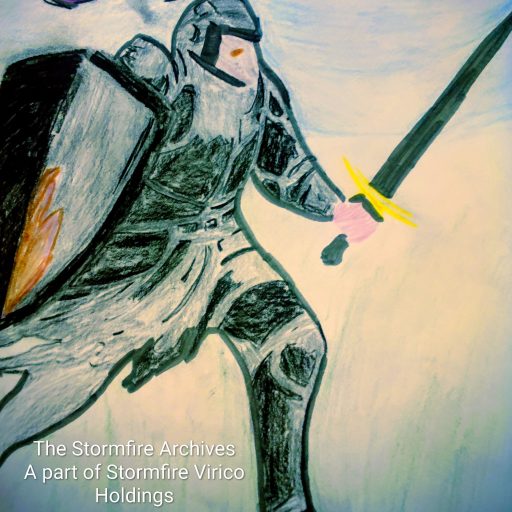
A vibrant artistic depiction of a stylized object, blending intricate designs with bright colors, invoking themes of lore and magic.
The Quiet Flame
The wind that swept over Emberhelm carried no warmth, only the ghost of fire long spent. I stood where the circle had once been whole, where twelve stones still defied the weight of empire, and one lay split a wound upon the land.
The others had gone. Drax to fury, Draven to silence, Rayne to his choices, and Taranis to chains. I remained, bound not by steel but by memory. It was not courage that kept me here; it was knowing that something sacred had been broken and that it was not yet done with us.
The Romans called this valley conquered. They built their roads and forts as if they could hammer meaning from earth and stone. But meaning does not bow to empire. It whispers, it lingers, it waits. And I have learned to listen.
I knelt beside the thirteenth stone, tracing the crack with my fingers. The split hummed faintly, as though it still remembered the storm that birthed it. I could almost hear Taranis’s voice beneath the wind, a murmur of thunder too distant to strike.
“Brother,” I whispered, “if the storm is caged, does the sky mourn its silence?”
A shadow passed across the ridge perhaps a hawk, perhaps a sign. In the old days, I would have asked the druids for meaning, but now I was the only one left to ask.
Rayne’s betrayal still cut deep, though part of me understood it. He had always been the one to see the long game, the patient serpent coiled beneath the waves. I did not forgive him, but neither could I condemn him fully. Perhaps this is how the gods feel when they look upon men weary, knowing, endlessly disappointed.
Night crept over the hills. I lit no fire; the Romans watched for smoke. Instead, I watched the stars, the same constellations our ancestors had trusted when the world was still young. Somewhere beyond those lights, I felt the pulse of something waking old magic, stirring beneath stone and soil, called forth by blood and betrayal alike.
The Circle was broken, yes. But its power had not vanished; it had merely changed shape. The storm that once lived in Taranis’s heart now whispered through the bones of the earth. I could feel it gathering, quiet but sure, as if the land itself prepared to rise.
In that silence, I spoke the old words not prayer, not spell, but remembrance. A promise carved into breath:
“When the storm returns, it will not ask who was loyal. It will ask who remains.”
The morning broke pale and cold, a thin mist rolling across the fields like a ghost that had forgotten its name. My horse shifted beneath me, uneasy. The world felt quieter than it should have been not the quiet of peace, but the kind born from expectation. Something waited ahead.
I had traveled for weeks now, keeping to forgotten roads, trading false names and favours for shelter. Rome’s messengers had ceased for a time, and that silence was heavier than any command. I began to wonder if I had been released… or abandoned.
At night, when the campfire dwindled, I caught myself tracing the symbol of the Ring into the dirt a circle broken clean through. No matter how many times I erased it, my hand drew it again. Habit or guilt, I couldn’t tell. Perhaps both.
Rumours reached me in fragments: a rebellion rising in the north, whispers that Drax had taken to leading the scattered tribes, and that Lore had vanished into the mists of the west, chasing prophecies no man could name. Draven was silent. And Taranis… Taranis had become a legend again.
They said he had escaped Rome’s chains, that his eyes burned brighter than ever, that lightning followed where he walked. I did not believe all of it but I wanted to. The world is easier to bear when its ghosts refuse to stay buried.
One night, beneath a blood-red moon, I reached the edge of the marshlands near Ravenmere. The air there was heavy, each breath tasting of iron and old secrets. The ruins of an outpost stood crooked against the skyline Roman stones built upon older foundations. It felt… familiar.
Inside, beneath moss and dust, I found carvings of the Circle faint, half-effaced by time. Words I had spoken in another life echoed in my memory: “We are the Ring. Bound by oath, unbroken by fear.”
I knelt, running my hand over the stone, feeling the groove of each line. “I broke it,” I whispered. “But perhaps it was already breaking.”
Something stirred in the shadows not human, not beast, but presence. A warmth against the air, like breath drawn from memory itself. For the first time since Emberhelm, I felt the Ring respond.
A whisper, faint but unmistakable, rippled through the ruin. “The Circle is never broken, only divided. The storm remembers.”
I rose slowly, the hairs on my arms prickling. Whatever force had once bound us had not died it waited, fragmented, patient. And now, it was calling.
When I rode from Ravenmere at dawn, I carried no banner, no ally, no command. Only purpose.
The Ring was broken but not gone. And if Taranis still lived, if the others still walked their paths… then the storm was far from finished.
The morning mist hung low across the valley, veiling the lands of Emberhelm in silver. From the high balcony of his hall, Lord Drax Stormborne watched the world stir awake.
Smoke from hearths curling above thatched roofs. The faint clang of the smithy below, and the distant echo of a horn calling men to the fields.
The realm had been quiet these past weeks, though quiet was not peace. Rome’s presence had spread like frost silent, glittering, and deadly to touch. Their banners were seen on the roads again, their soldiers marching east toward the fort that caged his brother.
Drax’s hands rested on the stone rail. Scarred knuckles gripping the cold edge as if the granite itself were his only anchor.
“Uncle Taranis forgives us all, father.”
The small voice broke the silence. His son stood behind him Caelum, barely thirteen summers. But already bearing the solemn eyes of a man twice his age. The boy held out a folded parchment, its wax seal cracked, its edges smudged with soot.
Drax took it carefully. The writing inside was firm but uneven, written in haste. Forgive nothing. Remember everything. Below, a single mark a lightning bolt drawn in charcoal.
Drax’s chest tightened. His brother’s hand. His brother’s defiance.
“Who gave you this?”
“One of the Roman guards, father,” Caelum replied. “He said… he said Uncle still lives. He fights every day.”
Before Drax answered, boots echoed behind them. Roberto stepped into the chamber, his armour dull and unpolished, the scent of road dust still clinging to him.
“My lord,” he began, voice low, “I spoke with one of the centurions. They see him as a danger now too much influence, even in chains. They’ve moved him deeper into the fort. Isolation. Only the soldiers see him.”
“Do they mistreat him?” Drax asked, though he already knew the answer.
Roberto hesitated. “They tried to crucify him last week. He survived. Yesterday, they threw him to the lions chained, unarmed. He walked out again.”
The hall fell silent. The fire popped in the hearth, throwing orange light across the stone floor. Drax turned back toward the window. his reflection caught in the misted glass grey at the temples, lines of command etched deep across his brow.
“They can’t kill him,” Roberto said quietly. “So they make him suffer.”
Drax exhaled slowly, the weight of his station pressing like iron against his ribs. “Then we’ll keep him alive in every way they can’t stop. Food, silver, messages whatever can reach him, it will.”
He turned to his son. “Caelum, you will remember this. A lord’s duty is not to speak loudest, but to act where no one sees.”
The boy nodded, solemn and still.
That afternoon, Drax rode out beyond the keep. The fields of Emberhelm stretched before him. The broad plains that once echoed with the clash of blades when the Stormborne banners flew proud.
The Farmers bowed as he passed, and he nodded in turn. To them, he was not just a lord. He was the last shield between their freedom and Roman law.
At the river’s edge, he dismounted, crouching where the waters ran dark and cold. He saw his reflection distorted in the ripples older, heavier, but not yet broken.
He remembered when Taranis had knelt in that same river,7 years ago. Swearing an oath to the gods of wind and storm. “We are not born to yield,” he had said, the water lapping at his wrists. “Even if Rome takes the land, they’ll never take the sky.”
Drax closed his eyes. The oath still lived within him, though it had been buried under the weight of command.
When he returned to the hall, he found Aislin. Stood waiting by the hearth his wife, wrapped in a shawl of woven wool. Her hair touched by the faintest trace of silver.
“You’ve heard the news,” she said softly.
He nodded.
“Will you go to him?”
Drax’s jaw tightened. “Not yet. The fort is surrounded. My every step is watched. To move too soon would doom us all.”
“And if you wait too long?”
He met her gaze, steady and unflinching. “Then he dies a legend. And legends, my love, outlast empires.”
She said nothing more. She simply placed her hand over his, and for a moment, the storm in his chest calmed.
That night, the wind rose.
From the balcony, Drax watched lightning fork across the distant hills. He thought of his brother, chained and bloodied, standing alone beneath the roar of lions and the jeers of men. And he swore, silently and fiercely, that this would not be the end.
The Romans thought they had captured a man. They had not realised they had locked away a tempest.
And storms… always find their way home.
The council chamber was dim, lit only by the flicker of oil lamps. Shadows stretched long across the stone floor, dancing like restless spirits.
“Are priests allowed to see Taranis?” Lore asked the centurion, his tone calm but deliberate.
The Roman officer hesitated, eyes flicking between Drax’s advisor and the lord himself. “Only those sanctioned by command, sir. The prisoner is considered… volatile. Dangerous to morale.”
“Dangerous,” Drax repeated quietly . His gaze fixed on the parchment that still bore his brother’s mark a black streak of charcoal shaped like lightning. “That is one word for faith unbroken.”
The centurion shifted, uneasy beneath the weight of the lord’s tone. He had served Rome for years. But there was something about the Stormborne that unnerved him men who spoke softly yet carried storms behind their eyes.
“Tell your commander,” Drax said at last, his voice cool as the mist outside. “that Emberhelm’s temple will pray for Rome’s victory. And for the salvation of the condemned. It would honour the gods to have a priest available for confession before transport.”
The officer nodded stiffly. “I will… relay the demand, my lord.”
When the door closed, Lore exhaled, rubbing his temples. “You plan to send one of ours.”
“Of course.” Drax turned toward the hearth, watching the flames burn low. “If Rome bars us with iron, we’ll walk through with words. Find one of the druids who wears a Roman mask one who can keep silent under pain.”
Lore bowed his head slightly. “A dangerous game.”
“All games are,” Drax murmured, eyes still on the fire, “when the stakes are blood.”
Two days later, beneath a grey dawn, a solitary figure rode from Emberhelm. He wore the plain robes of a Roman cleric, his face shadowed beneath a hood. No weapon hung at his side, no coin jingled in his pouch.
With only a small satchel of herbs, a ring wrapped in cloth, and a wax-sealed blessing marked his purpose.
His name was Maeron. Once a druid of the old faith now known to Rome as Marcus. A man who had survived the purges by trading his oak staff for a prayer scroll.
The road to Viroconium wound through dead forests. The mist-shrouded valleys, the silence broken only by the clatter of hooves and the distant calls of crows.
When he reached the Roman fort, guards searched him roughly, tearing through his satchel and stripping him of his cloak. Finding nothing amiss, they granted him ten minutes with the prisoner.
The cell smelled of iron, straw, and old blood. Chains hung from the walls like spiderwebs.
Taranis sat in the corner, wrists bound, his head bowed. A thin cut traced his cheek, half-healed, crusted with dust. He did not look up when the door opened.
“You come to pray?” His voice was low, worn smooth like riverstone.
“I come to remind you,” Maeron whispered.
Taranis lifted his head slowly, and for a moment the fire in his eyes banished the gloom. Maeron knelt before him and drew from his sleeve a small gold ring. its inner band engraved with the sigil of storm and flame.
Drax’s mark.
“Drax?”
“He watches,” Maeron said softly. “He waits. He sends this so you’ll know you are not forgotten. Food and coin move under Rome’s banners carried by men who owe him debts. You will have what you need to endure.”
Taranis reached for the ring. The chains clinked, faint as falling rain. “Tell him I am no longer enduring. I am learning.” His voice strengthened, each word edged with iron. “They think they cage me. But they are teaching me their weaknesses.”
He leaned closer, his gaze sharp, unyielding. “Tell Lore, Drax, and Draven I shall endure so they are safe. Tell them… the storm remembers.”
Maeron bowed deeply. “The gods still listen, even in Rome’s shadow.”
Taranis’s lips curled faintly. “Then let them listen to thunder.”
Outside, as Maeron was escorted back through the gates, lightning cracked across the horizon. The guards muttered that the storm came early that season.
Drax, miles away, looked up from his balcony at the same flash of light. whispered beneath his breath “Brother… I hear you.”
Thank you for reading if you have enjoyed please like, comment and subscribe.
The march south had stripped the world of meaning. Days blurred into rain and dust, dawn into dusk, until even time seemed shackled beside him.
By the time they reached the Roman fort near Corinium, Taranis Storm no longer knew how many nights had passed.
Only the rhythm of iron and boots. The murmur of Latin commands, and the distant echo of thunder in his bones.
The fort loomed ahead stone and order built upon the bones of chaos. Walls cut sharp against the grey horizon, guarded by rows of pikes and men who moved like clockwork. To Taranis, it felt wrong. A place without wind, without life.
Every sound was contained, controlled, sterile. Even the air smelled of discipline oil, smoke, and iron.
The storm in him recoiled.
They dragged him through the gates in chains. Soldiers gathered, curious and cautious. Some spat, others stared. Whispers followed him like ghosts daemon, barbarus, filius tempestatis. Son of the storm.
He smiled faintly. They weren’t wrong.
The cell they threw him into was little more than a pit of stone and shadow. The walls sweated damp, the floor slick with moss.
Above, a slit of light cut through the dark too narrow to touch the ground. He sat in the half-dark, wrists raw and heavy with iron. The silence of Rome pressed close, cold and absolute.
He did not pray. He waited.
When the footsteps came, they came as they always did measured, deliberate, Roman. The door creaked open, spilling lamplight like a wound across the floor.
Three entered.
A centurion, broad and cold-eyed, his crimson cloak pristine even in the grime. A scribe, pale and thin, clutching a wax tablet as if it were a shield.
And a woman cloaked, silent, her gaze as sharp as a blade. Her presence was wrong for this place; too poised, too knowing.
“Taranis of the Stormborne,” the centurion began, voice clipped and ceremonial.
“You stand accused of rebellion against Rome. The murder of imperial soldiers, and the disruption of trade along the Salt Road. Do you understand these charges?”
Taranis raised his head. His hair hung in dark, tangled strands, but his eyes were steady the colour of gathering thunder.
“I understand,” he said. “You’re afraid.”
The scribe faltered mid-stroke. The centurion’s jaw tensed. Only the woman’s expression remained still.
“You will answer with respect,” the Roman said.
“I already have.”
The blow came fast a strike across the face that turned his head with the sound of split skin.
Taranis straightened slowly, blood sliding from the corner of his mouth. His stare did not break.
The silence that followed was heavier than the hit.
The woman stepped forward. When she spoke, her accent carried the soft inflection of the East Greek, or something older.
“You fought well,” she said. “Even Rome admits that. There are ways to survive this. Serve us. Lead men under our banner. Take Roman land, a Roman name. You need only kneel.”
Taranis smiled faintly, the expression more weary than cruel.
“Rome offers gold to every man it fears. But my kind do not kneel. We weather.”
She tilted her head slightly. “Weather breaks.”
He met her eyes. “Only if it stops moving.”
For the first time, something flickered in her expression curiosity, maybe even a trace of respect.
The centurion, however, had no such patience. “Enough. He will be moved south to Londinium in three days. If he refuses Rome’s mercy, he will die as a slave.”
The woman’s gaze lingered on him a moment longer before she turned away. “He won’t bend,” she said quietly. “Not yet.”
They left him in the dark once more. The door slammed shut. The iron bolts fell into place.
Taranis exhaled slowly. The air was thick with the scent of blood and damp stone.
He tasted iron on his tongue metal, blood, defiance.
The light from above had shifted again, sliding across the wall like the movement of time itself.
He whispered, barely a sound. Not to gods, nor ghosts, but to the storm that still lived within his chest. It was quiet now, resting waiting. But it would come again. It always did.
When the night settled deep, the sound of rain returned, gentle against the stones.
In that rhythm, he found memory of his brothers’ faces in the torchlight. Drax’s steady eyes, Rayne’s trembling defiance, Draven’s silence. He had told them he would return. He intended to keep that promise.
The fort around him slept in its illusion of control.
But beyond the walls, clouds were gathering over the hills slow, patient, inevitable.
The smoke of Emberhelm still clung to the hills when I rode east, following the path we had carved in blood and ash. Behind me, the storm of Taranis’s fury faded, replaced by the steady march of Rome’s legions.
My heart did not leap at his capture only a calm, cold certainty. Survival, I had told myself. Survival for the people, for the line of the Ring.
They would call me traitor. They would whisper my name with venom. Let them. History is written by those who endure, not by those who fall screaming in the mud.
I thought of the thirteenth stone, split and silent, and of my brothers, scattered like crows in a gale.
Drax’s eyes had burned with anger. Lore’s had flashed with prophecy. Even Draven had known, in the briefest flicker of fear, that the world had shifted. And yet… no fire of regret touched me. Only the quiet pulse of inevitability.
Taranis would survive, I knew that. He always did. But survival alone was not enough. Rome would temper him, break him, and in that forging, perhaps he would learn that not all storms are born to rage. Some are meant to settle, to bring change unseen.
I rode on, keeping my gaze forward. The wind carried the salt from the sea, the same salt that Rome coveted. Every step away from the shattered circle was a step into the future I had chosen. And in that future, perhaps the people would live.
I was no hero. I was no villain. I was Rayne, and the Ring was broken.
Acrylic painting of a mother cradling her child under a moonlit sky, symbolizing love and connection.
Medium: Acrylic on paper
Size: A4
Description: A mother cradles her child beneath the glow of moon and stars, framed in swirling gold. This piece speaks of tenderness, resilience, and the eternal bond between generations.
They marched him up the salt-hill at Dodderhill, where the Roman timber bites into the skyline like bad teeth. Below, Salinae steams. The brine pits cough a white breath across the roofs, and every back in the town goes still; men with salt-burned hands, women with brined wrists, children with their mouths parted. All of them looking up. All of them waiting to see a lesson.
Storm’s wrists are raw from the iron. His shirt is torn where they hauled it over his head, the air is cold on old scars and new. There is a cut across his ribs from the morning’s struggle and the dried salt in it stings like sand.
A centurion with a wine-scarred mouth calls the charge in a language that thinks it is the only one that matters.
“Rebel. Murderer. Enemy of Rome.” The words land like stones. Men with square shields drag the condemned in a line. Three farmers. A boy who threw a stone. Storm.
“Use the cross for the big one,” the centurion says. “Make them see.”
They set the upright in the earth, ramming it with a post-driver until the ground answers. The carpenter’s nails gleam in a little wooden tray, thick as a man’s thumb. The hammer is clean. The executioner’s eyes flick to Storm and away again as if he’s looked at the sun too long.
Storm keeps his chin up because he will not bend. He smells oak smoke from the town, the sour of men in mail, the resin of fresh-split palings. He tastes brine on his teeth. A gull wheels and screams once, the cry torn thin by the wind.
A voice from the crowd below: not words, just a keening. Another voice, hoarse, calls his name the way a prayer is called: “Shield!”
He does not look down. He looks at the sky. Cloud, thin and grey and harmless. For now.
“Hold him,” the centurion says.
Four soldiers pin his arms. The fifth takes Storm’s right hand and forces it open against the cross-beam. The leather strap bites his palm. The executioner lifts the first nail. It is cold when it kisses the crease of Storm’s wrist.
Storm hears the old world in the edges of the day. The ring he once wore feels like a phantom weight on his finger. He sees Nessa’s hair in the corner of his sight when the wind shifts. He hears Boldolph and Morrigan somewhere he can’t walk to anymore. Rayne’s voice is the whisper in the hinge of the jaw: brother, hold still and we will live. Brother, lie down.
The hammer rises.
Thunder is far off. Not here, not yet. A single pulse on the horizon like a heart behind a ribcage. The executioner breathes. The hammer falls.
It meets iron and the iron skids, glancing off the nail head. The blow dents the wood and slams into Storm’s bones. He grunts despite himself. Blood beads. The executioner squints, checks the nail, lifts again.
The second stroke strikes home. Iron bites meat. The sky pulls tight.
A woman cries out below. “Enough! He fought for us!”
“Silence,” the centurion barks, not looking down.
Storm tastes copper. His vision narrows, then widens until he can see each hair on the executioner’s wrist, each pore, each fleck of sawdust stuck to the hammer’s face. It is the old sight, the red edge. He could go there—into the roar where nothing hurts until after—but he does not. He holds on. He wants to watch.
“Left,” the centurion says.
They take his other hand. Fingers spread. The nail’s cold mouth finds the vein. The hammer rises
and the wind turns.
Not a gust. A pivot. The kind of turning that changes seasons. Smoke from the brine pans below folds back on itself. Sparrows flatten to the earth. The hairs along Storm’s arms lift.
The first crack of thunder lands atop the fort like an axe into a block. Every man jolts. A standard topples with a clatter of bronze. The executioner flinches, the nail slips, and instead of flesh he drives it through the softened knot of the beam.
The shock carries up his arm. He swears. The soldier holding Storm’s elbow looks at the sky. The sky looks back.
Cloud blooms fast from the western line, rolling in on a bruise-coloured belly. A wolf-long shape seems to run along its edge and is gone. Another crack. Closer.
“Finish it,” the centurion snaps. But there’s a catch in it now, and he makes a sign with his two fingers as if to pinch off something unseen.
The hammer lifts for the third time.
Lightning hits the palisade post a spear’s throw away. Wood screams. Splinters go like hail. Men duck behind shields by training, but training breaks when the sky speaks in a voice older than their gods. A mule rears and snaps its lead. The nail tray overturns; iron skitters like teeth on stone.
Storm moves then.
He lets the red edge take him for a heartbeat just enough. He wrenches, twisting his pinned right wrist so the cut tears long and clean instead of deep. The leather strap splits where sweat has rotted it.
He brings his head forward under the beam, drives his shoulder into the soldier’s throat, hears the wet cough, feels the grip loosen. He kicks back, heel to knee, and the man behind him falls with a scream.
There is always a moment in a fight when the world decides. This is it.
He drives the crown of his head into the executioner’s face; the man drops the hammer, hands going to his nose. Storm grabs the hammer with his left hand, blood slicking the haft, and swings the weight into the chain on his left wrist. Once. Twice. The chain holds. The third blow finds the link that was barely peened shut, and it parts with a sweet, bright sound.
“Hold him!” the centurion bellows, but half his men are looking at the burning post and the other half are looking at the sky.
Shapes break from the heather below the berm three, five, a dozen men with black-painted shields and hunters’ faces. Brianna’s braid is bound with leather; Cadan’s scar shows white through ash. They come without horns or shouts, all knife and certainty.
Brianna hits the left flank like a thrown stone, her knife opening a belly before the man knows his shield is gone. Cadan slides under a spear and cuts the hamstring clean, then is up again and laughing because sometimes that is the only way to keep breath inside you.
“Storm!” Brianna barks.
He throws the hammer. She catches it by the neck and brings it down on a helmet rim, bending iron into eyebrow and eye. She tosses it back and he takes the chain a second time and frees his right.
The centurion finds his voice at last and orders the archers, but the bowstrings are wet now, the fletchings torn sideways by the sideways rain that has arrived without crossing the ground between. Arrows go high and crooked. One finds a farmer’s boy in the line of the condemned. The boy sits down as if to rest and does not get up again.
Storm would carry that if he let himself. Later, he thinks, later, and steps toward the centurion.
“Stand,” the centurion says, not to him but to what moves in his bones.
“I do,” Storm says.
They meet as men meet: iron-toothed and close. The centurion is trained. Storm is made. The first cut is Storm’s forearm across the centurion’s sword-hand, breaking the rhythm, and the second is Storm’s head against the man’s nose—again, because men are made of the same mistakes and the third is Storm’s thumb to the centurion’s eye. The man goes down with a sound nothing like command.
“Back!” a junior officer yelps. “Back to the fort!”
They drag their wounded. They leave their dead. They do not look at the cross. The storm does what storms do it eats the edges of everything.
From the town below, the people cannot see the cut and the grapple, only the outline of men against rain and the lightning that makes ghosts of them. Then those ghosts are gone into the gorse and the broom, and the hill is left with a burning post and an empty beam and a rumour that begins to run faster than hooves.
They bind Storm’s wrist tight with a strip of his own shirt and the last clean linen any of them have. The bleeding slows. His hands shake after it stops. He sits with his back against a birch, watching steam lift off his skin.
“Could have died,” Cadan says, not accusing, not gentle.
“Didn’t,” Storm answers.
Brianna crouches and studies the wound. “You’ll have two scars for one story,” she says. “The tale-singers will thank you.”
Storm looks at the knot of linen. He thinks of a nail driven through the heel of a stranger in a land he will never see, of crosses on a hill where a different empire stakes its truth. He thinks of Nessa’s mouth and Rayne’s eyes and of wolves that do not answer. He feels the tremor in himself and wonders if it will ever stop.
“Was it you?” Cadan asks. “The sky?”
Storm chews that like gristle and spits it out. “No,” he says. “It was the sky.”
Brianna huffs once, almost a laugh. “Then the sky is with us.”
They move as the light fails, cutting north and a little west, keeping to hedges and the backs of fields, avoiding every lane the Romans know.
The storm rolls away toward the Severn; behind it, the wood drips and the undergrowth smells green and clean as if nothing dies.
By the time they reach the low, wet ground where the oaks thicken half a day’s walk from the salt town, close enough to smell wood-smoke when the wind is right night has set.
They choose a place where yew anchors a little rise and an old fallen oak makes a table the size of a man. Cadan lights a small fire that no one will see unless they are meant to. Brianna lays out bread and dried meat and a handful of early wild garlic leaves, because ritual has to start with something you can eat.
Storm stands, because oaths are made on feet.
“We were a ring,” he says. “We were a house. We were a promise to people who do not want us anymore. Today I was meant to die to teach them to fear, and I did not. I don’t know if that is luck or the gods or a debt that will come due later.”
He looks at each of them. There are eleven counting him. Some are men who fought with him when the wolves still ran the ridge. Some are women who learned a knife because no one else would come. One is a boy who was a boy yesterday and is not anymore.
“I’m done waiting for any man’s mercy,” Storm says. “If you stay with me now, you stay knowing there will be no pardon. No ring to call us home. We will be hunted by chiefs and by Rome and by the stories men tell when they are afraid. We will strike and vanish.
We will take food from those who hoard it and give it to those who starve. We will cut chains where we find them. We will keep the lanes dangerous for those who would make them safe for empire. We will be the shadow that says not yet.”
He sets his palm on the fallen oak. Blood from the bandage seeps fresh and red and bright against the old grey wood.
“I name us,” he says, and the words come easy because they are true before he speaks them. “The Black Shields. Not for hiding” he taps the painted face of Brianna’s board, dull black with ash and pitch “but for what we carry in front of us so the ones behind can live.”
Brianna puts her hand over his. “Black Shields,” she says.
Cadan’s hand stacks next. “Black Shields.”
One by one, the others follow, rough palms and finer, scarred knuckles and bitten nails, hands that have stolen and fed and fought and held.
When they step back, the tree holds their blood in a dark print that already looks like a sigil.
A wind runs through the oak leaves though nothing else stirs. Somewhere far off a fox barks and another answers. In the dip of silence after, Storm thinks he hears just for a breath the long, low note of a wolf.
He looks up into the black roof of the wood and does not ask for a sign. He has had enough signs for one day.
“Sleep,” he tells them. “We move before light. The salt road will wake angry.”
Brianna nods, already spreading a cloak for the boy who is not a boy. Cadan checks the edges of the camp, his knife out, his shoulders easy for the first time since the hill.
Storm sits again with his back to the birch. His wrist throbs in time with his heart. When he closes his eyes, the hammer falls, and falls, and falls, and does not find him.
Below, the town spreads the story because towns are made to spread stories. By morning it will have a name it did not have yesterday the Hill of Ashes. By night there will be new chalk marks cut into the backs of gateposts that mean leave bread, and others that mean soldiers, and others that mean the Black Shields have passed.
He lets sleep take him only when the fire dies to a patient red and the rain begins again, soft and fine, washing the last blood from the bark.
From this moment Taranis Stormborne became known as Storm among his men.
The forests north of Emberhelm were not empty. They whispered in the cold leaves rustling without wind, branches creaking as if bearing witness.
Every step of Taranis’s horse cracked frost from the dead undergrowth, and in the darkness, unseen eyes marked his passage.
The Black Shields had grown in only a handful of days. Seven now a band stitched together from thieves, deserters, exiled warriors, and one woman with hair like raven feathers whose blade was sharper than her tongue. She called herself Brianna , and unlike the others, she did not flinch when Taranis looked at her.
They camped in the hollows where no light could reach. They moved before sunrise, leaving only cold ashes behind, and they spoke little, except for the soft murmur of plans and the low hum of old battle songs.
Their first strike had been for food. The second, for vengeance. The third would be for a message, not just for them but the starving.
Bryn Halwyn a hill fort the Romans had claimed but not yet reforged in their own style. Its high earthwork walls crouched like a sleeping beast above the winding road. That road was crawling now with supply wagons, the torchlight of the guards bobbing like fireflies in the mist.
Taranis’s voice was a low growl “Shields black. Faces darker.”
The Shields moved as one, melting into the tree line. Arrows hissed from the dark, the first taking a Roman through the throat before his shout could leave his mouth. The second dropped a driver from his cart, spilling barrels into the mud.
Then came the torches. They arced through the air, their fire licking greedily at wagon covers, rope, and dry straw. Flames climbed fast, reflected in the wide eyes of panicked mules.
Taranis was already moving. A shadow at the edge of the firelight, blade flashing, he cut through the first guard and didn’t stop. The air stank of blood and burning oak. The Romans shouted in their clipped tongue, but their formations shattered in the chaos.
By dawn, the road was empty but for the smell of wet ash and a single storm-sigil burned deep into the dirt where the wagons had stood.
When they were gone, the crows came, hopping between the blackened wheels and picking at the dead.
That night, beside a hidden fire, the Shields feasted on stolen bread and salt pork. Kerris leaned across the flames.
“What now?” she asked.
Taranis stared into the heart of the fire until his eyes stung. “We keep going until there’s nothing left to take. Or until they come for me.”
Kerris smirked. “And if they do?”
He smiled without warmth. “Then they’ll find the storm waiting.” he replied with a grin
An artistic representation featuring a vibrant blue sky, a radiant sun, and a colorful tree, embodying the themes of nature and rebirth.
The fires of the Ring had long since burned low. Smoke and judgment still clung to the stones, but the voices were gone scattered into the dark like leaves. The echoes of debate, of accusations half-spoken and oaths half-broken, were swallowed by wind.
Only Taranis remained.
He stood at the centre of the stone circle, not as a warlord or seer or storm-marked legend, but as a man uncertain of what to do next.
At his feet, a small crib newly carved, rough-edged but lovingly made sat in the shadow of an ancient standing stone.
Runes spiralled along its frame like protective thorns. Inside, the child slept, his breath barely stirring the wolfhide blanket that covered him.
Taranis stared. Watched. Listened to nothing but the sound of his son’s heartbeat soft, fragile, real.
“He’s mine,” he whispered.
The words fell like an oath.
He hadn’t spoken them aloud until now. Not to the Ring. Not even to himself. But the moment he looked into the child’s eyes, he had known.
There in that small, storm-dark gaze was the same flicker that had burned in his own since birth. A fire that would not die, even when beaten. Even when left in chains.
“I wasn’t sure,” he said, as if the child could hear him. “But now I am.”
Footsteps approached quiet but familiar. He didn’t turn.
Drax entered the ring with Aisin beside him. Her dark braid caught what little moonlight remained. She wore no armor, no crown but her presence always arrived like both.
They stood silently for a while, watching him.
“We thought you’d already gone,” Aisin said gently.
“I couldn’t,” Taranis replied. “Not yet.”
He gestured toward the crib, voice taut.
“I know what you’re thinking. That I’m out of character. That I’ve gone soft.”
He turned toward them now. His eyes were storm-lit, ringed with exhaustion. But beneath that a rawness neither of them had ever seen.
“He’s mine,” Taranis repeated. “There’s no denying it now.”
Aisin moved to the crib. She looked down at the child with the quiet reverence of a priestess before a sacred flame. One hand reached out, slow and certain, to brush the boy’s brow.
“He’s strong,” she said. “But quiet. Like he already knows too much.”
Taranis exhaled hard. His voice wavered a rare thing.
“If it’s too much… if he’s too much to carry…” “We’re not strangers to raising children,” Drax said. “This one isn’t just any child,” Taranis replied. “He’s my child. And I was no angel.”
He looked to Aisin, then Drax his oldest brother, his iron pillar.
“I can take him elsewhere. To a quiet place. Far from the weight of prophecy. Far from the Ring. Just say the word.”
Drax frowned.
“You’d give him up?”
“I’d shield him,” Taranis corrected. “From this. From me.”
Aisin turned to him, calm and sharp all at once.
“You fear yourself more than your enemies?”
“Yes,” he said. “Because I dream of betrayal, but never the face. I wake with my hand on my blade. I feel hunted in my own mind.”
He swallowed.
“I don’t trust myself near him. Not like this.”
Drax stepped forward and gripped his brother’s arm.
“Then trust us.”
Aisin nodded. “He stays. He is blood. That’s enough.”
Taranis closed his eyes. A moment of stillness passed between them.
Then he whispered, “His name is Caelum.”
The name rang like truth in the circle.
Drax smiled faintly. “Sky-born. Storm-blessed.”
“Let’s hope he lives to become more than that,” Taranis murmured.
Later – The Grove Beyond Emberhelm
Rayne stood in the dark, half-shrouded by the charred remnants of an old grove. Draven hovered nearby, shoulders hunched.
“So. He’s claimed him,” Rayne said, not asking.
“He named him Caelum,” Draven replied.
Rayne smiled thin, sharp.
“That’s dangerous. Naming something is binding it to fate.”
“He’s a child, Rayne.”
“No,” Rayne said. “He’s a threat. A future. A soft spot waiting to be pierced.”
Draven said nothing. He looked at the ash, not the stars.
“You said we’d only observe,” he whispered.
Rayne stepped closer, boots silent against the earth.
“And we are. But sometimes watching is how you choose the moment. Let the warlord get sentimental. Let him love.”
He leaned in, voice silk-wrapped iron.
“Love makes good men hesitate. And hesitation… kills kings.”