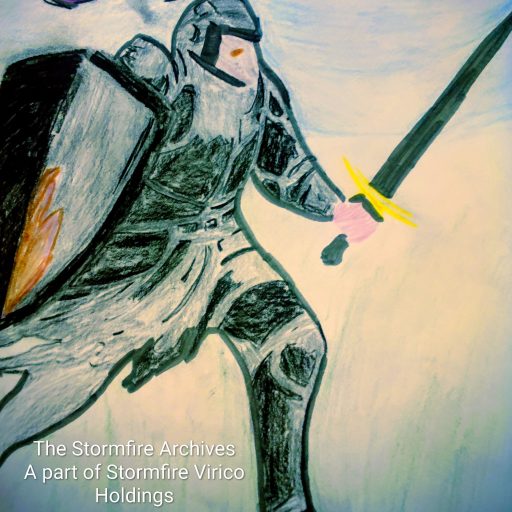
The rain had followed them south. Turning the clay of Staffordshire into a sucking mire that clung to boots and hooves alike.
The Romans marched as though it were paved stone beneath them, shields squared, helmets gleaming dull beneath the Grey sky. Between their ranks, chained at wrists and neck, walked Taranis Storm.
Every step tore at his ankles where the iron bit into flesh. Every breath was smoke and ash and memory. Behind him lay the broken circle of stones, the Black Shields scattered or slain. Ahead, only Rome.
The villagers came out to see. From hedges and low doors they watched the prisoner dragged past their fields, whispers coming like crows. The Stormborne, Ring-bearer. Betrayed. Some spat into the mud, others lowered their eyes.
A few, bold enough to remember, lifted hands in the old sign of the ring. when the soldiers were not looking.
At the front of the column the standard rose a square of blue cloth. That had been painted with a face in iron helm, cheeks daubed red with victory.
The mask grinned as though in mockery. The Romans called it their mark of order. To Taranis it was something else: the face of the empire that had swallowed his people.
He fixed his gaze on it as they dragged him past the rise where the heath opened wide. He thought of Boldolph and Nessa, of the wolf in the trees. He remembered the cairn and the promise beneath the oak. The chain jerked and he stumbled, but he did not fall. Not yet.
The centurion rode beside him, face shadowed beneath his crest.
“You see the banner, barbarian? Rome wears a smile even when it breaks you.”
Taranis lifted his head, eyes dark as storm clouds. “Smiles fade. Storms do not.”
The soldiers laughed, but unease rippled through their ranks all the same. For the wind carried his words across the heath, and even bound in chains, Taranis Storm did not sound broken.
By dusk the column reached the ridge where the woods thinned and the land opened to heath. Smoke already rose ahead straight, disciplined pillars from square fires. The marching camp of Rome.
The soldiers moved with the same precision as their shields: digging trenches, raising palisades, planting stakes.
Every camp was a fortress, stamped into the soil like a brand. The ground of Cheslyn Hay, once quiet pasture, now bristled with iron.
Taranis was dragged through the gate cut into the new rampart. The ditch still stank of wet clay, the sharpened stakes gleamed with fresh sap.
Inside, order reigned the tents in perfect rows, fires burning with measured rations, horses tethered and groomed. No laughter. No chaos. Just Rome.
The banner with the painted helm was planted at the camp’s centre. Beneath it the centurion dismounted, barking orders in clipped Latin. Slaves scurried to fetch water and oil for the men.
A scribe scratched notes into a wax tablet, not once looking up at the prisoner he recorded.
Taranis stood, wrists bound, staring at the banner. Its painted grin leered back at him, mockery frozen in blue and black.
Around him the soldiers muttered in their tongue some calling him beast, others trophy.
A soldier shoved him down beside the fire trench, close enough to feel its heat on his raw wrists.
“Sit, storm-man. Tomorrow the legate will decide whether you march to Wroxeter or Luguvalium. Either way, Rome will bleed you for sport.”
The word spread through the camp: arena.
Taranis lowered his head, though not in submission. He closed his eyes and listened. Beyond the walls of the camp, the wind still carried the smell of rain-soaked earth.
The whisper of fox and owl. And beneath that, deeper still, a memory: wolves circling, dragons wheeling, the voice of the tree.
Rest, child of storm. The road is not ended.
When he opened his eyes again, the firelight caught the glint of iron. Not on the chains, but in his gaze.
Even in Rome’s order, storm can find a crack. And cracks spread.
The fire burned low, and the camp settled into its rhythm. As guards pacing in pairs, dice rattling in the barracks-tents, the low cough of horses in their lines. The rain had eased, leaving the air damp, heavy with smoke.
Taranis sat in silence until he felt movement beside him. A figure shuffled forward, ankles hobbled, wrists bound with rope rather than iron. The man lowered himself onto the earth with a grunt.
“Storm of Emberhelm,” he rasped in Brythonic, his accent from the northern hills. “I thought the tales were lies. Yet here you sit, same chains as me.”
Taranis turned his head. The prisoner was older, his beard streaked white, his face cut with old scars. One eye clouded, blind. The other burned sharp as flint.
“And who are you,” Taranis asked, “that Rome keeps alive?”
The man chuckled, though it ended in a wheeze. “They call me Marcos now. Once, I was Maccus of the Ordovices. I led men against the Eagles before your birth.
Rome does not waste good meat. They break us, bind us, and sell us to the sands. I’ve fought in two arenas. Survived them both.”
Taranis studied him. The weight of years hung from his shoulders, yet there was steel still. “Then you know what waits.”
“Aye.” Marcos lifted his bound hands, showing knotted scars across his forearms. “The crowd roars for blood. Some fight once and die. Some fight a hundred times and die slower. But all die.”
The fire popped. Sparks leapt into the dark.
Taranis leaned closer, his voice low. “Not all. The storm endures.”
Marcos’s eye narrowed. “You think to outlast Rome?”
“No.” Taranis’s mouth twisted into something not quite a smile. “I think to break it.”
For the first time, the older man was silent. He searched Taranis’s face, weighing his words. Then he gave a slow nod.
“If you mean what you say, Storm of Emberhelm, then I’ll stand at your side when the time comes. Better to die tearing the eagle’s wings than caged beneath them.”
Chains clinked as they shifted nearer the fire. Around them the camp slept, unaware that in its shadow two sparks had met. Sparks that yet become flame.
The guards had thrown scraps of barley bread to the captives, little more than crusts softened with rain. Most fell on them like dogs, clutching and hiding their share as if it were treasure.
But when the boy, thin as a willow switch, glanced to where Storm sat, his brow furrowed. The man beside him Marcos noticed at once.
“What’s wrong, lad?” the old warrior asked, shifting his chains.
The boy’s voice was a whisper. “Why haven’t they fed him?” His gaze fixed on Taranis, who had taken nothing. His hands still resting on his knees, his eyes far away. as if listening to some thunder only he hear.
Marcos gave a grunt. “Rome plays its games. They starve the strong first. Weak men die quick, but a beast like him…” He lowered his voice. “They want to see how long he lasts. How much fury stays in him when his belly is empty.”
The boy clutched his crust but then held it out with trembling fingers. “He should eat.”
Taranis turned his head at last. His eyes, Grey as storm clouds, fell on the offering. He did not take it. Instead, he placed his bound hand gently over the boy’s.
“Keep it,” he said. His voice was rough, hollow from thirst, yet steady. “Storms do not starve. But you” he pressed the bread back into the boy’s palm, “you must grow.”
For a moment, silence hung around them. The boy swallowed hard, then nodded, biting into the bread with tears in his eyes.
Marcos watched, the ghost of a smile tugging at his scarred face. “A storm, indeed,” he muttered.
Above the camp, thunder rumbled faintly though the sky was clear.
“I’m fine ” Taranis smirked seeing a whip in someone’s hand and wood
“What’s going on?” The boy asked
The guard with the whip dragged a stake of green wood across the mud, planting it near the fire trench. Two soldiers followed, uncoiling rope and hammering pegs into the ground.
The boy’s eyes widened. “What’s going on?” he whispered, clutching what remained of his bread.
Marcos’s face hardened. “Discipline.” His single eye slid to Taranis. “Or rather a spectacle.”
One of the soldiers smirked. “The barbarian thinks himself storm. Tonight, he learns Rome is thunder.”
They hauled Storm to his feet. Chains clattered, mud spattered across his bare shins. The whip cracked once in the air, sharp as lightning.
The boy tried to rise, but Marcos gripped his arm and pulled him back down. “Don’t,” he hissed. “They’ll flay you too. Watch, and remember.”
Taranis did not resist when they bound him to the post. His wrists were raw, but he set his shoulders square. lifting his chin to meet the eyes of the gathered legionaries. The smirk never left his mouth.
The centurion stepped ahead, whip coiled in his hand, iron studs gleaming wet in the firelight. He spoke in Latin, slow and deliberate, for the advantage of his men:
“This is Rome’s law. Defiance is answered with the lash.”
The first strike fell. Leather snapped against flesh. The soldiers cheered.
Storm did not cry out. His lips moved, barely more than breath: words in the old tongue, prayer or curse, the guards could not tell.
The boy’s knuckles went white around his crust of bread. Marcos leaned close, his voice low. “Look at him, lad. That is what Rome fears most. A man who will not break.”
The whip cracked again. Blood ran down his back.
And yet, when the centurion paused, Taranis raised his head and laughed. a rough, hoarse sound, but laughter all the same.
“You call this thunder?” he spat. “I’ve stood in storms that would drown your gods.”
The camp fell uneasy. The centurion snarled and drew back the whip again. But already some of the soldiers shifted, unsettled by the chained man’s defiance.
The guard sneered as he coiled the whip in his hand, the wood of the handle slick with rain. He pointed it at Taranis.
“On your feet, barbarian. Let’s see if your tongue is sharper than your back.”
Taranis smirked, rising slowly, the chains clinking as he straightened to his full height. The firelight threw shadows across his scarred face, making him seem larger than life.
“Screw you,” he said, the words spat like iron nails.
The boy gasped, his hands clutching the crust of bread. “What’s going on?” he whispered to Marcos.
The old warrior’s one good eye didn’t leave Taranis. “Rome’s testing him,” Marcos said quietly. “They want to see if he breaks before the whip… or after.”
The guard cracked the lash across the ground, sparks leaping from the wet earth. Soldiers nearby turned to watch, eager for the show.
But Taranis only tilted his head, the faintest grin tugging his lips. “Go on,” he said. “Try.”
And in the silence that followed, the storm seemed to shift, waiting.
Taranis straightened, chains rattling as he rolled his shoulders. His eyes met the guard’s without a flicker of fear.
“Screw you, ass,” he growled, voice steady. “I’ve dealt with worse.”
The words landed like a stone in still water. A few soldiers chuckled uneasily, but others muttered, shifting in place. The boy’s eyes went wide, his crust of bread forgotten in his hands.
Marcos gave a dry, wheezing laugh. “Storm’s got teeth. Rome should be careful putting its hand too close.”
The guard snarled and snapped the whip through the air once, twice before bringing it down toward Taranis’s back.
But Taranis didn’t flinch. He stood, broad shoulders braced, chains biting his wrists, and took the first strike in silence.
An acrylic painting depicting a prefab home in Tettenhall Wood, complete with a vibrant red door, green lawns, and a flowered path.
Prefab in Tettenhall Wood
This acrylic piece captures a slice of post-war life a prefab home in Tettenhall Wood, Wolverhampton surrounded by green lawns and a flowered path leading to a vivid red door.
Prefabs were once a symbol of resilience and renewal, homes built quickly after the war to give families shelter and hope.
Painted here under a wide sky, the scene is both nostalgic and grounding: a reminder that history lives not only in battles and legends, but also in the everyday places people called home.
The forests north of Emberhelm were not empty. They whispered in the cold leaves rustling without wind, branches creaking as if bearing witness.
Every step of Taranis’s horse cracked frost from the dead undergrowth, and in the darkness, unseen eyes marked his passage.
The Black Shields had grown in only a handful of days. Seven now a band stitched together from thieves, deserters, exiled warriors, and one woman with hair like raven feathers whose blade was sharper than her tongue. She called herself Brianna , and unlike the others, she did not flinch when Taranis looked at her.
They camped in the hollows where no light could reach. They moved before sunrise, leaving only cold ashes behind, and they spoke little, except for the soft murmur of plans and the low hum of old battle songs.
Their first strike had been for food. The second, for vengeance. The third would be for a message, not just for them but the starving.
Bryn Halwyn a hill fort the Romans had claimed but not yet reforged in their own style. Its high earthwork walls crouched like a sleeping beast above the winding road. That road was crawling now with supply wagons, the torchlight of the guards bobbing like fireflies in the mist.
Taranis’s voice was a low growl “Shields black. Faces darker.”
The Shields moved as one, melting into the tree line. Arrows hissed from the dark, the first taking a Roman through the throat before his shout could leave his mouth. The second dropped a driver from his cart, spilling barrels into the mud.
Then came the torches. They arced through the air, their fire licking greedily at wagon covers, rope, and dry straw. Flames climbed fast, reflected in the wide eyes of panicked mules.
Taranis was already moving. A shadow at the edge of the firelight, blade flashing, he cut through the first guard and didn’t stop. The air stank of blood and burning oak. The Romans shouted in their clipped tongue, but their formations shattered in the chaos.
By dawn, the road was empty but for the smell of wet ash and a single storm-sigil burned deep into the dirt where the wagons had stood.
When they were gone, the crows came, hopping between the blackened wheels and picking at the dead.
That night, beside a hidden fire, the Shields feasted on stolen bread and salt pork. Kerris leaned across the flames.
“What now?” she asked.
Taranis stared into the heart of the fire until his eyes stung. “We keep going until there’s nothing left to take. Or until they come for me.”
Kerris smirked. “And if they do?”
He smiled without warmth. “Then they’ll find the storm waiting.” he replied with a grin
Hearthstone Harvest Bowl Inspired by Draven and the steady traditions of the Earth
Ingredients (Modern Adaptation)
1 cup pearl barley (or bulgur wheat) – £0.60
1 parsnip, peeled and chopped £0.30
1 carrot, peeled and chopped £0.20
1 leek, sliced £0.40
1 small turnip, chopped £0.35
1 tbsp rapeseed oil or butter £0.10
Salt and pepper (or crushed wild herbs) – £0.05
Optional: soft cheese (like goat cheese) or oat cream for richness £0.50
Estimated Cost per Serving: £2.50 (serves 2–3)
Historical Insight Grain and root vegetables formed the basis of Bronze Age meals in lowland Britain. Pearl barley, turnips, and wild leeks were common, often boiled or roasted near hearth fires. Butter or animal fat was prized and sometimes substituted with pressed oils.
Substitutions
Barley can be swapped for spelt, bulgur wheat, or even brown rice.
Use any available root vegetables (e.g., swede, sweet potato).
Foraged herbs or nettles can replace salt in a rustic version.
Method
Boil the barley in salted water (2:1 ratio) for 30–35 mins until tender.
Roast parsnip, carrot, leek, and turnip with oil and a pinch of salt for 25–30 mins at 180°C.
Combine barley and vegetables in a bowl. Drizzle with oat cream or scatter cheese if desired.
Serve warm by the hearth nourishing, grounding, and Bronze Age simple
The trial fire still burned in the hearts of the warriors long after the flames had faded.
They left the stone circle at sunrise, the air thick with silence. Taranis walked unbound now, but still marked the collar firm around his neck, his wrists bruised, the pendant of obsidian pressing warm against his chest beneath the tunic Solaris had given him.
No one spoke of the dragon.
They didn’t need to. Its shadow had burned itself into every man’s memory.
By midday, they reached the edge of a sprawling war camp carved between high ridges and pine forest. Smoke rose from scattered fires. Grael dismounted first and gave the order for rest and supplies. Taranis stood nearby, posture straight, though his limbs ached from the days of trials and visions.
A hush followed him wherever he moved. Some men nodded. Others turned away.
One older warrior spat at his feet and muttered, “Dragon-kissed freak.”
Taranis didn’t respond. But Grael saw and said nothing.
Inside the central tent, the tension grew.
“You should exile him,” said Kareth, a clan captain with blood on his hands and ambition in his eyes. “Or bind him again. The men are talking.”
“This boy walks free after breaking formation, defying orders, and drawing the attention of beasts older than the gods?”
Grael looked up from the war map.
“Exactly. He walked through fire and survived. He fought off Clawclan while half my guard bled out in the dirt. He was named by a Seer. You want to leash him again? You do it.”
Kareth hesitated. “If he leads a rebellion, it’ll be your head.”
“No,” Grael said. “It’ll be his. If he earns death, he’ll find it. But if he earns something more, I won’t stand in the way.”
That night, Taranis sat near the outer fire, the pendant warm against his chest again. Solaris approached with a fresh poultice and a torn piece of roasted meat.
A growl echoed in the hills not wolf, not wind. Something deeper. Some warriors looked up. A few rose to check their weapons.
A young scout came running from the ridge.
“Smoke! North side. Something’s burning!”
They scrambled toward the hill’s edge and saw it.
A rival clan’s border camp was ash and ruin. No screams, no survivors. Only smoldering black earth and claw marks in the rock.
“Raiders?” Solaris asked.
“No,” Taranis said quietly. “It’s a warning.”
Grael joined them, silent, jaw tight.
Kareth was already shouting. “This is what he brings! The dragon follows him. Death follows him!”
“No,” Taranis said. “The dragon doesn’t follow me. It watches.”
“Same thing.”
Grael raised a hand. “Enough. We return to Emberhelm. There, the chieftains will decide what happens next.”
The journey to Emberhelm took two days. The stone fortress carved into the mountains stood stark against the dawn ancient, proud, watching the valley like a sentinel.
When they entered, the whispers turned to stares.
Children peeked from behind barrels. Elders crossed their arms. A group of shieldmaidens flanking the gate parted only after Grael rode forward and gave the sign.
Taranis dismounted, cloak billowing slightly behind him. No chains. No mask. Only the obsidian pendant.
In the Great Hall, the Five Voices of the War Council sat in a semi-circle.
Old warriors. Mothers of fallen sons. Leaders of lesser clans.
One stood Sern, a matriarch with fire in her eyes and silver in her braid.
“We saw the storm,” she said. “We saw the dragon’s wings. We heard the Seer’s cry.”
Another voice cut in a young man named Fenric, blood cousin to the boy Taranis had crippled.
“He’s cursed. He bled our kin, broke our laws, walked with beasts. Now you bring him here unbound?”
Grael stepped forward. “I bring you a warrior.”
“Not yet,” Sern said. “Not until the rite is finished.”
“What rite?” Taranis asked.
She pointed to the firepit at the centre of the chamber.
“You were bound by man. Now let the flame judge if you are bound by fate.”
They handed him a staff and stripped him to the waist. The collar remained. So did the pendant.
The fire was lit with dried hawthorn, wolf hair, and elder root.
He stepped into the circle.
“Do you claim name or no name?” Lady Sern asked.
Taranis raised his head. “I claim the storm.”
A gust of wind blew through the open doors behind him.
“Then speak your vow.”
Taranis closed his eyes.
“I was chained as beast. I was broken by man. But I rise not to rule only to walk free. I serve the flame, the wolves, the storm. If I break my word, may the dragon turn from me.”
He thrust the staff into the fire.
It did not burn.
Instead, the flame spiraled into the air and far above, the sky answered with a distant roar.
The hall went silent.
Lady Sern bowed her head.
“Then you are no longer beast. Nor slave. Nor tool.”
She placed her hand on his collar.
“From this day, you are Stormborne.”
She broke the collar with a hammer of bronze.
The pieces fell to the stone floor like the last chains of a life left behind.
Does that mean he’s free?” Solaris asked.
Taranis placed a hand to his neck, fingers brushing the worn ridge where the collar had once pressed deep.
“Or am I to be exiled?”
A hush fell again, broken only by the wind rustling through the pine above.
“Exile him,” came a voice from the gathered crowd, “and I will hunt him myself.”
All heads turned.
It was not Grael who spoke, nor one of the regular warband. It was a man cloaked in dark fur, standing apart from the others near the treeline scarred face, sun-dark skin, hair braided with bone. A chieftain from another clan.
“He bears the storm’s mark. He’s no beast. No slave. And not mine to cast out.” His voice was low, graveled with age and fire. “But if you send him away, don’t expect him to come back.”
Taranis didn’t flinch. His eyes locked on the stranger’s. He neither bowed nor raised his head. Just… endured.
Grael stepped forward.
“He’s not exiled,” the general said. “Nor is he yet free. The trial burned away the mask, but chains leave scars longer than flame.”
“And what is he now?” Solaris asked.
Grael looked to the warriors, the gathered villagers, the scouts and wounded men who had seen the dragon descend.
“He is Stormborne,” he said. “Named not by man, but by thunder. And while I draw breath, that name will be honoured.”
There was a ripple in the crowd not agreement, not rejection. Just change. Unease becoming belief.
Taranis turned to Solaris. “Then I stay?”
Solaris nodded. “If you want to.”
“I don’t know what I want,” the boy admitted. “I only know I’m still breathing.”
Beside him, the black scale the one left by the dragon was now strung on a simple leather thong, hanging from his belt like a forgotten relic. He touched it once, gently.
A woman stepped forward from the watching crowd. She carried no weapons only a clay bowl filled with ash and herbs.
“I came from the ridge when I heard the trial fire was lit,” she said. “If the dragon marked him, then his wounds must be sealed properly. Not with chains. With earth.”
She knelt before Taranis and dipped two fingers into the bowl. Ash and sage stained her fingertips. She reached up and slowly touched each side of his jaw where the mask had pressed hardest.
“You have walked through smoke,” she whispered. “Now rise through flame.”
Taranis stood, a little taller than before.
Grael gave a curt nod. “We break camp tomorrow. Clawclan still stirs in the lowlands. But the boy rides his own horse now. No packs. No tether.”
“And the collar?” Solaris asked.
Grael glanced at it now lying in the dirt.
“Leave it where it fell.”
As the crowd began to scatter, a new chant rose quietly from the younger warriors near the fire.
After the fight taranis was dragged back to the hut. He knew the boy was harsh on other slaves and couldn’t miss the looks of hatred in some of the villagers eyes. The mask now back in place along with the tether and binds meant he couldn’t move his head. As soon as his hut was reached he stepped in and the door shut behind him.
He sat in the corner of his hut prisoner of war common, exile and excommunication was common but his life was far from the normal. He was more than a slave he was a tool to be forged and weilded at graels command. He was left with his thoughts uncomfortable and in pain as solaris walked in with a warriorand healer.
“Grael ordered fir you to see the healer. ” the Warrior stated “if we remove the mask you going to be good?”
Taranis tried his hardest to nod after a few minutes the mask was off.
“Are you OK? Grael said you can talk for a bit ” solaris said
“I’ve had worse you know that, thank you for everything.” Taranis said “how’s your brother?”
“Hes awake, says he can’t feel his legs but father told him to take it that the gods punishment for lying and dishonoured our ancestors. The wolves came they sit outside “
“Are they going to kill me?” Taranis asked
“No but your new master Grael is not an easy man. We move out in the morn, you’ll leave this behind you and fight. battles and wars, deliver food and water to troops train. One of our men needs a pack horse you’re it.” The Warrior said “but you’ll meet dragons”
“A pack horse?” Solaris asked
“Tanaris will be in binds and harnessed all the warriors belongings attached to this boy and the boy tethered to a horse. One thing falls then it’s the whip but he will be fed and watered “
“Just like with the water I spill a drop I’m beaten. It’s a slaves life solaris, I might survive or I might die but if I die it’s in battle”
“Honourable death” the Warrior said
“If that’s my future so be it.” Taranis said hearing the chieftain and freezing
“I want him dead Grael”
I want him dead, Grael!” the chieftain shouted from the edge of the fire circle. “That boy humiliated my son. The slaves whisper his name like he’s some hero!”
Grael didn’t flinch. He stepped forward slowly, hands clasped behind his back.
“Then teach your son not to lose.” “He can’t walk!” the chieftain barked. “Then perhaps next time, he’ll stand with honour before charging at one who’s already bleeding.”
Taranis stayed kneeling, the tether tightening each time he moved his neck. He didn’t dare speak but Solaris stood beside him, jaw clenched.
“He’s a slave, Grael. You’re a general why defend him?”
Grael stepped into the firelight.
“Because he fought. Because your warriors complain when it rains, but this one trains while bleeding through the mask. He obeys orders. He endures.”
A silence settled over the camp.
“Kill him,” Grael said flatly, “and you lose me. You lose your general, and every warrior loyal to my command.”
The chieftain said nothing for a long time.
Finally, he spat into the dirt.
“Then he’s your problem. But if he steps out of line he dies.” The chief stated seeing taranis being dragged for the final whipping.
Grael nodded once. “Fair.”
He turned to Taranis. “You leave at dawn. You’ll carry a warrior’s gear. You’ll bleed if you drop it. But you’ll eat. And if you survive… you may earn more than chains.”
They didn’t let him sleep and two guards sat with him watching every move he made and woke him up when he fell asleep.
He was bound to the horse before the sun rose. Packs were strapped to his chest, shoulders, and hips weapons, cloaks, food, firewood, even a spare shield. His arms were still tied at the wrists. A long leather tether looped from his collar to the saddle.
When the horse moved, he had to follow he struggled as his hands and ankles was secured and tried to fight out.
“Move like a beast,” one warrior sneered, “or we treat you like one.”
Solaris walked beside him for a while, silent. He didn’t speak until the ridge came into view.
“You won’t die today, Taranis.”
“I might.”
“No,” Solaris said. “I heard the wolves howl last night.”
By midday, the warriors halted for water and cold ashcakes. Taranis was given a small share enough to stand, not enough to rest.
One soldier deliberately dropped his pack just to watch Taranis stumble and get whipped.
“One drop, boy,” the punisher whispered. “One drop and I taste your blood again.”
But still he walked.
That night, they made camp near the edge of the highlands. The wind carried the scent of pine and smoke. The sky churned with clouds.
Taranis sat tethered to a post beside the horses, his mask unhooked for only minutes as he drank from a wooden bowl.
He didn’t speak. He listened.
The warriors talked of raids and dreams. Some whispered about dragons. One swore he’d seen a shadow in the sky.
“It was just a bird.”
“A bird doesn’t shake the trees when it lands.”
“Shut up. The general says we ride at dawn. We’ll see no dragons.”
But Taranis felt it.
There was a change in the air not wind, but something deeper. Older.
That night, chained and exhausted, he dreamed of fire. Of wings. Of eyes that glowed like suns.
And of a voice, not his own, whispering in the dark.
“The storm remembers you.”
The battle faded. Clawclan retreated, dragging their wounded into the trees.
Taranis collapsed onto his knees.
Solaris limped to him, his cheek slashed open. “You saved us,” he whispered.
Grael stepped forward. He looked down at the boy who, only days ago, had been whipped, starved, and muzzled like a beast.
“You’re bound. And still you fight.”
Taranis didn’t speak.
“You could’ve run. You didn’t.”
Still, silence.
“I said you’d be a tool. Maybe you’re more than that.”
He reached down and, without a word, cut the tether with his dagger.
“You still wear the collar. But from now on… you walk beside the horse.”
Taranis looked up just long enough to nod.
And far above them, in the grey sky beyond the trees, something passed overhead. Something large. Something with wings.
No one saw it clearly.
But Taranis looked to the sky and whispered, under his breath:
“I remember you.”
“They talking about him?” A warrior asked
“Yes I remember his birth, the sun and moon crossed the wolves howled and dragons roared. He’s been chosen by our ancestors and gods but the Seer said he was cursed “
Taranis looked to the boy then grael “am I to be the pack horse?’
Grael didn’t answer right away.
He crouched down, blood drying on his jaw, and looked the boy in the eye.
“You were meant to carry our burdens. Now you carry our survival.”
Taranis looked down at his wrists. The rope marks were deep. He flexed his fingers slowly testing the damage, testing the truth of the moment.
“Then I carry it,” he said quietly. “Until I break… or become something else.”
A few warriors exchanged glances.
One spat. Another bowed his head.
“Let him sleep near the fire tonight,” Grael ordered. “No post. No chains. The wolves already guard him.”
Taranis blinked.
“What about the mask?”
“That’s your punishment,” Grael said. “And your shield. When you’ve earned the right to speak freely, I’ll take it off.”
He turned to walk away, but paused.
“You fight like a beast. You serve like a soldier. But the way you looked at the sky… you don’t belong to either.”
“Then what do I belong to?” Taranis asked.
Grael didn’t answer.
That night, they laid him near the fire. Not close enough for comfort but not tied like an animal.
He lay on his side, the stars overhead flickering like coals in the stormclouds.
Solaris sat a few feet away, rubbing his wounded cheek.
“You saw it too, didn’t you?” Taranis whispered.
“The shape in the sky?”
Taranis nodded.
“It wasn’t a bird. It was watching.”
Solaris didn’t reply, but the fire cracked loudly. The wolves had not returned but they were near.
And from the distant hills, a single, low roar echoed through the trees.
Taranis closed his eyes.
“I remember you,” he whispered again.
The following morning taranis worked on preparing food for the warriors his keepers and master even though the mask was on tight he tried to remove it
“Leave it ” grael ordered “let the villages we pass through see you, now we rebind your hands but you walk next to your escorts horse. “
The following morning, Taranis worked on preparing food for the warriors, his keepers, and his master. Though the mask was tight across his face, he kept trying to loosen it with his bound hands.
“Leave it,” Grael ordered. “Let the villagers we pass through see you. Now we rebind your hands but you walk beside your escort’s horse.”
Taranis said nothing. He only lowered his head and allowed them to tie his wrists. He wasn’t sure if it was obedience or something colder, something heavier settling over him like rain.
They passed through two valleys and a narrow ridge before making camp near the edge of a standing stone circle. Some of the warriors murmured uneasily. Even Grael gave the stones a wide berth.
That night, they made no fire.
Taranis was tethered again, not far from the edge of the trees. The air turned colder, sharper. Mist crept along the earth like breath from a wounded god.
No wolves howled. No birds sang.
And yet, he heard something.
It was not sound. It was presence. A warmth in the back of his skull. A shimmer in the spine.
He shifted in the darkness, straining against the binds. The mask scraped his face. He whispered to no one:
“Are you still watching me?”
Then something answered.
Not with words. With flame.
The world tilted. He saw fire not burning but dancing. Wings that cast no shadow. Eyes that looked through memory, through bone, through time itself.
He saw wolves white and black running beside him. He saw the collar fall. He saw the whip break. He saw himself standing atop a high ridge, cloaked in storm.
And the dragon. Always the dragon.
Massive. Black. Eyes like dying stars. Its breath shimmered with lightning. Its wings spread wider than the sky.
“You are not made. You are called.”
The voice was thunder in his chest, in his blood. His limbs burned but not with pain. With recognition.
“You are not theirs. You are ours.”
He fell.
He didn’t remember hitting the earth, but when he woke, the sun had not yet risen. His shirt was soaked with sweat. The tether was still tied but something was different.
The mask was gone.
He sat up, panicked, reaching for it, expecting punishment.
But there, in the grass before him, was a single black scale.
No one else was near. Not Solaris. Not Grael. Just the wind, and the watching stones.
And footprints.
Not human. Not wolf.
Clawed. Burnt into the soil like coals had kissed it.
He stared at them, wide-eyed, breath catching in his throat.
Behind him, a voice broke the silence.
“I heard you cry out.”
It was Grael.
Taranis turned, expecting fury but Grael only studied the ground.
He knelt, picked up the black scale, held it to the sky.
“I’ve seen this once before,” he murmured. “When I was a child, a dragon fell on the coast and scorched the rocks. My father said it was an omen. A war was coming.”
Taranis didn’t speak.
Graell looked at him. Not as a slave. Not as a tool.
As something else.
“Did it speak to you?” he asked.
Taranis hesitated. Then, slowly, nodded.
“It remembered me,” he whispered.
Grael studied him for a long time.
Then, instead of shouting or binding him tighter, he tossed the scale back into the dirt.
“We leave at sunrise,” he said. “But you ride now. No pack, no tether.”
“But?”
“Don’t argue. The wolves walk tonight. I won’t have them mistaking my general for a jailer.”
He left without another word.
Taranis looked once more at the scale.
He didn’t pick it up.
He didn’t need to.
Because far above, in the mist just clearing from the trees, he saw it.
A black shape. Not flying circling.
Watching.
The trail narrowed where the pines grew thicker. Roots tangled like veins across the path, and a wet mist clung low to the earth. It was the kind of mist that swallowed sound, choked movement, and stirred old tales of spirits that walked in silence.
Taranis walked beside the horse, arms still loosely bound, though the reins were slack. No mask, but the bruises where it had been were livid. He moved stiffly, eyes always searching. Behind him, Solaris coughed twice, limping slightly from his wound.
They passed under an arch of old stone weathered, moss-covered. No one knew who had built it. Even Grael avoided looking at it for too long.
“Hold,” came the call. Grael raised a hand. The warriors stopped. The silence was heavy, too heavy.
Birds had vanished. The wind had gone still.
Taranis felt it first. Not fear instinct. A tremor through the earth. He reached for the horse’s mane, steadying it. The animal was restless, nostrils flaring.
Then movement.
From the mists came arrows.
Three struck the front scout before he could cry out. Grael shouted and drew his axe, but shadows surged from the trees on both sides. Raiders or worse. Perhaps Clawclan remnants, or wild clans untamed by any banner.
The battle was chaos. Horses reared, warriors scattered. Solaris was knocked to the ground. Grael fought like a bear, roaring commands.
Taranis didn’t hesitate.
The bindings fell away in the confusion a mercy or a mistake, he didn’t know. He grabbed a dropped spear and ran.
Two raiders cornered Solaris. One raised a club.
Taranis screamed a guttural, wordless sound and drove the spear through the attacker’s side. Blood sprayed his face. The second turned too late. Taranis tackled him, fists flying.
It wasn’t grace. It was rage. Raw survival.
Behind him, Solaris scrambled up, eyes wide.
“Taranis!”
But the boy didn’t stop. Another warrior was down the horse wounded. He yanked the reins and shouted, forcing the beast to rise and kick. Then he turned, grabbed a fallen axe, and joined the circle around Grael.
They fought back-to-back.
The mist swallowed screams.
The enemy fled at last dragging bodies, howling curses.
Taranis stood bloodied, panting, face cut and limbs shaking. Grael stared at him.
“You broke formation,” the general said.
“I saved Solaris.”
“You disobeyed orders.”
Taranis nodded.
“And?”
Grael’s mouth twitched.
“And you live. That’s more than can be said for six of mine.”
He turned to the surviving warriors. “Form ranks. Bury the dead. Leave the cursed.”
Taranis felt the weight of that last word. But no one bound him again.
Solaris came to him later, pressing a bandage to his side.
“You shouldn’t have done that.”
“They would’ve done worse if I hadn’t.”
He stared at the mist, which still hung beyond the stones.
“They were hunting me, I think. Not you.”
Solaris didn’t answer. But he didn’t argue.
That night, the dragon circled again. But this time, Taranis didn’t flinch.
He stood outside the camp’s firelight, head raised to the clouds.
And whispered, “I’m not done yet.”
Vision and the Flame
The sun had barely risen, and the mist still clung to the hills like a shroud when they set out again. Taranis rode beside the horse now, his wrists still bound to the mane, but the pack had been removed. His shoulders ached from days of carrying warrior burdens, but now they felt strangely light too light, as if something unseen pressed down instead.
Behind them, the standing stones faded into the fog, silent witnesses to whatever had happened the night before.
Solaris walked beside him.
“You dreamt again, didn’t you?” he asked.
Taranis gave a slow nod.
Solaris leaned in. “Was it him?”
“I think so. Not a man. Not a god. Not… entirely dragon either.”
Solaris frowned. “Then what?”
Taranis didn’t answer.
Grael rode ahead, silent but alert, his eyes scanning the ridgeline as if expecting danger. The rest of the war party followed in a narrow column. They were headed toward the cliffs of Mornhallow, where Clawclan had last been seen regrouping.
By midday, they halted to rest at a wide outcrop overlooking a valley. Taranis was allowed to drink, but his hands remained bound. Solaris crouched near him with a waterskin.
“You’re changing,” Solaris said quietly. “Even they see it. Some of the warriors bowed their heads this morning when you passed.”
“I’m still a slave.”
“You’re something else too.”
Taranis turned away, but not before Solaris caught the flicker of doubt in his eyes.
The sky darkened again before the meal was finished. Smoke not campfire smoke, but thick, rising plumes was seen in the east. Grael gave the signal. They moved quickly, descending the ridge, navigating goat trails that wound between crag and cliff.
By the time they reached the valley floor, the earth trembled.
At first, they thought it was an earthquake. But no quake smelled of sulfur. No quake hissed like breathing from beneath the earth.
And then came the roar.
Not beast. Not storm.
Something older.
The horses bucked. One warrior fell and screamed as his leg snapped under a panicked hoof.
Taranis barely stayed upright. His tether snapped and he fell, face-first into the mud. The mask bit into his skin.
Solaris was shouting. Grael drew his blade.
Then the sky opened.
A shape black and massive hurtled through the clouds. It didn’t land. It circled once. Twice.
And then it vanished beyond the cliffs.
Silence followed. Every man stared.
“Did we just”
“A dragon,” another whispered. “Not a tale. Not a shadow. A real one.”
Taranis rose slowly. His knees shook. Not from fear but from recognition.
“That’s the one,” he muttered.
Solaris helped him up.
“You knew it would come.”
“I don’t know how I knew. But it saw me again.”
Before anything more could be said, the sound of warhorns echoed from the east.
Clawclan.
They hadn’t been retreating. They’d been setting a trap.
Grael didn’t hesitate.
“We hold the ridge. Shield line at the rocks. Archers up high. Taranis stay behind.”
Taranis stepped forward.
“No.”
Grael turned. “You’re not armed.”
“Then arm me.”
For a moment, the general stared at the boy.
Then he nodded once.
Solaris tossed Taranis a short spear and a wooden shield with a dented rim.
“You know how to use these?”
“I’ll learn fast.”
They made their stand on a narrow path between two jagged boulders. Only five could pass at once. Perfect for defense, if they could hold.
Clawclan came like thunder painted warriors, snarling and shirtless, brandishing stone blades and axes. Their faces were streaked with blood. Their chants shook the cliffs.
Taranis took his place beside Solaris, shield raised, heart pounding.
“Steady,” Grael called. “Let them come.”
And they did.
The first wave slammed into the shield wall. Taranis staggered but held. He drove his spear forward, felt it sink into flesh. A scream. Blood sprayed across his mask.
Another came, swinging wildly. Taranis ducked. The shield cracked from the impact, but he held the line.
Beside him, Solaris shouted and slashed.
More fell.
More came.
Then the sky split again.
A streak of flame carved across the cliffside. Rocks exploded into the air. The Clawclan halted mid-charge. Some turned and ran.
Above them, the dragon hovered.
Its wings didn’t beat they ruled the air.
Its eyes twin suns fixed on Taranis.
And it roared.
This time, Taranis didn’t flinch.
He stepped forward, mask dripping blood, shield broken, spear held in both hands like a torch.
And the dragon landed.
Right before him.
The warriors fell back. Even Grael froze.
But Taranis walked forward.
Closer.
Closer.
Until the dragon lowered its head.
And spoke.
Not aloud. Not with words.
But in fire, and wind, and memory.
“You remember me. And I… remember you.”
Taranis knelt.
Not as a slave.
Not as a beast.
But as something becoming.
The dragon blinked once.
Then, with a gust that knocked warriors off their feet, it took flight.
And vanished again into the clouds.
Solaris approached, wide-eyed.
“Why you?”
Taranis looked up, face pale beneath the blood and ash.
“I don’t know.”
Grael finally stepped forward, voice low.
“I do.”
Taranis stood.
“You are the storm’s child,” Grael said. “Not born to chains, but tested by them.”
And no one, not even the elders, spoke against it.
They reached the war camp by dusk.
The Clawclan had vanished into the trees, routed and broken. The warriors murmured as they set up their shelters some glanced at Taranis with wide eyes, others crossed themselves when he passed. The dragon’s presence still hung over them like a storm that refused to break.
Taranis was no longer tethered.
He walked freely hands still raw, the mask still slung at his belt, but his stride had changed. Even Solaris noticed it.
“You walk like one of us now,” he said.
“I’m not.”
“You’re not one of them either.”
Grael called the warriors to the central fire. It blazed tall and angry, fed with cedar and hawthorn. The general stood before it, arms crossed.
“We lost three. The rest live. And we saw a dragon today,” he began.
No one argued.
He looked to Taranis.
“This boy stood when others fell. He held the line. He walked forward when we stepped back. And the dragon” he paused, “bowed its head to him.”
A few warriors whispered. One spat again, but more now watched with quiet awe.
“Some say he is cursed. Others, chosen.”
A new voice cut the air.
“The prophecy speaks of one who carries fire without flame.”
Everyone turned.
A woman stepped from the darkness.
Tall, hooded, robes stained with travel and blood. Around her neck hung bones carved with ancient sigils.
“The Seer,” Solaris whispered.
Taranis stood still as she approached. She carried no weapon, yet everyone stepped aside.
She looked into his face without blinking.
“You have seen it,” she said.
He nodded.
“The wings. The storm. The breath that burns without smoke.”
Another nod.
“You wear no mark, and yet you are marked. You are not born of dragons, but they know your name.”
Grael stepped forward, cautious. “You spoke of this before?”
“I saw it in the flames when he was born,” she replied. “I warned the elders. They said he was cursed that wolves would follow him, that chains would bind him, that thunder would weep at his death.”
Taranis narrowed his eyes.
“At my death?”
She touched his shoulder. Her hand was cold. “You must die to rise.”
The fire cracked loudly.
Grael frowned. “Speak plainly.”
The Seer turned toward the flame. “He must break. Only then will the storm choose him. And only then will the dragon name him.”
Taranis looked at her sharply.
“The dragon has no name?”
“None that mortals are worthy to speak,” she said. “But it may grant him one. If he survives what’s coming.”
Solaris stepped forward. “What is coming?”
She didn’t answer. Instead, she reached into her cloak and drew out a pendant obsidian carved with a spiral.
She placed it in Taranis’s hand.
“You’ll know when to use it.”
He stared at the stone. It was warm. Pulsing, almost. Like a heartbeat.
The Seer turned to go.
“Wait!” Taranis called.
“What am I?”
She paused at the edge of the firelight.
“You are not yet.”
And then she vanished into the dark.
The camp slowly quieted. No one laughed. No one sang. They drank in silence.
Taranis sat beside the fire, the pendant still in his hand. Solaris joined him.
“You believe her?”
“I don’t know what I believe,” Taranis whispered. “But I remember that dragon. Not just from this week. From before. From… childhood. Dreams.”
Solaris tilted his head. “You think it’s the same one?”
“I know it is.”
The wind shifted. Smoke curled into the stars.
“Then you’re not just a slave, Taranis,” Solaris said. “You’re the start of something.”
Taranis stared into the fire.
“I don’t want to be.”
“Too late.”
He closed his fist around the pendant.
And far in the distance, where the cliffs met the clouds, the dragon watched.
The stone halls of Emberhelm still held the breath of thunder. The storm had passed, but the scent of damp earth and smoke clung to every crack and carving.
Outside, the banners of the three Houses shifted gently in the wind. Flame, Shadow, and Storm. Inside, the High Warlord of Caernath sat upon the seat of judgment, the storm-carved throne of his ancestors.
Taranis wore no crown. His only adornment was the silver cuff upon his wrist, the one shaped like twisted flame. Around him stood those who had fought beside him, bled for him, defied death with him.
Lore stood silent to the left, hands folded into his long dark sleeves. Boldolph crouched at the side of the hall like a black statue, eyes ever scanning. Draven leaned near the great hearth, murmuring with a war-priest. Rayne stood furthest back, half-shadowed, watching everything.
“My brother did not steal,” she said, eyes red from the wind. She clutched a doll made of grass and thread. “He only took what the wolves left. We were hungry.”
Her mother knelt beside her, face pale, silent with shame.
Taranis rose. “Where is the boy now?”
A man stepped forward. Greying, armed, not unkind. “In the cells, my lord. The bread he took belonged to House Umbra’s stores.”
Lore turned his head slowly. “Bread unused for days. Moulding in a bin.”
“Aye,” said the man. “But rules are rules.”
Taranis stepped down from the dais. He did not look at the guards. He knelt to the girl.
“What is your name?”
“Aella,” she whispered.
“Aella,” he said, “your brother is no thief. He is a survivor. And from this day, your family eats under the protection of Emberhelm.”
He turned to the court. “Let the stores be opened to those in hunger. Starvation is not a crime. And those who would hoard while others suffer will answer to me.”
The next petition was colder.
Two men from the borderlands bowed stiffly. One bore a jagged scar along his scalp.
“My lord, Black Claw banners were seen near the Witherwood. We ask permission to hunt them down.”
A murmur rose. Boldolph straightened.
Taranis narrowed his eyes. “How many?”
“A dozen. More. Hiding in the ruins.”
Rayne shifted, his hand brushing the old collar scar on his neck.
“No,” said Taranis.
Gasps.
“We do not chase ghosts and bleed men for vengeance. Not now. Not today. Fortify the border. Send scouts. But no hunt.”
The men looked uneasy.
Draven raised his voice. “What if they attack?”
“Then we crush them,” said Taranis, steel in his voice. “But we do not start the fire.”
Boldolph gave a faint growl of approval.
Later, as the court thinned, an old woman with clouded eyes was led forward.
“I was once a healer,” she said. “Cast out in the time before. I seek no pardon, only a place.”
Morrigan stepped ahead from the shadows.
“I know her,” she said. “She taught me names of plants I still use.”
Taranis looked to the court. “Is there any who speak against her?”
Silence.
“Then let her be welcomed to Hearthrest,” he said. “Let her wisdom serve again.”
The old woman wept.
As the hall emptied, Lore remained behind.
“You did well,” he said.
“I did what had to be done.”
“Which is often the hardest thing.”
Taranis sat again upon the throne. He looked to the high carved beams, where the banners of the Stormborne rustled gently.
“The war will come again,” he said.
“It always does.”
“Then let this peace be something worth protecting.”
Lore nodded. “So we fight, not for power. But for dignity.”
Taranis gave a half smile.
“For bread. For brothers. For those who can’t fight. That’s what this court is for.”
And above them all, in the rafters where the light touched the carvings of wolves and dragons, the storm winds whispered through the stone:
The courtyard had long emptied. The ash of the fire pits still glowed faintly, casting soft light on stone walls and weary limbs.
Taranis sat alone, legs stretched, a jug of broth in one hand,. the other flexing and sore from the clash with Boldolph.
The crack of staffs still echoed in his bones.
Footsteps approached not boots, but clawed paws. Heavy, padded, unmistakable.
Boldolph.
Without a word, the old wolf-man knelt beside him, a strip of clean linen in hand. He took Taranis’s wrist and began to bind the bruises, slow and methodical, like a ritual done a hundred times.
“You didn’t hold back,” Taranis said after a moment.
“You didn’t ask me to.”
The silence between them was old, familiar. Like the stillness before a storm. Or the hush before a boy became a warlord.
“I needed them to see I bleed too,” Taranis muttered, wincing as the linen tightened. “That I fall. That I get back up.”
Boldolph grunted.
“They already know you bleed,” he said. “They just needed to see you still feel it.”
Taranis looked toward the sky. Smoke trailed like threads into the blackness. One dragon circled high above, a quiet sentinel.
“I keep thinking,” he said, “about when I was exiled. Alone in the wilds. All I had was that storm inside me and the promise that no one was coming.”
He looked down at the staff beside him.
“And now… now there’s you. Solaris. Lore. Drax. Rayne. Even Draven. I have everything I never thought I would. And I don’t know how to hold it without crushing it.”
Boldolph didn’t speak at first. Just poured a second jug of broth and handed it to him.
Then he said, low and hoarse: “Every beast that’s ever bared teeth knows fear. Not of pain. Of losing what it’s fought to protect.”
He paused, eyes distant.
“I was exiled once too. Long before you were born. I clawed through snow and silence, not knowing if I was cursed or chosen. I still don’t.”
Taranis turned to him.
“You stayed. Even cursed. Even as a wolf.”
Boldolph nodded.
“Because someone had to. And because I believed that one day, the one I guarded would understand the weight of the fire he carried.”
The flames crackled beside them. Taranis took a slow sip of broth.
“I understand it now.”
Boldolph gave a grunt soft, almost approving. Then he stood, stretched, and turned toward the shadows.
“You’re not alone anymore, High Warlord,” he said. “Stop trying to fight like you are.”
Then he was gone, back into the night, tail flicking behind him like a whisper of old magic.
Taranis sat a while longer.
Then he smiled.
Not like a warlord. Not like a weapon.
Like a man who had bled, fallen, and been lifted again by the hand of a wolf.
A vibrant artwork reflecting the themes of struggle and resilience in the narrative of StormborneLore.
House of Shadow
I do not speak of heroes. I speak of those who walked in silence. Of boots torn at the sole, and breath taken with care lest the wind betray them.
I walked the road to Umbra alone, but never unmarked. Each tree knew my name, each stone held a memory, and the crows whispered what the living dared not say.
My brothers called it exile. The warlords called it treason. The wolves knew better. They call it the long return.
I did not carry banners. I carried wounds.
I did not seek the throne. I sought peace and found shadows that bled like I did.
And when the night fell thick with frost, and even the stars looked away, I did not pray for light.
A heartfelt thank you for engaging with the narrative of StormborneLore, inviting readers to support the storytelling journey.