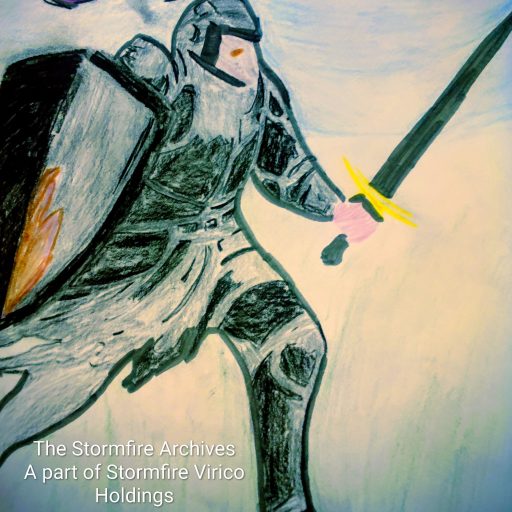
Artistic depiction reflecting the themes of dominance and rebellion in ‘The shadows of an Empire’ by StormborneLore.
The chains had not grown lighter with time, only quieter. Iron had long since given way to gold, yet weight was still weight . Taranis Stormborne felt every ounce of Rome’s fear in the links that bound him.
The ship that bore him south groaned through black waters. The guards would not meet his eyes. Some crossed themselves; others muttered old charms beneath their breath. When lightning flared over the horizon, a single flash revealed the island ahead jagged, volcanic, crowned with smoke.
His new world. His cage.
They called it Vulcarum Minor, a place for Rome’s unwanted gods.
The emperor had decreed he would not die, only vanish buried in salt and silence, where storms not reach. Yet the sea itself seemed to bow as the chained gladiator stepped onto the black sand. The air shimmered with heat and the scent of sulfur; the cliffs glowed faintly with fire beneath the stone.
There were others there broken soldiers, condemned priests, thieves who had stolen from temples. Men without names. And when they saw him, some whispered, “The Unbroken One.”
At night, when the guards slept, he spoke to them not of rebellion, but of memory.
Of oaths that outlast empires. Of the storm that lived in blood and bone.
Soon the whispers changed shape. The condemned began to mark their shields and cuffs with a blackened handprints. A sign of allegiance in the dark. They trained by moonlight, silent and tireless, forming a circle beneath the cliffs.
Taranis called them his Scutorum Nigrorum the Black Shields.
Not an army, not yet. A brotherhood. A promise.
As weeks became years, their network grew beyond the island. Soon ferrymen, smugglers, slaves who vanished and reappeared with gold, soldiers who served two masters. The storm’s reach was returning, invisible and patient.
When thunder rolled across the straits of Sicily, the guards whispered it was a warning from the gods. But Taranis knew better.
It was a reminder.
That no empire lasts forever.
A colorful thank you message encouraging readers to like and subscribe, featuring a bright sun and a blue sky.
The name Taranis Stormborne had long since faded from Rome’s records, but not from its whispers.
A hundred years had passed since the day the storm was chained. Yet still he fought beneath the sun not as a man, but as the empire’s curse.
They called him many things now. The Emperor’s Champion. The Storm Gladiator. To the slaves, he was The Unbroken One. And to Rome’s generals, he was a weapon too valuable to destroy, too dangerous to free.
Every emperor since his capture had ordered the same: “Keep him alive.” For his blood immortal, untamed had become Rome’s secret ritual. Each time the storm bled into the sand, their augurs said the city’s heart beat stronger.
Chains replaced chains. Iron became gold. He was moved from the pits of Britannia to the marble arenas of the south. A relic paraded before crowds who no longer remembered his rebellion only the spectacle of a god in man’s form.
Yet he remembered.
Every lash. Every fallen friend. Every whisper of his brothers Drax, Lore, Draven still echoing through the storm he carried in his veins.
And sometimes, when lightning forked across the horizon of the Mediterranean. The guards swore they saw him lift his face to the sky and smile.
“Not long now,” he would murmur, voice low and rough as distant thunder. “The empire will fall and I will still be standing.
A hundred years had passed since the storm was bound.
A hundred winters since Taranis Stormborne’s chains had sung beneath Rome’s hand yet still, his name whispered across the camps and the courts like a ghost too proud to fade.
In the hall of the Legion’s veterans, laughter rose among the embers. Drax, Draven, and Lore sat together with old friends, all bound by immortality, all marked by the centuries. The world had changed around them Rome had fallen, risen, and reshaped itself but some wounds did not age.
“They want to see how far they can push him before he dies,” one of the legionnaires said, swirling wine dark as blood in his cup. “The Empire’s still obsessed with him. Calls him champion now.”
Draven’s brow arched. “Champion?” he repeated, half with scorn, half with disbelief. “The Emperor’s champion? Then he’s no prisoner he’s a prize.”
Another man leaned closer, the firelight cutting sharp lines across his face. “Word is they’ll grant him exile. An island of his own. Somewhere the storms never touch.”
Lore laughed softly though there was no warmth in it. “Exile,” he said. “Rome’s mercy always comes wrapped in iron.”
Marcos older than them all, though untouched by time raised his cup. “Your brother’s no man anymore,” he said quietly. “He’s a story they can’t kill. A weapon they don’t understand.”
The hall fell silent. Only the fire spoke a low hiss, a breath of smoke curling upward.
A woman’s voice, cool as silver, broke the quiet. Calisto, immortal like the brothers, leaned against the pillar’s shadow. “Calisto owns your brother now,” she said. “Gladiator. Slave. Sold to noble women to keep their beds warm and their secrets buried.”
Draven’s hand tightened on the table. “You speak lies,” he growled.
Marcos shook his head slowly. “Not lies. Rome believes a man can be broken if he’s humiliated long enough.” His eyes darkened. “They never understood what blood he carried.”
Drax stared into the fire, jaw set like stone. “Then they’ve forgotten what happens when storms remember,” he murmured.
Outside, thunder rolled faintly over the hills distant, but coming closer.
Artistic representation of Lore Stormborne, featuring intricate patterns and vivid colors, symbolizing his connection to ancient powers and storms.
Rain fell soft upon Emberhelm not in sheets, but in threads, weaving through the night like strands of memory. Each drop whispered against the walls, tracing paths down stone carved before empires rose. The air smelt of iron, damp moss, and prophecy.
Lore moved through the Hall of Echoes with deliberate silence. The torches burned low, their flames bending in strange rhythm, as though swayed by unseen breath. Beneath the central arch lay the dais of oath and upon it, the gold ring.
It shimmered faintly in the half-light, a pulse of life within metal. Not the glow of firelight, but of something older.
Lore hesitated before it. His reflection warped in its surface his eyes darker, sharper, his face marked by the faint runes of bloodline and burden. “The ring of storm and oath,” he murmured. “The bond of the five.”
He reached out. The moment his fingers brushed it, the hall sighed.
A low hum filled the air not from stone or wind, but from within.
Then came the voice.
“Brother…”
The word was barely sound more vibration, more memory. It coiled through him like smoke through glass.
“Taranis…” Lore whispered, his voice trembling. The name itself seemed to awaken something. The torches guttered. The shadows around the walls began to move not randomly, but with purpose, forming the faint outlines of chained figures, of men bowed beneath lightning.
The ring pulsed again, once, twice. Gold bled to storm-grey.
“Show me,” Lore said. “Show me where he walks.”
The pulse deepened and suddenly, the hall was gone.
He stood in mist. Iron gates loomed before him, slick with rain. Beyond them, sand bloodstained and torn an arena. He heard the roars of lions, the clash of blades, the chanting of a foreign crowd. And there, in the centre, Taranis bare-armed, chained, and unbroken. His eyes like stormlight.
“Still he stands,” Lore breathed.
The vision shattered like glass beneath a hammer. He was back in the hall, gasping, knees to the stone floor. The ring still glowed in his palm, its pulse slowing to match his heartbeat.
He knew then: his brother lived but the bond between them had stirred something greater. The old powers beneath the land the ones the druids had whispered of were waking again.
A new sound reached him. A voice, aged as winter bark.
“The ring calls the storm again,” said Maeve, the seer. She stepped from the shadowed archway, her staff crowned with raven feathers and iron charms. “You’ve felt it too the pulse of the deep earth, the cry of the stones.”
Lore rose slowly. “He lives. I saw him. Rome cannot hold him.”
Maeve’s gaze was sharp, knowing. “No but when the storm returns, it will not come gently. Bonds such as yours were not forged for peace. The land remembers its oaths, Lore Stormborne. The blood remembers. And blood always calls for blood.”
He turned toward the open window, where thunder rolled faintly beyond the hills. The storm clouds were gathering again not yet upon them, but coming.
“Then let it come,” he said softly. “We are Stormborne. We do not kneel to the Empire. We endure… and when the sky breaks, we rise.”
The gold ring flared once more, bright as lightning and somewhere far to the south, in a Roman cell slick with rain, Taranis felt it too.
The fires in Emberhelm burned low, their glow tracing the hall’s carved beams in dull amber. Outside, wind howled through the moors, carrying the echo of the horn that had once called the clans to war. Now it was only memory.
Lord Drax Stormborne sat alone in the council chamber, a single goblet of wine untouched beside him. The maps and missives lay strewn across the oak table. Roman reports, messages from border scouts, pleas for grain from villages too frightened to send men to market.
He had not slept. Sleep meant dreams, and dreams brought Taranis.
His brother’s face haunted him not in death, but in defiance. Bound, bloodied, yet unbroken. There was strength in that memory, but guilt too.
“You always were the fire,” Drax murmured, voice low. “And I the stone that smothered it.”
A faint shuffle broke the silence. Caelum lingered at the doorway, unsure if he was welcome. “Father,” he said softly. “Marcos sent word. The Romans will move east toward the river forts. He says it’s only a patrol.”
Drax’s lips curved into something that have been a smile. “Marcos says many things to make Rome sound smaller than it is.”
He rose, the movement slow, heavy with sleepless weight. “Tell the men to prepare rations, but not weapons. We will not meet them with steel not yet.”
Caelum hesitated. “Uncle Taranis wouldn’t wait.”
“No,” Drax said, turning toward the window, where mist swirled over the dark moorlands. “He would burn the world to free one man. I must keep the world standing long enough for him to have one to return to.”
The boy nodded but did not understand. Few ever would.
Drax rested his hands on the cold stone sill, the wind tugging at his hair. Somewhere beyond the horizon, his brother still fought, still endured. And Drax the eldest, the anchor bore the burden of every storm that raged beyond his reach.
“Forgive me, brother,” he whispered to the wind. “I keep the hearth burning, not because I’ve forgotten you… but because I know you’ll come back to it.”
The storm had not yet left his veins. Even in exhaustion, Taranis’s breath came sharp as lightning through rain. The iron on his wrists bit deeper with each movement, the weight of Rome’s victory heavy, but not finished.
He heard them before he saw them the measured tread of Caelum and Marcos. The murmur of soldiers giving way as they entered the cell yard. The torches flared against the damp walls, shadows stretching long like reaching fingers.
“Uncle Marcos,” Caelum’s voice was quiet but edged with fear. “Can those chains come off him?”
Marcos paused beside the centurion who held the keys. His gaze lingered on Taranis, bloodstained and silent, the faint curl of defiance still etched into his mouth. “They can,” Marcos said slowly. “But they won’t. Not yet.”
Caelum’s jaw tightened. “He’s bleeding. If he dies”
“He won’t,” Marcos interrupted, eyes never leaving Taranis. “He’s too stubborn to die.”
Taranis lifted his head then, a slow, deliberate motion. “You sound almost proud, Marcos.” His voice was hoarse, roughened by sand and roar, but steady. “Tell me how does it feel, watching Rome chain another son of the storm?”
Marcos stepped closer, the metal of his own armour glinting in the firelight. “It feels like survival,” he said quietly. “A lesson you still refuse to learn.”
“Survival,” Taranis repeated, the word tasting like ash. “You call it that. I call it submission.”
The centurion moved between them, keys jangling. “Enough talk.” But Marcos lifted a hand not to command, but to stay him.
“Let him speak,” Marcos said. “Words weigh less than chains.”
Caelum’s eyes flicked between them, confusion and pain warring in his young face. “He fought lions, Uncle. Bears. He lived through what no man should. Why must you treat him like this?”
“Because,” Marcos
“You know they say deaths the final lesson?” Taranis grinned…Marcos’s eyes hardened, but not with anger with something closer to grief.
“Death teaches nothing,” he said. “It only silences the unteachable.”
Taranis laughed then a low, ragged sound that echoed off the stone like distant thunder. “Then maybe silence is what Rome fears most. A man who dies still defiant who doesn’t give them their spectacle.”
The centurion stepped ahead impatiently. “Enough of this.” He seized Taranis by the shoulder, but the bound warrior’s gaze did not waver.
“Do you see it, Caelum?” Taranis rasped. “Chains don’t make a man loyal. They only show who fears him most.”
Caelum swallowed hard, torn between the authority of his uncle and the raw conviction before him. “Uncle… he’s right. Rome fears him.”
Marcos turned sharply. “Rome fears no man.” Yet even as he said it, his voice faltered, as if the walls themselves disagreed.
A moment of silence fell the kind that breathes between lightning and thunder.
Then Taranis whispered, “You once said the blood of the storm can’t be trained. You were right. It can only be bound… for a while.”
The torches flickered, shadows dancing like spirits around the three men the Roman, the youth, and the storm-bound prisoner.
Marcos finally turned away. “Clean his wounds,” he said curtly to the centurion. “He fights again at dawn.”
As they left, Caelum lingered by the gate, his eyes locked on Taranis’s. “I’ll come back,” he said softly.
Taranis’s faint grin returned. “Then bring thunder, boy. Rome hasn’t heard enough of it yet.”
The cell door slammed shut, iron against stone but somewhere, deep beneath the fortress, thunder rolled.
The morning broke pale and cold, a thin mist rolling across the fields like a ghost that had forgotten its name. My horse shifted beneath me, uneasy. The world felt quieter than it should have been not the quiet of peace, but the kind born from expectation. Something waited ahead.
I had traveled for weeks now, keeping to forgotten roads, trading false names and favours for shelter. Rome’s messengers had ceased for a time, and that silence was heavier than any command. I began to wonder if I had been released… or abandoned.
At night, when the campfire dwindled, I caught myself tracing the symbol of the Ring into the dirt a circle broken clean through. No matter how many times I erased it, my hand drew it again. Habit or guilt, I couldn’t tell. Perhaps both.
Rumours reached me in fragments: a rebellion rising in the north, whispers that Drax had taken to leading the scattered tribes, and that Lore had vanished into the mists of the west, chasing prophecies no man could name. Draven was silent. And Taranis… Taranis had become a legend again.
They said he had escaped Rome’s chains, that his eyes burned brighter than ever, that lightning followed where he walked. I did not believe all of it but I wanted to. The world is easier to bear when its ghosts refuse to stay buried.
One night, beneath a blood-red moon, I reached the edge of the marshlands near Ravenmere. The air there was heavy, each breath tasting of iron and old secrets. The ruins of an outpost stood crooked against the skyline Roman stones built upon older foundations. It felt… familiar.
Inside, beneath moss and dust, I found carvings of the Circle faint, half-effaced by time. Words I had spoken in another life echoed in my memory: “We are the Ring. Bound by oath, unbroken by fear.”
I knelt, running my hand over the stone, feeling the groove of each line. “I broke it,” I whispered. “But perhaps it was already breaking.”
Something stirred in the shadows not human, not beast, but presence. A warmth against the air, like breath drawn from memory itself. For the first time since Emberhelm, I felt the Ring respond.
A whisper, faint but unmistakable, rippled through the ruin. “The Circle is never broken, only divided. The storm remembers.”
I rose slowly, the hairs on my arms prickling. Whatever force had once bound us had not died it waited, fragmented, patient. And now, it was calling.
When I rode from Ravenmere at dawn, I carried no banner, no ally, no command. Only purpose.
The Ring was broken but not gone. And if Taranis still lived, if the others still walked their paths… then the storm was far from finished.
“Taranis is our baby brother, no matter what some think,” Drax growled, his voice low and edged with iron. His gaze locked on Rain across the firelight, sharp enough to cut stone. “You betrayed him when he was a child and you betray him now.”
Rain’s jaw tightened, but he did not speak. The silence stretched between them, thick with memory and regret.
The old priest, Maeron, lifted his hand gently. “He forgives you, Rain,” he said, his tone weary yet steady. “He wanted Drax, Draven, and Lore to know he will endure what they give him. So that you three will survive. He says to make choices that will keep you all safe and your people.”
Drax’s expression did not soften, though his eyes flickered with something that have been pain. “He forgives far too easily.”
Maeron inclined his head. “Forgiveness is not weakness, my lord. It is the weapon of those who can’t be broken. The Romans won’t rule forever. Prepare for what comes next.”
At the edge of the fire, Caelum shifted uneasily, his young face caught between fear and pride. “But what about my uncle’s meals?” he asked suddenly. “Uncle was exiled from the Circle years before they caught him. I was a baby then. Now I’m fourteen he shouldn’t be forgotten again.”
The words silenced the hall. Even Rain, for all his bitterness, not meet the boy’s gaze.
Drax rose slowly, the firelight glinting off his scars. “He will not be forgotten,” he said at last. “Not while the storm still bears our name.”
“But won’t they strip him of his name?” Caelum pressed, voice trembling now. “If Rome erases it, how will anyone know he lived?”
Drax looked down at his son the fire’s glow. Reflected in the boy’s wide eyes and placed a steady hand on his shoulder.
“Names can be taken,” he said quietly. “But legacies can’t. The Romans think power is carved in stone. Ours is carved in memory.”
He turned back to Maeron. “Tell him that. Tell him Emberhelm remembers.”
The priest nodded, rising to leave. But before he turned, his gaze swept the circle of men gathered in the hall. “When the storm returns,” he said softly, “I hope you are ready to stand beneath it.”
When Maeron’s footsteps faded into the night, the hall remained silent. The storm outside broke, rain hammering against the shutters like the echo of distant drums.
Drax stood by the window long after the others had gone. He could not see the fort from here, but he could feel it the iron cage that held his brother. The empire pressing closer each season. Yet as lightning flashed over the valley, he smiled grimly.
Because storms, no matter how long they’re caged, always find their way home.
The road to Viroconium was slick with rain. Drax rode beneath a low sky, his cloak heavy with water, the wind biting at his face. Beside him, Maeron’s hood was drawn deep, the priest’s silence carrying the weight of things better left unspoken.
When they reached the outskirts of the Roman fort, the air stank of smoke and iron. The rhythmic clash of hammers and the cries of soldiers echoed through the mist. But above it all, there was another sound low, strained, human.
Drax reined his horse sharply, his eyes narrowing.
At the edge of the square, raised above the mud and the murmuring crowd. Hung a man bound to a crude wooden cross. Blood streaked his arms, his body marked by lashes and bruises. His hair clung to his face in the rain. But the set of his jaw the defiant lift of his head was unmistakable.
Taranis.
Drax’s heart clenched as the legionnaire stepped forward, spear in hand. “He struck a guard and tried to run,” the man said stiffly. “By Roman law, the punishment is public display.”
“Law,” Drax echoed, his voice quiet, almost a whisper but Maeron flinched at the tone. “You call this law?”
The soldier hesitated, but before he could respond, Maeron laid a hand on Drax’s arm. “Careful,” he murmured. “The walls have ears.”
Drax dismounted, boots sinking into the mud. He walked forward until he stood before the cross, rain washing the grime from his face. Taranis raised his head slowly, eyes bloodshot but burning with that same inner fire that no empire could snuff out.
“Brother,” Drax whispered.
Taranis gave a faint, broken smile. “You shouldn’t have come.”
“And leave you to the crows?” Drax’s voice cracked like thunder. “Never.”
Maeron stepped forward, murmuring Latin prayers under his breath for the watching soldiers. Though his words were laced with druidic meaning ancient phrases meant to shield, not to save. His fingers brushed the iron nails that bound Taranis’s wrists. “These are not deep,” he said quietly. “They did not mean to kill him. Only to shame.”
Taranis’s laugh was hoarse. “They can’t shame what they don’t understand.”
The centurion appeared, cloak heavy with rain. “This man belongs to Rome,” he declared. “You will step back, Lord of Emberhelm.”
Drax turned slowly, the weight of centuries in his gaze. “And yet Rome forgets whose land it stands upon.”
The centurion stiffened. “Do you threaten?”
“No.” Drax’s tone softened to a dangerous calm. “I remind.”
The priest raised his hands quickly. “My lord only seeks mercy,” Maeron said. “Let him pray with his brother before the gods.”
After a pause, the centurion gestured sharply. “You have one hour.”
When the soldiers withdrew to the gatehouse, Drax knelt beside the cross. The rain had turned to sleet, stinging against his skin. “Hold on,” he murmured. “We’ll get you down when the watch changes.”
Taranis shook his head weakly. “No. Not yet. If you cut me down, they’ll know you came. They’ll burn Emberhelm.”
“Then let them come,” Drax growled.
But Taranis only smiled faintly. “Storms must wait for the right sky, brother.”
Maeron placed a hand on Drax’s shoulder. “He’s right. Endurance, not rage. That is his rebellion.”
Drax bowed his head, jaw clenched. He hated the wisdom in those words. He hated that Taranis could still smile through chains and nails.
As dusk fell, lightning cracked beyond the hills, white and wild. The storm gathered again over Viroconium.
And though Rome saw only a prisoner’s suffering. Those who remembered the old ways knew the truth: A storm had been crucified and still, it did not die.
The dawn was cold, a thin veil of mist curling over the ramparts of the Roman fort. Taranis awoke to the metallic tang of iron and the distant clang of the blacksmith’s hammer.
His chains clinked softly as he shifted. The cold biting into bruised wrists, but the fire in his chest remained unbroken. He had learned to sleep with storms in his mind; the thunder never ceased, even when the sky cleared.
The sentries passed with measured steps, their eyes avoiding his. Even in chains, Taranis carried the weight of warning: a storm was bound, not broken.
Marcos stirred beside him, shoulders tense with age and pain. “They move you today,” he muttered, voice low. “Legionaries say they march prisoners to the amphitheatre. Another show… or training for others. Rome’s curiosity is insatiable.”
Taranis flexed his wrists against the iron, listening to the rhythm of the camp. The clatter of swords, the measured steps of patrols. The faint murmur of Latin all part of the pulse of this cage. He did not fear. He calculated.
The centurion arrived just as the morning sun began to pierce the mist. A figure of red and bronze framed against the wooden palisade.
“Stormborne,” he said, voice sharp, “prepare to march. Rome watches, and your survival is… optional.”
Taranis rose slowly, chains rattling in protest.
“Optional,” he echoed, smirk tugging at his lips, “like the wind choosing which trees to break.”
The march was silent, the prisoners lined in pairs, shields clinking and armor scraping. Taranis felt the eyes of the Romans on him, not all hostile.
The Curiosity and caution blended in the same gaze. Word had spread of his defiance surviving crucifixion. But unyielding under whip and sword and whispers of the “Storm of Emberhelm” made even hardened legionaries pause.
They crossed the outer hills and entered the amphitheatre grounds. Dust rose from the packed earth, carrying the scent of sweat, straw, and fear. The arena awaited not yet for combat, but for demonstration, for Rome’s fascination with endurance.
Taranis’ chains were secured to a central post. Around him, other prisoners fidgeted and whispered. He noticed the boy from the march days ago. A little child of six years old hiding behind a stack of crates, pale fingers gripping a fragment of bread. Their eyes met, and Taranis gave a faint nod not reassurance, not command, just acknowledgment.
A guard stepped forward, coiling a whip in his hand. “Today, we measure the storm,” he said in Latin, the words sharp as steel. “Let us see if the barbarian bends to Rome.”
Taranis let the chains pull taut, shoulders braced. “Storms bend only to themselves,” he whispered, almost to the wind.
The first demonstration began. Spears and short swords were thrust toward him, each movement designed to test, to gauge. Taranis shifted with the grace of the hunted and the hunter intertwined. As he continues deflecting, twisting, and using the very pull of the chains to redirect momentum.
Every strike met resistance, every thrust was countered. The audience of soldiers murmured in disbelief.
Marcos watched from the side, leaning heavily on his staff. “Still untamed,” he muttered. “Still Emberhelm.”
The sun climbed, and with it, Taranis’ endurance was tested further. Roman instructors pressed harder, pushing his limits, yet he remained unmoved, his grey eyes sharp as lightning.
When at last the centurion called an end, sweat streaming and blood staining the mud, Taranis did not collapse.
He simply lowered his gaze, catching a brief glimpse of the distant hills beyond the fort. Freedom waited there, somewhere beyond chains and Roman order.
As the prisoners were herded back to their quarters, Taranis’ mind raced. Rome could cage him, whip him, measure his endurance, but it could not touch the storm in his heart. The pulse of Emberhelm beat in every step, every breath, every thought of revenge, strategy, and survival.
That night, as firelight danced across the walls of the fort and the whistle of wind through battlements echoed like distant thunder, Taranis sat, chained but unbroken, and whispered to himself:
“Let Rome watch. Let them wait. Storms do not obey. Storms endure. And storms return.”
Night in the Roman fort was never truly silent. Even beneath the canopy of stars, there was always the creak of timber. The shuffle of soldiers on watch, the hiss of oil lamps dying in the cold wind. Yet somewhere beyond that human rhythm, another sound pulsed faint, rhythmic, like the heartbeat of the land itself.
Taranis listened.
He had learned to hear through walls of stone and iron. The whispers of chains, the breath of the wind through narrow slits.All were messages if one knew how to listen.
Marcos stirred nearby, groaning as he rolled against the rough bedding. “You hear it again,” he murmured, voice barely a rasp. “The storm that waits?”
Taranis’ eyes were half-shut, the dim firelight carving hollows beneath his cheekbones. “The storm doesn’t wait,” he said softly. “It watches.”
He turned the small iron shackle at his wrist, feeling for the weak link not yet ready, but close. Every night he tested it. Every day, he marked the rhythm of the guards, the rotation of their watch. Patience, he reminded himself. Storms struck only when the wind was right.
Beyond the barracks, the faint roar of the sea carried inland. Somewhere past those black waters lay the route to Gaul and beyond that, Rome. The thought of being caged beneath marble arches made his blood run colder than the chains.
The door creaked open. A shadow slipped inside small, quick, hesitant. The boy from the arena. He carried a satchel and a half-broken torch.
“They’ll see you,” Marcos hissed.
The boy shook his head. “The north wall guard sleeps. He drinks too much. I brought you this.” From the satchel, he pulled a narrow blade no longer than a hand, its edge dulled but serviceable.
Taranis took it without a word, his fingers brushing the boy’s for a heartbeat. “Why?” he asked.
The boy’s voice trembled. “Because you didn’t kill me when they told you to. Because the others they say you were a king once.”
Taranis looked up then, eyes grey as frost. “A king?” He almost smiled. “No. A storm given form. And Rome can chain storms, but it can not make them serve.”
The boy swallowed, uncertain whether to fear or believe him. “Then what will you do?”
Taranis turned the blade in his hand, the firelight glinting off the iron. “Wait,” he said. “And remember.”
He hid the weapon within the straw bedding, marking its place with a small twist of rope. Then he looked toward the sliver of moonlight cutting across the dirt floor. A thought of home of the high ridges above Emberhelm, of his brothers’ faces fading in memory. Rayne’s eyes full of guilt. Drax’s silence. Draven’s quiet grief.
He did not hate them. Not yet. But the distance between them had become as sharp as any blade.
When dawn came, the fort stirred again the horns of the morning watch echoing across the fields. The centurion approached, flanked by two guards.
“Stormborne,” he said, voice cold. “The governor himself has taken interest. You are to be moved south to Londinium within a fortnight.”
Taranis met his gaze. “To be paraded, then? Or displayed?”
Taranis’ jaw tightened, but his eyes betrayed nothing. Inside, the storm turned once more.
He whispered beneath his breath, too low for the Romans to hear:
As the guards led him from the barracks. He caught a glimpse of the horizon low clouds gathering over the hills, rolling in from the west. It was almost poetic.
“Emberhelm still breathes.”
That night, the chains whispered again not with fear, but with promise. The weak link shuddered beneath his fingers. And when the next storm broke over Viroconium, it would not be made of rain.
The march south had stripped the world of meaning. Days blurred into rain and dust, dawn into dusk, until even time seemed shackled beside him.
By the time they reached the Roman fort near Corinium, Taranis Storm no longer knew how many nights had passed.
Only the rhythm of iron and boots. The murmur of Latin commands, and the distant echo of thunder in his bones.
The fort loomed ahead stone and order built upon the bones of chaos. Walls cut sharp against the grey horizon, guarded by rows of pikes and men who moved like clockwork. To Taranis, it felt wrong. A place without wind, without life.
Every sound was contained, controlled, sterile. Even the air smelled of discipline oil, smoke, and iron.
The storm in him recoiled.
They dragged him through the gates in chains. Soldiers gathered, curious and cautious. Some spat, others stared. Whispers followed him like ghosts daemon, barbarus, filius tempestatis. Son of the storm.
He smiled faintly. They weren’t wrong.
The cell they threw him into was little more than a pit of stone and shadow. The walls sweated damp, the floor slick with moss.
Above, a slit of light cut through the dark too narrow to touch the ground. He sat in the half-dark, wrists raw and heavy with iron. The silence of Rome pressed close, cold and absolute.
He did not pray. He waited.
When the footsteps came, they came as they always did measured, deliberate, Roman. The door creaked open, spilling lamplight like a wound across the floor.
Three entered.
A centurion, broad and cold-eyed, his crimson cloak pristine even in the grime. A scribe, pale and thin, clutching a wax tablet as if it were a shield.
And a woman cloaked, silent, her gaze as sharp as a blade. Her presence was wrong for this place; too poised, too knowing.
“Taranis of the Stormborne,” the centurion began, voice clipped and ceremonial.
“You stand accused of rebellion against Rome. The murder of imperial soldiers, and the disruption of trade along the Salt Road. Do you understand these charges?”
Taranis raised his head. His hair hung in dark, tangled strands, but his eyes were steady the colour of gathering thunder.
“I understand,” he said. “You’re afraid.”
The scribe faltered mid-stroke. The centurion’s jaw tensed. Only the woman’s expression remained still.
“You will answer with respect,” the Roman said.
“I already have.”
The blow came fast a strike across the face that turned his head with the sound of split skin.
Taranis straightened slowly, blood sliding from the corner of his mouth. His stare did not break.
The silence that followed was heavier than the hit.
The woman stepped forward. When she spoke, her accent carried the soft inflection of the East Greek, or something older.
“You fought well,” she said. “Even Rome admits that. There are ways to survive this. Serve us. Lead men under our banner. Take Roman land, a Roman name. You need only kneel.”
Taranis smiled faintly, the expression more weary than cruel.
“Rome offers gold to every man it fears. But my kind do not kneel. We weather.”
She tilted her head slightly. “Weather breaks.”
He met her eyes. “Only if it stops moving.”
For the first time, something flickered in her expression curiosity, maybe even a trace of respect.
The centurion, however, had no such patience. “Enough. He will be moved south to Londinium in three days. If he refuses Rome’s mercy, he will die as a slave.”
The woman’s gaze lingered on him a moment longer before she turned away. “He won’t bend,” she said quietly. “Not yet.”
They left him in the dark once more. The door slammed shut. The iron bolts fell into place.
Taranis exhaled slowly. The air was thick with the scent of blood and damp stone.
He tasted iron on his tongue metal, blood, defiance.
The light from above had shifted again, sliding across the wall like the movement of time itself.
He whispered, barely a sound. Not to gods, nor ghosts, but to the storm that still lived within his chest. It was quiet now, resting waiting. But it would come again. It always did.
When the night settled deep, the sound of rain returned, gentle against the stones.
In that rhythm, he found memory of his brothers’ faces in the torchlight. Drax’s steady eyes, Rayne’s trembling defiance, Draven’s silence. He had told them he would return. He intended to keep that promise.
The fort around him slept in its illusion of control.
But beyond the walls, clouds were gathering over the hills slow, patient, inevitable.