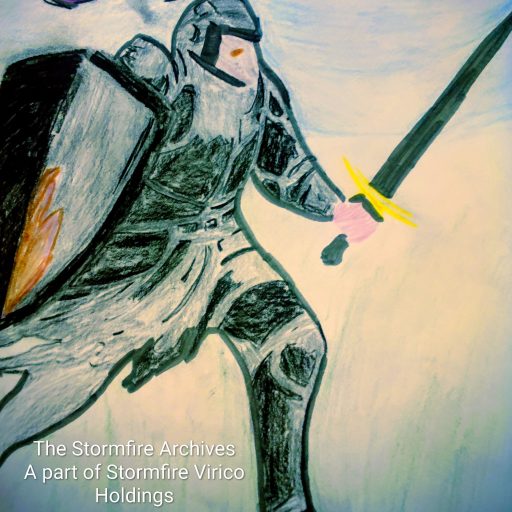
The morning broke pale and cold, a thin mist rolling across the fields like a ghost that had forgotten its name. My horse shifted beneath me, uneasy. The world felt quieter than it should have been not the quiet of peace, but the kind born from expectation. Something waited ahead.
I had traveled for weeks now, keeping to forgotten roads, trading false names and favours for shelter. Rome’s messengers had ceased for a time, and that silence was heavier than any command. I began to wonder if I had been released… or abandoned.
At night, when the campfire dwindled, I caught myself tracing the symbol of the Ring into the dirt a circle broken clean through. No matter how many times I erased it, my hand drew it again. Habit or guilt, I couldn’t tell. Perhaps both.
Rumours reached me in fragments: a rebellion rising in the north, whispers that Drax had taken to leading the scattered tribes, and that Lore had vanished into the mists of the west, chasing prophecies no man could name. Draven was silent. And Taranis… Taranis had become a legend again.
They said he had escaped Rome’s chains, that his eyes burned brighter than ever, that lightning followed where he walked. I did not believe all of it but I wanted to. The world is easier to bear when its ghosts refuse to stay buried.
One night, beneath a blood-red moon, I reached the edge of the marshlands near Ravenmere. The air there was heavy, each breath tasting of iron and old secrets. The ruins of an outpost stood crooked against the skyline Roman stones built upon older foundations. It felt… familiar.
Inside, beneath moss and dust, I found carvings of the Circle faint, half-effaced by time. Words I had spoken in another life echoed in my memory: “We are the Ring. Bound by oath, unbroken by fear.”
I knelt, running my hand over the stone, feeling the groove of each line. “I broke it,” I whispered. “But perhaps it was already breaking.”
Something stirred in the shadows not human, not beast, but presence. A warmth against the air, like breath drawn from memory itself. For the first time since Emberhelm, I felt the Ring respond.
A whisper, faint but unmistakable, rippled through the ruin. “The Circle is never broken, only divided. The storm remembers.”
I rose slowly, the hairs on my arms prickling. Whatever force had once bound us had not died it waited, fragmented, patient. And now, it was calling.
When I rode from Ravenmere at dawn, I carried no banner, no ally, no command. Only purpose.
The Ring was broken but not gone. And if Taranis still lived, if the others still walked their paths… then the storm was far from finished.
“Taranis is our baby brother, no matter what some think,” Drax growled, his voice low and edged with iron. His gaze locked on Rain across the firelight, sharp enough to cut stone. “You betrayed him when he was a child and you betray him now.”
Rain’s jaw tightened, but he did not speak. The silence stretched between them, thick with memory and regret.
The old priest, Maeron, lifted his hand gently. “He forgives you, Rain,” he said, his tone weary yet steady. “He wanted Drax, Draven, and Lore to know he will endure what they give him. So that you three will survive. He says to make choices that will keep you all safe and your people.”
Drax’s expression did not soften, though his eyes flickered with something that have been pain. “He forgives far too easily.”
Maeron inclined his head. “Forgiveness is not weakness, my lord. It is the weapon of those who can’t be broken. The Romans won’t rule forever. Prepare for what comes next.”
At the edge of the fire, Caelum shifted uneasily, his young face caught between fear and pride. “But what about my uncle’s meals?” he asked suddenly. “Uncle was exiled from the Circle years before they caught him. I was a baby then. Now I’m fourteen he shouldn’t be forgotten again.”
The words silenced the hall. Even Rain, for all his bitterness, not meet the boy’s gaze.
Drax rose slowly, the firelight glinting off his scars. “He will not be forgotten,” he said at last. “Not while the storm still bears our name.”
“But won’t they strip him of his name?” Caelum pressed, voice trembling now. “If Rome erases it, how will anyone know he lived?”
Drax looked down at his son the fire’s glow. Reflected in the boy’s wide eyes and placed a steady hand on his shoulder.
“Names can be taken,” he said quietly. “But legacies can’t. The Romans think power is carved in stone. Ours is carved in memory.”
He turned back to Maeron. “Tell him that. Tell him Emberhelm remembers.”
The priest nodded, rising to leave. But before he turned, his gaze swept the circle of men gathered in the hall. “When the storm returns,” he said softly, “I hope you are ready to stand beneath it.”
When Maeron’s footsteps faded into the night, the hall remained silent. The storm outside broke, rain hammering against the shutters like the echo of distant drums.
Drax stood by the window long after the others had gone. He could not see the fort from here, but he could feel it the iron cage that held his brother. The empire pressing closer each season. Yet as lightning flashed over the valley, he smiled grimly.
Because storms, no matter how long they’re caged, always find their way home.
The road to Viroconium was slick with rain. Drax rode beneath a low sky, his cloak heavy with water, the wind biting at his face. Beside him, Maeron’s hood was drawn deep, the priest’s silence carrying the weight of things better left unspoken.
When they reached the outskirts of the Roman fort, the air stank of smoke and iron. The rhythmic clash of hammers and the cries of soldiers echoed through the mist. But above it all, there was another sound low, strained, human.
Drax reined his horse sharply, his eyes narrowing.
At the edge of the square, raised above the mud and the murmuring crowd. Hung a man bound to a crude wooden cross. Blood streaked his arms, his body marked by lashes and bruises. His hair clung to his face in the rain. But the set of his jaw the defiant lift of his head was unmistakable.
Taranis.
Drax’s heart clenched as the legionnaire stepped forward, spear in hand. “He struck a guard and tried to run,” the man said stiffly. “By Roman law, the punishment is public display.”
“Law,” Drax echoed, his voice quiet, almost a whisper but Maeron flinched at the tone. “You call this law?”
The soldier hesitated, but before he could respond, Maeron laid a hand on Drax’s arm. “Careful,” he murmured. “The walls have ears.”
Drax dismounted, boots sinking into the mud. He walked forward until he stood before the cross, rain washing the grime from his face. Taranis raised his head slowly, eyes bloodshot but burning with that same inner fire that no empire could snuff out.
“Brother,” Drax whispered.
Taranis gave a faint, broken smile. “You shouldn’t have come.”
“And leave you to the crows?” Drax’s voice cracked like thunder. “Never.”
Maeron stepped forward, murmuring Latin prayers under his breath for the watching soldiers. Though his words were laced with druidic meaning ancient phrases meant to shield, not to save. His fingers brushed the iron nails that bound Taranis’s wrists. “These are not deep,” he said quietly. “They did not mean to kill him. Only to shame.”
Taranis’s laugh was hoarse. “They can’t shame what they don’t understand.”
The centurion appeared, cloak heavy with rain. “This man belongs to Rome,” he declared. “You will step back, Lord of Emberhelm.”
Drax turned slowly, the weight of centuries in his gaze. “And yet Rome forgets whose land it stands upon.”
The centurion stiffened. “Do you threaten?”
“No.” Drax’s tone softened to a dangerous calm. “I remind.”
The priest raised his hands quickly. “My lord only seeks mercy,” Maeron said. “Let him pray with his brother before the gods.”
After a pause, the centurion gestured sharply. “You have one hour.”
When the soldiers withdrew to the gatehouse, Drax knelt beside the cross. The rain had turned to sleet, stinging against his skin. “Hold on,” he murmured. “We’ll get you down when the watch changes.”
Taranis shook his head weakly. “No. Not yet. If you cut me down, they’ll know you came. They’ll burn Emberhelm.”
“Then let them come,” Drax growled.
But Taranis only smiled faintly. “Storms must wait for the right sky, brother.”
Maeron placed a hand on Drax’s shoulder. “He’s right. Endurance, not rage. That is his rebellion.”
Drax bowed his head, jaw clenched. He hated the wisdom in those words. He hated that Taranis could still smile through chains and nails.
As dusk fell, lightning cracked beyond the hills, white and wild. The storm gathered again over Viroconium.
And though Rome saw only a prisoner’s suffering. Those who remembered the old ways knew the truth: A storm had been crucified and still, it did not die.
The morning mist hung low across the valley, veiling the lands of Emberhelm in silver. From the high balcony of his hall, Lord Drax Stormborne watched the world stir awake.
Smoke from hearths curling above thatched roofs. The faint clang of the smithy below, and the distant echo of a horn calling men to the fields.
The realm had been quiet these past weeks, though quiet was not peace. Rome’s presence had spread like frost silent, glittering, and deadly to touch. Their banners were seen on the roads again, their soldiers marching east toward the fort that caged his brother.
Drax’s hands rested on the stone rail. Scarred knuckles gripping the cold edge as if the granite itself were his only anchor.
“Uncle Taranis forgives us all, father.”
The small voice broke the silence. His son stood behind him Caelum, barely thirteen summers. But already bearing the solemn eyes of a man twice his age. The boy held out a folded parchment, its wax seal cracked, its edges smudged with soot.
Drax took it carefully. The writing inside was firm but uneven, written in haste. Forgive nothing. Remember everything. Below, a single mark a lightning bolt drawn in charcoal.
Drax’s chest tightened. His brother’s hand. His brother’s defiance.
“Who gave you this?”
“One of the Roman guards, father,” Caelum replied. “He said… he said Uncle still lives. He fights every day.”
Before Drax answered, boots echoed behind them. Roberto stepped into the chamber, his armour dull and unpolished, the scent of road dust still clinging to him.
“My lord,” he began, voice low, “I spoke with one of the centurions. They see him as a danger now too much influence, even in chains. They’ve moved him deeper into the fort. Isolation. Only the soldiers see him.”
“Do they mistreat him?” Drax asked, though he already knew the answer.
Roberto hesitated. “They tried to crucify him last week. He survived. Yesterday, they threw him to the lions chained, unarmed. He walked out again.”
The hall fell silent. The fire popped in the hearth, throwing orange light across the stone floor. Drax turned back toward the window. his reflection caught in the misted glass grey at the temples, lines of command etched deep across his brow.
“They can’t kill him,” Roberto said quietly. “So they make him suffer.”
Drax exhaled slowly, the weight of his station pressing like iron against his ribs. “Then we’ll keep him alive in every way they can’t stop. Food, silver, messages whatever can reach him, it will.”
He turned to his son. “Caelum, you will remember this. A lord’s duty is not to speak loudest, but to act where no one sees.”
The boy nodded, solemn and still.
That afternoon, Drax rode out beyond the keep. The fields of Emberhelm stretched before him. The broad plains that once echoed with the clash of blades when the Stormborne banners flew proud.
The Farmers bowed as he passed, and he nodded in turn. To them, he was not just a lord. He was the last shield between their freedom and Roman law.
At the river’s edge, he dismounted, crouching where the waters ran dark and cold. He saw his reflection distorted in the ripples older, heavier, but not yet broken.
He remembered when Taranis had knelt in that same river,7 years ago. Swearing an oath to the gods of wind and storm. “We are not born to yield,” he had said, the water lapping at his wrists. “Even if Rome takes the land, they’ll never take the sky.”
Drax closed his eyes. The oath still lived within him, though it had been buried under the weight of command.
When he returned to the hall, he found Aislin. Stood waiting by the hearth his wife, wrapped in a shawl of woven wool. Her hair touched by the faintest trace of silver.
“You’ve heard the news,” she said softly.
He nodded.
“Will you go to him?”
Drax’s jaw tightened. “Not yet. The fort is surrounded. My every step is watched. To move too soon would doom us all.”
“And if you wait too long?”
He met her gaze, steady and unflinching. “Then he dies a legend. And legends, my love, outlast empires.”
She said nothing more. She simply placed her hand over his, and for a moment, the storm in his chest calmed.
That night, the wind rose.
From the balcony, Drax watched lightning fork across the distant hills. He thought of his brother, chained and bloodied, standing alone beneath the roar of lions and the jeers of men. And he swore, silently and fiercely, that this would not be the end.
The Romans thought they had captured a man. They had not realised they had locked away a tempest.
And storms… always find their way home.
The council chamber was dim, lit only by the flicker of oil lamps. Shadows stretched long across the stone floor, dancing like restless spirits.
“Are priests allowed to see Taranis?” Lore asked the centurion, his tone calm but deliberate.
The Roman officer hesitated, eyes flicking between Drax’s advisor and the lord himself. “Only those sanctioned by command, sir. The prisoner is considered… volatile. Dangerous to morale.”
“Dangerous,” Drax repeated quietly . His gaze fixed on the parchment that still bore his brother’s mark a black streak of charcoal shaped like lightning. “That is one word for faith unbroken.”
The centurion shifted, uneasy beneath the weight of the lord’s tone. He had served Rome for years. But there was something about the Stormborne that unnerved him men who spoke softly yet carried storms behind their eyes.
“Tell your commander,” Drax said at last, his voice cool as the mist outside. “that Emberhelm’s temple will pray for Rome’s victory. And for the salvation of the condemned. It would honour the gods to have a priest available for confession before transport.”
The officer nodded stiffly. “I will… relay the demand, my lord.”
When the door closed, Lore exhaled, rubbing his temples. “You plan to send one of ours.”
“Of course.” Drax turned toward the hearth, watching the flames burn low. “If Rome bars us with iron, we’ll walk through with words. Find one of the druids who wears a Roman mask one who can keep silent under pain.”
Lore bowed his head slightly. “A dangerous game.”
“All games are,” Drax murmured, eyes still on the fire, “when the stakes are blood.”
Two days later, beneath a grey dawn, a solitary figure rode from Emberhelm. He wore the plain robes of a Roman cleric, his face shadowed beneath a hood. No weapon hung at his side, no coin jingled in his pouch.
With only a small satchel of herbs, a ring wrapped in cloth, and a wax-sealed blessing marked his purpose.
His name was Maeron. Once a druid of the old faith now known to Rome as Marcus. A man who had survived the purges by trading his oak staff for a prayer scroll.
The road to Viroconium wound through dead forests. The mist-shrouded valleys, the silence broken only by the clatter of hooves and the distant calls of crows.
When he reached the Roman fort, guards searched him roughly, tearing through his satchel and stripping him of his cloak. Finding nothing amiss, they granted him ten minutes with the prisoner.
The cell smelled of iron, straw, and old blood. Chains hung from the walls like spiderwebs.
Taranis sat in the corner, wrists bound, his head bowed. A thin cut traced his cheek, half-healed, crusted with dust. He did not look up when the door opened.
“You come to pray?” His voice was low, worn smooth like riverstone.
“I come to remind you,” Maeron whispered.
Taranis lifted his head slowly, and for a moment the fire in his eyes banished the gloom. Maeron knelt before him and drew from his sleeve a small gold ring. its inner band engraved with the sigil of storm and flame.
Drax’s mark.
“Drax?”
“He watches,” Maeron said softly. “He waits. He sends this so you’ll know you are not forgotten. Food and coin move under Rome’s banners carried by men who owe him debts. You will have what you need to endure.”
Taranis reached for the ring. The chains clinked, faint as falling rain. “Tell him I am no longer enduring. I am learning.” His voice strengthened, each word edged with iron. “They think they cage me. But they are teaching me their weaknesses.”
He leaned closer, his gaze sharp, unyielding. “Tell Lore, Drax, and Draven I shall endure so they are safe. Tell them… the storm remembers.”
Maeron bowed deeply. “The gods still listen, even in Rome’s shadow.”
Taranis’s lips curled faintly. “Then let them listen to thunder.”
Outside, as Maeron was escorted back through the gates, lightning cracked across the horizon. The guards muttered that the storm came early that season.
Drax, miles away, looked up from his balcony at the same flash of light. whispered beneath his breath “Brother… I hear you.”
Thank you for reading if you have enjoyed please like, comment and subscribe.
Dawn broke over the Roman camp like a blade drawn through fog. Grey light pooled across churned mud and sharpened stakes, catching on helmets and spearheads lined in perfect order.
The night’s rain had thinned to mist, and every droplet clinging to the leather tents shimmered like glass. The smell of smoke, sweat, and iron hung heavy in the air the scent of empire.
Taranis stirred. His back ached where the whip had bitten, skin raw beneath crusted blood. Yet the fire inside him burned brighter than pain the storm had not passed. It gathered.
Across from him, Marcos watched with his one good eye. The old fighter’s face a map of old wars and fading loyalties. “Rome wants to see storms broken,” he murmured, voice gravel-deep. “They’ll test you again today. But storms… storms don’t break. They shift. They wait.”
Taranis tilted his head, a faint smirk cutting through exhaustion. “And if they try?”
Marcos shrugged, rough amusement in his tone. “Then you show them the wind can cut as deep as the sword.”
Trumpets blared as the camp came alive in a heartbeat. Orders barked in Latin, armor clattered, horses stamped restlessly against their ropes. Two guards approached, eyes cold, hands twitching near the whips at their belts.
“On your feet,” one barked.
Taranis rose slowly. Chains clinked. His shoulders squared, each movement deliberate. The iron at his wrists and ankles was heavy a reminder that for now, he belonged to Rome.
Yet even bound, he carried the air of something untamed. The guards kept their distance, as though the storm in his eyes strike.
They led him toward a cleared space at the edge of the camp. A makeshift ring had been marked out with stakes and rope a place for training, punishment, or testing.
The centurion stood nearby, expression carved from granite. The boy from last night watched from behind a cart, pale fingers gripping the wood. He didn’t dare speak.
The centurion’s voice carried over the murmurs. “The barbarian survived crucifixion,” he said in clipped Latin. “He has killed Roman soldiers with sword, axe, and bow. Let us see if his storm can be harnessed or if it dies in the mud.”
Taranis met his gaze.
“Let him watch,” he murmured in Brythonic the tone sharp, almost ceremonial. The centurion frowned, not understanding, but the words left a chill in the air.
A guard offered him a practice axe, a short sword, and a small round shield. The weapons were worn, dulled, mockeries of what he once wielded but they would do.
He ran a thumb along the axe’s handle, testing the balance. The first bout began.
Two legionaries stepped into the ring, boots sinking into wet earth. They grinned, confident, soldiers against a chained barbarian. Taranis didn’t move until they struck.
The first swing came from the right clean, practiced.
He stepped aside, caught the motion with the rim of his shield, and turned it aside. The counter came low and fast a backhand with the axe that cracked into the soldier’s guard, splintering the wood. Mud sprayed. Gasps followed.
The second soldier lunged from behind. But Taranis ducked, dragging his chain taut to trip him, then drove an elbow into his ribs.
He rose without looking back. Breathing steady. Eyes cold.
He didn’t grin. He didn’t boast. He simply waited.
The crowd quieted. Even the centurion lowered his stylus for a moment.
“Again,” he said.
Another pair entered. Then another. By the third round, Taranis’s arms burned and his wrists bled where the chains bit into skin. Yet his movements only grew sharper measured, adaptive, each strike like thunder rolling closer.
Marcos leaned toward a watching soldier. “That’s no wild man,” he muttered. “That’s a storm that learned to fight back.”
By midday, silence had fallen across the ring. The spectators no longer laughed. They watched uneasy, enthralled, afraid.
The centurion finally raised a hand. “Enough,” he ordered. “Feed him. Let him rest. He will fight again tomorrow with steel.”
Taranis tilted his head, the faintest smirk touching his mouth. “Feed the storm,” he murmured, “and see what it grows into.”
The boy crept closer, slipping a crust of bread from his tunic and setting it by his side.
Taranis nodded once not gratitude, but recognition. A gesture between survivors.
As they led him away, one of the younger guards spoke quietly, incapable of concealing his curiosity. “They say you fought crucifixion itself and lived. What man survives that?”
Taranis turned his head slightly. The grey in his eyes caught the light. “Not a man,” he said. “A storm that forgot to die.”
Marcos barked a laugh, shaking his head. “Gods help Rome,” he said. “They’ve chained lightning and think it’ll sit still.”
When they finally removed his restraints for cleaning, Taranis flexed his wrists, skin bruised and torn. He studied the marks, then smirked.
“At least they removed the restraints,” he said quietly. “I grew up fighting in them.”
The centurion said nothing. The sky grumbled overhead thunder rolling distant but deliberate.
Then, softly, as if remembering something half-buried in blood and rain, Taranis spoke again.
“They put me up,” he said, eyes fixed north. “Nailed me in on the hill at Salinae”
Marcos frowned. “And yet here you are.”
Taranis flexed his fingers, old scars catching the light. “I ripped myself off,” he said simply.
Silence cracked through the camp. Guards shifted. Somewhere, a dog began to howl.
“Rome thinks it crucified me,” he murmured. “But the dead don’t stay nailed not when the gods still have use for them.”
Thunder answered. Closer this time.
Rome had not yet learned that storms do not serve. They return.
The circle of stones stood under a bruised sky. The thirteenth stone, already cracked from the battle at Emberhelm, seemed to strain against itself as though it knew what was coming. Thirteen seats. Only twelve filled.
Taranis Storm to his outlaws stood at the centre. His cloak was damp from rain, his wrist still bandaged from the Hill of Ashes. Around him, the brothers of the Ring shifted like wolves uneasy in their own skins.
Drax spoke first. “The Black Shields raid in your name. The people whisper of you, not of us. The balance is broken.”
“It was never balanced,” Taranis replied. His voice was low, bitter. “We bled for fields that gave us no bread. Rome takes salt from our earth while we quarrel. If I raid, it is to feed our people, not to wear a crown.”
Lore’s eyes flicked to the sky. “And yet the crown follows you, brother. The omens have turned. The storm no longer waits.”
Then Rayne stepped forward, the firelight showing the sly curve of his smile. “No storm lasts forever. Some of us have chosen survival.”
From the shadows came the tramp of iron boots. The air filled with the rhythm of Rome square shields, horsehair crests, iron blades that gleamed even in the grey. The circle of stones was surrounded.
Draven’s face went pale. His lips moved as if to speak, but no words came.
“You led them here,” Taranis said.
Rayne did not deny it. “Our people will live beneath Rome’s law. Better chains of iron than graves of ash.”
The thirteenth stone split with a sound like thunder. Dust trickled down its face. The Ring was broken.
Battle erupted. Drax drew steel, Lore called fire from the runes, Aisin shielded the cradle where Caelum slept. Nessa’s blade sang bright before she was dragged into the fray, her cry lost in the clash.
Taranis fought like the storm itself blade flashing, shield breaking, each stroke cutting down another soldier. But for every man he felled, three more closed in. Nets weighted with lead tangled his limbs. Chains of iron bit deep.
He roared once, a sound that shook the stones. Lightning split the sky as if the gods themselves mourned. Then the Romans dragged him down. His black shield shattered under their boots.
“Take him alive,” the centurion barked. “Rome has use for beasts like this.”
When the fighting ended, the circle lay in ruin. Smoke curled from broken fires. Brothers lay wounded or scattered. The thirteenth stone was nothing but rubble.
Taranis, Storm of Emberhelm, was shackled in chains and marched south along the salt road. Behind him, the old world fell silent. Ahead lay the lash, the arena, and the roar of foreign crowds.
He lifted his head once to the sky and whispered through bloodied lips:
“If I must fight, let it be as storm, not as slave.”
When the Roman legions marched into Britain in AD 43 under Emperor Claudius, they did not find an empty land. They found a patchwork of proud tribes, each with its own rulers, gods, and customs.
To the west of Watling Street lay the Cornovii, rooted in Shropshire and Staffordshire. To the south, around the salt-rich lands of Droitwich and Gloucestershire, stood the Dobunni. Both tribes would feel the weight of Rome’s advance.
Salt and Survival
Salt was life. It preserved food, healed wounds, and was as valuable as coin. The Romans renamed Droitwich Salinae and placed it under heavy control, taxing the salt trade and guarding it with military force.
For the Celts, who had long drawn wealth from the brine springs, this was both a theft and an insult. To strike the salt routes was to strike at Rome itself.
Resistance and Betrayal.
Not all Britons resisted. Some tribal leaders saw the might of Rome and chose to make an alliance. They took Roman names, built villas, and dressed in the style of their conquerors.
Others fought tooth and nail, their warriors painted, their gods called upon in the forests and on the hills. This clash between loyalty to tradition and the lure of Roman power split kin and tribe alike betrayal often hurt more than Roman swords.
Gods of Two Worlds.
The Romans rarely erased local gods. Instead, they blended them into their own pantheon.
Taranis, Celtic god of thunder, was aligned with Jupiter, wielder of lightning.
Sulis, worshipped at Bath, was merged with Minerva, goddess of wisdom.
Even the war goddess Andraste found echoes in Roman Mars and Bellona.
For many, this was a mask. Outwardly Roman, inwardly Celtic still. Temples rose with Latin names carved into stone, yet behind closed doors, the old rituals carried on offerings at sacred groves, whispered invocations at standing stones.
Daily Life Under Rome.
Markets bustled with pottery, wine, and oil imported from Gaul and Spain. Roman roads cut straight through the land, binding together forts, towns, and villas. Yet step off the road and you might still find Celtic roundhouses, farmers living as their ancestors had, and druids carrying wisdom that defied Rome’s order.
Legacy.
Celtic–Roman Britain was not either fully conquered or fully free. It was a place of merging, conflict, and uneasy coexistence. Rome imposed its order, but the spirit of the land the forests, the rivers, the stones still whispered the old names.
For some, like the warriors of legend, this was a time of rebellion. For others, a time of survival. And for figures like Taranis Stormborne, also known as Storm caught between gods and men, Rome and Celt, it was the crucible that forged myths still told today.