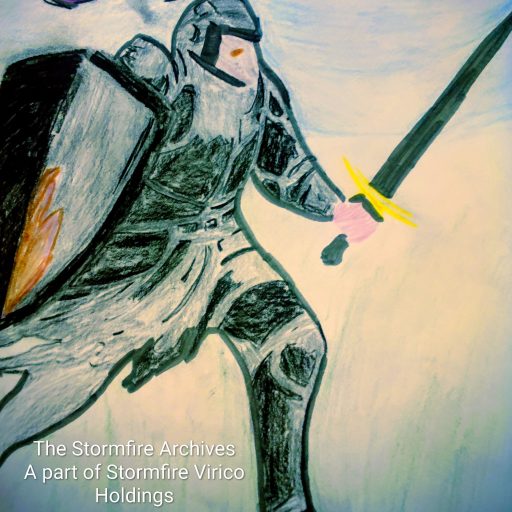
The rain had softened to a whisper by the time they carried Thunorric back to Rægenwine’s Inn.
Mud clung to their boots, streaked dark with blood and ash. Behind them, the Chase lay heavy and silent, as if the forest itself were holding its breath.
Rægenwine threw open the door. “Get him to the hearth,” he ordered. “And mind that floor it’s new.”
They laid Thunorric on a bench near the fire. The outlaw was pale beneath the soot, breath rasping shallow. His cloak was soaked through, half-torn, the linen beneath blackened where blood had seeped through the binding.
Leofric crouched beside him, his right hand bound where the Saxons had taken the quill fingers. He tried to help but winced when his wrist trembled. “Hold still,” he said quietly, voice cracking.
“Always tellin’ me that,” Thunorric muttered, managing a faint smirk.
Dægan pressed a cloth to the wound, jaw tight. “You should’ve let me handle it.”
“You’d have talked ’em to death,” the outlaw rasped.
“Better than bleeding for it.”
“Maybe,” Thunorric whispered, eyes flicking toward the fire, “but the world don’t change through words, brother. It changes when someone dares to move first.”
Leofric looked between them, the candlelight trembling in his hand. “And yet without words, no one remembers why it mattered.”
The silence that followed was heavy thicker than smoke.
Rægenwine broke it with a sigh. “Gods save me, you two’ll argue even when one of you’s dyin’.”
Thunorric laughed once a short, broken sound that still carried warmth. “Not dyin’, just tired.”
Outside, the storm grumbled one last time before fading into the hills. Eadric stood at the door, watching the mist roll through the trees. “They’ll be back,” he said. “Saxons don’t like losin’.”
“Then they’ll find us waitin’,” Dægan said.
Leofric met his gaze. “How many storms can we survive?”
“As many as it takes,” the lawman replied.
James sat by the wall, knees tucked to his chest, eyes wide in the flicker of the fire. He’d seen battles in stories, never in flesh.
His father looked smaller now, human, but somehow more powerful for it . Not because he couldn’t die, but because he refused to.
Leofric reached across the table with his left hand, placing a quill beside the parchment. “Rest,” he said softly. “The story will keep till morning.”
Thunorric closed his eyes, and for a moment, it was quiet enough to believe him.
James stirred from his place by the hearth, rubbing sleep from his eyes. “Will Da be well?” he asked, voice small but steady.
Thunorric’s eyes flickered open, a tired grin crossing his face. “Ah’m awlroight,” he rasped. “Takes more’n a Saxon spear to stop your old man.”
James nodded, though his lip trembled. He reached for his father’s hand, small fingers curling around calloused ones. For a moment, even the fire seemed to soften its crackle.
Rægenwine watched from behind the counter, muttering, “Ain’t nothin’ that’ll kill a Storm-kin not till the world’s ready.”
The boy smiled at that, and the brothers exchanged a glance that said more than words ever.
Author’s Note
After the chaos of The Law and the Storm. This quiet chapter shows what comes after the fight. When strength gives way to silence and survival becomes its own courage. The Storm-kin endure not because they can’t die, but because they refuse to fade.
As I mentioned yesterday, much of what is now England. Was once Welsh land so as part of today’s celebrations,. I give a small nod to my Welsh roots and the history that shaped these lands.
I’d like to wish everyone a Calan Gaeaf hapus, also known as a Happy First Day of Winter!
To many Christians, it’s celebrated as All Saints’ Day. But whatever name you know it by,. Take a moment to enjoy the turning of the season and stay safe as winter begins.
An artistic interpretation titled ‘The Shadows of an Empire’ by StormborneLore, showcasing intricate patterns and vibrant colors.
The Whispering Blades
“You’ll see the arena again, Lupus when the Empire finds another crowd worth impressing. But empires fade. Storms… they wait.”
“So what then? More isolation for the beast brought out to haul rocks or is he permitted to do what he wants?” another guard asked, half mocking, half wary.
Marcus didn’t answer at first. His gaze lingered on the prisoner the golden-eyed giant who once made cities tremble. Even in chains, there was something unyielding about him. The air seemed heavier when he stood too close, as if the storm itself remembered him.
“Let him work,” Marcus said finally, voice low. “If the gods haven’t broken him by now, we won’t.”
Taranis lifted the stone in silence, the weight nothing to him. His eyes met Marcus’s through the drifting ash not with hatred, but understanding. Men like Marcus were cracks in the Empire’s armour, and he already felt the storm beginning to seep through.
That night, whispers spread through the camps. The slaves spoke of tools vanishing, guards turning blind eyes. The strange marks carved into the rock walls of the caves symbols of the storm.
The Ordo was no longer training in secret. It was beginning to move.
The Whispering Blades
It began with the disappearance of a centurion. No body, no blood just his helmet left beside the sea. Then came the merchant ships that docked with half their crew missing and their cargo of weapons gone.
Rome’s prefects called it piracy. The guards called it witchcraft. But Marcus knew better. He had seen the marks black circles intersected by lines like lightning. Carved into the stones where the missing men last stood.
The storm’s sigil.
On the island, Taranis moved through shadow. The Ordo had become something more not merely prisoners, but a network. Smugglers, spies, deserters, slaves. Men who owed no loyalty to Rome but to one another, bound by the mark and by his word.
Their blades were not drawn in open rebellion but in silence. Messages replaced banners; coded phrases replaced oaths. In the dark corners of the empire, the name Lupus became a warning. A curse whispered between soldiers before they slept.
And from time to time, Marcus would find strange bundles left near the guardhouse. Parcels of food, maps, and notes written in a language he did not know. The storm was moving faster than he was capable of reporting.
One night, a messenger boat came through rough seas bearing the Emperor’s seal. A new order had been given:
“Transfer the prisoner known as Lupus to Sicily. The Emperor demands his presence for a special ceremony.”
Marcus read the scroll three times. The words were clear, yet something in him hesitated. He looked toward the cliffs, where lightning split the horizon. The faint echo of a hammer striking iron rang out in the volcanic dark.
The storm was preparing to leave its island.
In the morning, Taranis stood by the docks, chains freshly bound. The soldiers dared not meet his eyes. As he stepped aboard, the sea hissed against the hull, and the sky grumbled above them.
Marcus saluted him not as a guard, but as a soldier to another.
“The gods will tire before you do, Stormborne,” he said quietly.
Taranis smiled faintly, the expression like distant thunder. “They already have.”
The ship set sail toward Sicily. Behind them, the island burned in the dawn. A black wound sealed by smoke, hiding the thousand blades that whispered beneath it.
The storm was no longer waiting. It was coming ashore.
A colorful thank you note encouraging readers to like and subscribe, featuring a bright sunny sky and green landscape.
The island rose like a wound from the sea. Cliffs blackened by smoke and jagged rock, licked by molten streams that hissed as they met the waves.
Taranis Stormborne stepped onto the scorched soil, chains clinking, eyes burning with quiet fury. The guards flinched at his gaze, sensing a storm that would not be tamed.
Days and nights blurred into one endless trial. He lifted stones heavier than any sword, endured storms that tore at his flesh., Taranis bore the mockery of Rome’s guards.
Yet each hardship was fuel. Each lash, each shout, An each impossible task was a lesson in patience. In endurance, in power that is quiet but absolute.
He was not alone for long. The exiles, criminals, and broken soldiers were gathered by the emperor’s decree.
Taranis was sent to the island as unwanted remnants of a fading empire. Many despaired, some sought only survival. But Taranis saw potential. In every desperate man, he saw loyalty waiting to be earned, strength waiting to be honed.
Under the cloak of night, he gathered the willing. They trained in secret. The volcanic caves became their arena; the cliffs their obstacle course. The ash-strewn beaches their battlefield. Each man swore a quiet oath, blackened by soot and sealed with the mark of the hand.
They were no longer prisoners. They were the first of the Black Shields the Ordo Scutorum Nigrorum.
Messages traveled beyond the island. But the smugglers whispered of shadows moving in the hills. As escaped slaves returned bearing tales of a golden-eyed gladiator who taught men the secrets of survival and strategy. Rome did not yet hear the name, but the seeds were planted. A storm was coming, and it carried the memory of chains.
In the stillness of volcanic nights, Taranis would climb the cliffs alone, facing lightning forks across the horizon. He lifted his face to the sky, the wind whipping across scars older than the empire itself.
“Soon,” he whispered, voice low as distant thunder, “the storm will awaken. And all who have betrayed the storm will bow… or fall.”
Years passed like tides, and the island became a crucible. Every man, every strike of the hammer, every lesson whispered in the dark. Was a note in a symphony that only Taranis heard. The Ordo grew, silent and unstoppable. Not an army, not yet. But a promise. A shadow. A storm that waited.
The world beyond the cliffs continued, oblivious to the wheels turning in secret. And when Rome faltered, as it always would, the storm would be ready to rise again.
“Hey, what’s his Roman name? I heard it’s Lupus,” a young boy said, looking to Marcus as he walked to his cell.
“I don’t care what they call me,” Taranis replied, voice low and rough. “But answer me this, Dominus when do I see the arena again? Or am I deemed too dangerous?”
The name Taranis Stormborne had long since faded from Rome’s records, but not from its whispers.
A hundred years had passed since the day the storm was chained. Yet still he fought beneath the sun not as a man, but as the empire’s curse.
They called him many things now. The Emperor’s Champion. The Storm Gladiator. To the slaves, he was The Unbroken One. And to Rome’s generals, he was a weapon too valuable to destroy, too dangerous to free.
Every emperor since his capture had ordered the same: “Keep him alive.” For his blood immortal, untamed had become Rome’s secret ritual. Each time the storm bled into the sand, their augurs said the city’s heart beat stronger.
Chains replaced chains. Iron became gold. He was moved from the pits of Britannia to the marble arenas of the south. A relic paraded before crowds who no longer remembered his rebellion only the spectacle of a god in man’s form.
Yet he remembered.
Every lash. Every fallen friend. Every whisper of his brothers Drax, Lore, Draven still echoing through the storm he carried in his veins.
And sometimes, when lightning forked across the horizon of the Mediterranean. The guards swore they saw him lift his face to the sky and smile.
“Not long now,” he would murmur, voice low and rough as distant thunder. “The empire will fall and I will still be standing.
A vibrant artistic depiction of a stylized object, blending intricate designs with bright colors, invoking themes of lore and magic.
The Quiet Flame
The wind that swept over Emberhelm carried no warmth, only the ghost of fire long spent. I stood where the circle had once been whole, where twelve stones still defied the weight of empire, and one lay split a wound upon the land.
The others had gone. Drax to fury, Draven to silence, Rayne to his choices, and Taranis to chains. I remained, bound not by steel but by memory. It was not courage that kept me here; it was knowing that something sacred had been broken and that it was not yet done with us.
The Romans called this valley conquered. They built their roads and forts as if they could hammer meaning from earth and stone. But meaning does not bow to empire. It whispers, it lingers, it waits. And I have learned to listen.
I knelt beside the thirteenth stone, tracing the crack with my fingers. The split hummed faintly, as though it still remembered the storm that birthed it. I could almost hear Taranis’s voice beneath the wind, a murmur of thunder too distant to strike.
“Brother,” I whispered, “if the storm is caged, does the sky mourn its silence?”
A shadow passed across the ridge perhaps a hawk, perhaps a sign. In the old days, I would have asked the druids for meaning, but now I was the only one left to ask.
Rayne’s betrayal still cut deep, though part of me understood it. He had always been the one to see the long game, the patient serpent coiled beneath the waves. I did not forgive him, but neither could I condemn him fully. Perhaps this is how the gods feel when they look upon men weary, knowing, endlessly disappointed.
Night crept over the hills. I lit no fire; the Romans watched for smoke. Instead, I watched the stars, the same constellations our ancestors had trusted when the world was still young. Somewhere beyond those lights, I felt the pulse of something waking old magic, stirring beneath stone and soil, called forth by blood and betrayal alike.
The Circle was broken, yes. But its power had not vanished; it had merely changed shape. The storm that once lived in Taranis’s heart now whispered through the bones of the earth. I could feel it gathering, quiet but sure, as if the land itself prepared to rise.
In that silence, I spoke the old words not prayer, not spell, but remembrance. A promise carved into breath:
“When the storm returns, it will not ask who was loyal. It will ask who remains.”
The dawn was cold, a thin veil of mist curling over the ramparts of the Roman fort. Taranis awoke to the metallic tang of iron and the distant clang of the blacksmith’s hammer.
His chains clinked softly as he shifted. The cold biting into bruised wrists, but the fire in his chest remained unbroken. He had learned to sleep with storms in his mind; the thunder never ceased, even when the sky cleared.
The sentries passed with measured steps, their eyes avoiding his. Even in chains, Taranis carried the weight of warning: a storm was bound, not broken.
Marcos stirred beside him, shoulders tense with age and pain. “They move you today,” he muttered, voice low. “Legionaries say they march prisoners to the amphitheatre. Another show… or training for others. Rome’s curiosity is insatiable.”
Taranis flexed his wrists against the iron, listening to the rhythm of the camp. The clatter of swords, the measured steps of patrols. The faint murmur of Latin all part of the pulse of this cage. He did not fear. He calculated.
The centurion arrived just as the morning sun began to pierce the mist. A figure of red and bronze framed against the wooden palisade.
“Stormborne,” he said, voice sharp, “prepare to march. Rome watches, and your survival is… optional.”
Taranis rose slowly, chains rattling in protest.
“Optional,” he echoed, smirk tugging at his lips, “like the wind choosing which trees to break.”
The march was silent, the prisoners lined in pairs, shields clinking and armor scraping. Taranis felt the eyes of the Romans on him, not all hostile.
The Curiosity and caution blended in the same gaze. Word had spread of his defiance surviving crucifixion. But unyielding under whip and sword and whispers of the “Storm of Emberhelm” made even hardened legionaries pause.
They crossed the outer hills and entered the amphitheatre grounds. Dust rose from the packed earth, carrying the scent of sweat, straw, and fear. The arena awaited not yet for combat, but for demonstration, for Rome’s fascination with endurance.
Taranis’ chains were secured to a central post. Around him, other prisoners fidgeted and whispered. He noticed the boy from the march days ago. A little child of six years old hiding behind a stack of crates, pale fingers gripping a fragment of bread. Their eyes met, and Taranis gave a faint nod not reassurance, not command, just acknowledgment.
A guard stepped forward, coiling a whip in his hand. “Today, we measure the storm,” he said in Latin, the words sharp as steel. “Let us see if the barbarian bends to Rome.”
Taranis let the chains pull taut, shoulders braced. “Storms bend only to themselves,” he whispered, almost to the wind.
The first demonstration began. Spears and short swords were thrust toward him, each movement designed to test, to gauge. Taranis shifted with the grace of the hunted and the hunter intertwined. As he continues deflecting, twisting, and using the very pull of the chains to redirect momentum.
Every strike met resistance, every thrust was countered. The audience of soldiers murmured in disbelief.
Marcos watched from the side, leaning heavily on his staff. “Still untamed,” he muttered. “Still Emberhelm.”
The sun climbed, and with it, Taranis’ endurance was tested further. Roman instructors pressed harder, pushing his limits, yet he remained unmoved, his grey eyes sharp as lightning.
When at last the centurion called an end, sweat streaming and blood staining the mud, Taranis did not collapse.
He simply lowered his gaze, catching a brief glimpse of the distant hills beyond the fort. Freedom waited there, somewhere beyond chains and Roman order.
As the prisoners were herded back to their quarters, Taranis’ mind raced. Rome could cage him, whip him, measure his endurance, but it could not touch the storm in his heart. The pulse of Emberhelm beat in every step, every breath, every thought of revenge, strategy, and survival.
That night, as firelight danced across the walls of the fort and the whistle of wind through battlements echoed like distant thunder, Taranis sat, chained but unbroken, and whispered to himself:
“Let Rome watch. Let them wait. Storms do not obey. Storms endure. And storms return.”
Night in the Roman fort was never truly silent. Even beneath the canopy of stars, there was always the creak of timber. The shuffle of soldiers on watch, the hiss of oil lamps dying in the cold wind. Yet somewhere beyond that human rhythm, another sound pulsed faint, rhythmic, like the heartbeat of the land itself.
Taranis listened.
He had learned to hear through walls of stone and iron. The whispers of chains, the breath of the wind through narrow slits.All were messages if one knew how to listen.
Marcos stirred nearby, groaning as he rolled against the rough bedding. “You hear it again,” he murmured, voice barely a rasp. “The storm that waits?”
Taranis’ eyes were half-shut, the dim firelight carving hollows beneath his cheekbones. “The storm doesn’t wait,” he said softly. “It watches.”
He turned the small iron shackle at his wrist, feeling for the weak link not yet ready, but close. Every night he tested it. Every day, he marked the rhythm of the guards, the rotation of their watch. Patience, he reminded himself. Storms struck only when the wind was right.
Beyond the barracks, the faint roar of the sea carried inland. Somewhere past those black waters lay the route to Gaul and beyond that, Rome. The thought of being caged beneath marble arches made his blood run colder than the chains.
The door creaked open. A shadow slipped inside small, quick, hesitant. The boy from the arena. He carried a satchel and a half-broken torch.
“They’ll see you,” Marcos hissed.
The boy shook his head. “The north wall guard sleeps. He drinks too much. I brought you this.” From the satchel, he pulled a narrow blade no longer than a hand, its edge dulled but serviceable.
Taranis took it without a word, his fingers brushing the boy’s for a heartbeat. “Why?” he asked.
The boy’s voice trembled. “Because you didn’t kill me when they told you to. Because the others they say you were a king once.”
Taranis looked up then, eyes grey as frost. “A king?” He almost smiled. “No. A storm given form. And Rome can chain storms, but it can not make them serve.”
The boy swallowed, uncertain whether to fear or believe him. “Then what will you do?”
Taranis turned the blade in his hand, the firelight glinting off the iron. “Wait,” he said. “And remember.”
He hid the weapon within the straw bedding, marking its place with a small twist of rope. Then he looked toward the sliver of moonlight cutting across the dirt floor. A thought of home of the high ridges above Emberhelm, of his brothers’ faces fading in memory. Rayne’s eyes full of guilt. Drax’s silence. Draven’s quiet grief.
He did not hate them. Not yet. But the distance between them had become as sharp as any blade.
When dawn came, the fort stirred again the horns of the morning watch echoing across the fields. The centurion approached, flanked by two guards.
“Stormborne,” he said, voice cold. “The governor himself has taken interest. You are to be moved south to Londinium within a fortnight.”
Taranis met his gaze. “To be paraded, then? Or displayed?”
Taranis’ jaw tightened, but his eyes betrayed nothing. Inside, the storm turned once more.
He whispered beneath his breath, too low for the Romans to hear:
As the guards led him from the barracks. He caught a glimpse of the horizon low clouds gathering over the hills, rolling in from the west. It was almost poetic.
“Emberhelm still breathes.”
That night, the chains whispered again not with fear, but with promise. The weak link shuddered beneath his fingers. And when the next storm broke over Viroconium, it would not be made of rain.
Acrylic painting of a mother cradling her child under a moonlit sky, symbolizing love and connection.
Medium: Acrylic on paper
Size: A4
Description: A mother cradles her child beneath the glow of moon and stars, framed in swirling gold. This piece speaks of tenderness, resilience, and the eternal bond between generations.
A vibrant depiction of a lone Roman soldier standing ready against a stormy backdrop, symbolizing the strength and fragility of empires.
Medium: Acrylic on paper
Size: A4
Description: A lone Roman soldier stands vigilant against a stormy sky, spear and shield at the ready. The piece captures both the strength and fragility of empire one figure set against the vast shifting forces of history.
A colorful thank you note encouraging readers to like and subscribe, featuring a sunny sky and green landscape.