Category: Festivals

  • Stormwulf’s Legacy: Bloodlines and Battles Reawakened

    Stormwulf’s Legacy: Bloodlines and Battles Reawakened

    (Anglo-Saxon Cycle – c. 431 AD)

    “They say Daddy’s a savage,” James said, peering up at his older brothers and uncles clustered near the hearth.

    “Yeah?” Rægenwine asked, turning from the counter with a half-grin. “So, kids what’s your names, then?”

    The tallest boy straightened, shoulders square. “I’m Harold,” he said. “Mother was from the islands south. Said we had the sea in our blood.”

    “Sea, eh?” Rægenwine nodded. “Explains the loud voices.”

    A shorter lad stepped ahead, freckles bright against soot-streaked skin. “I’m Bram. Da says I take after him.”

    “Then gods help us all,” Rægenwine muttered.

    The youngest, barely more than a child, piped up from behind his brothers. “Name’s Wulfie. Da says I’m the fastest.”

    Thunorric chuckled from his bench, voice rough but proud. “Fastest to eat, more like.”

    The boys laughed; the sound eased something heavy in the room.

    Leofric smiled faintly, setting his quill aside. “Stormwulf’s brood,” he said quietly. “Born from thunder, raised in mischief.”

    “Aye,” Rægenwine said, pouring fresh ale for the older two. “Let’s just hope they grow wiser than their da.”

    Thunorric’s grin widened. “No chance o’ that,” he said. “But they’ve never had to steal, or draw steel and that’s more than I had.”

    Silence followed, soft but full. The fire cracked, throwing gold across their faces. Outside, the crows stirred in the trees and somewhere in the distance, a single horn blew low and long.

    The laughter faded as the horn sounded again. This time closer this time deep, mournful, rolling through the mist like thunder that had lost its way.

    Rægenwine’s hand froze halfway to his cup. “That weren’t no huntin’ horn.”

    Leofric rose, eyes narrowing. “It’s Roman in pitch but the cadence… that’s Saxon.”

    Dægan stepped toward the door, the old Roman discipline returning to his shoulders. “A warning, or a call.”

    Thunorric pushed himself upright, steadying against the bench. “Either way, it’s for us.”

    He looked toward his sons Harold, Bram, Wulfie, and James. But something ancient flickered in his eyes, pride, and fear in equal measure.

    “Rægenwine,” he said. “Get the lads below. If it’s a fight, I’ll not have them caught in it.”

    “Aye,” the innkeeper muttered, already herding them toward the cellar door. “Never peace long in this place.”

    Outside, the horn sounded a third time shorter now, urgent. The rain began again, a thin hiss against the shutters.

    Dægan lifted the bar and stepped into the courtyard. Mist rolled thick as smoke, curling between the trees. Shapes moved beyond the hedge slow, deliberate, too many to count.

    Leofric joined him, clutching a staff instead of his quill. “I’ll not write this one,” he murmured. “I’ll live it.”

    Thunorric followed, sword in hand, cloak dragging through the mud. “Then we stand as Storm-kin once more,” he said, the old fire rising in his voice. “Law, ink, and steel against whatever gods come knockin’.”

    The horn fell silent. Only the rain answered.

    A fourth sound rose from the woods not a horn this time,. But a long, low wail that carried no breath of man or beast. The rain faltered as if listening.

    Leofric’s grip tightened on his staff. “That’s no war cry.”

    Thunorric’s gaze swept the treeline. “Aye. That’s the sound of the barrow waking.”

    Rægenwine froze halfway down the cellar steps. “Don’t jest, lad. Not tonight.”

    But the air had changed. Smoke from the hearth drifted sideways, drawn toward the door, as though something outside was pulling it. The fire hissed then flared blue.

    “Gods preserve us,” Leofric whispered. “The gate’s open.”

    From the fog came shapes first shadows. Then clearer forms: figures in torn cloaks, faces pale as ash, eyes like dim embers. The dead soldiers of Pennocrucium men who’d died beneath Roman banners, left unburied when the empire fell.

    Their armour rattled faintly, not in march but in memory.

    Dægan stepped ahead, voice low but steady. “I buried you myself,” he said. “Why rise now?”

    The lead figure halted, half his face gone to rot, the other still wearing the iron discipline of a centurion. “Because Rome forgot us,” the dead man rasped. “But the storm remembers.”

    Thunorric’s sword gleamed in the blue firelight. “Then you’ve come home, brother,” he said. “And this time, you’ll find your peace.”

    The dead looked at one another, uncertain as if the word peace was one they’d long forgotten.

    Then the horn blew once more a sound from both worlds and the dead advanced.

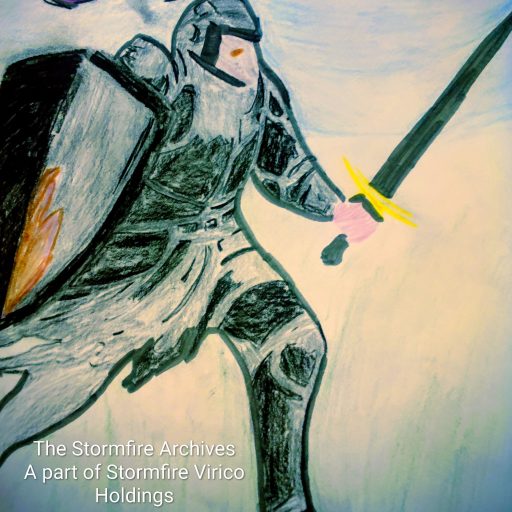
    Copyright Note© 2025 E. L. Hewitt / Stormborne Arts. All rights reserved.Unauthorized copying or reproduction of this artwork and text is prohibited.

    Thank you for reading.

    Futher Reading

    Rægenwine’s Inn: A Gathering of Legends

    The Law and the Storm

    The Prophecies and Tales of Taranis Unfolded

    Ancient Magic and Myth of the Stormborne

    Chronicles of Draven

    The Chronicles of Drax

    Join the Adventure in Tales of Rayne’s Universe

  • Celebrating Calan Gaeaf: A Nod to Welsh Heritage

    Celebrating Calan Gaeaf: A Nod to Welsh Heritage


    As I mentioned yesterday, much of what is now England. Was once Welsh land so as part of today’s celebrations,. I give a small nod to my Welsh roots and the history that shaped these lands.


    I’d like to wish everyone a Calan Gaeaf hapus, also known as a Happy First Day of Winter!


    To many Christians, it’s celebrated as All Saints’ Day. But whatever name you know it by,. Take a moment to enjoy the turning of the season and stay safe as winter begins.

  • Galan Gaeaf Celebrations: History and Superstitions

    Galan Gaeaf Celebrations: History and Superstitions

    Nos Galan Gaeaf Hapus

    During Roman Britain, people celebrated a festival very like Samhain it was called Galan Gaeaf.


    When the Romans invaded England, they began to see its celebrations blend with their own traditions:

    Feralia a Roman festival to honour the dead, sharing the same reverence for ancestors.

    Pomona a Roman celebration for the goddess of fruit and trees. which gave rise to the tradition of bobbing for apples.

    Galan Gaeaf is an Ysbrydnos a spirit night. when the veil between worlds thins and spirits walk the earth.
    The term first appears in literature as Kalan Gayaf. In the laws of Hywel Dda, and is related to Kalan Gwav.


    In Christian tradition, it became All Saints’ Day, but for those who still celebrate Calan Gaeaf. It remains the first day of winter a time of endings, beginnings, and remembrance.

    Let us not forget our past our warriors, our farmers, and the land itself that gives us life.

    Ancient Traditions

    As a harvest festival, farmers would leave a patch of uncut straw. Then race to see who can cut it fastest. The stalks were twisted into a mare, the Caseg Fedi.


    One man would try to sneak it out in his clothes. If successful, he was rewarded; if caught, he was mocked.

    Another tradition, Coelcerth, saw a great fire built. Each person placed a stone marked with their name into the flames. If any name-stone was missing by morning, it was said that person would die within the year.


    Imagine the chill of dawn as people searched the ashes for their stones!

    Then there was the terror of Y Hwch Ddu Gwta. The black sow without a tail and her companion, a headless woman who roamed the countryside. The only safe place on Galan Gaeaf night was by a roaring hearth indoors.

    Superstitions were everywhere:
    Touching or smelling ground ivy was said to make you see witches in your dreams.


    Boys would cut ten ivy leaves, discard one, and sleep with the rest beneath their pillows to glimpse the future.


    Girls grew a rose around a hoop, slipped through it three times. cut the bloom, and placed it under their pillow to dream of their future husband.

    It was also said that if a woman darkened her room on Hallowe’en night and looked into a mirror. Her future husband’s face would behind her.
    But if she saw a skull, it meant she would die before the year’s end.

    In Staffordshire, a local variation involved lighting a bonfire and throwing in white stones . If the stones burned away, it was said to foretell death within a year.

    Food and Feasting

    Food is central to the celebration. While I don’t make the traditional Stwmp Naw Rhyw. a dish of nine vegetables I make my own variation using mixed vegetables and meat.

    There’s little real difference between the Irish Gaelic Samhain and the Welsh Calan Gaeaf.


    Each marks the turn of the year the death of one cycle and the birth of another.


    Over time, every culture left its mark: the Anglo-Saxons with Blōdmonath (“blood month”). Later Christian festivals layered upon the old ones.

    The Borderlands of Cheslyn Hay

    I was born in a small village called Cheslyn Hay, in South Staffordshire. WHhich I think is about five miles from what the Norse called the Danelaw, the frontier lands.


    Before the Romans came, much of Staffordshire and indeed much of England was part of ancient Welsh territory.
    Though little is known of this period, imagination helps fill the gaps between the facts.

    The Danelaw was established after the Treaty of Wedmore (878 CE). Between King Alfred of Wessex and the Viking leader Guthrum.

    It divided England roughly from London northwards, trailing the Thames, through Bedfordshire, along Watling Street (A5), and up toward Chester.

    Watling Street the old Roman road that passes through Wall (near Lichfield). Gailey was often described as the de facto border between Mercia (to the west) and the Danelaw (to the east).

    Cheslyn Hay lies just west of Watling Street, near Cannock and Walsall. Placing it right on the edge of Mercian territory within sight of Danelaw lands.
    Because of that proximity, the area would have been influenced by both sides.


    Norse trade routes and settlers passed nearby, along Watling Street and the River Trent.


    Villages like Wyrley, Penkridge, and Landywood show both Old English and Celtic/Norse roots.

    It’s easy to imagine that my ancestors have traded or farmed alongside Norse settlers. after all, many Vikings were farmers too.


    Part of my family came from Compton and Tettenhall Wood. Where a local battle is still spoken of today; the other side from Walsall.


    Archaeological finds near Stafford and Lichfield suggest Viking artefacts and burial mounds, linking the landscape to that history.

    So while Cheslyn Hay wasn’t technically within the Danelaw. It stood upon the Mercian frontier what I like to call “the Border of the Ring” . where Saxon, Norse, and Brythonic traditions once met and mingled.

    My Celebration Tonight

    As I live in a flat, I’ll light a single candle instead of a bonfire. Cook a small feast vegetables and pork with a potato topping.


    For pudding, I’ll have blueberries, strawberries, and banana with an oat topping and warm custard.


    I’ll raise a glass to my ancestors and set a place at the table for any who wish to join.

    Thank you for reading.
    Nos Galan Gaeaf Hapus

  • Samhain: The Veil Between Storms

    Samhain: The Veil Between Storms

    An abstract painting featuring concentric arches in a variety of colors, including purple, blue, green, and brown, creating a layered effect.
    A vibrant, abstract depiction of layered arcs in various colors, symbolizing the interconnectedness of realms during Samhain.

    By E.L. Hewitt Ancient Magic and Myth of the Stormborne

    When the nights deepen and the last harvest fades, the air thickens with memory.


    The Celts called it Samhain the turning of the year. When the veil between living and spirit thins to a breath.

    In the Stormborne lands, it was known as The Veil Between Storms. A night when thunder sleeps, and whispers rise in its place.


    The old fires were lit not for warmth, but to guide the ancestors home.

    Ritual of the Returning Flame

    At dusk, light a single candle or hearth flame.


    Place it near an open window or door.
    Whisper the names of those who walked before you kin, friend, or forgotten soul.
    Then say:

    “The storm remembers, and so do I.”

    Let the flame burn through the hour, then bury its wax or ashes in the soil before dawn.


    It is said that the ground carries those names to the deep roots of the world.
    where the Stormborne keep their watch.

    Offerings and Symbols

    Rowan berries for protection.

    Salt for cleansing.

    Apples sliced and shared to honour the cycle of life and death.

    Mist water or rainwater collected on the night itself the Tear of the Storm.

    Lore and Reflection

    To the Romans, Samhain was superstition.
    To the Stormborne, it was a covenant proof that nothing truly ends, only changes form.
    They spoke of a wind that carried voices across centuries.
    of ancestors who stood unseen beside the cairns, listening for thunder.

    “All storms are echoes,” they said,
    “and the dead are never gone — only waiting for the next sky.”

    So when you hear rain on the stones or wind through the birch,
    pause and remember.
    You are standing in the same breath that moved your ancestors.
    The storm still knows your name.

    Copyright Note

    © 2025 E. L. Hewitt / Stormborne Arts. All rights reserved.
    Unauthorized copying or reproduction of this artwork and text is prohibited.

    Thank you for reading.© 2025 Emma Hewitt / StormborneLore. All rights reserved.Unauthorized copying or reproduction of this content is prohibited.

    If you enjoyed this story, like, share, or leave a comment. Your support keeps the storm alive and the chronicles continuing.

    If you want to read more about Lore please see Ancient Magic and Myth of the Stormborne