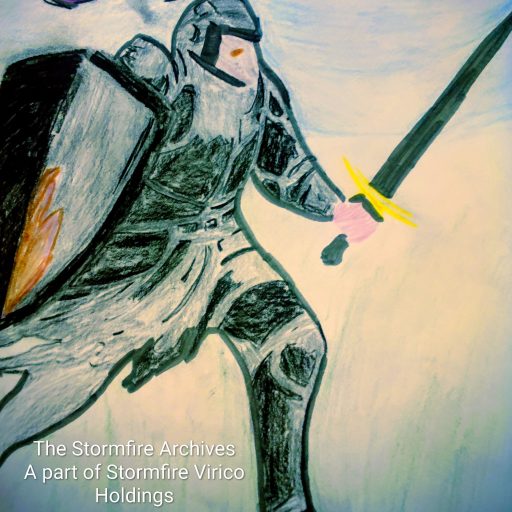
The forests north of Emberhelm were not empty. They whispered in the cold leaves rustling without wind, branches creaking as if bearing witness.
Every step of Taranis’s horse cracked frost from the dead undergrowth, and in the darkness, unseen eyes marked his passage.
The Black Shields had grown in only a handful of days. Seven now a band stitched together from thieves, deserters, exiled warriors, and one woman with hair like raven feathers whose blade was sharper than her tongue. She called herself Brianna , and unlike the others, she did not flinch when Taranis looked at her.
They camped in the hollows where no light could reach. They moved before sunrise, leaving only cold ashes behind, and they spoke little, except for the soft murmur of plans and the low hum of old battle songs.
Their first strike had been for food. The second, for vengeance. The third would be for a message, not just for them but the starving.
Bryn Halwyn a hill fort the Romans had claimed but not yet reforged in their own style. Its high earthwork walls crouched like a sleeping beast above the winding road. That road was crawling now with supply wagons, the torchlight of the guards bobbing like fireflies in the mist.
Taranis’s voice was a low growl “Shields black. Faces darker.”
The Shields moved as one, melting into the tree line. Arrows hissed from the dark, the first taking a Roman through the throat before his shout could leave his mouth. The second dropped a driver from his cart, spilling barrels into the mud.
Then came the torches. They arced through the air, their fire licking greedily at wagon covers, rope, and dry straw. Flames climbed fast, reflected in the wide eyes of panicked mules.
Taranis was already moving. A shadow at the edge of the firelight, blade flashing, he cut through the first guard and didn’t stop. The air stank of blood and burning oak. The Romans shouted in their clipped tongue, but their formations shattered in the chaos.
By dawn, the road was empty but for the smell of wet ash and a single storm-sigil burned deep into the dirt where the wagons had stood.
When they were gone, the crows came, hopping between the blackened wheels and picking at the dead.
That night, beside a hidden fire, the Shields feasted on stolen bread and salt pork. Kerris leaned across the flames.
“What now?” she asked.
Taranis stared into the heart of the fire until his eyes stung. “We keep going until there’s nothing left to take. Or until they come for me.”
Kerris smirked. “And if they do?”
He smiled without warmth. “Then they’ll find the storm waiting.” he replied with a grin
From the outer wall, Taranis could taste the storm before it broke sharp on the air, heavy in his bones. The valley below was black save for the faint glint of torchlight far beyond the river. The strangers from the ridge had come at last.
“They’re not raiders,” Drax said, joining him at the wall. “Too few for a siege. Too disciplined for a skirmish.”
“Too confident to live,” Taranis replied, though the set of his jaw told another story.
By the time the first horn blew, the outer gate was already under assault. Not a roar of chaos, but the steady, hammering rhythm of a trained force. Boldolph and Morrigan were first to meet them teeth bared, fur bristling, their snarls rolling over the walls like distant thunder.
Then the sky tore.
Pendragon and Tairneanach came from the dark like living fire. Wings swept low, scattering the first wave of attackers into the river. For a heartbeat, the night belonged to Emberhelm.
But then a cry from the inner courtyard.
Nessa, blade in hand, burst from the shadows. “Caelum’s chamber is empty!”
Taranis didn’t think he moved. Past the gate, through the melee, cutting down the enemy commander’s guard one by one until steel rang on steel. The man was quick, his armour unfamiliar banded metal, curved like river reeds, not the crude plates of the hill tribes. A shadow of Rome in the making.
Behind them, the wolves fought on. Boldolph took a spear to the ribs and kept moving. Morrigan’s howl was the last thing many would hear before the river claimed them.
Inside the sacred circle, Lore’s voice rose over the clash an old chant to bind the enemy’s will. Draven tried to hold the stones, his hands trembling against the carved runes. Rayne was nowhere to be seen.
The duel was short and brutal. Taranis drove his blade through the man’s chest, wrenching it free as lightning split the sky. But in that moment, the circle of stones shook. One the thirteenth stone cracked down its face with a sound like the earth breaking.
Pendragon roared once more, then wheeled away into the storm. Tairneanach followed. Neither would be seen again.
When the gate finally closed, the field beyond was strewn with the dead ours and theirs. Boldolph lay on the bridge, Morrigan beside him, the river taking their last breath.
And in the quiet after, Caelum was found untouched, but with a strip of strange iron tied to his crib. A mark, a warning, or a promise.
Taranis stood in the ruins of Emberhelm, rain running from his cloak, watching the storm move east.
“I will find who brought them to our gates,” he said.
From the shadows, Rayne’s voice answered, almost too soft to hear. “You won’t have to look far.”
Battles became rare. Raids grew smaller, born less from conquest and more from desperation. The crops suffered under strange seasons. Hunger took more than steel ever could. But with hardship came strange progress sharper tools, tighter village bonds, cleverer defences. Old powers shifted. The land quieted, not in peace, but in waiting.
And in that uneasy quiet, Taranis was content.
For the first time in years, he did not lead an army. He pursued a girl instead one with a scar beneath her eye and a laugh like war drums. She gave as good as she got, and that delighted him. The village wives said she would either tame him or kill him. The bards were divided on which would be the better story.
Meanwhile, I, Drax, his brother by blood and blade, walked a different path. I raised my people among the hills and rivers of Caernath. Children on hips, grain in hand, my wife laughing in doorways. I had earned my peace, or so I believed.
Lore, always the wisest of us, had vanished into his libraries. He said little, but he read much stars, omens, bones, spells. His son was growing fast, and Lore spoke often of unity, of law, of councils instead of kings.
Even Draven kept to himself in those days, unsure of where to cast his loyalty. And Rayne, well… Rayne’s silence was never a good sign.
Then the rumours came.
Another village, wiped clean. A warlord found burnt and broken, no enemies in sight. Smoke and whispers. They say a giant walked the battlefield, crowned in fire and storm. One witness swore she saw a great horned beast at his side. Another swore it was a dragon, wings spread across the sky like nightfall.
The name on their tongues? Taranis.
And with his name, the same plea echoed once again from the mouths of elders, farmers, and war-chiefs alike: “Take the crown.”
He refused. For the thirteenth time.
No matter their offerings gold, land, blood-oaths he turned his back on kingship. He called no banners. Built no fortress. No throne. Yet still he came when battle called. He turned tides, struck down tyrants, disappeared again into wind and legend.
And so, we formed the Ring not a court of nobles, but of equals. Thirteen warriors, leaders, seers, and voices of the old ways. It stood for balance, for judgment, for law older than any written word. At its centre: a circle of sacred stones, each carved with the oath of Stormborne.
And there, in that ring, Taranis spoke not often but when he did, the skies listened.
We thought we were building something unbreakable.
But we were wrong.
Because while we looked outward at the world beyond the hills, a darker storm gathered within us. In the silence of Lore’s spells, in the smile behind Rayne’s eyes, in the omens Draven refused to speak aloud.
The Thirteenth Ring was strong. But it only took one brother’s betrayal to crack the stone. And so the storm began to turn inward.
“Where’s the mother?” I asked.
“Her village was attacked. They slaughtered her while she screamed my name,” Taranis said.
The circle of stones stood solemn beneath a heavy sky bruised with gathering storm clouds. Within the sacred ring, thirteen seats carved with ancient runes and oaths bore silent witness as the brothers gathered once more.
Taranis sat with the weight of years pressing upon him, the child cradled carefully in Drax’s strong arms a fragile ember amidst the gathering darkness. The air was thick, charged with the unspoken dread of a prophecy unfolding.
Lore was the first to break the silence, stepping forward with measured grace. His voice was calm but sharp as flint, each word deliberate and coldly reasoned.
“Brother,” Lore said, eyes fixed on Taranis, “you speak of betrayal as if the serpent has already struck. Who do you suspect? Who harbors this poison within our bloodline?”
Rayne’s lips twitched into a mocking smile, his gaze a knife’s edge glinting in the half-light.
“Perhaps,” Rayne replied smoothly, “the betrayal lies not in our veins but in the stubbornness of one who refuses the crown. The storm we fear may well be born of his silence.”
Draven shifted uneasily on his stone, fingers twisting nervously as he swallowed hard.
“I… I cannot imagine we would turn against our own,” Draven stammered. “We are brothers forged in battle. Our oaths hold us true.”
Taranis’s gaze snapped sharply to Draven, eyes burning with bitter warning. “Blood is thicker than loyalty,” Taranis said quietly, “but fate is the thinnest thread of all easily severed, and often broken by the weakest hand.”
I stood from my seat, the strength in my voice like a hammer striking an anvil. “I swear to all here, I will raise this child as my own, guard him with my life. No harm will come to him under my watch.”
Rayne’s eyes narrowed dangerously. “Loyalty is a coin with many faces, brother,” Rayne said softly, stepping closer. “What of your people? Your wife and child? When the scales are tipped, whose cries will you hear first?”
Lore raised a hand, tracing the worn runes on his stone seat with thoughtful fingers.
“We stand at a crossroads. The old gods grow silent; new faiths rise from the south and east. It is no betrayal to seek survival. Perhaps adaptation is the true path.”
Taranis’s jaw clenched, muscles taut with anger and grief. “Survival without honor is death,” he growled. “One of you will fracture this Ring. When that stone breaks, the whole will crumble. Mark my words.”
A sudden gust of wind swept through the circle, rattling the ancient stones like a voice from the past. The child stirred in my arms, a small cry cutting through the tension like a knife.
The brothers’ eyes flickered to the babe innocent yet burdened with the weight of prophecy.
Silence fell again, thick with dread and unspoken accusations.
Rayne smiled then, colder and sharper than any blade. “So be it,” he whispered. “Let the storm come. I will be ready.”
From the edge of the circle, Draven lowered his gaze, his hands trembling. Behind closed eyes, fear and uncertainty warred in his heart a battle he dared not share.
Lore’s eyes scanned the sky, already darkening with rolling thunder. “We must decide soon,” Lore murmured, “for if we do not act, the fates will decide for us.”
Taranis stared out over the ring, his voice low but resolute.
“The time of peace is over. The Ring must hold or all we built will fall to ruin.”
He stood slowly, setting the child gently in my arms before turning toward the path out of the circle.
As he walked away, his figure a storm-shadow against the fading light, the brothers remained each wrestling with the secrets they now carried.
Told from Morrigan’s point of view. Lyrical, sorrowful, protective.
They buried him where the roots run deep, beneath a sky that would not speak. No stone, no name, no parting word just silence where the storm once stirred.
But we are not gods, nor men who flee. We are wolves, and wolves still see.
I smelled his blood. I heard his cry. I knew the truth, he did not die.
They called him beast, then cast him low but ash does not forget the glow.
So we dug with fang, with heart, with howl, we marked the traitors, bone and soul.
The wind rolled down from the mountain like a warning.
Three days had passed since the Trial by Fire. Taranis had been seen walking beside Grael’s warhorse, the shattered collar left behind, and the obsidian pendant still warm against his chest. But not everyone had accepted his transformation.
Some called him storm-marked. Others, cursed.
In a low tent near the edge of camp, whispers brewed.
“He defied the gods,” one said.
“Walked through flame and came out smiling,” said another.
“Flame tricks the weak. It blinds.”
The men gathered around the edge of the fire, cloaks pulled close against the creeping mist. They weren’t Grael’s most loyal, nor Solaris’s brothers. They were wolves without a pack mercenaries who had once served the Clawclan, now waiting for coin and chaos.
They didn’t wear Stormborne colours. Not yet.
“Tonight,” muttered Kareth, his eyes gleaming with spite. “We do what fire could not.”
A few nodded.
“He should’ve died in chains. He’s no warrior. He’s a beast.”
“And beasts don’t get reborn.”
They struck after moonrise.
Taranis had gone to the stream to refill his waterskin, alone as he often did, choosing solitude over celebration. The camp had begun to sleep. The guards were half-drunk from fermented berry wine.
They came from the trees six of them. Faces covered, blades drawn.
The first blow caught him across the shoulder, sending him to the ground.
“Traitor,” one hissed. “Freak.”
Taranis fought back with bare fists, striking like the wolf they feared but it was too many. A second dagger found his ribs. A club broke across his spine.
He fell to one knee.
They kicked him until he stopped moving.
Until his breathing went quiet.
Until he bled into the moss and stones.
They dragged the body to the far side of camp, past the standing stones, into a hollow in the woods where no firelight reached.
They left no markers. No words. Just dirt over his body and a curse on their breath.
“He walks no more,” Kareth said. “The storm dies in silence.”
And they returned to camp, blades clean, alibis ready.
No one would find him.
No one would weep.
They believed the gods had finally corrected their mistake.
But Taranis was not dead.
He dreamed of fire.
He dreamed of wolves.
He dreamed of the black dragon watching from above not with pity, but with fury.
And beneath the soil, his fingers twitched.
The early morning sin rose and grael could be heard hollering
“STORMBORNE WHERE ARE YOU?” grael shouted looking around for taranis
“He fled, he’s a coward” one of kareths men said smirking Wolves circled where his body lay leading them to discover taranis body still and cold.
Two days passed “we will find him tether him again no escape this time.” A warrior said as the wolves circled a piece of land “Hes dead grael” a Saris said “He deserves a real burying ” another said
The earth did not keep him.
Not on the first day, when silence reigned. Not on the second, when the wolves came. But on the third the wind changed.
At first, just a shift. A stillness. Then, a scent.
Morrigan arrived first. White fur gleaming against the ash-darkened trees. She paced in a wide circle around the hollow. Then came Boldolph, the black wolf, teeth bared, hackles raised.
They howled.
A low, haunting sound not grief. Warning.
Grael rode at once, followed by Solaris and half the guard. When they reached the hollow, they found the wolves digging. Claws tearing through dirt, paws flinging soil like rain.
Grael dismounted. Something in his chest cracked.
“Taranis…”
Solaris dropped to his knees beside the wolves, hands trembling.
“Help me dig!”
No one moved until the first scrap of cloth was exposed. A torn edge of tunic, blood-black, crusted to the earth.
Then the digging began in earnest.
It took three men and two wolves to drag the body out.
He was pale. Lips cracked. Blood dried to his skin. The obsidian pendant still hung around his neck, dirt pressed into the ridges.
One eye was swollen shut. Bruises ran like vines across his chest and arms.
But he was breathing.
Shallow. Ragged. But alive.
Solaris shouted for the healer. Grael stared at the boy like he was seeing a ghost.
“No burial mound,” he said softly. “No cairn. Just a shallow grave… and a storm too stubborn to die.”
The healer worked in silence, hands quick and firm. Crushed pine and fireweed were pressed into the wounds, stitched with thread made from gut and hope. Taranis didn’t speak. He didn’t need to. Each time the wind shifted, the wolves growled low in their throats, sensing the old power flicker just beneath his skin.
By nightfall, they had moved him to a guarded hut near the heart of camp. Four warriors stood watch. Grael gave orders that anyone who tried to enter unbidden would be struck down no questions asked.
Solaris sat beside the boy, wiping dried blood from his temple.
“You stubborn bastard,” he whispered. “Even the grave gave up on you.”
Taranis didn’t reply. But his eyes opened barely and fixed on the obsidian pendant now laid upon his chest.
Grael returned before moonrise.
“Speak if you can,” he said.
Taranis’s voice was a thread. “They buried me.”
“I know.”
“They didn’t even check.”
“I know that too.”
“Will you punish them?”
Grael paused. “I already have.”
He tossed something at Solaris’s feet a piece of fur, torn and bloodied.
“Kareth?”
“Gone,” Grael said. “Dragged into the trees by Boldolph. I don’t expect him back.”
Silence settled between them again.
“I should be dead,” Taranis murmured.
Grael nodded slowly. “You were.”
That night, as the wind moaned through the valley, a scout returned from the northern ridge.
“There’s smoke again,” she said. “Not ours. Not Clawclan. Something… older.”
She hesitated before finishing.
“There’s no fire. But trees are blackened. Stones cracked. Something passed through.”
“What kind of something?” Grael asked.
The scout swallowed.
“The kind that flies without wings.”
By dawn, word had spread. Taranis had survived. Taranis had risen.
They called it impossible. Witchcraft. Proof of corruption.
But some whispered another name.
Stormborne.
He stood the next morning.
Not for long, and not without pain, but he stood.
Morrigan watched from the doorway. She did not enter only nodded once, her red eyes gleaming.
“Even the wolves thought you were lost,” Solaris said.
“I was,” Taranis replied, voice raw. “But I heard them. In the soil. Calling.”
He stepped out into the morning light slow, stiff, but upright. The warriors turned to look. One dropped to a knee. Another stepped back in fear.
Grael met him near the edge of the camp.
“We’re riding soon. There are still wars to fight.”
Taranis nodded. “Then I’ll ride.”
“No packs,” Grael said. “No chains.”
Solaris handed him his cloak. “And no grave can hold you.”
Taranis turned to the standing stones, where birds now circled. Thunder echoed in the far hills.
He placed his palm against the earth the earth that had tried to hold him.
“Not today,” he whispered. “I am not done.”
In Emberhelm, the elders would speak of that day for generations.
The day the Stormborne rose from the grave. The day the wolves howled not for mourning but for warning.
And from that moment on, no one dared bury him again.
The trial fire still burned in the hearts of the warriors long after the flames had faded.
They left the stone circle at sunrise, the air thick with silence. Taranis walked unbound now, but still marked the collar firm around his neck, his wrists bruised, the pendant of obsidian pressing warm against his chest beneath the tunic Solaris had given him.
No one spoke of the dragon.
They didn’t need to. Its shadow had burned itself into every man’s memory.
By midday, they reached the edge of a sprawling war camp carved between high ridges and pine forest. Smoke rose from scattered fires. Grael dismounted first and gave the order for rest and supplies. Taranis stood nearby, posture straight, though his limbs ached from the days of trials and visions.
A hush followed him wherever he moved. Some men nodded. Others turned away.
One older warrior spat at his feet and muttered, “Dragon-kissed freak.”
Taranis didn’t respond. But Grael saw and said nothing.
Inside the central tent, the tension grew.
“You should exile him,” said Kareth, a clan captain with blood on his hands and ambition in his eyes. “Or bind him again. The men are talking.”
“This boy walks free after breaking formation, defying orders, and drawing the attention of beasts older than the gods?”
Grael looked up from the war map.
“Exactly. He walked through fire and survived. He fought off Clawclan while half my guard bled out in the dirt. He was named by a Seer. You want to leash him again? You do it.”
Kareth hesitated. “If he leads a rebellion, it’ll be your head.”
“No,” Grael said. “It’ll be his. If he earns death, he’ll find it. But if he earns something more, I won’t stand in the way.”
That night, Taranis sat near the outer fire, the pendant warm against his chest again. Solaris approached with a fresh poultice and a torn piece of roasted meat.
A growl echoed in the hills not wolf, not wind. Something deeper. Some warriors looked up. A few rose to check their weapons.
A young scout came running from the ridge.
“Smoke! North side. Something’s burning!”
They scrambled toward the hill’s edge and saw it.
A rival clan’s border camp was ash and ruin. No screams, no survivors. Only smoldering black earth and claw marks in the rock.
“Raiders?” Solaris asked.
“No,” Taranis said quietly. “It’s a warning.”
Grael joined them, silent, jaw tight.
Kareth was already shouting. “This is what he brings! The dragon follows him. Death follows him!”
“No,” Taranis said. “The dragon doesn’t follow me. It watches.”
“Same thing.”
Grael raised a hand. “Enough. We return to Emberhelm. There, the chieftains will decide what happens next.”
The journey to Emberhelm took two days. The stone fortress carved into the mountains stood stark against the dawn ancient, proud, watching the valley like a sentinel.
When they entered, the whispers turned to stares.
Children peeked from behind barrels. Elders crossed their arms. A group of shieldmaidens flanking the gate parted only after Grael rode forward and gave the sign.
Taranis dismounted, cloak billowing slightly behind him. No chains. No mask. Only the obsidian pendant.
In the Great Hall, the Five Voices of the War Council sat in a semi-circle.
Old warriors. Mothers of fallen sons. Leaders of lesser clans.
One stood Sern, a matriarch with fire in her eyes and silver in her braid.
“We saw the storm,” she said. “We saw the dragon’s wings. We heard the Seer’s cry.”
Another voice cut in a young man named Fenric, blood cousin to the boy Taranis had crippled.
“He’s cursed. He bled our kin, broke our laws, walked with beasts. Now you bring him here unbound?”
Grael stepped forward. “I bring you a warrior.”
“Not yet,” Sern said. “Not until the rite is finished.”
“What rite?” Taranis asked.
She pointed to the firepit at the centre of the chamber.
“You were bound by man. Now let the flame judge if you are bound by fate.”
They handed him a staff and stripped him to the waist. The collar remained. So did the pendant.
The fire was lit with dried hawthorn, wolf hair, and elder root.
He stepped into the circle.
“Do you claim name or no name?” Lady Sern asked.
Taranis raised his head. “I claim the storm.”
A gust of wind blew through the open doors behind him.
“Then speak your vow.”
Taranis closed his eyes.
“I was chained as beast. I was broken by man. But I rise not to rule only to walk free. I serve the flame, the wolves, the storm. If I break my word, may the dragon turn from me.”
He thrust the staff into the fire.
It did not burn.
Instead, the flame spiraled into the air and far above, the sky answered with a distant roar.
The hall went silent.
Lady Sern bowed her head.
“Then you are no longer beast. Nor slave. Nor tool.”
She placed her hand on his collar.
“From this day, you are Stormborne.”
She broke the collar with a hammer of bronze.
The pieces fell to the stone floor like the last chains of a life left behind.
Does that mean he’s free?” Solaris asked.
Taranis placed a hand to his neck, fingers brushing the worn ridge where the collar had once pressed deep.
“Or am I to be exiled?”
A hush fell again, broken only by the wind rustling through the pine above.
“Exile him,” came a voice from the gathered crowd, “and I will hunt him myself.”
All heads turned.
It was not Grael who spoke, nor one of the regular warband. It was a man cloaked in dark fur, standing apart from the others near the treeline scarred face, sun-dark skin, hair braided with bone. A chieftain from another clan.
“He bears the storm’s mark. He’s no beast. No slave. And not mine to cast out.” His voice was low, graveled with age and fire. “But if you send him away, don’t expect him to come back.”
Taranis didn’t flinch. His eyes locked on the stranger’s. He neither bowed nor raised his head. Just… endured.
Grael stepped forward.
“He’s not exiled,” the general said. “Nor is he yet free. The trial burned away the mask, but chains leave scars longer than flame.”
“And what is he now?” Solaris asked.
Grael looked to the warriors, the gathered villagers, the scouts and wounded men who had seen the dragon descend.
“He is Stormborne,” he said. “Named not by man, but by thunder. And while I draw breath, that name will be honoured.”
There was a ripple in the crowd not agreement, not rejection. Just change. Unease becoming belief.
Taranis turned to Solaris. “Then I stay?”
Solaris nodded. “If you want to.”
“I don’t know what I want,” the boy admitted. “I only know I’m still breathing.”
Beside him, the black scale the one left by the dragon was now strung on a simple leather thong, hanging from his belt like a forgotten relic. He touched it once, gently.
A woman stepped forward from the watching crowd. She carried no weapons only a clay bowl filled with ash and herbs.
“I came from the ridge when I heard the trial fire was lit,” she said. “If the dragon marked him, then his wounds must be sealed properly. Not with chains. With earth.”
She knelt before Taranis and dipped two fingers into the bowl. Ash and sage stained her fingertips. She reached up and slowly touched each side of his jaw where the mask had pressed hardest.
“You have walked through smoke,” she whispered. “Now rise through flame.”
Taranis stood, a little taller than before.
Grael gave a curt nod. “We break camp tomorrow. Clawclan still stirs in the lowlands. But the boy rides his own horse now. No packs. No tether.”
“And the collar?” Solaris asked.
Grael glanced at it now lying in the dirt.
“Leave it where it fell.”
As the crowd began to scatter, a new chant rose quietly from the younger warriors near the fire.
The campfire had burned low when Solaris approached the general.
Taranis knelt nearby, his wrists loosely bound, the bone collar still tight against his throat. The punishment mask lay beside him, waiting.
“Sir?” Solaris said cautiously. “Are we binding him again?”
Grael didn’t answer immediately. He watched the boy the blood-crusted bruises, the unspoken tension in his shoulders, the way his eyes never stopped scanning the shadows.
“He walks beside the horse now,” Grael said. “Not behind it. That’s earned.”
“But he’s still tethered?” solaris said
Grael nodded. “Until he earns trust with more than fire.”
Solaris stepped closer, lowering his voice. “And the food? He eats with us now?”
“He eats what he earns. No more. No less.” grael said
Taranis stirred then, lifting his head. His voice cracked as he spoke.
“Now I’ve got one foot in both worlds… the world of a chosen, and one of an outcast.” He looked at them both. “One move and I could be executed. The other move, and be honoured.”
Solaris winced as the mask was fitted back over the boy’s face.
“Why the mask again?” he asked.
“To remind him,” Grael said. “And to remind us.”
“Of what?”
“That chains and power aren’t opposites. They’re a balance.”
Taranis tried to move from grael and the other warriors tried to move his head so the mask wouldn’t go on as a dragon flew over head
“Put it on” grael ordered
“No I’m human just like you”
Taranis jerked back, blood still dried in the corners of his mouth. The dragon’s shadow passed again overhead, and something ancient stirred in his chest not rage, not fear, but refusal.
“I said no!” he growled, voice muffled but defiant.
Solaris stepped between him and the other warriors. “Wait. He’s not”
Too late.
One of the guards lunged forward, grabbing the mask. Taranis shoved back, throwing his shoulder into the man’s chest. The warrior stumbled, caught off guard by the boy’s strength.
Another grabbed his arm but Taranis twisted, slammed his elbow into the man’s face.
Blood sprayed.
Chaos erupted.
Three warriors tried to restrain him now. Grael did not move. He watched.
Taranis fought like a cornered wolf. Wild. Desperate. Silent.
The mask hit the ground and cracked in two.
When they finally wrestled him down, he was bleeding from the nose and lip, panting like an animal. His wrists were raw, eyes wild.
But he was smiling.
“You see me now?” he said through gritted teeth. “I’m not yours.”
Solaris stood frozen. The broken mask lay at his feet.
Grael finally stepped forward.
“Enough,” he barked.
The warriors pulled back.
Taranis didn’t rise. He waited.
“Let him up,” Grael ordered. “And don’t touch him again tonight.”
“But sir” a guard started.
“I said don’t.”
Grael looked down at the broken mask, then at the blood on Taranis’s knuckles.
“You broke it,” he said flatly.
“I’d break a hundred more,” Taranis spat.
Grael didn’t respond. Instead, he knelt.
“You want to be seen? Fine. Then let the clans see what you are.”
He picked up the shattered halves of the mask.
“You’ll wear no disguise. No shield. Not until you earn a new one.”
Taranis met his gaze. “Good.”
Grael stood.
“But remember this, boy there’s a cost to being seen. You can’t take it back.”
Taranis said nothing.
The dragon roared again in the sky.
Solaris knelt beside him later, whispering, “You’re going to get yourself killed.”
Taranis looked at the stars.
“Or freed.”
“What will it take for him to be freed?” Solaris asked
“Freedom for him? He crippled your brother, he killed a farmer, used by the gods themselves, stories say he killed a bird as a child and his village was killed before his exile freedom is a long way off. What do you say grael ?” A warrior asked
Grael remained silent for a long while. The fire crackled. Embers danced. “I say,” he murmured, “we’ve seen men freed for less… and killed for more.”
He tossed the shattered mask into the flames.
“If he was sent by the gods, then they’ll test him again. Until then, he walks. He bleeds. He earns.”
A warrior scoffed. “And when the next village sees that face?”
“Then let them decide,” Grael said. “Fear him. Pity him. Curse him. But they’ll see him without the mask. And so will we.”
Taranis didn’t flinch. He stared into the fire, as if daring it to speak.
Grael remained silent for a long while.
The fire crackled between them. Sparks drifted upward into the night, like fleeing ghosts. Taranis sat still, blood streaking his jaw, the collar tight around his throat. The broken mask lay shattered near the flames.
He stepped forward and tossed the mask into the fire. It hissed as it cracked deeper, flames licking the black bone.
A warrior scoffed. “And when the next village sees that face? He crippled a boy. His own kin say he’s cursed. What do we tell them?”
“Tell them the truth,” Grael replied. “He wears no mask because he broke it. He walks unchained because I said so. And if that offends them, they can challenge it by trial.”
Another man spat. “The Seer warned us he carries the fire without flame. You think a prophecy makes him safe?”
“I think,” Solaris said quietly, “he didn’t run when he could’ve. He fought. He stood. He bled beside us.”
Silence settled again.
Then Grael turned to his men, sweeping his eyes across the ring of warriors.
“Fine,” he said. “Let the clans decide. Those who want him gone, speak now.”
A few murmurs, but none stepped forward.
“Those who would test him, not as a slave, but as a warrior raise your blades.”
One sword lifted. Then another. And another.
Not all.
But enough.
Taranis watched them. His chest rose and fell slowly. The embers reflected in his eyes.
“So be it,” Grael said. “Tomorrow at first light, he joins the line. No chains. No mask. One trial. If he survives the boy becomes flame.”
A hush fell across the camp.
Solaris leaned down beside him. “You’ve got one shot.”
Taranis looked up, a flicker of defiance in his eyes.
“Then I’ll make it burn.”
The company reached the ancient ruins just after dusk.
Twisted trees clawed at the moonlight, their roots entwined with blackened stones. Smoke drifted from old hearth pits, and torches lined the perimeter of what once had been a stronghold now just skeletal walls and broken pillars.
They called it the Bones of Fire, where traitors, exiles, and monsters were judged in the old ways.
Taranis was unshackled but flanked by two guards. His collar still bit into his skin, and dried blood streaked his jaw. He walked unbound, but every step echoed like thunder. Warriors lined the central circle, murmuring. Some remembered his defiance. Others remembered the dragon.
At the heart of the ruins stood a black stone altar scorched by lightning, older than the clans themselves. Grael waited there, sword at his side, expression unreadable.
A Seer stood beside him the same woman from the fire, robed in bone and shadow.
“This place,” Solaris whispered, stepping beside Taranis, “is where they test souls.”
“I thought I already failed,” Taranis said, not looking at him.
“No. This is where they see if you can rise.”
The crowd hushed as Grael raised his hand.
“Taranis of no clan. Slave by judgment. Exile by blood. Chosen by storm or cursed by fire,” the general said. “You stand here not as a man, but as a question. The people demand an answer.”
The Seer stepped forward, her voice like wind through hollow bones.
“You are accused of rebellion, violence, and breaking the old order. But the gods remember your name. So the trial shall be by the elements by Fire, by Bone, and by Storm.”
Murmurs rippled through the crowd.
Grael gestured, and three warriors brought forth the tools: a flame bowl carved of obsidian, a bone blade wrapped in cords of sinew, and a weathered spearhead struck once by lightning.
“You will face each,” the Seer said. “If you fall, your death is justice. If you rise, you walk reborn.”
Solaris stepped forward. “He saved us. He held the line”
“And still the trial stands,” Grael said. “This is not for you, Flamekeeper. This is between him and the gods.”
Taranis stepped into the circle.
“I’m not afraid,” he said.
“You should be,” the Seer whispered.
They began with Fire.
Taranis knelt before the obsidian bowl. Flames danced without smoke. The Seer extended her hand.
“Reach into the fire. Take the coal. Speak no sound.”
He did.
Pain erupted, white and total, but he did not scream. The coal branded his palm. Smoke curled from his clenched fist but his jaw never broke. When he stood, the mark glowed faintly.
Next came Bone.
He was handed the blade and told to carve a single rune into his chest a mark of truth.
“Only the worthy know which symbol to choose,” the Seer said.
Taranis hesitated.
Then slowly, he pressed the blade to his chest and etched a spiral. Not of chaos, but of growth the same symbol the Seer had once placed in his hand. Blood streamed down his ribs. Still, he stood.
Then came Storm.
They placed him at the peak of the ruin, where the wind screamed like a thousand dead warriors. He had to face the sky and remain standing until the gods answered or until the storm broke him.
Lightning gathered. Thunder rolled.
The dragon came.
Not with flame, but with presence a black silhouette circling high above.
The campfire had burned low, all golden coals and wind-tossed ash, when Solaris approached the general.
Taranis knelt nearby, shoulders hunched. His wrists were bound, but not tight just enough to remind. The black collar still pressed against his neck like a verdict carved in bone. His mask, polished smooth and pitiless, lay beside him like a shadow waiting to return.
“Sir?” Solaris spoke softly. “Are we binding him again tonight?”
Grael didn’t respond at once. He studied the boy or whatever he was becoming with a gaze that weighed survival against prophecy.
“He walks beside the horse now,” Grael said. “Not behind it. That’s earned.”
“But still tethered?”
“Until trust is more than fire and fury.”
Solaris hesitated, then asked more plainly, “And the food? He eats with us now?”
“He eats what he earns,” Grael said. “He trains. He serves. He carries burdens. So we feed him as one of the line half rations until proven otherwise. If he bleeds for us again, the portions grow. But he’s no beggar. He earns it.”
Taranis stirred. His voice cracked when he spoke.
“Now I’ve got one foot in both worlds… the world of a chosen, and one of an outcast. One step wrong, and I’m whipped or worse. One step right, and they carve my name into stone.”
Solaris frowned. “But the mask…”
Grael stepped closer. He picked it up and turned it over in his hand.
“We remove it when he fights. When he trains. When he speaks with command. But in towns and camps?” He pressed it gently to the boy’s face. “It reminds him and us of what he was forged from.”
“Forged?” Solaris echoed. “Or broken?”
Grael didn’t blink. “Both.”
“And can he see through it?”
“Barely. But that’s the point. To teach him to listen more. Feel more. Trust the wind and the wolves.”
The fire cracked.
Solaris stepped back, watching as the leather straps were tightened once more.
“And when does it come off for good?”
“When the storm calls him by name,” Grael said.
“And if it never does?”
Grael didn’t answer.
The wind howled across the ridge sharp and ancient.
And far above, in the swirling clouds, something winged and watching passed through the sky without sound.