The Black Leaper soaring over the serene lakes of Chistlyn, embodying the spirit of freedom and magic.
They say that if you stand by the lakes of the Chistlyn at sunrise. Before the mist has fully lifted, before the birds dare to break the quiet you hear it.
A single, heavy exhale. Like the world itself taking a breath.
From the tree line emerges the Black Leaper. A spirit-steed older than the villages around Cannock Chase, older than the Forest Kings, older even than the Stormborne line.
Its coat is the colour of midnight after rain, slick and shifting like a storm cloud gathering its strength.
When it moves, the air warms with the scent of wet grass and pine sap. The ground trembles just enough to remind you that it is real.
Some say the Leaper was once a war horse belonging to a forgotten chieftain.
A beast so fiercely loyal that it refused to pass on when its master fell. Others whisper that it is no creature of this world at all. But a guardian born from the lake’s deepest waters, shaped from moonlight, fog, and old magic.
Whatever the truth, one thing is certain: the Black Leaper does not walk. It flies.
Witnesses speak of the thunder of hooves striking the earth for only a heartbeat. Before the creature rises, soaring over lakes and treetops in a single, impossible leap.
Many who see it feel a sudden pull in their chest . As if the horse carries every unspoken longing for freedom with it.
This artwork captures the creature in that moment between worlds. When the sun glows warm on its back, the wind twists its mane into wild ribbons. The forest watches in held breath as the guardian crosses the sky.
Some believe the Leaper appears only to those who feel trapped or lost. Others say it is a sign of protection, a reminder that the path ahead is wider than it seems.
Authors Note : Chistlyn is the Anglo Saxon name for what is now known as Cheslyn Hay.
For the artists or those interested. The drawing was drawn using Ohuhu Markers on A4 plain paper.
I wonder if the Black Leaper passed you by, what would it be urging you to run toward. Or away from?
Thank you for reading, if you have enjoyed this story or like the illustrations. Please support me by liking and follow.
“Father, what does exile mean?” Julius asked, peering up with wide, uncertain eyes.
Before Drax could answer, Marcus spoke first, his tone full of the confidence only youth could forge. “It means Father can kill Uncle Taranis. It means Uncle has no home, and should be on his island. Right, Father?”
The fire crackled. For a long moment, Drax said nothing. The weight of the question pressed heavier than the armour across his shoulders.
“No, Marcus,” he said at last, voice low. “Exile does not always mean an enemy. Sometimes it means Rome has no place for a man who refuses to kneel.”
The boys exchanged a glance, uncertain. Julius frowned. “But you serve Rome. Uncle does not.”
Drax looked out toward the dark treeline where his brother had vanished. The smoke twisting like ghostly fingers into the grey sky. “I serve peace,” he said. “Rome just calls it something else.”
“Will you fight him, Father?”
Drax’s jaw tightened. “If I must. But I hope the gods grant me a choice before that day.”
Marcus turned back to the fire, his expression thoughtful. “Uncle said the storm’s already here.”
“Aye,” Drax murmured, his gaze distant. “And sometimes the storm wears a familiar face.”
Thunder grumbled again, rolling through the valleys. Drax drew his cloak closer. Feeling the weight of legacy settle across him the burden of blood and oath, of brotherhood turned to legend.
Somewhere beyond the hills, Taranis walked free.
Drax, bound by Rome and duty, wondered who among them was truly exiled.
Taranis’s journey south, inspired by Stone Age foraging along the Severn Valley in ancient Worcestershire.
As Taranis wandered deeper into exile, he crossed the ancient paths of what we now call Worcestershire a land shaped by rivers, caves, and sacred woodlands. The Severn Valley offered not only shelter, but food: fish from clean waters, herbs from wild meadows, and woodlands dense with fuel.
This meal marks a turning point when hunger gave way to skill, and the boy began to understand the land, not fear it.
Whole small fish (e.g. trout, sardines, or mackerel) 2 £2.00–£3.00 Lemon or vinegar (optional) 1 tbsp £0.10 Salt ¼ tsp £0.05 Fresh herbs (wild garlic, rosemary, thyme) 1 tbsp £0.20 Oil or animal fat 1 tsp £0.05 Flatbread or root mash (optional side) — £0.20–£0.50
Estimated Total Cost: £2.60–£4.00 (Serves 2 — ~£1.50–£2.00 per portion)
Stone Age version:
Catch fish from stream or river. Clean and season with gathered herbs and a dash of salt.
Wrap in leaves (dock, burdock) or skewer whole and cook over embers, turning slowly.
Serve with roasted roots or foraged greens.
Modern method:
Preheat grill or pan. Clean fish, season inside and out with herbs, salt, and lemon/vinegar.
Lightly brush with oil or animal fat.
Grill for 4–5 mins per side or until crisp and flaky.
Optional lemon/vinegar: Aids digestion and preservation
🔄 Ingredient Substitutions Fish → firm tofu (vegan) or mushrooms (grilled)
Wild herbs → store-bought thyme, parsley, dill
Side: roasted parsnips or potatoes for a modern twist
📖 Suggested Story Pairing Best paired with: “The Hollow Howl” or “The Crossing” (a future post of Taranis crossing into new lands) moments when survival becomes instinct, and fear becomes focus.
This is the meal of transformation not feasting, but claiming life back one bite at a time. The boy who was cast out now learns to live.
The island smoldered beneath a grey dawn, volcanic ash drifting in spirals that mirrored the labyrinth of the Black Shields’ training paths. Taranis Stormborne stood atop a jagged cliff, chains long gone, his shadow cast over the men who moved like echoes of his command.
“Strength is patience,” he reminded them, voice low but unyielding. “Silence is more than absence; it is a weapon.”
The men obeyed, their movements precise, their eyes alert to every change in wind or light. Exiles, criminals, and freed soldiers had become something else entirely a force of quiet purpose. In the flickering smoke of the island’s vents, Taranis traced lines in the sand, marking the future with symbols only they understood.
A scout returned, breathless and wide-eyed. “Rumors, Lupus… Rome speaks of shadows in the hills, whispers of an army unknown.”
Taranis nodded, the storm within him mirrored in the sky above. Lightning tore across the horizon. “Let them whisper,” he said. “Every shadow will remind them: the storm bends, but it never breaks.”
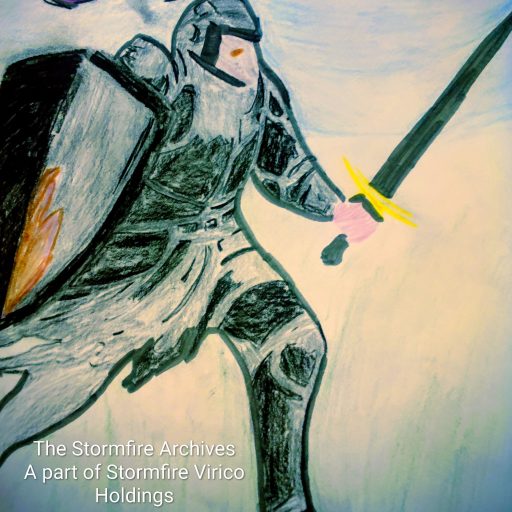
Artistic representation of Lore Stormborne, featuring intricate patterns and vivid colors, symbolizing his connection to ancient powers and storms.
Rain fell soft upon Emberhelm not in sheets, but in threads, weaving through the night like strands of memory. Each drop whispered against the walls, tracing paths down stone carved before empires rose. The air smelt of iron, damp moss, and prophecy.
Lore moved through the Hall of Echoes with deliberate silence. The torches burned low, their flames bending in strange rhythm, as though swayed by unseen breath. Beneath the central arch lay the dais of oath and upon it, the gold ring.
It shimmered faintly in the half-light, a pulse of life within metal. Not the glow of firelight, but of something older.
Lore hesitated before it. His reflection warped in its surface his eyes darker, sharper, his face marked by the faint runes of bloodline and burden. “The ring of storm and oath,” he murmured. “The bond of the five.”
He reached out. The moment his fingers brushed it, the hall sighed.
A low hum filled the air not from stone or wind, but from within.
Then came the voice.
“Brother…”
The word was barely sound more vibration, more memory. It coiled through him like smoke through glass.
“Taranis…” Lore whispered, his voice trembling. The name itself seemed to awaken something. The torches guttered. The shadows around the walls began to move not randomly, but with purpose, forming the faint outlines of chained figures, of men bowed beneath lightning.
The ring pulsed again, once, twice. Gold bled to storm-grey.
“Show me,” Lore said. “Show me where he walks.”
The pulse deepened and suddenly, the hall was gone.
He stood in mist. Iron gates loomed before him, slick with rain. Beyond them, sand bloodstained and torn an arena. He heard the roars of lions, the clash of blades, the chanting of a foreign crowd. And there, in the centre, Taranis bare-armed, chained, and unbroken. His eyes like stormlight.
“Still he stands,” Lore breathed.
The vision shattered like glass beneath a hammer. He was back in the hall, gasping, knees to the stone floor. The ring still glowed in his palm, its pulse slowing to match his heartbeat.
He knew then: his brother lived but the bond between them had stirred something greater. The old powers beneath the land the ones the druids had whispered of were waking again.
A new sound reached him. A voice, aged as winter bark.
“The ring calls the storm again,” said Maeve, the seer. She stepped from the shadowed archway, her staff crowned with raven feathers and iron charms. “You’ve felt it too the pulse of the deep earth, the cry of the stones.”
Lore rose slowly. “He lives. I saw him. Rome cannot hold him.”
Maeve’s gaze was sharp, knowing. “No but when the storm returns, it will not come gently. Bonds such as yours were not forged for peace. The land remembers its oaths, Lore Stormborne. The blood remembers. And blood always calls for blood.”
He turned toward the open window, where thunder rolled faintly beyond the hills. The storm clouds were gathering again not yet upon them, but coming.
“Then let it come,” he said softly. “We are Stormborne. We do not kneel to the Empire. We endure… and when the sky breaks, we rise.”
The gold ring flared once more, bright as lightning and somewhere far to the south, in a Roman cell slick with rain, Taranis felt it too.
The rain had followed them south. Turning the clay of Staffordshire into a sucking mire that clung to boots and hooves alike.
The Romans marched as though it were paved stone beneath them, shields squared, helmets gleaming dull beneath the Grey sky. Between their ranks, chained at wrists and neck, walked Taranis Storm.
Every step tore at his ankles where the iron bit into flesh. Every breath was smoke and ash and memory. Behind him lay the broken circle of stones, the Black Shields scattered or slain. Ahead, only Rome.
The villagers came out to see. From hedges and low doors they watched the prisoner dragged past their fields, whispers coming like crows. The Stormborne, Ring-bearer. Betrayed. Some spat into the mud, others lowered their eyes.
A few, bold enough to remember, lifted hands in the old sign of the ring. when the soldiers were not looking.
At the front of the column the standard rose a square of blue cloth. That had been painted with a face in iron helm, cheeks daubed red with victory.
The mask grinned as though in mockery. The Romans called it their mark of order. To Taranis it was something else: the face of the empire that had swallowed his people.
He fixed his gaze on it as they dragged him past the rise where the heath opened wide. He thought of Boldolph and Nessa, of the wolf in the trees. He remembered the cairn and the promise beneath the oak. The chain jerked and he stumbled, but he did not fall. Not yet.
The centurion rode beside him, face shadowed beneath his crest.
“You see the banner, barbarian? Rome wears a smile even when it breaks you.”
Taranis lifted his head, eyes dark as storm clouds. “Smiles fade. Storms do not.”
The soldiers laughed, but unease rippled through their ranks all the same. For the wind carried his words across the heath, and even bound in chains, Taranis Storm did not sound broken.
By dusk the column reached the ridge where the woods thinned and the land opened to heath. Smoke already rose ahead straight, disciplined pillars from square fires. The marching camp of Rome.
The soldiers moved with the same precision as their shields: digging trenches, raising palisades, planting stakes.
Every camp was a fortress, stamped into the soil like a brand. The ground of Cheslyn Hay, once quiet pasture, now bristled with iron.
Taranis was dragged through the gate cut into the new rampart. The ditch still stank of wet clay, the sharpened stakes gleamed with fresh sap.
Inside, order reigned the tents in perfect rows, fires burning with measured rations, horses tethered and groomed. No laughter. No chaos. Just Rome.
The banner with the painted helm was planted at the camp’s centre. Beneath it the centurion dismounted, barking orders in clipped Latin. Slaves scurried to fetch water and oil for the men.
A scribe scratched notes into a wax tablet, not once looking up at the prisoner he recorded.
Taranis stood, wrists bound, staring at the banner. Its painted grin leered back at him, mockery frozen in blue and black.
Around him the soldiers muttered in their tongue some calling him beast, others trophy.
A soldier shoved him down beside the fire trench, close enough to feel its heat on his raw wrists.
“Sit, storm-man. Tomorrow the legate will decide whether you march to Wroxeter or Luguvalium. Either way, Rome will bleed you for sport.”
The word spread through the camp: arena.
Taranis lowered his head, though not in submission. He closed his eyes and listened. Beyond the walls of the camp, the wind still carried the smell of rain-soaked earth.
The whisper of fox and owl. And beneath that, deeper still, a memory: wolves circling, dragons wheeling, the voice of the tree.
Rest, child of storm. The road is not ended.
When he opened his eyes again, the firelight caught the glint of iron. Not on the chains, but in his gaze.
Even in Rome’s order, storm can find a crack. And cracks spread.
The fire burned low, and the camp settled into its rhythm. As guards pacing in pairs, dice rattling in the barracks-tents, the low cough of horses in their lines. The rain had eased, leaving the air damp, heavy with smoke.
Taranis sat in silence until he felt movement beside him. A figure shuffled forward, ankles hobbled, wrists bound with rope rather than iron. The man lowered himself onto the earth with a grunt.
“Storm of Emberhelm,” he rasped in Brythonic, his accent from the northern hills. “I thought the tales were lies. Yet here you sit, same chains as me.”
Taranis turned his head. The prisoner was older, his beard streaked white, his face cut with old scars. One eye clouded, blind. The other burned sharp as flint.
“And who are you,” Taranis asked, “that Rome keeps alive?”
The man chuckled, though it ended in a wheeze. “They call me Marcos now. Once, I was Maccus of the Ordovices. I led men against the Eagles before your birth.
Rome does not waste good meat. They break us, bind us, and sell us to the sands. I’ve fought in two arenas. Survived them both.”
Taranis studied him. The weight of years hung from his shoulders, yet there was steel still. “Then you know what waits.”
“Aye.” Marcos lifted his bound hands, showing knotted scars across his forearms. “The crowd roars for blood. Some fight once and die. Some fight a hundred times and die slower. But all die.”
The fire popped. Sparks leapt into the dark.
Taranis leaned closer, his voice low. “Not all. The storm endures.”
Marcos’s eye narrowed. “You think to outlast Rome?”
“No.” Taranis’s mouth twisted into something not quite a smile. “I think to break it.”
For the first time, the older man was silent. He searched Taranis’s face, weighing his words. Then he gave a slow nod.
“If you mean what you say, Storm of Emberhelm, then I’ll stand at your side when the time comes. Better to die tearing the eagle’s wings than caged beneath them.”
Chains clinked as they shifted nearer the fire. Around them the camp slept, unaware that in its shadow two sparks had met. Sparks that yet become flame.
The guards had thrown scraps of barley bread to the captives, little more than crusts softened with rain. Most fell on them like dogs, clutching and hiding their share as if it were treasure.
But when the boy, thin as a willow switch, glanced to where Storm sat, his brow furrowed. The man beside him Marcos noticed at once.
“What’s wrong, lad?” the old warrior asked, shifting his chains.
The boy’s voice was a whisper. “Why haven’t they fed him?” His gaze fixed on Taranis, who had taken nothing. His hands still resting on his knees, his eyes far away. as if listening to some thunder only he hear.
Marcos gave a grunt. “Rome plays its games. They starve the strong first. Weak men die quick, but a beast like him…” He lowered his voice. “They want to see how long he lasts. How much fury stays in him when his belly is empty.”
The boy clutched his crust but then held it out with trembling fingers. “He should eat.”
Taranis turned his head at last. His eyes, Grey as storm clouds, fell on the offering. He did not take it. Instead, he placed his bound hand gently over the boy’s.
“Keep it,” he said. His voice was rough, hollow from thirst, yet steady. “Storms do not starve. But you” he pressed the bread back into the boy’s palm, “you must grow.”
For a moment, silence hung around them. The boy swallowed hard, then nodded, biting into the bread with tears in his eyes.
Marcos watched, the ghost of a smile tugging at his scarred face. “A storm, indeed,” he muttered.
Above the camp, thunder rumbled faintly though the sky was clear.
“I’m fine ” Taranis smirked seeing a whip in someone’s hand and wood
“What’s going on?” The boy asked
The guard with the whip dragged a stake of green wood across the mud, planting it near the fire trench. Two soldiers followed, uncoiling rope and hammering pegs into the ground.
The boy’s eyes widened. “What’s going on?” he whispered, clutching what remained of his bread.
Marcos’s face hardened. “Discipline.” His single eye slid to Taranis. “Or rather a spectacle.”
One of the soldiers smirked. “The barbarian thinks himself storm. Tonight, he learns Rome is thunder.”
They hauled Storm to his feet. Chains clattered, mud spattered across his bare shins. The whip cracked once in the air, sharp as lightning.
The boy tried to rise, but Marcos gripped his arm and pulled him back down. “Don’t,” he hissed. “They’ll flay you too. Watch, and remember.”
Taranis did not resist when they bound him to the post. His wrists were raw, but he set his shoulders square. lifting his chin to meet the eyes of the gathered legionaries. The smirk never left his mouth.
The centurion stepped ahead, whip coiled in his hand, iron studs gleaming wet in the firelight. He spoke in Latin, slow and deliberate, for the advantage of his men:
“This is Rome’s law. Defiance is answered with the lash.”
The first strike fell. Leather snapped against flesh. The soldiers cheered.
Storm did not cry out. His lips moved, barely more than breath: words in the old tongue, prayer or curse, the guards could not tell.
The boy’s knuckles went white around his crust of bread. Marcos leaned close, his voice low. “Look at him, lad. That is what Rome fears most. A man who will not break.”
The whip cracked again. Blood ran down his back.
And yet, when the centurion paused, Taranis raised his head and laughed. a rough, hoarse sound, but laughter all the same.
“You call this thunder?” he spat. “I’ve stood in storms that would drown your gods.”
The camp fell uneasy. The centurion snarled and drew back the whip again. But already some of the soldiers shifted, unsettled by the chained man’s defiance.
The guard sneered as he coiled the whip in his hand, the wood of the handle slick with rain. He pointed it at Taranis.
“On your feet, barbarian. Let’s see if your tongue is sharper than your back.”
Taranis smirked, rising slowly, the chains clinking as he straightened to his full height. The firelight threw shadows across his scarred face, making him seem larger than life.
“Screw you,” he said, the words spat like iron nails.
The boy gasped, his hands clutching the crust of bread. “What’s going on?” he whispered to Marcos.
The old warrior’s one good eye didn’t leave Taranis. “Rome’s testing him,” Marcos said quietly. “They want to see if he breaks before the whip… or after.”
The guard cracked the lash across the ground, sparks leaping from the wet earth. Soldiers nearby turned to watch, eager for the show.
But Taranis only tilted his head, the faintest grin tugging his lips. “Go on,” he said. “Try.”
And in the silence that followed, the storm seemed to shift, waiting.
Taranis straightened, chains rattling as he rolled his shoulders. His eyes met the guard’s without a flicker of fear.
“Screw you, ass,” he growled, voice steady. “I’ve dealt with worse.”
The words landed like a stone in still water. A few soldiers chuckled uneasily, but others muttered, shifting in place. The boy’s eyes went wide, his crust of bread forgotten in his hands.
Marcos gave a dry, wheezing laugh. “Storm’s got teeth. Rome should be careful putting its hand too close.”
The guard snarled and snapped the whip through the air once, twice before bringing it down toward Taranis’s back.
But Taranis didn’t flinch. He stood, broad shoulders braced, chains biting his wrists, and took the first strike in silence.
The circle of stones stood under a bruised sky. The thirteenth stone, already cracked from the battle at Emberhelm, seemed to strain against itself as though it knew what was coming. Thirteen seats. Only twelve filled.
Taranis Storm to his outlaws stood at the centre. His cloak was damp from rain, his wrist still bandaged from the Hill of Ashes. Around him, the brothers of the Ring shifted like wolves uneasy in their own skins.
Drax spoke first. “The Black Shields raid in your name. The people whisper of you, not of us. The balance is broken.”
“It was never balanced,” Taranis replied. His voice was low, bitter. “We bled for fields that gave us no bread. Rome takes salt from our earth while we quarrel. If I raid, it is to feed our people, not to wear a crown.”
Lore’s eyes flicked to the sky. “And yet the crown follows you, brother. The omens have turned. The storm no longer waits.”
Then Rayne stepped forward, the firelight showing the sly curve of his smile. “No storm lasts forever. Some of us have chosen survival.”
From the shadows came the tramp of iron boots. The air filled with the rhythm of Rome square shields, horsehair crests, iron blades that gleamed even in the grey. The circle of stones was surrounded.
Draven’s face went pale. His lips moved as if to speak, but no words came.
“You led them here,” Taranis said.
Rayne did not deny it. “Our people will live beneath Rome’s law. Better chains of iron than graves of ash.”
The thirteenth stone split with a sound like thunder. Dust trickled down its face. The Ring was broken.
Battle erupted. Drax drew steel, Lore called fire from the runes, Aisin shielded the cradle where Caelum slept. Nessa’s blade sang bright before she was dragged into the fray, her cry lost in the clash.
Taranis fought like the storm itself blade flashing, shield breaking, each stroke cutting down another soldier. But for every man he felled, three more closed in. Nets weighted with lead tangled his limbs. Chains of iron bit deep.
He roared once, a sound that shook the stones. Lightning split the sky as if the gods themselves mourned. Then the Romans dragged him down. His black shield shattered under their boots.
“Take him alive,” the centurion barked. “Rome has use for beasts like this.”
When the fighting ended, the circle lay in ruin. Smoke curled from broken fires. Brothers lay wounded or scattered. The thirteenth stone was nothing but rubble.
Taranis, Storm of Emberhelm, was shackled in chains and marched south along the salt road. Behind him, the old world fell silent. Ahead lay the lash, the arena, and the roar of foreign crowds.
He lifted his head once to the sky and whispered through bloodied lips:
“If I must fight, let it be as storm, not as slave.”
They marched him up the salt-hill at Dodderhill, where the Roman timber bites into the skyline like bad teeth. Below, Salinae steams. The brine pits cough a white breath across the roofs, and every back in the town goes still; men with salt-burned hands, women with brined wrists, children with their mouths parted. All of them looking up. All of them waiting to see a lesson.
Storm’s wrists are raw from the iron. His shirt is torn where they hauled it over his head, the air is cold on old scars and new. There is a cut across his ribs from the morning’s struggle and the dried salt in it stings like sand.
A centurion with a wine-scarred mouth calls the charge in a language that thinks it is the only one that matters.
“Rebel. Murderer. Enemy of Rome.” The words land like stones. Men with square shields drag the condemned in a line. Three farmers. A boy who threw a stone. Storm.
“Use the cross for the big one,” the centurion says. “Make them see.”
They set the upright in the earth, ramming it with a post-driver until the ground answers. The carpenter’s nails gleam in a little wooden tray, thick as a man’s thumb. The hammer is clean. The executioner’s eyes flick to Storm and away again as if he’s looked at the sun too long.
Storm keeps his chin up because he will not bend. He smells oak smoke from the town, the sour of men in mail, the resin of fresh-split palings. He tastes brine on his teeth. A gull wheels and screams once, the cry torn thin by the wind.
A voice from the crowd below: not words, just a keening. Another voice, hoarse, calls his name the way a prayer is called: “Shield!”
He does not look down. He looks at the sky. Cloud, thin and grey and harmless. For now.
“Hold him,” the centurion says.
Four soldiers pin his arms. The fifth takes Storm’s right hand and forces it open against the cross-beam. The leather strap bites his palm. The executioner lifts the first nail. It is cold when it kisses the crease of Storm’s wrist.
Storm hears the old world in the edges of the day. The ring he once wore feels like a phantom weight on his finger. He sees Nessa’s hair in the corner of his sight when the wind shifts. He hears Boldolph and Morrigan somewhere he can’t walk to anymore. Rayne’s voice is the whisper in the hinge of the jaw: brother, hold still and we will live. Brother, lie down.
The hammer rises.
Thunder is far off. Not here, not yet. A single pulse on the horizon like a heart behind a ribcage. The executioner breathes. The hammer falls.
It meets iron and the iron skids, glancing off the nail head. The blow dents the wood and slams into Storm’s bones. He grunts despite himself. Blood beads. The executioner squints, checks the nail, lifts again.
The second stroke strikes home. Iron bites meat. The sky pulls tight.
A woman cries out below. “Enough! He fought for us!”
“Silence,” the centurion barks, not looking down.
Storm tastes copper. His vision narrows, then widens until he can see each hair on the executioner’s wrist, each pore, each fleck of sawdust stuck to the hammer’s face. It is the old sight, the red edge. He could go there—into the roar where nothing hurts until after—but he does not. He holds on. He wants to watch.
“Left,” the centurion says.
They take his other hand. Fingers spread. The nail’s cold mouth finds the vein. The hammer rises
and the wind turns.
Not a gust. A pivot. The kind of turning that changes seasons. Smoke from the brine pans below folds back on itself. Sparrows flatten to the earth. The hairs along Storm’s arms lift.
The first crack of thunder lands atop the fort like an axe into a block. Every man jolts. A standard topples with a clatter of bronze. The executioner flinches, the nail slips, and instead of flesh he drives it through the softened knot of the beam.
The shock carries up his arm. He swears. The soldier holding Storm’s elbow looks at the sky. The sky looks back.
Cloud blooms fast from the western line, rolling in on a bruise-coloured belly. A wolf-long shape seems to run along its edge and is gone. Another crack. Closer.
“Finish it,” the centurion snaps. But there’s a catch in it now, and he makes a sign with his two fingers as if to pinch off something unseen.
The hammer lifts for the third time.
Lightning hits the palisade post a spear’s throw away. Wood screams. Splinters go like hail. Men duck behind shields by training, but training breaks when the sky speaks in a voice older than their gods. A mule rears and snaps its lead. The nail tray overturns; iron skitters like teeth on stone.
Storm moves then.
He lets the red edge take him for a heartbeat just enough. He wrenches, twisting his pinned right wrist so the cut tears long and clean instead of deep. The leather strap splits where sweat has rotted it.
He brings his head forward under the beam, drives his shoulder into the soldier’s throat, hears the wet cough, feels the grip loosen. He kicks back, heel to knee, and the man behind him falls with a scream.
There is always a moment in a fight when the world decides. This is it.
He drives the crown of his head into the executioner’s face; the man drops the hammer, hands going to his nose. Storm grabs the hammer with his left hand, blood slicking the haft, and swings the weight into the chain on his left wrist. Once. Twice. The chain holds. The third blow finds the link that was barely peened shut, and it parts with a sweet, bright sound.
“Hold him!” the centurion bellows, but half his men are looking at the burning post and the other half are looking at the sky.
Shapes break from the heather below the berm three, five, a dozen men with black-painted shields and hunters’ faces. Brianna’s braid is bound with leather; Cadan’s scar shows white through ash. They come without horns or shouts, all knife and certainty.
Brianna hits the left flank like a thrown stone, her knife opening a belly before the man knows his shield is gone. Cadan slides under a spear and cuts the hamstring clean, then is up again and laughing because sometimes that is the only way to keep breath inside you.
“Storm!” Brianna barks.
He throws the hammer. She catches it by the neck and brings it down on a helmet rim, bending iron into eyebrow and eye. She tosses it back and he takes the chain a second time and frees his right.
The centurion finds his voice at last and orders the archers, but the bowstrings are wet now, the fletchings torn sideways by the sideways rain that has arrived without crossing the ground between. Arrows go high and crooked. One finds a farmer’s boy in the line of the condemned. The boy sits down as if to rest and does not get up again.
Storm would carry that if he let himself. Later, he thinks, later, and steps toward the centurion.
“Stand,” the centurion says, not to him but to what moves in his bones.
“I do,” Storm says.
They meet as men meet: iron-toothed and close. The centurion is trained. Storm is made. The first cut is Storm’s forearm across the centurion’s sword-hand, breaking the rhythm, and the second is Storm’s head against the man’s nose—again, because men are made of the same mistakes and the third is Storm’s thumb to the centurion’s eye. The man goes down with a sound nothing like command.
“Back!” a junior officer yelps. “Back to the fort!”
They drag their wounded. They leave their dead. They do not look at the cross. The storm does what storms do it eats the edges of everything.
From the town below, the people cannot see the cut and the grapple, only the outline of men against rain and the lightning that makes ghosts of them. Then those ghosts are gone into the gorse and the broom, and the hill is left with a burning post and an empty beam and a rumour that begins to run faster than hooves.
They bind Storm’s wrist tight with a strip of his own shirt and the last clean linen any of them have. The bleeding slows. His hands shake after it stops. He sits with his back against a birch, watching steam lift off his skin.
“Could have died,” Cadan says, not accusing, not gentle.
“Didn’t,” Storm answers.
Brianna crouches and studies the wound. “You’ll have two scars for one story,” she says. “The tale-singers will thank you.”
Storm looks at the knot of linen. He thinks of a nail driven through the heel of a stranger in a land he will never see, of crosses on a hill where a different empire stakes its truth. He thinks of Nessa’s mouth and Rayne’s eyes and of wolves that do not answer. He feels the tremor in himself and wonders if it will ever stop.
“Was it you?” Cadan asks. “The sky?”
Storm chews that like gristle and spits it out. “No,” he says. “It was the sky.”
Brianna huffs once, almost a laugh. “Then the sky is with us.”
They move as the light fails, cutting north and a little west, keeping to hedges and the backs of fields, avoiding every lane the Romans know.
The storm rolls away toward the Severn; behind it, the wood drips and the undergrowth smells green and clean as if nothing dies.
By the time they reach the low, wet ground where the oaks thicken half a day’s walk from the salt town, close enough to smell wood-smoke when the wind is right night has set.
They choose a place where yew anchors a little rise and an old fallen oak makes a table the size of a man. Cadan lights a small fire that no one will see unless they are meant to. Brianna lays out bread and dried meat and a handful of early wild garlic leaves, because ritual has to start with something you can eat.
Storm stands, because oaths are made on feet.
“We were a ring,” he says. “We were a house. We were a promise to people who do not want us anymore. Today I was meant to die to teach them to fear, and I did not. I don’t know if that is luck or the gods or a debt that will come due later.”
He looks at each of them. There are eleven counting him. Some are men who fought with him when the wolves still ran the ridge. Some are women who learned a knife because no one else would come. One is a boy who was a boy yesterday and is not anymore.
“I’m done waiting for any man’s mercy,” Storm says. “If you stay with me now, you stay knowing there will be no pardon. No ring to call us home. We will be hunted by chiefs and by Rome and by the stories men tell when they are afraid. We will strike and vanish.
We will take food from those who hoard it and give it to those who starve. We will cut chains where we find them. We will keep the lanes dangerous for those who would make them safe for empire. We will be the shadow that says not yet.”
He sets his palm on the fallen oak. Blood from the bandage seeps fresh and red and bright against the old grey wood.
“I name us,” he says, and the words come easy because they are true before he speaks them. “The Black Shields. Not for hiding” he taps the painted face of Brianna’s board, dull black with ash and pitch “but for what we carry in front of us so the ones behind can live.”
Brianna puts her hand over his. “Black Shields,” she says.
Cadan’s hand stacks next. “Black Shields.”
One by one, the others follow, rough palms and finer, scarred knuckles and bitten nails, hands that have stolen and fed and fought and held.
When they step back, the tree holds their blood in a dark print that already looks like a sigil.
A wind runs through the oak leaves though nothing else stirs. Somewhere far off a fox barks and another answers. In the dip of silence after, Storm thinks he hears just for a breath the long, low note of a wolf.
He looks up into the black roof of the wood and does not ask for a sign. He has had enough signs for one day.
“Sleep,” he tells them. “We move before light. The salt road will wake angry.”
Brianna nods, already spreading a cloak for the boy who is not a boy. Cadan checks the edges of the camp, his knife out, his shoulders easy for the first time since the hill.
Storm sits again with his back to the birch. His wrist throbs in time with his heart. When he closes his eyes, the hammer falls, and falls, and falls, and does not find him.
Below, the town spreads the story because towns are made to spread stories. By morning it will have a name it did not have yesterday the Hill of Ashes. By night there will be new chalk marks cut into the backs of gateposts that mean leave bread, and others that mean soldiers, and others that mean the Black Shields have passed.
He lets sleep take him only when the fire dies to a patient red and the rain begins again, soft and fine, washing the last blood from the bark.
From this moment Taranis Stormborne became known as Storm among his men.
The night was raw and sharp with frost, the air thick with the scent of pine and woodsmoke drifting from distant hearths. Taranis rode ahead, the black shield strapped to his back catching what little moonlight broke through the bare branches.
Behind him, the Black Shields moved like a shadow given form. Seven riders their shields painted black and marked with the storm-sigil in dull grey ash. Among them, Brianna kept pace, her raven-dark hair bound in a warrior’s braid, eyes fixed on the road ahead.
Their target lay where the old trader’s road bent toward the river. a Roman supply convoy, fat with grain, salted pork, and amphorae of oil. The guards wore the same polished arrogance as all Rome’s men helmets gleaming, spears upright, their march a perfect, disciplined rhythm.
Taranis raised his fist. The forest seemed to hold its breath. Then his hand dropped, and the night erupted.
Arrows hissed from the treeline, felling the lead guard before the others could shout. Brianna’s blade flashed as she rode through the side of the column, cutting down a soldier who tried to raise his horn. Taranis slammed into the rearmost wagon, sending it lurching into the ditch.
The fight was short, brutal. When it ended, the snow was churned with blood and the mules stood trembling, steam curling from their nostrils.
“Take the lot,” Taranis said. “Every last sack.”
The Shields loaded what they could onto their own wagons, but instead of retreating into the forest as usual, Taranis turned his horse toward the lowland villages along the marsh. They moved in silence, the wagons creaking under the weight of Rome’s stolen bounty.
The first door they knocked on belonged to a bent-backed widow with two hungry children. Brianna handed her a sack of grain without a word.
At the next farmstead, a half-crippled shepherd received a barrel of salted pork. By the time they reached the edge of Emberhelm’s border, half the load was gone.
The rest, Taranis delivered at dawn to Lore’s men at the southern watch, and to Drax’s quartermaster in the hills.
When Brianna caught up to him by the river, she frowned.
“You give more than you keep. That’s not how outlaws survive.”
Taranis shrugged, eyes on the water.
“Then I’m not an outlaw. I’m a storm. Storms take, but they leave the earth ready to grow again.”
She studied him for a long moment before nodding once.
“Then let’s see how long the earth lets you live.”