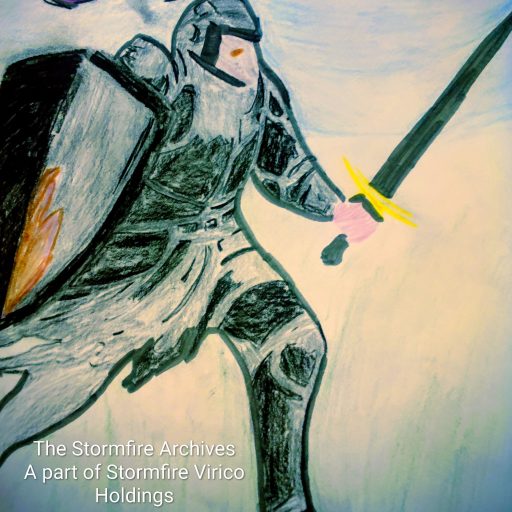

The dawn was cold, a thin veil of mist curling over the ramparts of the Roman fort. Taranis awoke to the metallic tang of iron and the distant clang of the blacksmith’s hammer.
His chains clinked softly as he shifted. The cold biting into bruised wrists, but the fire in his chest remained unbroken. He had learned to sleep with storms in his mind; the thunder never ceased, even when the sky cleared.
The sentries passed with measured steps, their eyes avoiding his. Even in chains, Taranis carried the weight of warning: a storm was bound, not broken.
Marcos stirred beside him, shoulders tense with age and pain.
“They move you today,” he muttered, voice low. “Legionaries say they march prisoners to the amphitheatre. Another show… or training for others. Rome’s curiosity is insatiable.”
Taranis flexed his wrists against the iron, listening to the rhythm of the camp. The clatter of swords, the measured steps of patrols. The faint murmur of Latin all part of the pulse of this cage. He did not fear. He calculated.
The centurion arrived just as the morning sun began to pierce the mist. A figure of red and bronze framed against the wooden palisade.
“Stormborne,” he said, voice sharp, “prepare to march. Rome watches, and your survival is… optional.”
Taranis rose slowly, chains rattling in protest.
“Optional,” he echoed, smirk tugging at his lips, “like the wind choosing which trees to break.”
The march was silent, the prisoners lined in pairs, shields clinking and armor scraping. Taranis felt the eyes of the Romans on him, not all hostile.
The Curiosity and caution blended in the same gaze. Word had spread of his defiance surviving crucifixion. But unyielding under whip and sword and whispers of the “Storm of Emberhelm” made even hardened legionaries pause.
They crossed the outer hills and entered the amphitheatre grounds. Dust rose from the packed earth, carrying the scent of sweat, straw, and fear. The arena awaited not yet for combat, but for demonstration, for Rome’s fascination with endurance.
Taranis’ chains were secured to a central post. Around him, other prisoners fidgeted and whispered. He noticed the boy from the march days ago. A little child of six years old hiding behind a stack of crates, pale fingers gripping a fragment of bread. Their eyes met, and Taranis gave a faint nod not reassurance, not command, just acknowledgment.
A guard stepped forward, coiling a whip in his hand. “Today, we measure the storm,” he said in Latin, the words sharp as steel. “Let us see if the barbarian bends to Rome.”
Taranis let the chains pull taut, shoulders braced. “Storms bend only to themselves,” he whispered, almost to the wind.
The first demonstration began. Spears and short swords were thrust toward him, each movement designed to test, to gauge. Taranis shifted with the grace of the hunted and the hunter intertwined. As he continues deflecting, twisting, and using the very pull of the chains to redirect momentum.
Every strike met resistance, every thrust was countered. The audience of soldiers murmured in disbelief.
Marcos watched from the side, leaning heavily on his staff. “Still untamed,” he muttered. “Still Emberhelm.”
The sun climbed, and with it, Taranis’ endurance was tested further. Roman instructors pressed harder, pushing his limits, yet he remained unmoved, his grey eyes sharp as lightning.
When at last the centurion called an end, sweat streaming and blood staining the mud, Taranis did not collapse.
He simply lowered his gaze, catching a brief glimpse of the distant hills beyond the fort. Freedom waited there, somewhere beyond chains and Roman order.
As the prisoners were herded back to their quarters, Taranis’ mind raced. Rome could cage him, whip him, measure his endurance, but it could not touch the storm in his heart. The pulse of Emberhelm beat in every step, every breath, every thought of revenge, strategy, and survival.
That night, as firelight danced across the walls of the fort and the whistle of wind through battlements echoed like distant thunder, Taranis sat, chained but unbroken, and whispered to himself:
“Let Rome watch. Let them wait. Storms do not obey. Storms endure. And storms return.”
Night in the Roman fort was never truly silent. Even beneath the canopy of stars, there was always the creak of timber. The shuffle of soldiers on watch, the hiss of oil lamps dying in the cold wind. Yet somewhere beyond that human rhythm, another sound pulsed faint, rhythmic, like the heartbeat of the land itself.
Taranis listened.
He had learned to hear through walls of stone and iron. The whispers of chains, the breath of the wind through narrow slits.All were messages if one knew how to listen.
Marcos stirred nearby, groaning as he rolled against the rough bedding. “You hear it again,” he murmured, voice barely a rasp. “The storm that waits?”
Taranis’ eyes were half-shut, the dim firelight carving hollows beneath his cheekbones. “The storm doesn’t wait,” he said softly. “It watches.”
He turned the small iron shackle at his wrist, feeling for the weak link not yet ready, but close. Every night he tested it. Every day, he marked the rhythm of the guards, the rotation of their watch. Patience, he reminded himself. Storms struck only when the wind was right.
Beyond the barracks, the faint roar of the sea carried inland. Somewhere past those black waters lay the route to Gaul and beyond that, Rome. The thought of being caged beneath marble arches made his blood run colder than the chains.
The door creaked open.
A shadow slipped inside small, quick, hesitant. The boy from the arena. He carried a satchel and a half-broken torch.
“They’ll see you,” Marcos hissed.
The boy shook his head. “The north wall guard sleeps. He drinks too much. I brought you this.” From the satchel, he pulled a narrow blade no longer than a hand, its edge dulled but serviceable.
Taranis took it without a word, his fingers brushing the boy’s for a heartbeat. “Why?” he asked.
The boy’s voice trembled. “Because you didn’t kill me when they told you to. Because the others they say you were a king once.”
Taranis looked up then, eyes grey as frost. “A king?” He almost smiled. “No. A storm given form. And Rome can chain storms, but it can not make them serve.”
The boy swallowed, uncertain whether to fear or believe him. “Then what will you do?”
Taranis turned the blade in his hand, the firelight glinting off the iron. “Wait,” he said. “And remember.”
He hid the weapon within the straw bedding, marking its place with a small twist of rope. Then he looked toward the sliver of moonlight cutting across the dirt floor. A thought of home of the high ridges above Emberhelm, of his brothers’ faces fading in memory. Rayne’s eyes full of guilt. Drax’s silence. Draven’s quiet grief.
He did not hate them. Not yet. But the distance between them had become as sharp as any blade.
When dawn came, the fort stirred again the horns of the morning watch echoing across the fields. The centurion approached, flanked by two guards.
“Stormborne,” he said, voice cold. “The governor himself has taken interest. You are to be moved south to Londinium within a fortnight.”
Taranis met his gaze. “To be paraded, then? Or displayed?”
The centurion smiled faintly. “Displayed, perhaps. Studied, certainly. Rome values curiosities.”
Taranis’ jaw tightened, but his eyes betrayed nothing. Inside, the storm turned once more.
He whispered beneath his breath, too low for the Romans to hear:
As the guards led him from the barracks. He caught a glimpse of the horizon low clouds gathering over the hills, rolling in from the west. It was almost poetic.
“Emberhelm still breathes.”
That night, the chains whispered again not with fear, but with promise. The weak link shuddered beneath his fingers.
And when the next storm broke over Viroconium, it would not be made of rain.
It would be made of iron.
FURTHER READING
 The Penda Stormfire Archives
Leave a comment