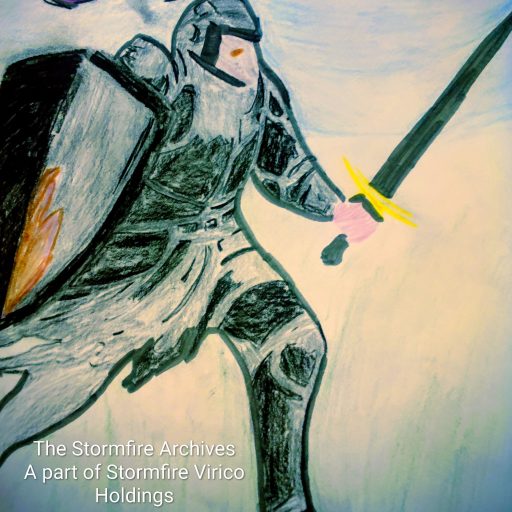

Dawn broke over the Roman camp like a blade drawn through fog.
Grey light pooled across churned mud and sharpened stakes, catching on helmets and spearheads lined in perfect order.
The night’s rain had thinned to mist, and every droplet clinging to the leather tents shimmered like glass. The smell of smoke, sweat, and iron hung heavy in the air the scent of empire.
Taranis stirred. His back ached where the whip had bitten, skin raw beneath crusted blood. Yet the fire inside him burned brighter than pain the storm had not passed. It gathered.
Across from him, Marcos watched with his one good eye. The old fighter’s face a map of old wars and fading loyalties. “Rome wants to see storms broken,” he murmured, voice gravel-deep. “They’ll test you again today. But storms… storms don’t break. They shift. They wait.”
Taranis tilted his head, a faint smirk cutting through exhaustion.
“And if they try?”
Marcos shrugged, rough amusement in his tone. “Then you show them the wind can cut as deep as the sword.”
Trumpets blared as the camp came alive in a heartbeat. Orders barked in Latin, armor clattered, horses stamped restlessly against their ropes. Two guards approached, eyes cold, hands twitching near the whips at their belts.
“On your feet,” one barked.
Taranis rose slowly. Chains clinked. His shoulders squared, each movement deliberate. The iron at his wrists and ankles was heavy a reminder that for now, he belonged to Rome.
Yet even bound, he carried the air of something untamed. The guards kept their distance, as though the storm in his eyes strike.
They led him toward a cleared space at the edge of the camp.
A makeshift ring had been marked out with stakes and rope a place for training, punishment, or testing.
The centurion stood nearby, expression carved from granite. The boy from last night watched from behind a cart, pale fingers gripping the wood. He didn’t dare speak.
The centurion’s voice carried over the murmurs. “The barbarian survived crucifixion,” he said in clipped Latin. “He has killed Roman soldiers with sword, axe, and bow. Let us see if his storm can be harnessed or if it dies in the mud.”
Taranis met his gaze.
“Let him watch,” he murmured in Brythonic the tone sharp, almost ceremonial. The centurion frowned, not understanding, but the words left a chill in the air.
A guard offered him a practice axe, a short sword, and a small round shield. The weapons were worn, dulled, mockeries of what he once wielded but they would do.
He ran a thumb along the axe’s handle, testing the balance.
The first bout began.
Two legionaries stepped into the ring, boots sinking into wet earth. They grinned, confident, soldiers against a chained barbarian.
Taranis didn’t move until they struck.
The first swing came from the right clean, practiced.
He stepped aside, caught the motion with the rim of his shield, and turned it aside. The counter came low and fast a backhand with the axe that cracked into the soldier’s guard, splintering the wood. Mud sprayed. Gasps followed.
The second soldier lunged from behind. But Taranis ducked, dragging his chain taut to trip him, then drove an elbow into his ribs.
He rose without looking back. Breathing steady. Eyes cold.
He didn’t grin.
He didn’t boast.
He simply waited.
The crowd quieted. Even the centurion lowered his stylus for a moment.
“Again,” he said.
Another pair entered. Then another.
By the third round, Taranis’s arms burned and his wrists bled where the chains bit into skin. Yet his movements only grew sharper measured, adaptive, each strike like thunder rolling closer.
Marcos leaned toward a watching soldier. “That’s no wild man,” he muttered. “That’s a storm that learned to fight back.”
By midday, silence had fallen across the ring. The spectators no longer laughed. They watched uneasy, enthralled, afraid.
The centurion finally raised a hand. “Enough,” he ordered. “Feed him. Let him rest. He will fight again tomorrow with steel.”
Taranis tilted his head, the faintest smirk touching his mouth.
“Feed the storm,” he murmured, “and see what it grows into.”
The boy crept closer, slipping a crust of bread from his tunic and setting it by his side.
Taranis nodded once not gratitude, but recognition. A gesture between survivors.
As they led him away, one of the younger guards spoke quietly, incapable of concealing his curiosity. “They say you fought crucifixion itself and lived. What man survives that?”
Taranis turned his head slightly. The grey in his eyes caught the light.
“Not a man,” he said. “A storm that forgot to die.”
Marcos barked a laugh, shaking his head. “Gods help Rome,” he said. “They’ve chained lightning and think it’ll sit still.”
When they finally removed his restraints for cleaning, Taranis flexed his wrists, skin bruised and torn. He studied the marks, then smirked.
“At least they removed the restraints,” he said quietly. “I grew up fighting in them.”
The centurion said nothing.
The sky grumbled overhead thunder rolling distant but deliberate.
Then, softly, as if remembering something half-buried in blood and rain, Taranis spoke again.
“They put me up,” he said, eyes fixed north. “Nailed me in on the hill at Salinae”
Marcos frowned. “And yet here you are.”
Taranis flexed his fingers, old scars catching the light.
“I ripped myself off,” he said simply.
Silence cracked through the camp. Guards shifted. Somewhere, a dog began to howl.
“Rome thinks it crucified me,” he murmured.
“But the dead don’t stay nailed not when the gods still have use for them.”
Thunder answered. Closer this time.
Rome had not yet learned that storms do not serve.
They return.
Futher Reading

 The Penda Stormfire Archives
Leave a comment